


Trying to pick the right AI automation tool can feel like a chore. So many platforms promise the world, but when you try to figure out what you'll actually pay, their pricing pages are a mess. You’re left guessing what the final bill will look like.
This is especially true with metered models. That’s why I’m taking a close look at the Aissist.io pricing structure. I want to give you a clear, no-fluff breakdown of their plans, what it could mean for your budget, and how it compares to more modern, predictable options.
What is Aissist.io?
Aissist.io calls itself an "Agentic AI" platform. In simple terms, they offer AI agents that are meant to automate sales and service tasks from start to finish. The core idea is to move beyond basic chatbots that just pull answers from a help center. Instead, their AI aims to handle complex, multi-step processes on its own. The product line is now AgentMesh (the agents), Pulse (insights) and Evolve (optimization).
Their AI workforce is designed to plug directly into help desks like Zendesk, Intercom, Front and Freshdesk, acting just like a human agent in the queue. They claim an 83% automation rate and a 4.8 CSAT, which are vendor figures I have not independently tested. The main focus is on automating entire workflows, which sounds pretty great for businesses with highly structured processes.
Aissist.io pricing explained
Aissist.io meters usage per AI interaction and caps the charge per resolution. This can work for some, but you still have to keep an eye on volume. Let’s dig into how it works, based on what’s on their pricing page.
How the per-resolution pricing works
First off, it’s important to know what Aissist.io counts as an "interaction." It's one incoming message and one AI response. A typical support chat can have several of them, so the page also caps what you pay per resolution: you are charged the lower of the metered amount and the cap.

Here’s how their plans are set up:
-
Free: Up to 1,000 tickets a month, no credit card, on the free engine, which handles FAQs and basic procedures.
-
Growth: Unlimited tickets and the advanced engine at $0.20 to $0.60 per resolution, depending on channel. There is no contract and you can stop any time.
-
Enterprise: A volume discount, a higher SLA, and dedicated AI engineer support, quoted through sales.
Aissist.io gives its own estimates by channel:
| Channel | Interactions per session | Estimated cost per resolution |
|---|---|---|
| Email, form, social media | 2 | $0.25 |
| Web chat, WhatsApp, SMS | 5 | $0.60 (capped) |
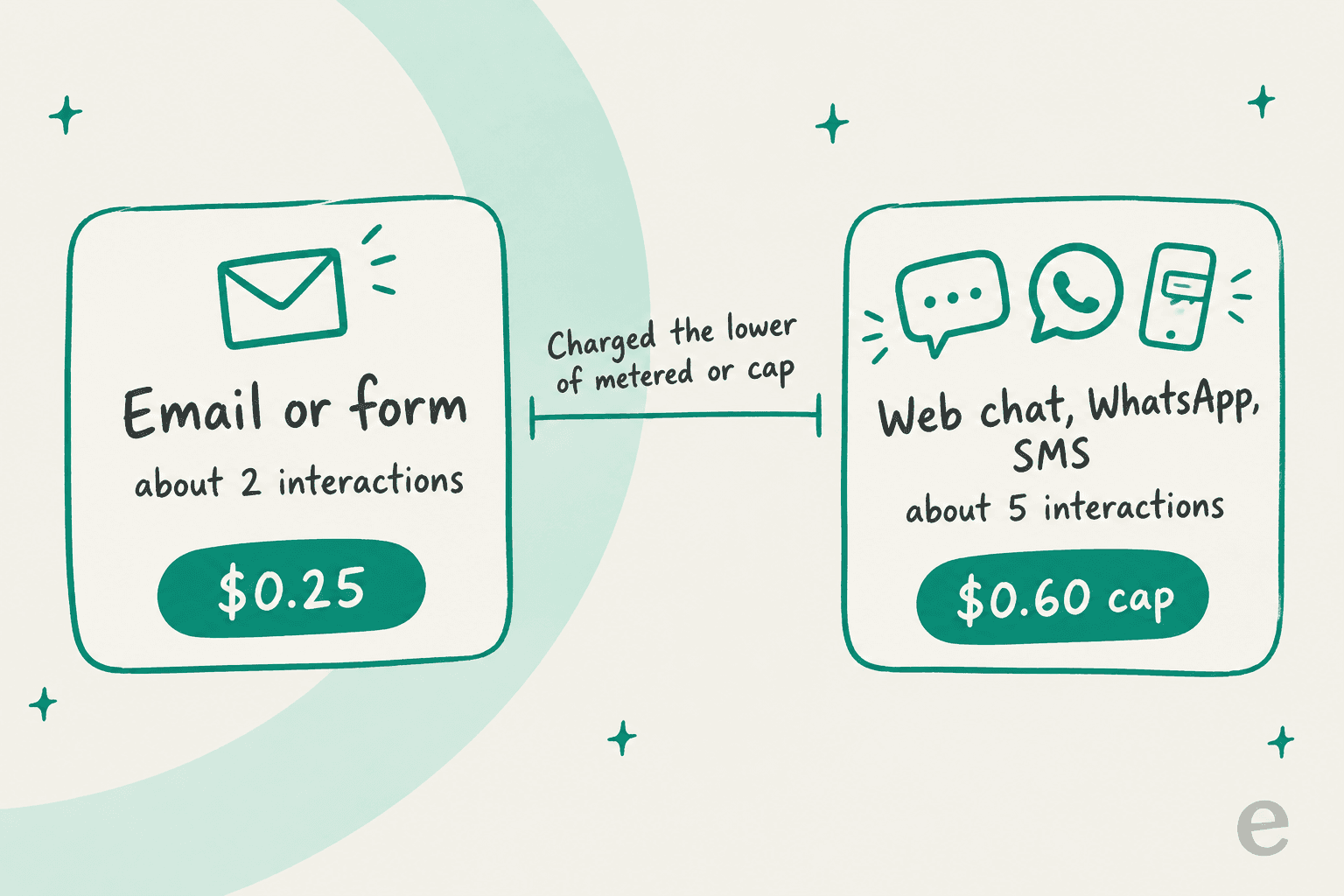
Here is what that means at volume. If 5,000 chat resolutions land in a month, the most the metered charge can reach is $3,000 at the $0.60 cap. If the same volume arrives by email at the $0.25 estimate, it is about $1,250. Aissist.io says these are estimates, not a quote.
What should you watch for?
Cost still follows volume. A great marketing campaign or a seasonal sales rush means more resolutions, and the bill rises with them, although the per-resolution cap puts a ceiling on each one. It’s worth modelling your channel mix first, since chat and messaging cost more than email.
The advanced engine sits on the Growth plan, so you start paying once you want more than basic FAQ handling. Pulse and Evolve each include one free feature with AgentMesh (weekly insight and AI optimization), while the other modules, such as Ledger and Agents Insights, are priced by contract.
Aissist.io: Key features and limitations
Putting the numbers aside for a moment, let's look at the platform itself and some of the hurdles you might run into.
Strengths
Aissist.io’s focus on "Agentic AI" is definitely ambitious. The idea of an agent that can follow complex, multi-step procedures is appealing for businesses that rely on repeatable processes. AgentMesh, their multi-agent platform, is built for this kind of deep automation, which makes it stand out from simpler chatbot tools.
The native integrations are also a plus, as the AI can work directly from your existing help desk queue, which can feel smoother than tacking on an entirely separate system.
Potential limitations to consider
Deep workflow automation usually means more to configure. Aissist.io does offer a self-serve path: a Quick Start that runs from setting up a workspace and adding knowledge to connecting systems, defining sub agents, testing and going live. Teams with complex processes should still budget time for the sub agents and integrations, which is the part that decides results. Aissist.io itself points to complexity as a reason AI projects stall.
Testing is covered too. The docs include a Simulator step before go-live. What the docs summary does not say is whether the Simulator replays your historical tickets, which is the check I care about most before an AI talks to customers.
Finally, an agent that works inside your helpdesk queue still means deciding which tickets it owns and which go to a person. That control lives in the sub agents and instructions you set up, so read those docs for the level of control you need.
A transparent alternative to Aissist.io: eesel AI
If you’re looking for powerful AI automation with a fixed monthly price, an alternative like eesel AI offers a totally different approach that’s all about transparency, control, and simplicity.
Fixed, predictable pricing
eesel AI uses fixed monthly plans. You pick a monthly batch of credits, where one credit is one ticket or one chat however long it runs, and every integration, channel, report and seat is included. You can see all the details on the eesel AI pricing page.
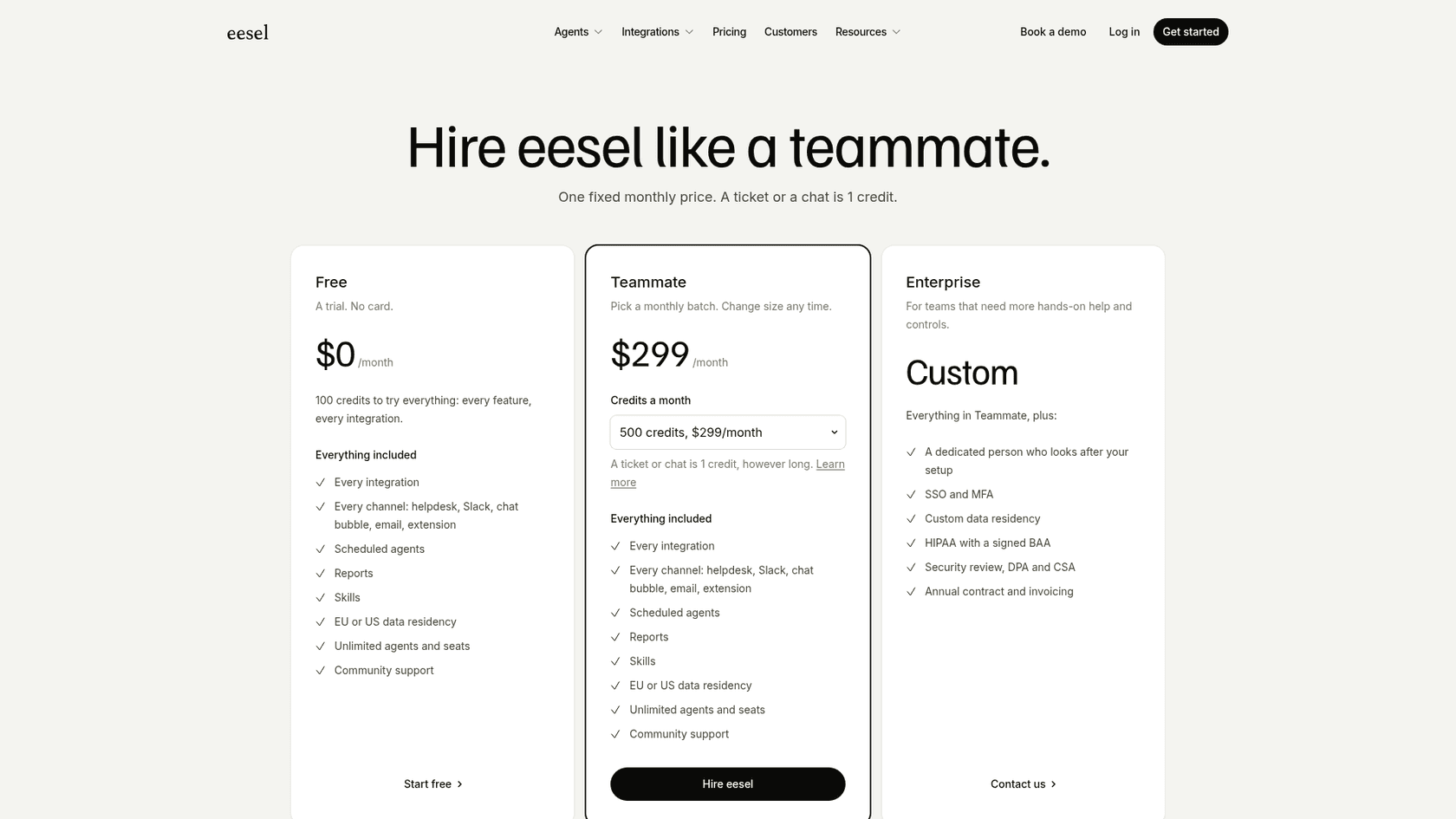
| Monthly credits | Price |
|---|---|
| 100 (free plan, no card) | $0 |
| 500 | $299/month |
| 1,000 | $499/month |
| 2,500 | $999/month |
| 5,000 | $1,899/month |
The difference is straightforward: your bill is set by the batch you pick, not by how many messages each conversation takes. If you run out, agents pause until credits reset, or you can turn on overage with a monthly cap you set at $0.80 per extra credit. That is easy to budget around, though the trade-off is that you pay for the batch even in a quiet month.
| Feature | Aissist.io | eesel AI |
|---|---|---|
| Pricing Model | Metered per interaction, capped per resolution | Fixed monthly plan, 1 credit per ticket or chat |
| Cost Predictability | Scales with resolutions ($0.20 to $0.60 each) | Fixed per monthly batch |
| Setup Process | Self-serve signup, Quick Start docs | Self-serve, live in minutes |
| Pre-launch Testing | Simulator in the docs | Simulation on historical tickets |
| Control | Instructions and sub agents | Granular control over ticket automation |
| Knowledge Sources | Websites, documents, data sources | Past tickets, help centers, Google Docs, Confluence & 100+ sources |
Go live in minutes, not months
eesel AI is built to be completely self-serve. You can sign up, connect your help desk in a click, and set up your first AI agent in minutes, all without having to talk to a salesperson. Aissist.io also offers self-serve signup, so the difference here is less about access and more about how quickly you can check results on your own data.
Test with confidence using simulation
One of the biggest things that sets eesel AI apart is its simulation mode. Before your AI ever chats with a customer, you can run it on thousands of your own past tickets. The simulation gives you an accurate preview of its performance, resolution rate, and how much you could save. This lets you build confidence, tweak the AI’s behavior, and make sure everything goes smoothly when you launch. It’s a low-risk way to prove it works before launch, and the replay on your own history is the part I would ask any vendor, Aissist.io included, to show you.
Aissist.io pricing: Choose a tool that grows with you, not against you
Aissist.io has a capable AI solution, and its per-resolution model, with 1,000 free tickets a month, is a fair way to start small. The trade-off is that cost follows volume, so budget by channel mix.
For most businesses, it’s better to have a partner that offers clarity and control. eesel AI provides a customizable, easy-to-use platform with a fixed monthly price. My goal is to help your team automate with confidence: test on your own history, decide exactly how to roll out, and know the monthly cost up front.
Ready to see how it works for yourself? You can start free with 100 credits and run a simulation on your own data to see your potential automation rate in minutes.
Frequently asked questions
What is the main characteristic of Aissist.io pricing?
Aissist.io meters usage per AI interaction but caps the charge per resolution at $0.20 to $0.60 depending on channel, and you are charged the lower of the two. Your monthly spend therefore still moves with the number of conversations your AI agents resolve.
How does Aissist.io's pricing define an "interaction" for billing purposes?
In Aissist.io's pricing structure, an "interaction" is one incoming message and one AI response. A typical support conversation involves several of them, which is why the per-resolution cap matters.
Are there different tiers for Aissist.io pricing, and what do they offer?
Yes, Aissist.io lists three plans: Free (1,000 tickets a month on the free engine), Growth (unlimited tickets, advanced engine, $0.20 to $0.60 per resolution), and Enterprise (volume discount, higher SLA, dedicated AI engineer support).
Is there a free option or trial available for Aissist.io?
Yes. The Free plan includes 1,000 tickets every month with no credit card, and the page also mentions a trial without commitment. It runs on the free engine, which Aissist describes as sufficient for FAQs and basic procedures.
How does Aissist.io's pricing compare to a predictable subscription model like eesel AI?
Aissist.io bills per resolution, so the monthly total follows your resolved volume. eesel sells a fixed monthly plan sized to volume, from $299 a month for 500 credits (one credit per ticket or chat), with every integration and unlimited seats included.