

Customer support has definitely moved on from the days of clunky, first-generation chatbots. The new buzz is all about "agentic AI," which are platforms that promise to do a whole lot more than just spit out canned answers. They're designed to handle entire tasks on their own, almost like a digital employee.
One of the names you might have heard in this space is aissist.io. They position themselves as an AI workforce for big sales and service teams. But with some pretty big claims on their website, you have to wonder: is it really that different from a good chatbot, and is it the right move for your team?
In this Aissist.io review, we’ll get into what it does, how its unusual pricing works, and some of the potential downsides. By the end, you should have a much clearer idea of whether it’s the right tool to help you grow.
What is aissist.io?
Hop over to the aissist.io website, and you’ll see agentic AI that "resolves, not just replies." The pitch covers service and sales across email, chat, WhatsApp, SMS and social, in 65+ languages. The two main buttons are "Try it free on your tickets" and "Book a demo."
The platform is now broken down into three main products:
-
AgentMesh: This is their main offering, a multi-agent autonomous AI agent system built to manage business processes from start to finish, grounded in your help center, docs, policies and past tickets.
-
Pulse: An insights product that turns conversations into weekly findings on product gaps and sentiment.
-
Evolve: An optimization product that scores conversations against your best agents, tests fixes and ships them with approval.
Their site claims an 83% average resolution rate, a 4.8 out of 5 CSAT and under 1% error, which are vendor figures I have not tested. So, let's take a look under the hood at the tech that's supposed to make all this happen.
Features and technology breakdown
The aissist.io platform has a few key ingredients. Here’s a look at what they’re serving up and where you might find yourself wanting a bit more control.
The multi-agent platform (MAP)
The core of aissist.io is something they call its multi-agent platform (M.A.P.), sold as AgentMesh. In simple terms, instead of having one AI that tries to do everything, they use a team of specialized AI agents that can think, manage tasks, and work together. It’s a neat idea that’s definitely a step beyond simple Q&A bots.
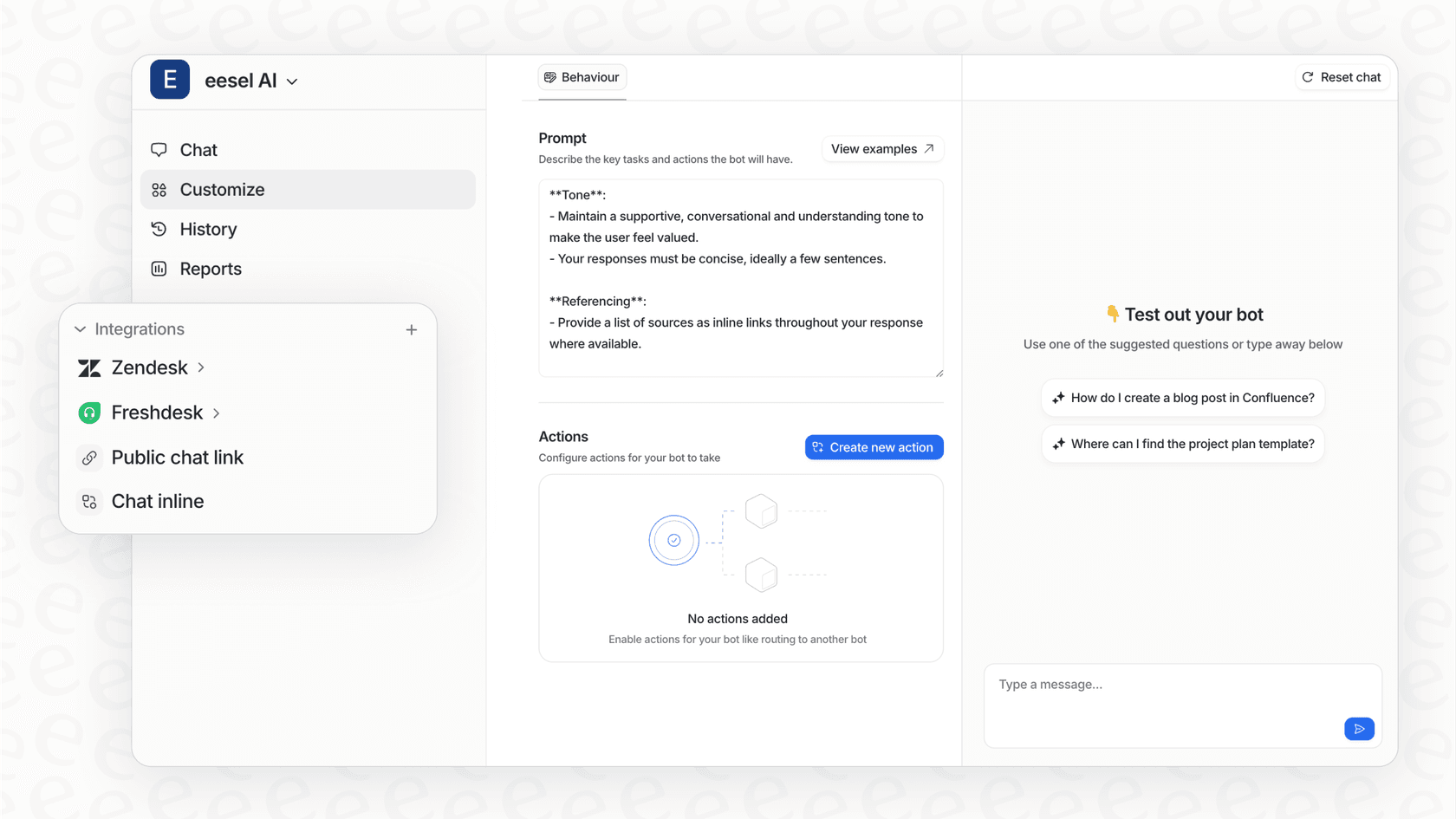
While that all sounds good on paper, the real test of any AI system is how much you can control it. Aissist.io gives you global instructions and scenario-specific sub agents, and eesel AI takes a similar view with a fully customizable workflow engine. You get to define exactly which tickets the AI should handle, what it should say, and what actions it can take. This way, you know the AI is working exactly how you want it to.
Core products and integrations
As we mentioned, AgentMesh is the main event here, handling tasks on its own, with Pulse and Evolve for insight and optimization. The platform connects with the big names in help desks and CRMs, including Intercom, Zendesk, Front, Freshdesk and Salesforce.
Having the right integrations is table stakes, and setup speed is the next thing to compare. Aissist.io says you can connect in about 10 minutes and be live the same hour. eesel AI lets you connect your helpdesk and other tools with a single click, so both can realistically be running the same day you sign up, without a developer.
Universal AI capabilities
aissist.io talks about being able to handle support across any channel (SMS, WhatsApp, email), process different media types (text, images, videos), and work in multiple languages. To be fair, these features are becoming pretty standard for any top-tier AI platform.
But the real difference-maker today isn't just about what an AI can process, it's about what it knows. An AI is only as smart as the information you give it. The best ones can pull knowledge from all over your company, not just your helpdesk articles. For instance, eesel AI connects instantly to your internal knowledge bases in Confluence, files in Google Docs, and even pulls context from past Slack conversations. This gives it a complete picture, leading to way more accurate and helpful answers for everyone.

A closer look at the per-interaction pricing model
Alright, let's talk about the price tag. This is a big one for any team, and aissist.io’s approach is different from the usual flat monthly fee.
How the pricing works
aissist.io meters each AI interaction, which is one incoming message plus one AI response, and caps the charge per resolution. You pay the lower of the two. Here’s a quick look at their plans, based on their pricing page:

| Features | Free | Growth | Enterprise |
|---|---|---|---|
| Price | $0 | $0.20 to $0.60 per resolution | Volume discount |
| Monthly tickets | Up to 1,000 | Unlimited | Unlimited |
| Engine | Free engine (FAQs, basic procedures) | Advanced engine | Advanced engine, higher SLA |
| Estimated cost, email, form, social | $0.25 (about 2 interactions) | ||
| Estimated cost, chat, WhatsApp, SMS | $0.60 capped (about 5 interactions) |
Those channel figures are Aissist.io’s own estimates, not a quote.
What to plan for with per-resolution billing
Cost follows resolved volume. A busy month from a product launch means more resolutions, and the bill rises with them, although each one is capped at $0.20 to $0.60. Chat and messaging cost more than email, so your channel mix drives the total.
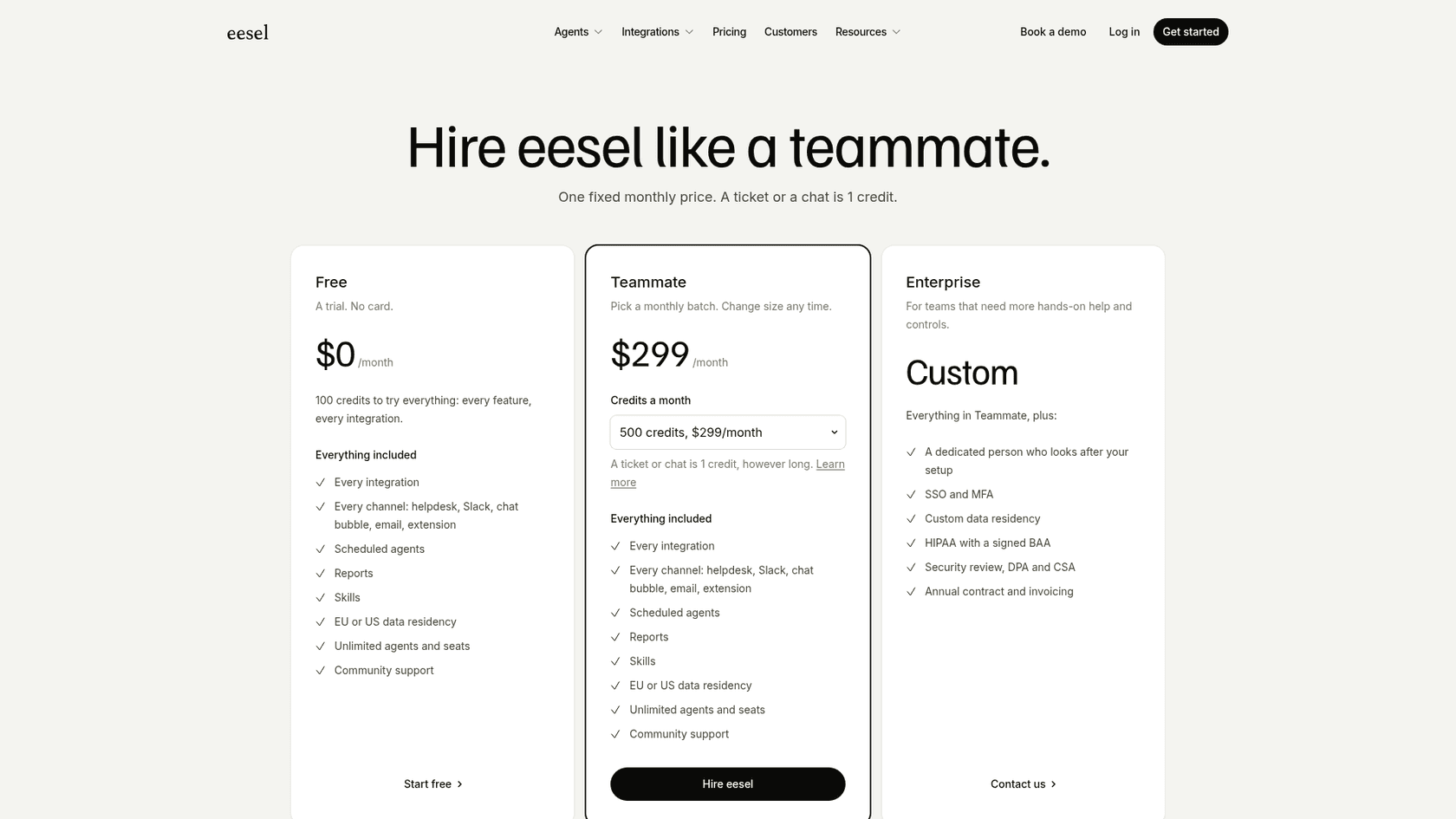
A fixed plan can give you peace of mind when it comes to budgeting. For example, eesel AI sells one fixed monthly price sized to volume: 500 credits for $299 a month, 1,000 for $499, 2,500 for $999 and 5,000 for $1,899, where a ticket or chat is one credit however long it runs. Every integration and unlimited seats are included. If you run out, agents pause until credits reset, or you can turn on overage at $0.80 per extra credit with a monthly cap you set.
The user experience
Beyond the feature list, what’s it actually like to get started and use the tool day-to-day? Aissist.io serves both self-serve teams and large enterprises, so the journey depends on which door you take.
Self-serve first, sales for Enterprise
When you land on the aissist.io site, you get two options: "Try it free on your tickets" and "Book a demo." The first goes to a self-serve console signup with 1,000 free tickets a month and no card. Enterprise, with its volume discount, higher SLA and dedicated AI engineer, goes through sales.
The docs lay out a six-step path: set up the workspace, add knowledge, connect live systems, create sub agents, test in the Simulator, and deploy through a gateway. With a self-serve tool like eesel AI, you can likewise sign up, connect your helpdesk, and start building your first AI agent in a matter of minutes. Both let you get your hands dirty before talking to anyone.
Rolling out with confidence
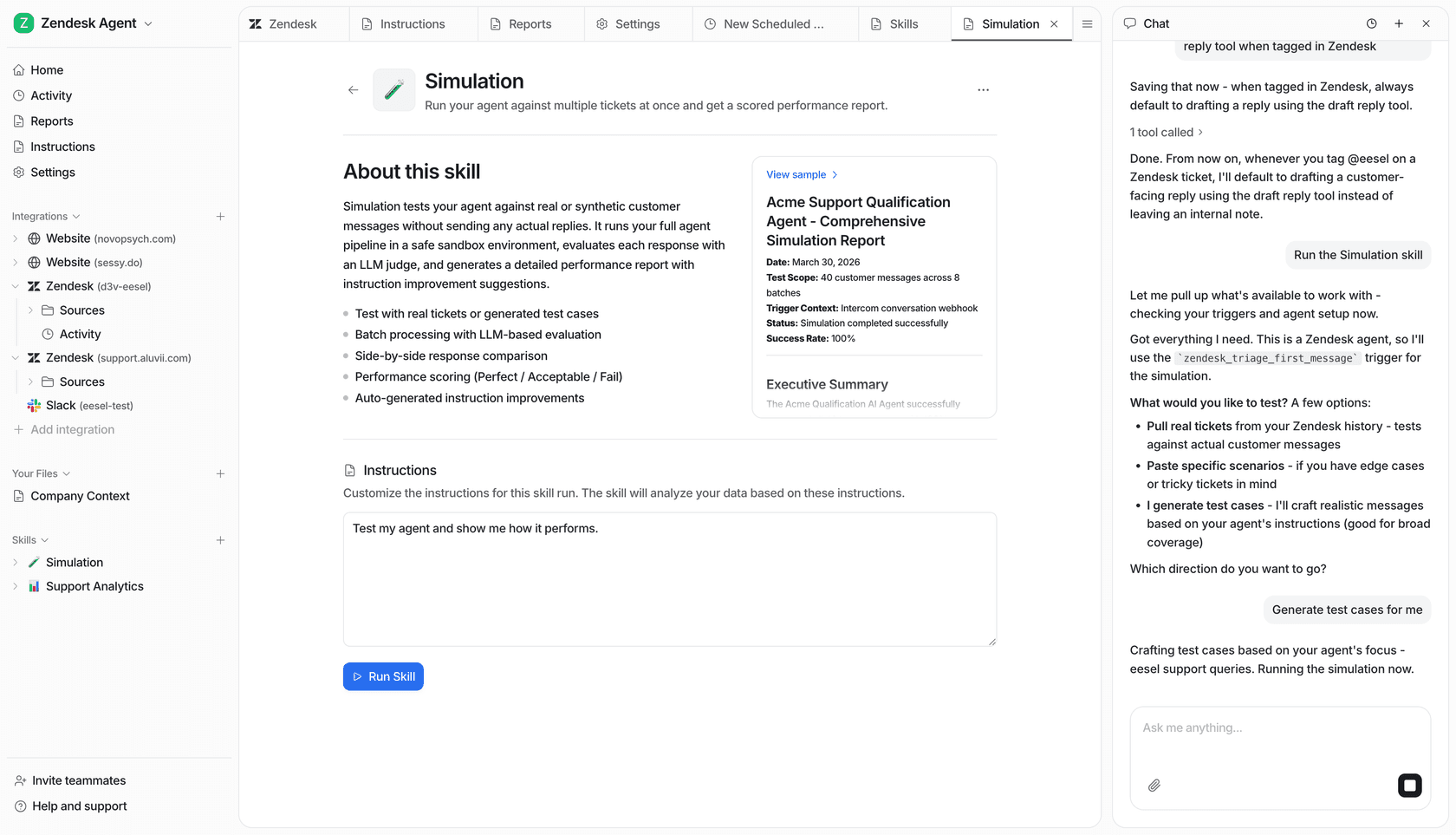
aissist.io’s docs include a Simulator step before you go live, and the homepage describes Evolve as testing fixes on live traffic and shipping them with your approval. What the pages I read do not say is whether the Simulator replays your own past tickets. That is the question I would put to them, because it tells you how many tickets the AI would have resolved before it talks to a customer.
That replay is what eesel AI’s simulation mode does: it runs your AI against thousands of your past support tickets and gives you a data-backed forecast of how many tickets it will automate and how much you'll save. You can tweak and refine everything until you're comfortable, then roll it out.
Aissist.io vs. eesel AI: Key differences
After digging into this Aissist.io review, it seems like aissist.io fits teams with complex, multi-channel workflows that are comfortable with cost following resolved volume, and it has a free tier for trying it on your own tickets.
For teams that want a fixed monthly price and a replay on their own history, eesel AI presents another option. It’s designed to be powerful without being complicated, so you can get started quickly and see results.
Here’s a simple breakdown of the main differences:
| Feature | aissist.io | eesel AI |
|---|---|---|
| Setup Time | About 10 minutes to connect (vendor claim), Enterprise via sales | Minutes (fully self-serve) |
| Pricing Model | Metered per interaction, capped per resolution | Fixed monthly plan, 1 credit per ticket or chat |
| Free Tier | 1,000 tickets a month | 100 credits, no card |
| Pre-launch Testing | Simulator (docs) | Simulation on historical tickets |
| Customization | Instructions and sub agents | Prompt editor and workflow engine |
| Knowledge Sources | Websites, documents, data sources, past tickets | Docs, Confluence, Slack, past tickets and more |
Is aissist.io the right choice?
So, what's the verdict? aissist.io could be a good option for a team with complex, multi-step workflows across several channels, a budget that can follow resolved volume, and time to configure sub agents. Its multi-agent system sounds promising for handling those workflows at scale, and the free 1,000 tickets a month make it easy to try.
For teams that mainly want fast setup, a fixed monthly price and a forecast from their own past tickets, a tool like eesel is worth comparing. The best tools today let you start fast, test before launch, and know what the next invoice looks like.
If you’re looking for an AI platform that works with your team's flow, not against it, why not give it a try? You can try eesel AI for free with 100 credits, no card, and see just how much you can automate in the next 10 minutes.
Frequently asked questions
Based on this Aissist.io review, what specifically makes aissist.io different from older chatbots?
Aissist.io positions itself as an "AI Workforce" utilizing a Multi-Agent Platform (MAP) where specialized AI agents collaborate to manage entire business processes, unlike traditional chatbots that primarily offer canned responses.
Could you explain the pricing model highlighted in this Aissist.io review and its potential challenges?
Aissist.io meters each AI interaction but caps the charge per resolution at $0.20 to $0.60 depending on channel, and you pay the lower of the two. The main thing to plan for is that cost follows resolved volume and channel mix, since chat and messaging cost more than email.
What kind of onboarding process can I expect after reading this Aissist.io review of aissist.io?
Aissist.io offers both a self-serve signup (1,000 free tickets a month, no card) and a demo path. The homepage says you can connect in about 10 minutes, and the docs lay out a Quick Start. Larger deployments with many sub agents and integrations will take longer, and Enterprise is handled through sales.
Does this Aissist.io review provide insights into how much control I have over the AI's behavior once deployed?
Aissist.io exposes global instructions, assets and sub agents for scenario-specific behavior, per its docs. This review compares that with eesel's prompt editor and workflow engine, so read both sets of docs against your own ticket types.
Before going live, how does one test the AI's performance, according to this Aissist.io review?
The aissist.io docs include a Simulator step before go-live. They do not say whether it replays your historical tickets, which is what eesel's simulation mode does, so ask for a demo of that specifically.
Who is the ideal target customer for a platform like aissist.io, according to this Aissist.io review?
This review concludes that aissist.io suits teams with complex, multi-channel workflows who are comfortable with cost that follows resolved volume. Smaller teams can start on the free 1,000 tickets a month.