


Trying to pick the right sales intelligence platform can be a headache, especially when you’re staring at a pricing page that feels like it’s written in another language. You know you need a good tool to boost your outreach, but the last thing you want is a surprise on your credit card statement.
Let’s cut through the noise. We’re going to walk through Apollo.io’s pricing for 2026, plan by plan. We'll look at what you get, what you don't, and most importantly, dig into their credit system to figure out what you'll actually end up paying. By the end, you should have a much clearer picture of whether Apollo is the right move for your business.
What is Apollo.io?
So, what is Apollo.io, anyway? In simple terms, it's a platform that rolls a bunch of sales tools into one. It’s built for B2B sales, marketing, and even recruiting teams. Its main gig is helping you find accurate contact info for people you want to sell to, clean up the lead lists you already have, and set up automated email and call campaigns. It’s designed to handle that whole early part of the sales cycle, from finding a name to making that first contact.
A detailed look at Apollo pricing plans
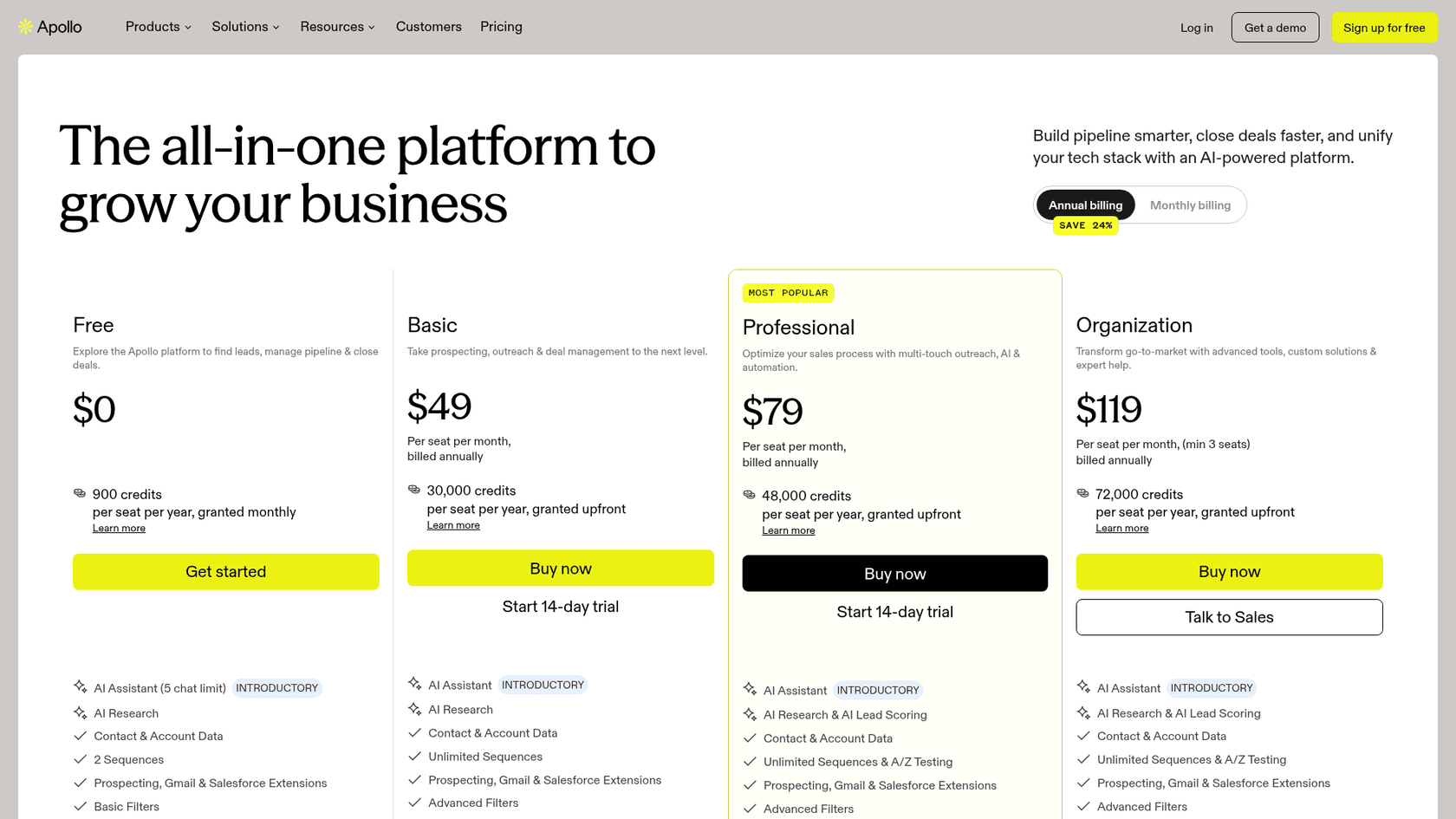
Apollo has four main pricing tiers, and each one is meant to grow with your business. Whether you’re a solo founder testing an idea or a huge sales team at a big company, they have an option for you. Let's break down what each plan really offers, looking at both the cheaper annual rates and the more flexible monthly ones.
The free plan: A starting point with limits
- Price: $0
- Best for: Individuals, freelancers, or tiny startups wanting to test the waters.
The Free plan is basically Apollo's "try before you buy" offer. You get a small credit allowance, the ability to set up two automated outreach sequences, and the Chrome extension, which is genuinely useful for grabbing leads while you browse.
But the free ride ends pretty quickly. You’re capped at 900 credits per seat per year, granted monthly. At 8 credits per phone number, that covers roughly 112 numbers for the whole year. It’s a great way to get a feel for the platform, but you’ll hit the paywall fast if you plan on building a real pipeline.
The basic plan: For growing teams
- Price: $49/user/month (billed annually) or $65/user/month (billed monthly).
- Best for: Small teams that are ready to scale their outbound sales.
The Basic plan is where things start to get real. Your credit allowance jumps to 30,000 credits per seat per year, granted upfront (2,500 a month on monthly billing), which feels a lot more usable. You also get unlimited sequences, AI research and lead scoring, the US dialer, and connections to popular CRMs like Salesforce and HubSpot.
It’s a solid step up, but it's not the complete package. Dialer minutes draw from the same credit pool, and a hungry sales team can still chew through those credits surprisingly fast. It's a good middle ground, but don't be surprised if you find yourself wanting more.
The professional plan: Unlocking automation and calling
- Price: $79/user/month (billed annually) or $99/user/month (billed monthly).
- Best for: Established sales teams who need a full suite of automation and calling tools.
For a lot of sales teams, the Professional plan is where Apollo really starts to shine. This is the tier that adds Apollo's AI agents, A/Z testing, pre-built reports, and call recordings (4,000 minutes). Your credits go up again to 48,000 per seat per year (4,000 a month on monthly billing).
But here’s something to pay attention to if your team lives on the phone: the US dialer is included from Basic, but it bills 1 credit per 30 seconds, so an hour of calling uses 120 credits. International, parallel, and power dialing sit in a separate Advanced Dialer add-on at $119 per team per month.
The organization plan: For enterprise needs
- Price: $119/user/month (billed annually, min 3 users) or $149/user/month (monthly).
- Best for: Large companies, especially those with international teams and strict security requirements.
The Organization plan is the "all-you-can-eat" version of Apollo. It’s got everything from the Professional plan, but adds fully customizable reports, SSO, more granular team permissions, and tighter security features. You get the biggest pile of credits, too: 72,000 per seat per year. Global teams that need international calling add the Advanced Dialer on top. This plan is really for larger companies that need total control.
| Feature | Free | Basic | Professional | Organization |
|---|---|---|---|---|
| Price (Annual) | $0 | $49/user/mo | $79/user/mo | $119/user/mo |
| Price (Monthly) | $0 | $65/user/mo | $99/user/mo | $149/user/mo |
| Credits per seat | 900/yr | 30,000/yr | 48,000/yr | 72,000/yr |
| US Dialer (credits apply) | No | Yes | Yes | Yes |
| Advanced Dialer ($119/team/mo add-on) | No | Add-on | Add-on | Add-on |
| Sequences | 2 | Unlimited | Unlimited | Unlimited |
| Custom Reports | No | No | No | Yes |
The real Apollo pricing cost: Understanding the credit system
Okay, here’s where things get tricky. The monthly price you see on their website is just the beginning. The real cost of Apollo is tangled up in its credit system, and if you’re not paying close attention, it’s easy to get hit with extra costs you didn't plan for.
How are Apollo credits used in Apollo pricing?
Think of credits as Apollo's internal currency. You spend them to do the most important stuff on the platform, like finding contact info or pulling leads into your CRM.
Here's a quick look at what things cost:
- Email Address: 1 credit
- Mobile Number: 8 credits
- AI Research: 1 credit per run
- US Dialer: 1 credit per 30 seconds
- Data Enrichment: 1-8 credits
The big thing to notice here is the cost of mobile numbers. Getting a phone number costs eight times as much as getting an email. If your team does a lot of cold calling, your credit balance is going to drop like a rock.
The hidden costs: When credits run out
So, what happens when your sales team is on a roll and blows through the monthly credit allowance? You have to buy more, and this is where the hidden costs really pop up.
You add extra credits in the app with a Customize Credits slider. They are charged immediately and renew each cycle until you drag the slider back to zero, and the pricing page doesn't list a per-credit rate. Admins can also set per-user credit caps, which helps when one rep drains a shared pool.
Let’s put that into perspective. A Professional seat on monthly billing gets 4,000 credits a month, which covers 500 mobile numbers (4,000 / 8) and nothing else. Add email lookups, enrichment, and two hours of dialing a day (about 240 credits a day) and a busy rep can reach the cap before the month ends.
Apollo also has a strict "use it or lose it" policy: unused credits expire at the end of each billing cycle, including purchased add-on credits.
Is Apollo pricing the right fit for your business?
Alright, we've picked apart the plans and the sneaky credit system. So, the big question is: is Apollo worth the price for your business?
The pros: Why teams choose Apollo
Look, Apollo is popular for a good reason. It does a lot of things right.
- It's an all-in-one shop: It combines a huge B2B database with tools for reaching out, which means you might be able to cancel separate subscriptions to services like ZoomInfo and Outreach.
- The database is massive: Apollo lists 240M+ contacts and 30M+ accounts, which is the fuel every sales team needs.
- The automation is solid: The sequencing tool is pretty powerful. You can build some really complex outreach campaigns and let them run on their own.
The cons: Potential drawbacks to consider
But it’s not perfect, and there are a few things you should really think about before signing up.
- The pricing is complicated: As we've seen, the credit system can be a bit of a minefield. It's tough to predict exactly what you'll spend each month, which makes budgeting a pain.
- Some features sit behind add-ons or higher tiers: The US dialer comes with paid plans, but international, parallel, and power dialing need the Advanced Dialer add-on, and A/Z testing starts on Professional.
- It only does one thing: Apollo is laser-focused on getting new customers in the door. It’s great for that, but it does absolutely nothing for the other half of the business, keeping those customers happy once you've signed them.
Thinking beyond sales: Optimizing your entire customer journey
That last point brings up a bigger question. While you're pouring money into tools like Apollo to win new customers, are you putting the same effort into supporting them after the sale?
A healthy business needs to balance how it gets customers with how it keeps them. It doesn’t make sense to spend thousands on sales tools to bring people in the front door if they’re just going to walk out the back because of bad support.
This is where a tool like eesel AI fits in perfectly. While Apollo handles everything before the sale, eesel automates the customer support world after the sale. eesel AI has straightforward pricing: one fixed monthly price sized to your ticket volume, with 1 credit per ticket or chat, however long. No per-seat fee to track, no surprises.
Best of all, it works with the tools you're already using. It connects right into help desks like Zendesk and Freshdesk, and chat tools like Slack and MS Teams in just a few clicks. You don't have to go through a painful migration process. By automatically answering common support questions and helping your agents write replies faster, you can seriously cut down your support costs. That frees up money and people, which makes that investment in a powerful sales tool like Apollo a whole lot easier to justify.
Making an informed decision on your tech stack and Apollo pricing
So, what's the verdict? Apollo.io is a seriously powerful sales platform that can get you great results. But its real cost is tied to that credit system, and you have to manage it carefully to keep your budget in check. The right choice really comes down to what your team needs, how you sell, and your overall business goals.
As you figure it out, just remember to think about your entire set of tools. The best companies don’t just focus on winning customers; they focus on keeping them. Balancing your sales software with smart support automation is how you build a business that lasts.
If you're looking to create that balance by making your customer support more efficient, take a look at how eesel AI can help your team and cut costs. Start a free trial or book a demo today.
Frequently asked questions
My team does a lot of cold calling, so how will that affect the Apollo pricing for our plan?
A call-heavy strategy will deplete your credits much faster because mobile numbers cost 8 credits each and the US dialer bills 1 credit per 30 seconds. Budget for extra credits, and for the $119 per team per month Advanced Dialer add-on if you need international, parallel, or power dialing.
If we don't use all our credits, do they roll over in the Apollo pricing model?
No, they do not. Apollo uses a "use it or lose it" policy for credits, meaning any unused credits expire at the end of your billing cycle and do not carry over to the next month.
Do I need a more expensive plan to get a dialer in the Apollo pricing structure?
No. The US dialer is included on Basic, Professional, and Organization (credits apply). International, parallel, and power dialing need the Advanced Dialer add-on, which is $119 per team per month on a paid plan.
Is the free plan actually useful, or is the Apollo pricing designed to force an upgrade?
The free plan is best seen as a trial to explore the platform's interface. Its allowance of 900 credits per seat per year is not sufficient for any serious, ongoing prospecting, so you will need to upgrade for real pipeline building.