

If you're digging into Axelera AI, you're probably not just kicking tires. You're likely serious about building some heavy-duty AI into a project, especially if it involves edge computing. But figuring out the price of advanced tech like this is never as simple as looking at a price tag. It’s about understanding the total cost to get a solution up and running.
The real question isn't just "How much is the hardware?" but "What am I actually trying to accomplish?" Are you in the business of building a custom AI-powered device from scratch? Or are you trying to use AI to solve a business problem, like streamlining your operations?
This guide will break down Axelera AI's hardware costs, but more importantly, we’ll explore the other path: using a ready-made AI software solution to automate parts of your business. We'll compare the "build it yourself" approach with the "buy a solution" model so you can figure out which road makes the most sense for you.
What is Axelera AI?
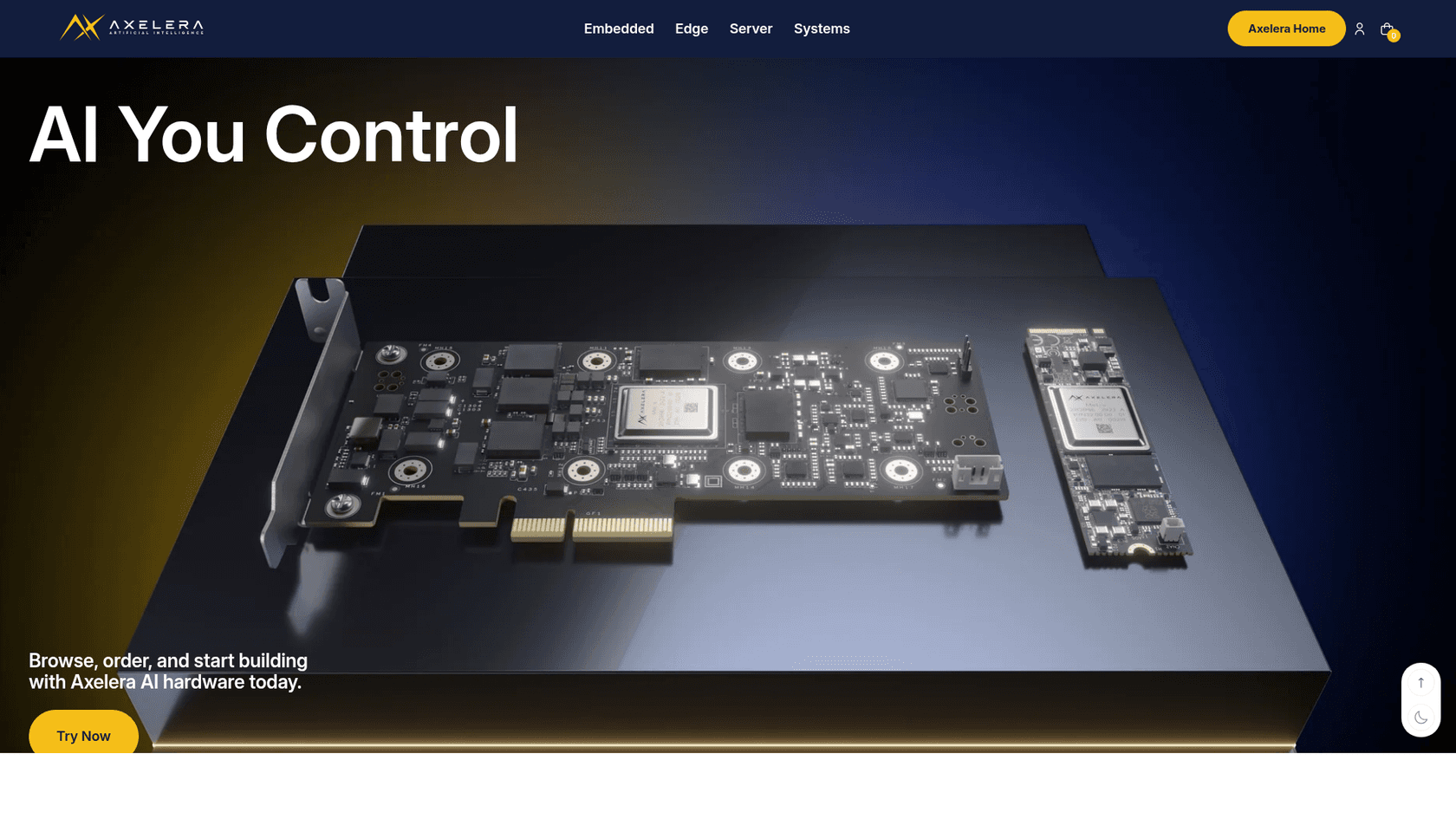
Put simply, Axelera AI is a company that designs and sells specialized hardware, the engines for artificial intelligence. Their main products are AI Processing Units (AIPUs) and accelerator cards, like their Metis M.2 and PCIe cards.
Their whole game is about AI inference at the "edge." All that means is running the AI smarts directly on a device, think a security camera, a factory robot, or a retail sensor, instead of sending data to a distant cloud server and waiting for an answer. This approach makes AI faster, more private, and way more reliable, especially if you're working with a shaky internet connection.
It's important to know who their products are for. They’re selling to developers, system integrators, and companies that build their own hardware. These are teams creating bleeding-edge applications in fields like computer vision, industrial automation, and robotics. They aren't selling a simple plug-and-play tool for the average business; they're providing the core components for engineers to create something entirely new.
How Axelera AI products and features affect pricing
Before we can talk dollars and cents, it helps to know what you’re actually buying. Axelera AI’s products are essentially the raw ingredients for a custom AI solution. Let's take a quick look at the main components.
How core hardware impacts pricing
The heart of their technology is the Metis AIPU, a custom-designed chip. It’s built with an in-memory computing architecture that makes it both powerful and energy-efficient. That's a big deal for edge devices that might be running on a battery.
You can get this tech in a few different packages:
-
Embedded 110m M.2 card: A small M.2 2280 card made for devices where every millimeter counts. It has a single quad-core Metis AIPU and delivers 214 TOPS at 3.5 to 9 W typical power.
-
Edge 130p PCIe card: This is a larger half-height card that fits into a standard PCIe slot. It carries one Metis AIPU with 16 GB of memory and also reaches 214 TOPS (Trillions of Operations Per Second), at 8 to 15 W typical power.
-
Compute boards and multi-AIPU cards: The Embedded 111c pairs a Metis AIPU with an Arm-based Rockchip RK3588 host for multi-stream vision and generative AI. The Server 150p stacks four Metis AIPUs for 856 TOPS. The Edge 232p, built on Axelera's second-generation Europa AIPU (629 TOPS), is listed as coming soon.
Here’s a quick rundown of the main hardware options:
| Product | Form Factor | Key Feature | Best for |
|---|---|---|---|
| Embedded 110m | M.2 2280 | Single Metis AIPU, 214 TOPS | Small-footprint, embedded systems |
| Edge 130p | PCIe, half-height | Single Metis AIPU, 16 GB | Demanding computer vision apps |
| Embedded 111c | Compute board | Metis AIPU + Rockchip RK3588 host | Standalone multi-stream vision and GenAI |
| Server 150p | PCIe | 4x Metis AIPU, 856 TOPS | Highest performance vision tasks |
| Edge 232p (coming soon) | PCIe, half-height | Europa AIPU, 629 TOPS | Next-generation edge workloads |
The role of development tools and complete systems in pricing
Hardware alone doesn't do much. To bring these cards to life, developers need software. Axelera provides the Voyager SDK, which is a toolkit engineers use to get their AI models running on the Metis hardware.
For teams that want a bit of a head start, Axelera also sells pre-integrated systems, including a Mini PC and a Dell Pro Slim Plus XE5 workstation with an Edge 130p card already installed. This just goes to show the level of technical know-how involved. It’s a platform for engineers, not an everyday business tool.
A deep dive into Axelera AI pricing
Alright, let's get to the main event. Axelera AI sells physical hardware, so you’re looking at a per-unit cost. It's a capital expense, but as you'll see, it's just the starting point of the total investment.
Official hardware pricing
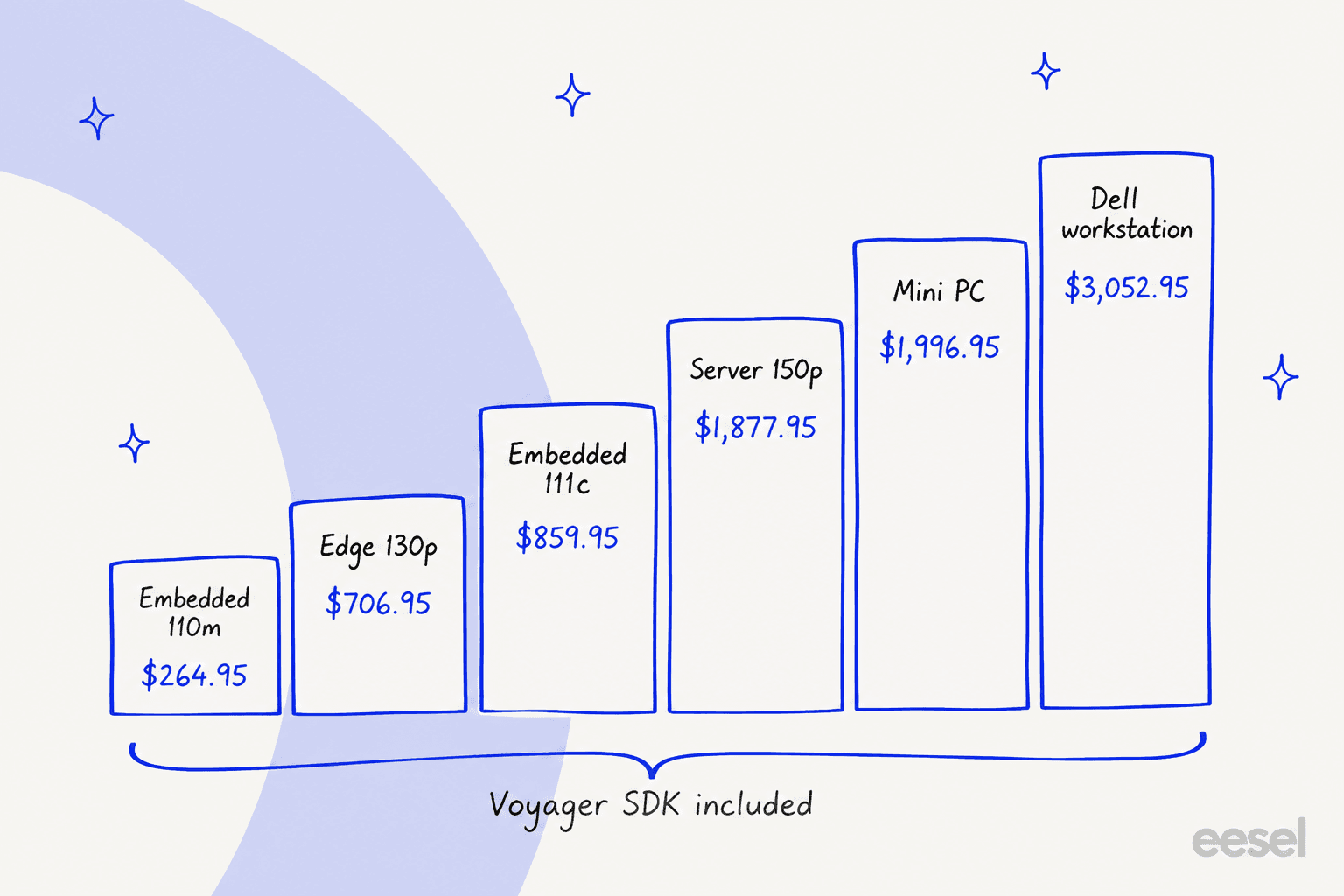
Here are the list prices for their cards and systems, taken from the official Axelera AI store USD catalog on 6 October 2026. The storefront can show slightly higher figures by region (I saw $286.95 for the Embedded 110m), so confirm the price at checkout. Every product in the catalog is listed as available, except the Edge 232p, which shows "coming soon" with no price.
| Product | Price (USD) | Availability |
|---|---|---|
| Embedded 110m M.2 card | $264.95 (no cooling) / $277.95 (active cooling) | Available |
| Edge 130p PCIe card (16 GB) | $706.95 | Available |
| Embedded 111c compute board | $859.95 | Available |
| Server 150p (4 AIPUs, 16 GB) | $1,877.95 | Available |
| Axelera AI Mini PC | $1,996.95 | Available, limited development units |
| Dell Pro Slim Plus XE5 with Edge 130p | $3,052.95 | Available |
| Edge 232p (Europa, 629 TOPS) | Not listed | Coming soon |
Hidden costs beyond the listed price
That price list above? Think of it as the entry fee. When you decide to build a custom AI solution from the chip up, the sticker price of the hardware is just one piece of a much larger financial puzzle.
Here’s what you really need to budget for:
-
Engineering Talent: This is the big one. You'll need a team of skilled developers and AI specialists who know their way around hardware integration, SDKs, and AI model optimization. These aren't your typical software engineers. Finding, hiring, and keeping this kind of talent is both expensive and incredibly competitive.
-
Development Time: Building, testing, and deploying a custom AI application isn't something you knock out in a weekend. It took Axelera AI 25 months from launch to start shipping its platform. Even if your project is smaller, you should realistically plan for many months, maybe even over a year, of development before you have something ready for the market.
-
Ongoing Maintenance: Your work isn't done once the application goes live. You're on the hook for maintaining everything, the software, the hardware, pushing updates, fixing bugs, and making sure nothing breaks when operating systems and other software libraries change.
This "build" path is the right one for companies with serious R&D budgets and in-house engineering teams, especially if their main product is aI-powered hardware. But for most other businesses, there’s a much faster and saner way to use AI.
The alternative: Turnkey AI solutions
This brings us to a different way of thinking: shifting from "building" AI to simply "using" it. For a lot of businesses, this change in approach can save a ton of time, money, and frustration.
When a software-first approach makes more sense
Ask yourself this: is your goal to design and sell a new AI-powered camera, or is it to solve an immediate business problem, like cutting down on customer support tickets or giving your team instant answers to their questions?
If you're in the second camp, you don't need to start from scratch. AI-powered Software-as-a-Service (SaaS) platforms are built specifically to solve these kinds of problems. They plug into the tools you're already using and start delivering value in minutes, not years.
A great example of this is eesel AI. It's an AI platform designed to automate customer support and organize internal knowledge. Instead of buying computer chips and hiring a team of engineers, you just connect it to your existing systems and let it do its thing.
Complexity and cost: A comparison
Let's put the two approaches next to each other to see how different they are.
-
Setup: With Axelera AI, you're looking at installing hardware, making sure your computer is compatible (they test on Ubuntu 22.04), and having a team that can work with their SDK. In contrast, a platform like eesel AI has one-click integrations. You can connect it to your help desk, whether you use Zendesk or Freshdesk, and your knowledge sources like Confluence or Google Docs, in just a few minutes. No developers required.
-
Time to Value: Building a solution with hardware can take a long, long time to see any return on your investment. With eesel AI, you can be up and running the same day. Its AI trains on your past support tickets and existing documents, so it learns your business and brand voice right away.
-
Pricing: The Axelera AI route involves buying hardware upfront, followed by the large and often unpredictable ongoing costs of an engineering team. eesel AI's fixed monthly price starts at $299 for 500 credits, and a ticket or chat is one credit however long it runs. There is no per-seat fee, and you can start with 100 free credits, so there is no surprise bill.

One of the biggest differences is the risk involved. With the "build" approach, you sink a lot of time and money into a project before you even know if it will work the way you hope. eesel AI offers a simulation mode that lets you test the AI on thousands of your past support tickets before it ever talks to a real customer. This gives you a risk-free way to see exactly how it will perform and calculate your potential return on investment, something that's pretty much impossible when you're building from the ground up.
Choosing your AI path beyond just Axelera AI pricing
So, what’s the takeaway here? There isn't a single "best" option. It all comes down to your company's goals, resources, and how quickly you need to get things done.
The "Build" path, using hardware from companies like Axelera AI, is for you if your core business is creating new, hardware-centric AI products. If you're designing the next generation of smart drones, medical scanners, or autonomous robots, this is your world. The upfront investment is steep, but it gives you complete control to build something unique.
Then there's the "Buy" path. Using a ready-to-go software platform like eesel AI makes a lot more sense for most other companies. If you want to use AI to make your business run smoother, improve your customer service, and give your team the information they need, this is the fastest and most cost-effective way to do it. It’s less risky, doesn’t require a specialized engineering team, and delivers results you can see almost immediately.
Get started with AI today, no hardware required
If your main goal is to reduce your support ticket volume, help your agents respond faster, and automate the repetitive questions that eat up your team's day, you don't need a hardware lab.
You can see what a turnkey AI solution feels like right now.
Start with 100 free credits (no card) and see how you can automate your support in just a few minutes.
Frequently asked questions
What is the typical range for Axelera AI pricing when considering their core hardware products?
The listed Axelera AI pricing for their accelerator cards starts at about $265 for the Embedded 110m M.2 card and runs to roughly $3,053 for a pre-integrated Dell workstation. These are per-unit costs for the physical hardware from the store's USD price list; the storefront can show slightly higher figures depending on region.
How does product availability impact the overall Axelera AI pricing and project planning?
In the store's USD catalog every listed product shows as available, but the Mini PC page notes that Axelera is fulfilling volume orders first with limited development units, and the Edge 232p is marked "coming soon" with no price. Lead times therefore still shape project planning, which directly influences Axelera AI pricing for a solution.
For what kind of projects is Axelera AI pricing most appropriate, and when should I consider alternatives?
Axelera AI pricing is most appropriate for companies whose core business involves building new, hardware-centric AI products, requiring deep R&D and in-house engineering. For businesses aiming to solve immediate operational problems, a turnkey AI software solution is generally faster and more cost-effective.
How does the total cost of ownership for a custom solution using Axelera AI pricing compare to a SaaS AI platform?
A custom solution involving Axelera AI pricing incurs upfront hardware costs, substantial engineering expenses, and long development cycles. In contrast, a SaaS AI platform typically has clear, usage-based pricing with immediate setup and much lower risk and development overhead.
Are the development tools, like the Voyager SDK, included in the Axelera AI pricing for hardware, or are they separate costs?
The Voyager SDK is public on GitHub and is listed as included on the store's card product pages, so it has no separate line item. The need for specialized engineering skills to use it still adds significantly to the overall Axelera AI pricing for development.
Can I get a pre-built system with Axelera AI hardware, and what is the associated Axelera AI pricing for those?
Yes. The store lists the Axelera AI Mini PC at $1,996.95 and a Dell Pro Slim Plus XE5 workstation with an Edge 130p card at $3,052.95, both pre-integrated. The Axelera AI pricing for these systems therefore runs from about $2,000 to $3,053, providing a head start for development.