


When DeepL first hit the scene in 2017, it felt like magic. It was hailed as the most accurate machine translator out there, leaving giants like Google in the dust. Its knack for understanding context and spitting out natural-sounding translations made it a go-to for pretty much everyone.
But a lot has changed since then. The AI world moves fast, and the translation landscape is crowded. While DeepL is still a big name, more and more users are starting to question its quality, app performance, and customer support. Is it still the king of the hill, or are there better, more dependable options out there for businesses?
This DeepL review will give you the real story. We’ll look at its accuracy, features, pricing, and where it falls short, so you can decide if it’s the right fit for you.
What is DeepL?
So, what’s actually under the hood? DeepL is an AI translation tool from Germany that got its smarts from a massive database of human-translated texts called Linguee. That’s its secret sauce. Instead of just swapping words, its neural networks look at whole sentences to figure out the real meaning and context.
The company breaks its offerings down into a few products:
-
DeepL Translator: The free tool you've probably used. It's a simple web page and app for quick translations, but it has limits on how much you can translate.
-
DeepL Pro: The paid subscription for professionals and teams. This gets you higher limits, better security, document translation, and the ability to choose a formal or informal tone.
-
DeepL API: For developers who want to build DeepL's translation tech into their own websites or apps.
-
DeepL Write: A separate AI writing tool that helps you clean up your grammar and style in your original text before you translate it.
How accurate is DeepL?
The big claim to fame for DeepL has always been its incredible translation quality. It’s known for making translations that don't just get the words right but also sound like something a human would actually say, especially for European languages like English, German, French, and Spanish. They even claim to be more accurate than competitors, and for a long time, they were.
Lately, though, the story has started to change. If you browse through forums or the latest Trustpilot reviews, you’ll see a running theme: people think the service is getting "dumber." Users are reporting more awkward sentences, weird literal translations of idioms, and a general failure to grasp context in longer documents. Some long-time fans even say it’s now worse than Google Translate.
| Metric | DeepL's Claim | What Users Are Saying (2024 to 2026) |
|---|---|---|
| Accuracy | Consistently outperforms competitors by a factor of 3:1. | Users report a noticeable drop in quality and more context errors. |
| User Rating | The world's most accurate translator. | A 2.5/5 TrustScore on Trustpilot from 777 reviews. |
| Reliability | Enterprise-grade security and performance. | Regular complaints about bugs, app crashes, and service outages. |
That inconsistency is a deal-breaker for any business. When you're dealing with customers, you can't have a tool that's a genius one minute and completely clueless the next. The root of the problem is that DeepL is trained on generic, public data. It has no idea about your company’s lingo, brand voice, or the common problems your customers face.
This is why tools like eesel AI are built differently. Instead of a one-size-fits-all model, eesel AI learns from your company's data, your old support tickets, your internal guides in Confluence or Google Docs, and your macros. It gets your business, so the answers it gives are always accurate and on-brand.
Features, usability, and limitations
DeepL is undeniably easy to use. The web, desktop, and mobile apps all have a clean design, and handy features like document translation (PDF, DOCX, PPTX) and the "Ctrl+C+C" keyboard shortcut make it great for personal productivity.
But if you're trying to use it for your business, you'll start to see the cracks.
Key features
-
Simple Interface: Easy copy-and-paste for text and drag-and-drop for documents.
-
API Access: Lets you plug its translation engine into other software.
-
Glossary: You can tell it how to translate specific terms to keep things consistent. Team and Business plans also add shared style rule lists.
-
DeepL Write: A nice add-on for polishing your text before translating, though it is a separate tool.
Where DeepL falls short for businesses
Here are the big problems you'll run into:
Language coverage has widened, but quality varies. DeepL's translator page now says "Explore our 100+ languages", up from the about 30 languages earlier versions of this review counted, most of them European. If your customers speak less common languages, test your own language pairs before you commit.
Customization runs through glossaries and style rules. Every paid plan has a glossary. Team adds 5 shared style rule lists, and Business adds 20 style rule lists, unlimited glossaries, and translation memory. I did not find a way to train the model on your brand's voice beyond those rules.
As one Reddit user put it, the tool often messes up technical terms because its knowledge is too general.
It's surprisingly buggy. Scroll through user reviews and you'll find many complaints. The desktop app is known for freezing, crashing, and hogging computer memory. People also report service outages, which is a huge problem when you're paying for a business tool.
Support response times are a recurring complaint. This might be the biggest complaint of all. Paying Pro customers say responses can be slow or hard to get, even when they're having issues with billing or major technical glitches.
For a business, these are more than just small annoyances. You need your tools to be reliable, flexible, and supported. A platform like eesel AI is designed for business from the ground up. It has a fully customizable workflow engine that lets you decide which tickets the AI handles, define its tone of voice, and pull knowledge from any source you use. You can even set up custom actions, like having it look up an order status or assign a ticket to the right team, things a simple translator can't even dream of.
Pricing and value for money
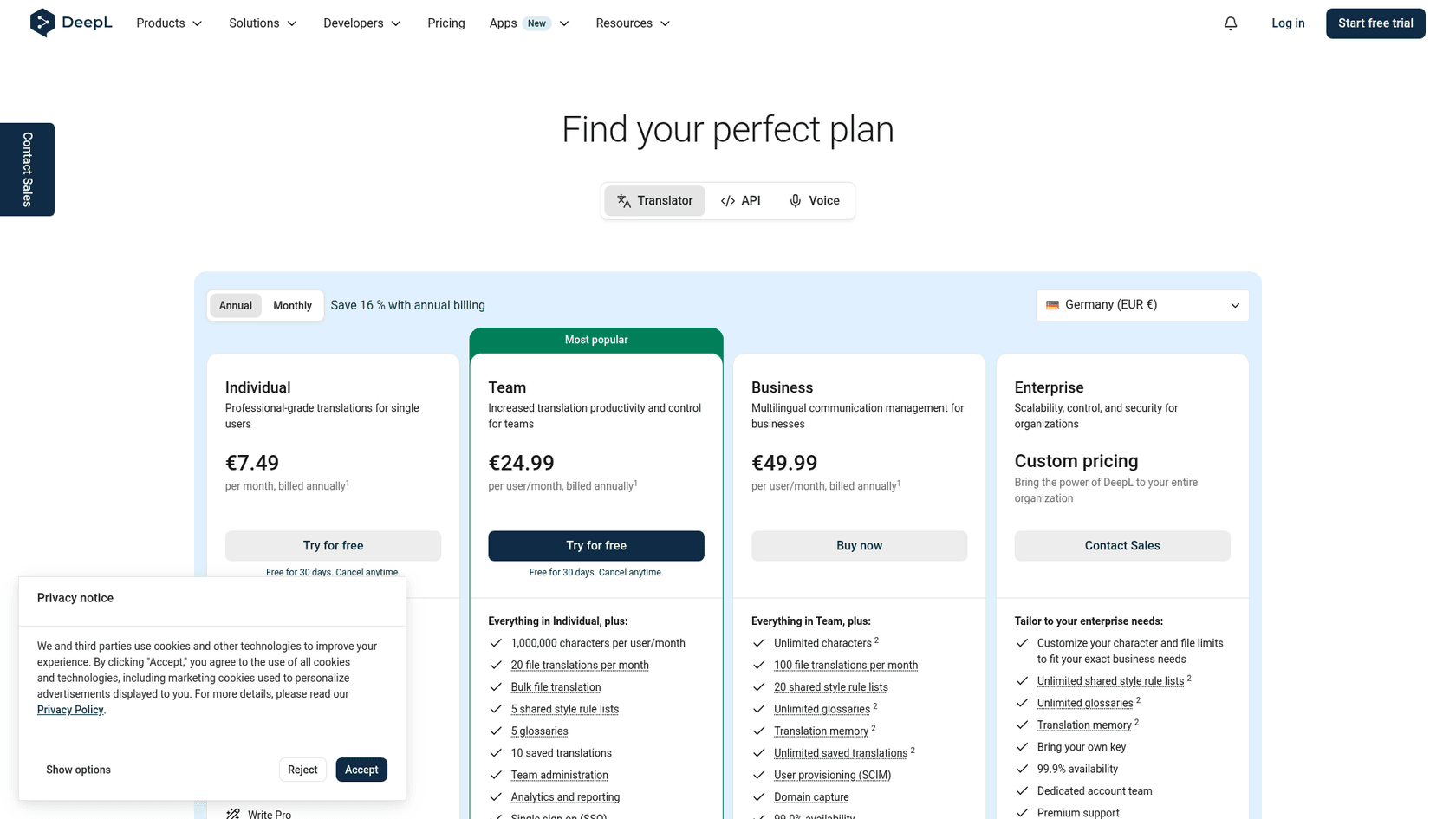
DeepL has a free version, but the limits are pretty tight. For anything serious, you'll need a Pro plan.
DeepL Pro pricing (For individuals and teams)
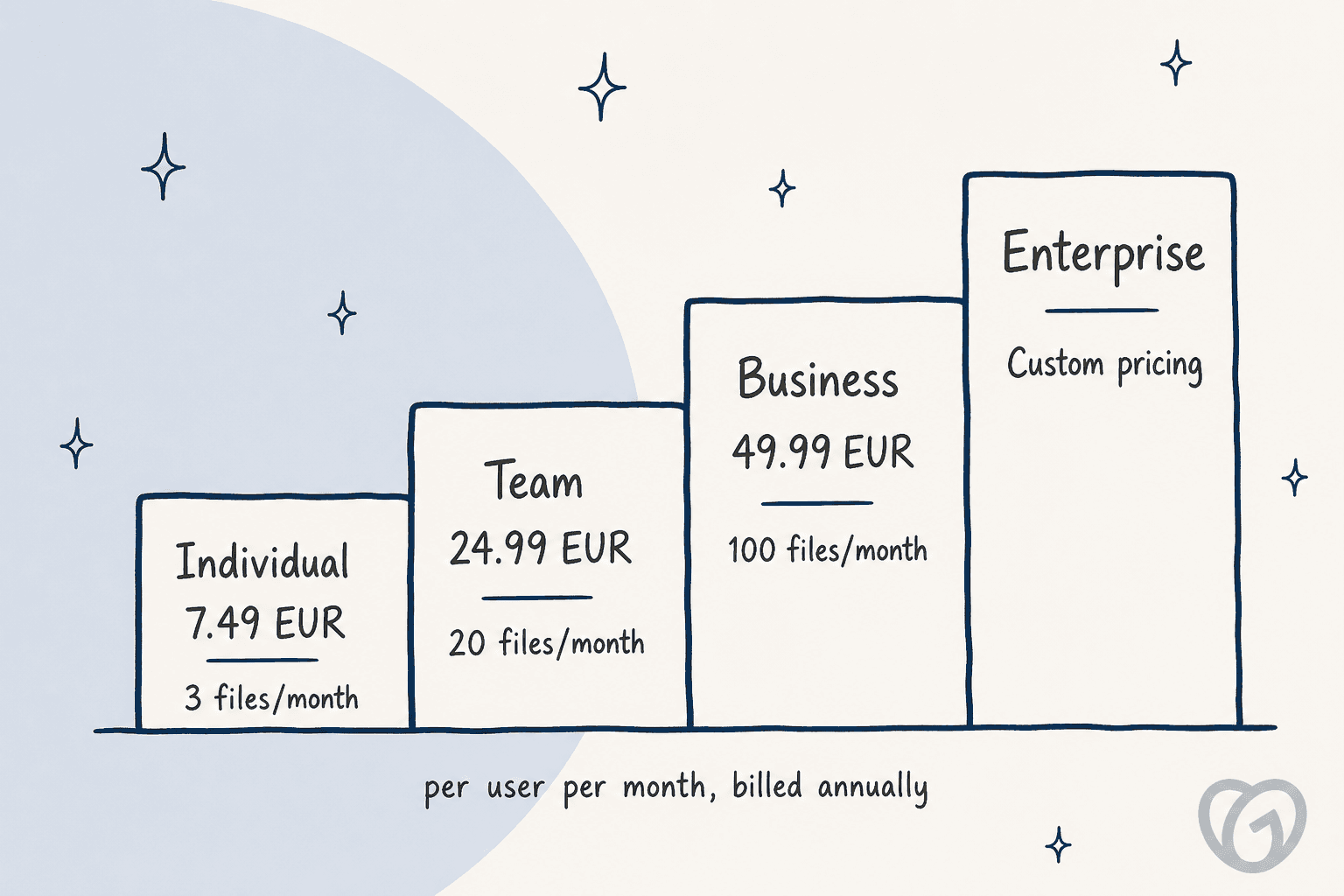
| Plan | Price (billed annually) | Key features |
|---|---|---|
| Individual | €7.49 /month | 300,000 characters/month, 3 file translations/month, 1 glossary. |
| Team | €24.99 /user/month | 1M characters/user/month, 20 file translations, 5 shared style rule lists, 5 glossaries, SSO. |
| Business | €49.99 /user/month | Unlimited characters, 100 file translations, 20 style rule lists, unlimited glossaries, translation memory, SCIM. |
| Enterprise | Custom | Custom limits, 99.9% availability, dedicated account team. |
Every plan has a 30-day free trial, and DeepL serves prices in your local currency, so I've listed the euro prices from its Pro page.
DeepL API pricing: A breakdown
If you want to integrate DeepL into your website or app, you'll need the API plan, which is priced differently.
-
Developer (free): a one-time credit of 1 million characters and 1 API key.
-
Growth: $26/month billed annually, which includes 12 million characters per year, then $27.50 per extra million characters (DeepL API plans).
The pricing seems simple enough on the surface, but a couple of big problems pop up when you look closer:
-
It can cost more than some alternatives. The API costs more than competitors like Google Translate ($20/million characters) or Microsoft Translator ($10/million characters). If your business translates a lot of text, that extra cost will add up very quickly.
-
Billing complaints on Trustpilot. Reviewers describe surprise charges, subscriptions renewing without warning, and difficulty canceling their accounts. Some say they felt stuck in annual plans they never meant to renew, so check the renewal terms before you subscribe.
For comparison, a platform like eesel AI has clear, predictable pricing: one fixed monthly price sized to your ticket volume (from $299/month for 500 credits, where 1 credit is one ticket or chat), plus a free plan with 100 credits and no card. There's no per-seat fee, so your bill stays the same in a busy month. Even better, eesel AI gives you a clear return on your investment. Its simulation mode lets you test the AI on your past support tickets to see exactly what your automation rate and cost savings will be before you pay a dime. It lets you build a real business case and launch with confidence, something you just can't do with DeepL.
The verdict: A great tool for you, a risky choice for your business
So, what's the verdict on this DeepL review?
For personal use, if you're a student, a freelancer, or just need to translate a document here and there, it's still a fantastic tool. It’s easy to use and the quality for common languages is still impressive.
But for a business? It depends on how much you need beyond translation. The reported reliability issues, customization that runs through glossaries and style rules, slow support responses, and billing complaints make it a harder fit, and you should test the language pairs you need first. The "pretty good" translation it offers just doesn't cut it when you need a real AI automation platform that actually understands your business.
If you’re looking to use AI to improve your customer support, you need a tool that was actually built for that. eesel AI gives you a simple, fully customizable, and transparently priced platform that works with the tools you already use. It does more than just translate words; it automates entire workflows, drafts on-brand replies, and brings all your company knowledge together.
Instead of just translating problems, you can start automating solutions. You can get started with eesel AI in minutes, not months.
Frequently asked questions
What does this DeepL review say about the current accuracy of DeepL's translations?
While DeepL was once highly praised for its accuracy, recent user feedback in this DeepL review indicates a noticeable drop in quality. Users report more awkward phrases, literal translations of idioms, and a struggle with context, especially in longer documents. This inconsistency makes it less reliable for business-critical translations.
For a business, what are the primary drawbacks highlighted in this DeepL review?
This DeepL review points out several business drawbacks, including reported bugs and app crashes, slow support responses on billing and technical issues, and complaints about renewals. DeepL has since widened its language list and added style rules and translation memory on higher plans, so I weigh those older concerns less than I used to.
Does this DeepL review address the cost-effectiveness and potential billing concerns of DeepL Pro or API plans?
Yes, this DeepL review notes that DeepL's API can be more expensive than competitors per character. More critically, it highlights Trustpilot reviews that raise billing concerns, including unexpected renewals and difficulty canceling subscriptions.
Can this DeepL review clarify if DeepL can be customized to match a company's specific brand voice or technical terminology?
This DeepL review finds that customization works through glossaries and rules. Team adds 5 shared style rule lists, and Business adds 20 style rule lists, unlimited glossaries, and translation memory. I did not find a feature for training a model on your own brand voice beyond those rules, so specialized content still needs a human check.
According to this DeepL review, is DeepL suitable for translating a wide range of global languages?
DeepL now says its translator covers 100+ languages, up from the roughly 30 (mostly European) this review originally counted. Quality can still vary by language pair, so test the languages your customers use before committing.
What's the main difference in suitability for personal versus business use, according to this DeepL review?
This DeepL review concludes that DeepL remains a good tool for personal use, such as for students or freelancers needing occasional translations due to its ease of use. However, for businesses, the reported reliability issues, glossary-and-rule-based customization, and slow support make it a harder fit.