


What Elementum AI actually costs
The short version is that you cannot find out from Elementum. I went looking the way any buyer would, and every obvious door is closed on purpose.
The elementum.ai/pricing URL returns a hard 404, confirmed both in a browser and with a plain curl. There is no pricing link anywhere in the site navigation either, only a "Contact Sales" button that routes to the quote form. And the terms of service do not leave it to chance: "All fees and pricing information will be Elementum's Confidential Information," with a second clause telling the customer not to disclose any pricing information. That is a deliberate posture, not an oversight, and it is worth naming plainly because it changes how you have to shop. The usual ritual for buying software, which is read the reviews and check the price, does not work here. You evaluate on architecture and on the one rate card that leaked out through a review site.
To be fair to Elementum, quote-only pricing is common at the enterprise end of this market. Plenty of serious AI customer service software sells the same way, and so do a lot of the AI customer service companies it competes with. There is a real company behind this one, too. Nader Mikhail founded it, the board includes Frank Slootman and Michael Scarpelli, and Snowflake Ventures invested in September 2025. The confidentiality is a choice, not a red flag. It just means the price discovery is on you.
The one real rate card, and why you cannot trust it as today's price
There is exactly one place a computable Elementum number exists: a three-tier card the vendor supplied to G2. Here it is in full, because a pricing post owes you the whole table, not a "starts at" line.
| Plan | Price | Term or unit | What it is |
|---|---|---|---|
| Proof of Concept | $0 | One-off | Free custom demo on sample data |
| Pilot | Starting at $10,000 | 1 month | A 30-day trial to "80/20" solution readiness |
| Go-Live | Starting at $3.00 | Per 1 credit | Consumption-based, unlimited users |
Two things stand out. The first is that this is the most concrete Elementum pricing anyone has published, so credit where it is due: a free proof of concept, then a real dollar floor on the pilot, then a per-credit go-live rate with seats explicitly not metered. The unlimited-users part is a real design choice, and it lines up with the company's public argument that AI makes legacy software cheaper through "fewer seats, less software, more automation."
The second thing is the date. The card carries its own timestamp, and the pricing data was "last updated on November 12, 2024." That is before Snowflake Ventures invested, and before the "AI-native replacement for legacy SaaS" positioning the company runs on today. G2's own footer says final cost negotiations must be conducted with the seller. So the honest way to read this card is as the last rate card Elementum published, not as a live 2026 quote.

One aggregator, checkthat.ai, claims Elementum "starts at $19 per user per month." Ignore it. It is an SEO page, not a source, and its number directly contradicts the vendor's own card, which is credit-based with unlimited users and has no per-user rate at all.
What a credit actually buys (and why $3.00 will not become a bill)
Here is the fact that reframes the whole exercise. The billable unit is a credit, and Elementum has defined it exactly once, on that G2 card: consumption-based pricing where you buy credits that "reflect units of compute and storage to automate workflows."
"Units of compute and storage" is not something you can multiply. There is no published conversion anywhere from one credit to a workflow run, an agent action, a row processed, or a query answered. So the $3.00 figure, real as it is, cannot be turned into a monthly forecast. You can know the price of a credit and still have no idea what a credit does.

Two more gaps sit underneath that. The terms of service contain no billing section at all, so no minimum spend, no renewal mechanics, and no overage language are published anywhere. And Elementum's AI docs describe a bring-your-own-provider model, where you configure OpenAI, Anthropic, Snowflake Cortex, Gemini or Bedrock with your own API keys. That is a good thing for governance, and set against vendors that resell tokens at an undisclosed markup it is the cleaner deal. But it also means the model spend is a separate bill you owe your provider, on top of Elementum credits. The credit line is not the whole cost.
The costs that are not on any Elementum page
If you only budget for credits, you will under-count. The AI half of Elementum has two hard dependencies that carry their own price tags, and both are documented plainly in the docs, to the company's credit.
The bigger one is the warehouse. A CloudLink can connect to a data warehouse or a REST API, but AI services "require a data-warehouse CloudLink" and "cannot run on an API CloudLink." The warehouses named are Snowflake, BigQuery and Databricks, and nothing else appears, so no Redshift, no Postgres, no SQL Server. If you do not already run one of those, that is a platform purchase in its own right, and you should price it the way you would price Snowflake or Databricks alongside the Elementum contract.
Then there is setup. Before you connect anything, you whitelist six Elementum IP addresses in your data platform's firewall, and Snowflake needs RSA key-pair authentication for the Cortex features. The docs describe the platform as built for business users, and the app builder does look approachable, but somebody technical has to hand the business user a connected warehouse before any of the no-code part begins. That is real implementation time, and it belongs in the total cost even though no line item names it.

What you are actually paying for
Price only makes sense next to what it buys, so it is worth being precise about what the credit runs. Elementum's whole pitch is that it "runs natively inside your data cloud," querying your warehouse in place without copying or moving data. That claim holds up in the docs, and for a CIO under a data-residency mandate it is a materially different posture from a vendor replicating your tables into its own cloud.
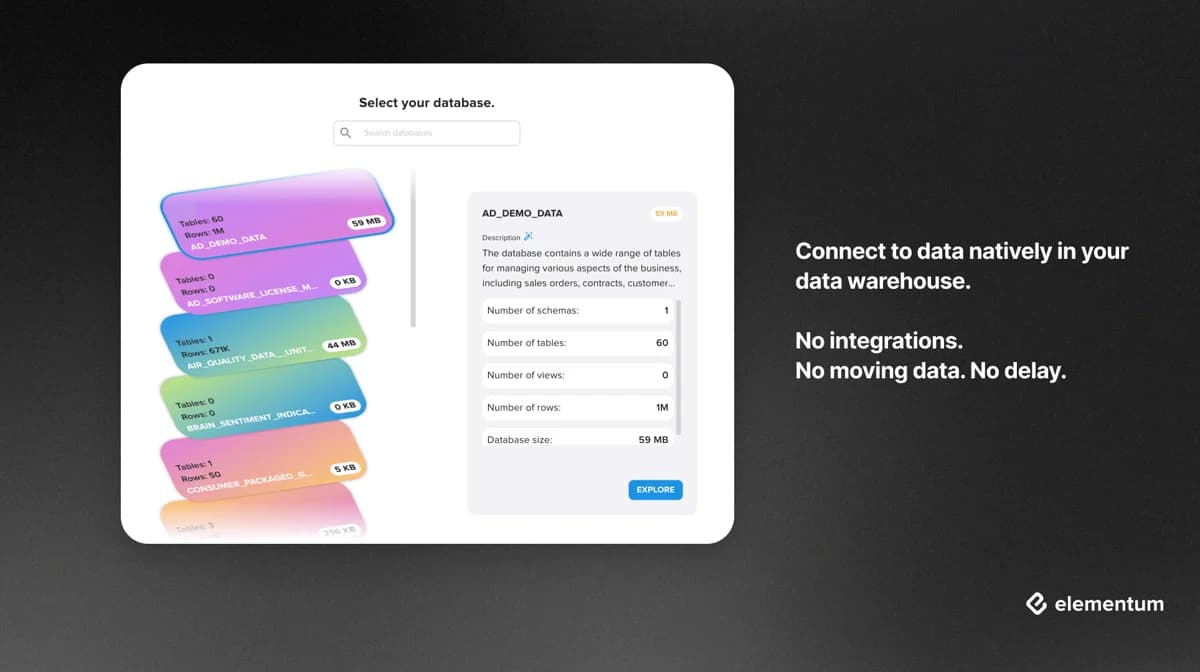
What that buys is warehouse orchestration. Elementum's AI search indexes standard Snowflake tables using Cortex embeddings. There is no help-centre crawl, no ticket ingestion, and no document store, which is the job AI for knowledge management and knowledge retrieval tools are built for. Ask "what is the status of purchase order 4471" and Elementum is well built for it. Ask "what is our parental leave policy in Germany," and that answer lives in a PDF the platform has no documented way to read. That is not a knock, it is a category. Elementum acts on rows, so if your requirement is governed lookups over data-cloud tables, this is the right shape, and building the same logic yourself with ITSM automation tools is the cheaper version.
The credit also runs an automation builder and conversational agents, deployed to four surfaces: in-app, Microsoft Teams, Slack, and phone. Notably not on that list are email, a web chat widget, and any helpdesk. Across six agent documentation pages there is no named connector for Zendesk, Jira, ServiceNow, Workday or Okta. An agent can call eight tools, and six of them act only on Elementum's own apps and tables. Reaching outward means either an MCP connection to an external server or a Send API Request action you wire per endpoint, which is a respectable escape hatch for an engineering team but is not a connector. Worth knowing before a procurement cycle, not during one.

Support and SLA: what the price includes
One thing that is refreshingly clear is support, which is bundled at no extra charge as long as you are paid up. There is no Standard/Premium/Enterprise support split, no paid support add-on, and one published SLA that applies to every customer. The catch is access: you designate a single contact who can open tickets, not open access for every user.
The support page, last updated August 10, 2026, publishes the targets, all on "commercially reasonable efforts."
| Severity | Response | Resolution target |
|---|---|---|
| SEV 1 (critical outage) | 1 hour | 8 hours |
| SEV 2 (core function down) | 4 business hours | 7 calendar days |
| SEV 3 (material issue) | 3 business days | Estimated within 3 months |
| SEV 4 (minor) | 5 business days | Commercially reasonable efforts |
A couple of things to read closely. A workaround counts as a resolution, and only SEV 1's one hour is measured in clock hours, with SEV 2 in business hours and SEV 3 and 4 in business days. SEV 1 gets 24/7 coverage; everything else runs Sunday morning through Friday evening Mountain Time, plus a Saturday window. It is a fair, standard enterprise SLA. Just know that "resolution" is defined generously.
Elementum pricing versus a credit-based helpdesk agent
The reason so many people land on an Elementum pricing search from the support side is that the "single AI-powered front door for HR, IT, Finance and Sales" reads exactly like an internal helpdesk. If that is why you are here, the comparison that matters is not feature-by-feature, it is whether you can price the thing at all, and whether it reads the corpus your questions actually live in. It is worth putting Elementum next to the rest of the best AI helpdesk software on exactly those two axes.
| Elementum | eesel | |
|---|---|---|
| Published price | None, quote only | From $299/mo (500 credits) |
| Billable unit | Credit ("compute and storage") | Credit (1 ticket or conversation) |
| Can you model the bill up front? | No published conversion | Yes, pick the plan that fits your volume |
| Warehouse required | Yes | No |
| Reads help centre and past tickets | No, warehouse tables only | Yes |
| Dry run before go-live | Not documented | Yes, simulate on ticket history |
| Free to start | Free proof of concept | 100 free credits |
That "can you model the bill" row is the whole game. A vendor that will not publish a unit is a vendor whose cost you cannot forecast before you commit, which is the first thing any honest AI support cost comparison has to establish. Plug your own volume into the two models and the gap is obvious: one side gives you a number, the other gives you a phone call.
Why the reviews will not help you price it
One last trap when you are sizing this up. You cannot fall back on the reviews to sanity-check value, because the public review record is for a different product. Elementum was founded in 2012 as a supply-chain company, and it drifted through "Supply Chain Orchestration," then enterprise service management, before landing on today's AI-native positioning around 2024.
G2 holds 3.3 out of 5 from three reviews, the newest dated April 2022, and one of those is excluded by G2 as a seller business partner, so the score effectively rests on two. Capterra holds 4.3 from 28 reviews, every one of them inside a six-week window in June and July 2020, and nearly all labelled incentivized or vendor-referred. Read the bodies and it is unambiguous:
"Really helpful to follow up and solve incidents related to Logistics. Very easy to use. All users were able to add incidents and push on how to resolve them."

That is an incident-management tool for supply-chain claims, not the agentic platform on sale now. G2 says the quiet part out loud on the product page: "There are not enough reviews of elementum for G2 to provide buying insight." None of this is a knock on the current product. It just means the star ratings tell you nothing about whether the 2026 price is fair, so you are back to modelling the cost yourself, from a card that will not convert into one.
Try eesel
If you came here to price an AI helpdesk agent and Elementum turned out to be warehouse orchestration, here is the honest contrast. eesel sells AI teammates you hire rather than a platform you configure, and the one that matters against Elementum is the helpdesk teammate. It joins the queue you already run in Zendesk, Freshdesk, Jira Service Management, Front, Gorgias, Help Scout or Slack, and it reads your help centre, past tickets, macros and wiki pages, which is exactly the corpus Elementum cannot index.
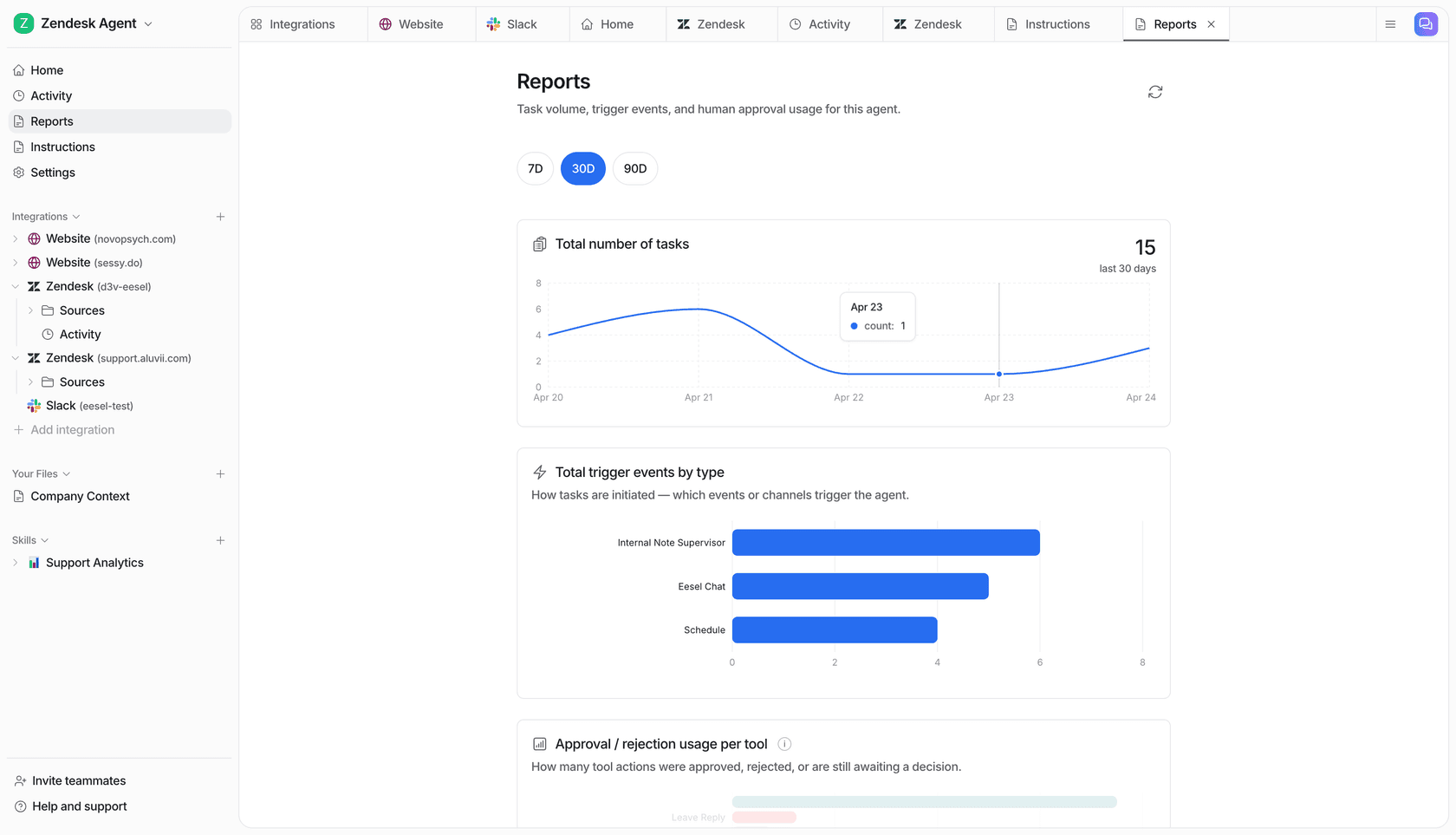
The pricing is the part you can actually model. It is one fixed monthly price sized to volume, where 1 credit is one ticket or helpdesk conversation, counted per conversation and not per reply, with no per-seat fee and no platform fee. You start with 100 free credits, paying a year upfront gets two months free, and SSO and MFA (from $199 a month) or data residency ($500 a month) are add-ons. A thousand tickets a month is the 1,000-credit plan at $499. You can look that up today.
And the thing Elementum's docs do not offer, we lean on hardest. The simulation skill replays the agent against your own historical tickets, so you see the answers it would have sent before it sends any of them. I have watched enough confident-sounding bots answer confidently and wrongly to think that pass is the single most valuable hour in a rollout. A Spanish insurance brokerage we work with ran more than 560 of their own real conversations through a custom agent inside 48 hours, before it touched a live queue, and changed the routing rules twice on the back of what came out. Where a platform cannot offer that, the first month of production becomes the test.
"We could try to write our own LLM application but we didn't want to invest our time into that. We wanted something that we would not have to maintain."
Karel, GENERAL BYTES
eesel is not an ITSM platform, so no CMDB and no asset management, and it does not query your Snowflake warehouse in place the way Elementum does. If governed orchestration over data-cloud tables is the actual requirement, Elementum is the right tool and this is not. But if your volume is tickets answered from documents, and you want a price you can multiply and a dry run before go-live, that is the trade eesel is built for.
Frequently Asked Questions
How much does Elementum AI cost?
/pricing URL returns a 404 and its terms of service make all fees confidential. The only rate card anywhere is a vendor-supplied one on G2 showing a free proof of concept, a pilot starting at $10,000 for one month, and go-live from $3.00 per credit. It was last updated in November 2024, before the AI repositioning, so treat it as a floor, not a quote. For a number you can multiply today, compare an AI helpdesk agent on a fixed monthly plan from $299 for 500 credits.