
What does the EU AI Act actually ask of a support team?
The AI Act splits responsibility between two roles. A provider builds an AI system and puts it out under its own name, like a helpdesk vendor shipping an AI agent. A deployer uses an AI system under its own authority, which is what you are when you switch that agent on for your customers. Most support teams are deployers, and a few become providers when they build their own bot in-house or rebrand and retrain someone else's.
For a support team, four parts of the law matter. Everything else (rules for general-purpose models, product safety, law enforcement) is someone else's problem.
| Rule | What it means for support | Applies since | Maximum fine |
|---|---|---|---|
| Article 50 transparency | Tell people they're talking to AI; tell people if emotion recognition is running on them | 2 August 2026 | €15M or 3% of turnover |
| Article 5 bans | No AI that infers emotions of workers, so no voice-emotion scoring of your agents | 2 February 2025 | €35M or 7% of turnover |
| Article 4 AI literacy | Take measures so staff using AI understand it | 2 February 2025 | Set by each country |
| Annex III high-risk uses | Extra duties if your AI scores agents, credit or insurance risk | 2 December 2027 | €15M or 3% of turnover |
The fine caps come from Article 99, which also tells each country to weigh the interests of small businesses and to apply whichever cap is lower for SMEs. National market surveillance authorities do the enforcing, and the Commission says on its 2 August explainer that they can now issue those fines.
Didn't the Digital Omnibus delay all of this?
Partly, and that's where a lot of teams got the wrong idea. The Digital Omnibus on AI (Regulation 2026/1744, adopted 8 July 2026) pushed the high-risk rules back, but it left the chatbot disclosure date alone. According to the amended Article 113, the timeline now looks like this:
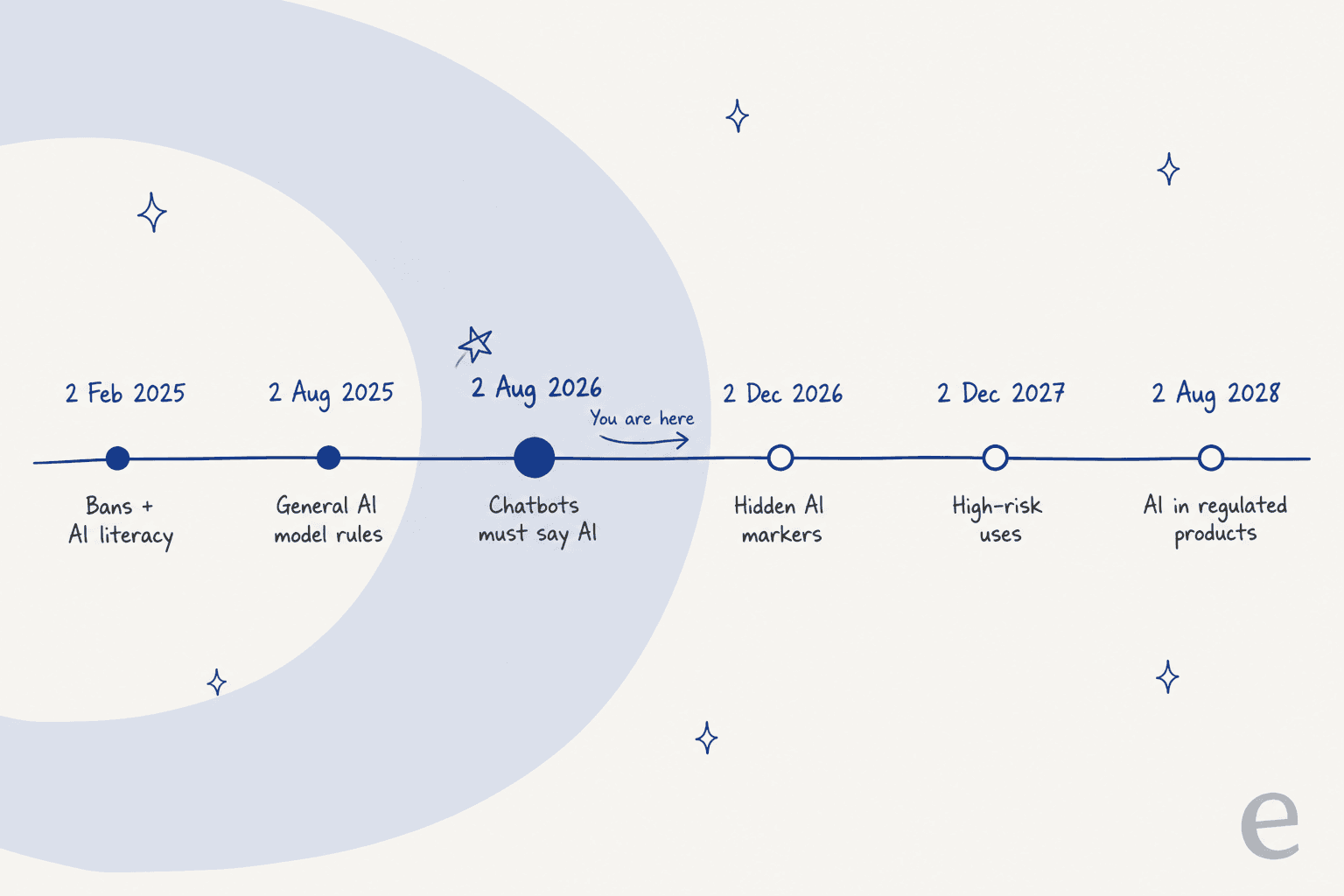
The one transparency deadline that did move is technical: AI systems already on the market before 2 August 2026 have until 2 December 2026 to add machine-readable markers to the content they generate, per the Commission's Article 50 FAQ. That's a job for your vendor's engineers. The "you're talking to AI" notice has been live since August.
Which of your support AI needs an "I'm AI" notice?
Here's the part that saves the most work. The Commission's Article 50 guidelines, published 20 July 2026, list four things that all have to be true before the disclosure rule kicks in: it's an AI system, it's meant to interact, the interaction is direct, and it's with a person. The word doing the heavy lifting is direct.
The guidelines spell out that customer service is the textbook case on both sides of the line. A helpdesk chatbot that answers customers is in scope. An agent using AI to help write a reply is not:
"Direct interaction excludes indirect or mediated human interaction where a natural person is exposed to AI outputs without directly interacting with the system (for example, if customer service representatives use AI assistance tools to help them communicate with natural persons...)"
Sort your tools into two piles and most of the anxiety goes away:
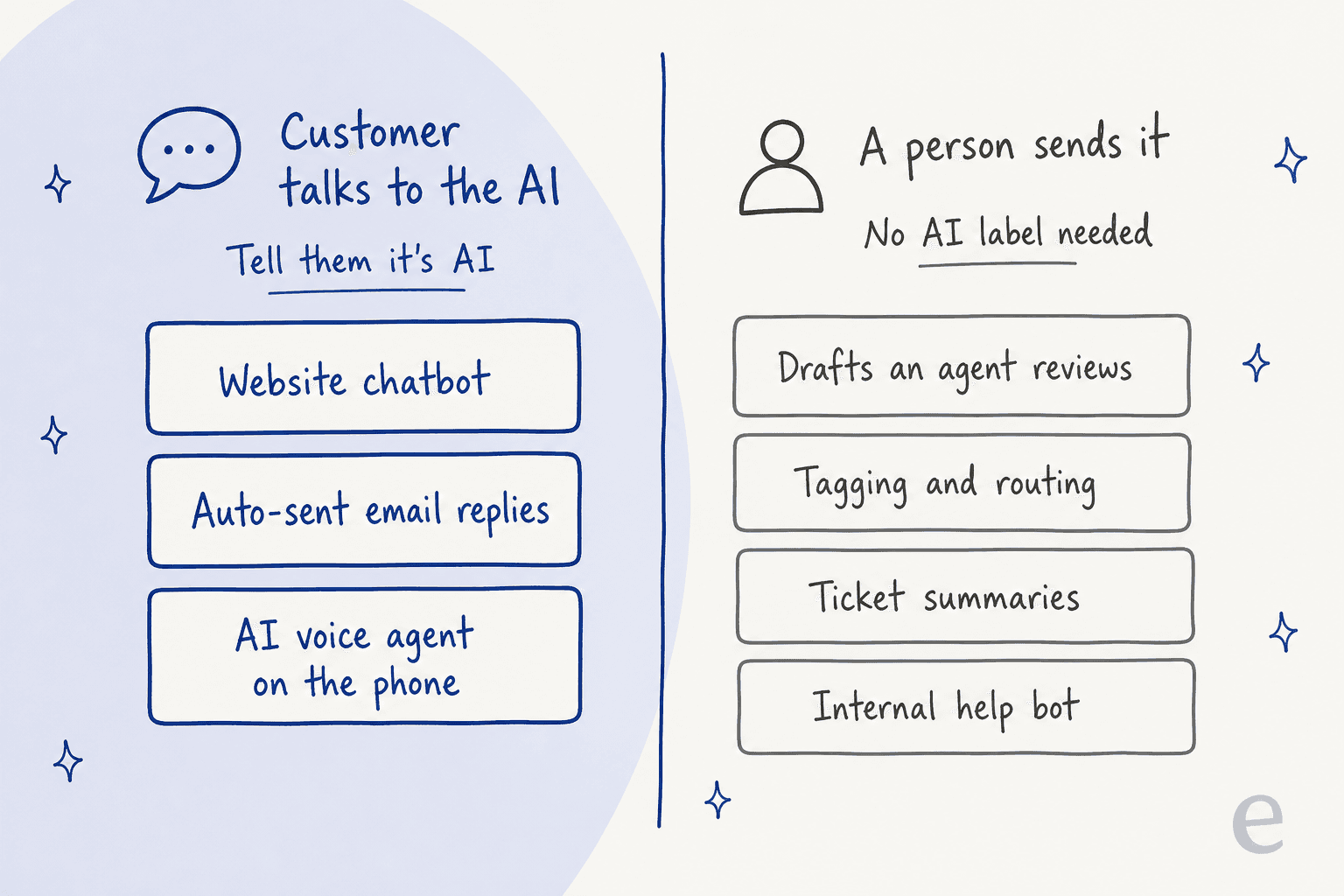
Three details from the guidelines are worth knowing before you file anything in the right-hand pile:
- "A human could intervene" isn't a loophole. The guidelines say the mere possibility of a person reviewing outputs can't be used to dodge the rule. Drafts are only out of scope when a person actually reviews them and sends them as the main voice in the conversation.
- Mixed conversations need labels on the AI parts. If a chat escalates from a bot to a person, or a person hands back to a bot, the AI-generated turns need the disclosure.
- Auto-sent email counts. Interaction can happen "via technical communication means including online interfaces, phone or e-mail", and the guidelines' own example of a good disclosure is an AI-written email with an AI label at the top. Rule-based auto-replies and classic out-of-office messages aren't AI systems, so they're out.
Internal bots for trained staff get a pass too. The guidelines list an "internal employee-facing assistant for properly trained staff" (HR, legal, IT support) as a case where the AI nature is obvious enough that no label is needed.
Where eesel customers land
This is the split I see every week. Dokument 24, a Danish legal-documents service, has eesel prepare about 670 Danish draft replies a month as internal notes in Zendesk, and someone on the team edits and sends each one. That's mediated interaction. Nordbutiker, which sells e-bikes and mobility scooters across four Nordic countries, runs a separate customer-facing bot for each brand and language on its store websites. Those bots talk to customers directly, so each one needs its own notice, in its own language.
What counts as a good disclosure?
Article 50(5) only says the information must be "clear and distinguishable", given "at the latest at the time of the first interaction", and accessible. The guidelines fill in the detail, and they're refreshingly practical. A single prominent notice before the first interaction is enough in most cases.
| Works | Not enough on its own |
|---|---|
| A first-turn greeting that says it's AI ("I'm the AI assistant for...") | A line in your terms and conditions or privacy policy |
| A plain-language label near the message box ("You're chatting with an AI system") | A generic name like "Assistant" or "Support" |
| A persistent AI badge or icon next to the bot's replies | A human photo or human-sounding name on the bot avatar |
| An AI label at the top of an AI-written email | "Services on this website use AI" across the whole site |
| A spoken line at the start of a call ("This is an AI-powered assistant") | "Powered by LLMs" or other tech jargon |
| Answering honestly whenever a customer asks "is this a bot?" | Hidden metadata or a watermark the customer can't see |
The guidelines want more than one notice in "riskier contexts", and two of their examples are squarely support work: complaints handling, and conversations about financial advice, insurance, legal or health questions. In those, they expect periodic reminders, especially when a conversation changes hands or the AI's role changes. Anything aimed at the general public also has to work for people with disabilities, older customers and children, so a grey 9px disclaimer doesn't cut it.
A common read in developer threads is that context does the job on its own:
"The main point is that it is trying to prevent deception, e.g. in a "live support chat" where a website claims you're talking to a human when in fact you're not... if it's clear from the context, that you're interacting with AI, it doesn't need to be explicitly said. No cookie banners."

The first half is right. The second half is where support teams get caught: the obviousness exception won't save a customer-facing bot. The guidelines say it should be read "restrictively", and they name helpdesk chatbots whose replies customers "may perceive as human-generated" as an example where the rule applies.
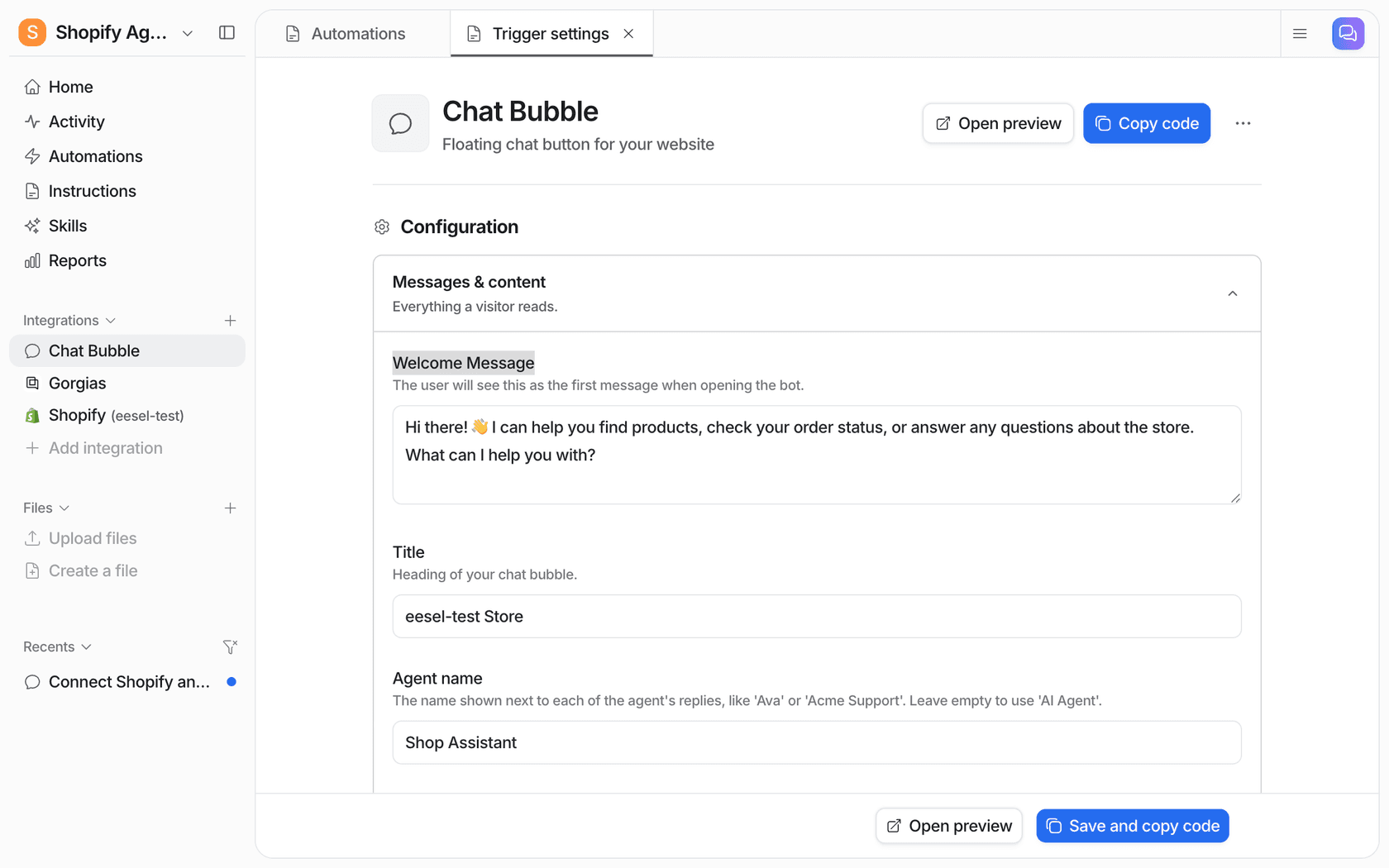
Here's what a basic, compliant-looking setup can look like. In eesel's chat bubble, the agent name is set next to each reply, and a separate disclaimer line sits under the message box:
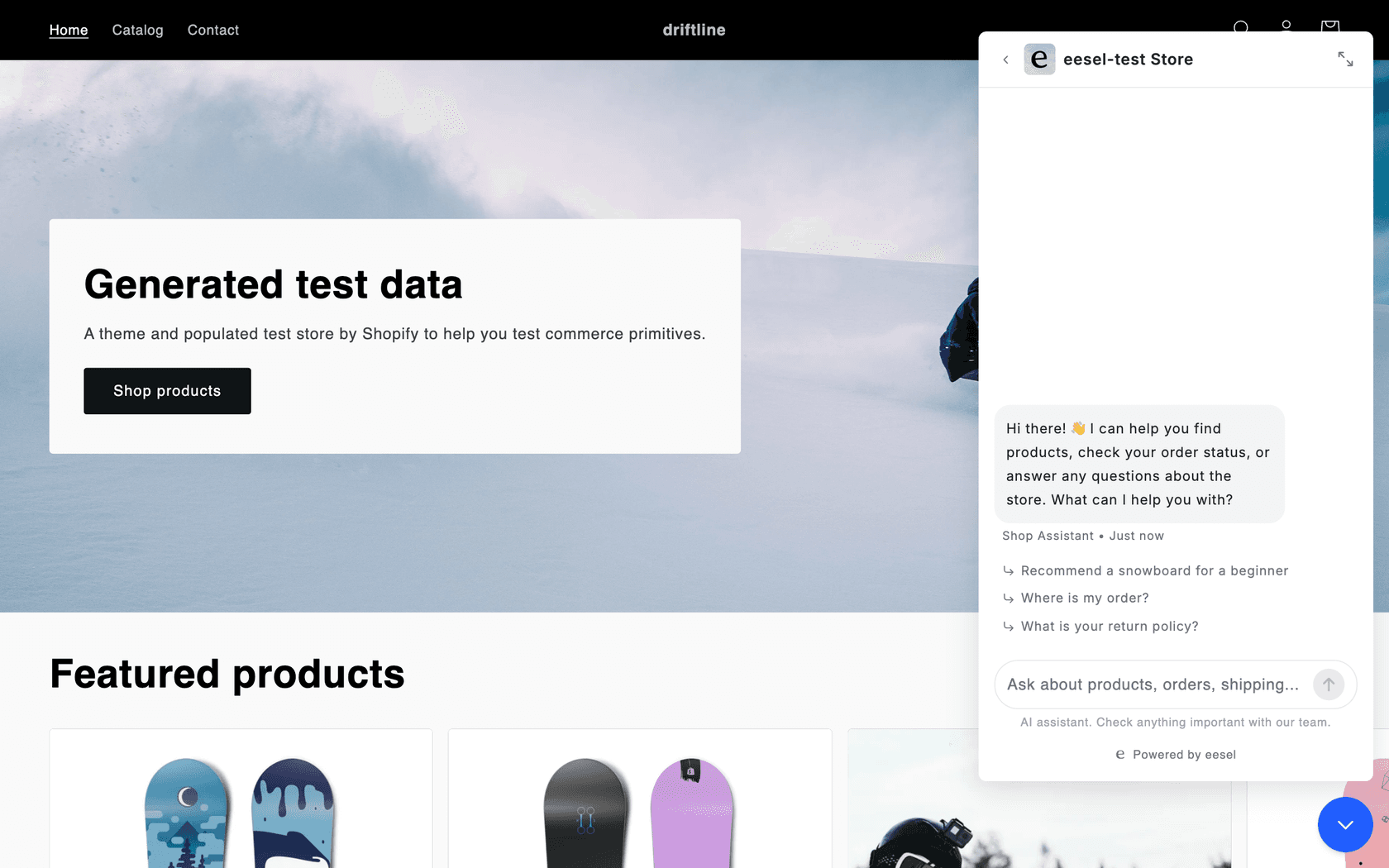
Notice the trap in that screenshot. The name "Shop Assistant" is exactly the kind of generic label the guidelines call ambiguous; the disclaimer line under the input box is what does the legal work. If you want both to carry the message, put AI in the welcome message too. eesel signs replies "AI Agent" when you leave the agent name empty.
There's a business reason to do this beyond the fine. Customers who spot a bot posing as a person stop trusting the company, not just the bot:
"I think a voice agent trying to appear as a human is actually hurting the business that’s deploying it. I can tell within 5 seconds that it’s not a real human and then my sentiment is they’re 1. being cheap and 2. trying to play me."
Named personas are fine, by the way. Norden-Frisia's bot is called CaptAIn, "Captain plus AI", with its own avatar and a greeting in the local dialect. A persona with AI in the name is a good start; pairing it with one plain sentence in the greeting ("I'm an AI assistant") removes any doubt for a passenger who doesn't spot the wordplay. The failure mode is a human first name with no label at all, which is how one coding tool's support bot ended up in a Hacker News pile-on in 2025:
"LLMs pretending to be people (you named it Sam!) and not labeled as such is clearly intended to be deceptive."

Does this support AI need a disclosure?
Pick a setup to see which EU AI Act rule applies, from when, and what to change.
Put an AI statement in the first message and a visible AI label near the message box, in every language the bot speaks. Make sure it answers honestly when someone asks if they're talking to a bot.
Add an AI label at the top of every email the AI sends without a person reviewing it. Rule-based auto-replies and out-of-office messages aren't AI systems, so they don't need one.
This is outside the disclosure rule as long as a person actually reviews the draft and sends it as the main voice. A review step that exists only on paper doesn't count.
Say it out loud at the start of the call, for example “This is an AI-powered assistant”. Repeat it after transfers or long holds, and don't rely on a beep or tone alone.
Text isn't biometric data, so flagging angry tickets from their wording isn't emotion recognition under the AI Act. It's still personal data processing, so it belongs in your GDPR records.
Inferring workers' emotions is banned outside medical or safety reasons. Switch off any tool that rates agents on how stressed or friendly they sound from the audio.
AI that monitors and evaluates worker performance is on the high-risk list. If scores feed promotion or termination decisions, ask your vendor for its classification in writing now.
Evaluating creditworthiness or pricing life and health insurance is high-risk. A bot that explains the application form isn't doing that job; one that tells customers whether they qualify is.
Does sentiment analysis count as emotion recognition?
Usually not, and this is the most misunderstood part of the law in support teams. The Act defines an emotion recognition system as AI that infers emotions or intentions "on the basis of their biometric data". Text isn't biometric data. So the sentiment analysis your helpdesk runs on ticket text to flag an angry customer is not emotion recognition under the AI Act, though it's still personal data processing under GDPR.
Voice is different, because a voice is biometric. That's where the rules get sharp:
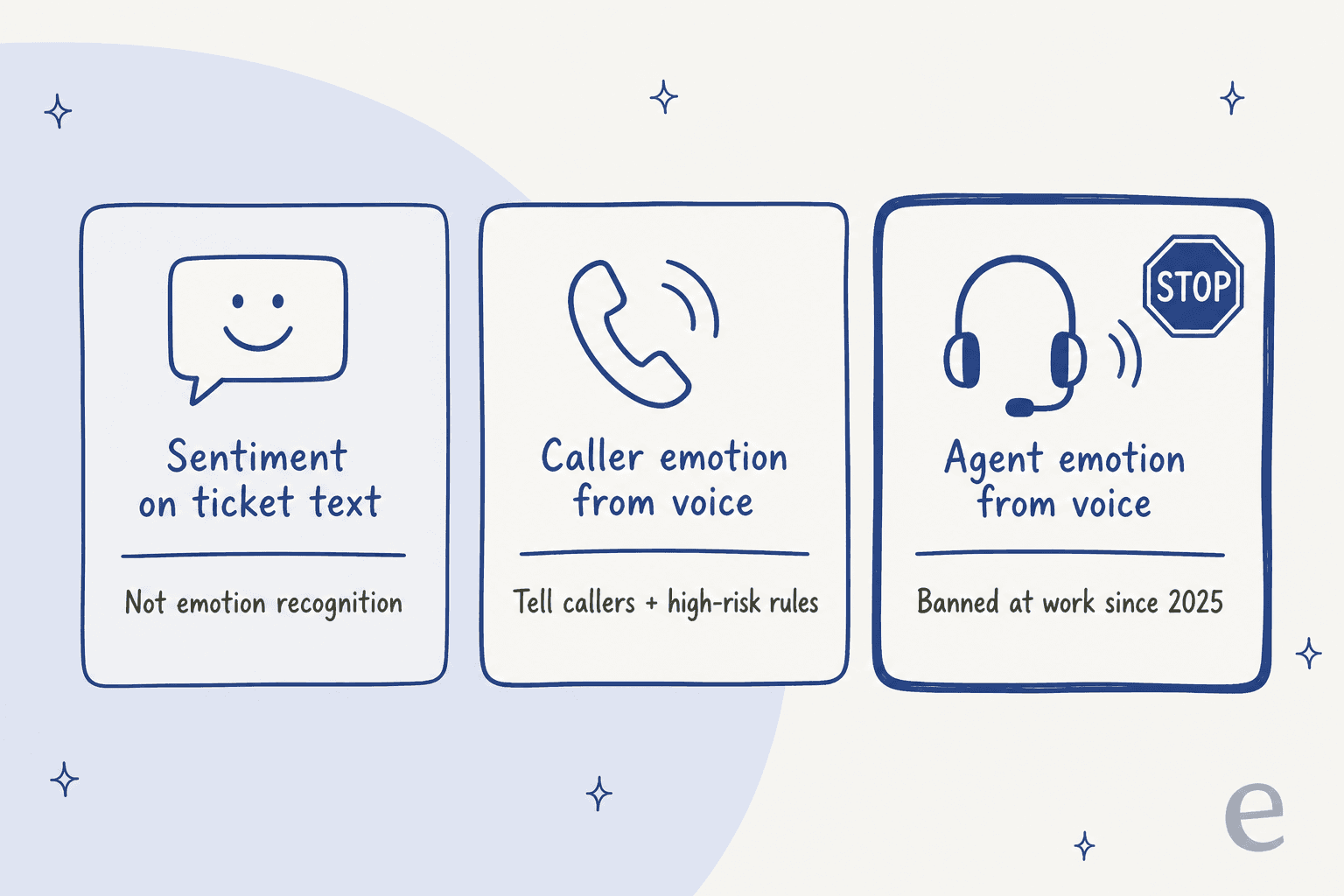
- Scoring your agents' emotions from their voice is banned. Article 5(1)(f) prohibits AI that infers the emotions of people "in the areas of workplace and education institutions", except for medical or safety reasons. A call-center tool that rates agents on how stressed or friendly they sound falls under it, and the ban has applied since
2 February 2025, with the highest fine tier in the Act. - Detecting a caller's emotion from their voice is allowed but loaded. You must tell callers it's running under Article 50(3) since August 2026, and the guidelines confirm every emotion recognition system is also high-risk, so the full high-risk duties apply from
2 December 2027.
If you buy call center software with "emotion AI" or "tone coaching", ask the vendor one question: does it analyse the audio of the voice, or the words of the transcript? The answer decides which bucket you're in.
When does support AI become high-risk?
Rarely, but the edge cases are closer to support than most guides admit. The high-risk list in Annex III is about what the AI decides, not which industry you're in. Three entries brush against support work:
- AI that monitors or evaluates workers. Point 4(b) covers AI "to monitor and evaluate the performance and behaviour of persons" in work relationships, or to allocate tasks based on personal traits. An AI QA tool that scores every agent's conversations and feeds promotion or termination decisions sits close to this line.
- Credit and insurance decisions. Points 5(b) and 5(c) cover creditworthiness and life or health insurance pricing. A support bot that tells a customer whether they qualify for a loan, rather than explaining the form, is doing a high-risk job.
- Public benefits and emergency triage. Points 5(a) and 5(d) cover deciding eligibility for public assistance and triaging emergency calls.
Article 6(3) gives an escape hatch for AI that only performs a "narrow procedural task" or a "preparatory task", and doesn't materially influence the outcome. It closes the hatch for anything that profiles people: an Annex III system that profiles natural persons is always high-risk.
smava is the useful example here. It's a Berlin credit comparison platform, about as regulated as support gets, and its three eesel agents categorise tickets, draft replies word for word from approved macros, and never send on their own. They don't assess anyone's creditworthiness, so the industry alone doesn't make the support AI high-risk.
If you are a deployer of a high-risk system from December 2027, Article 26 asks for named human oversight, keeping the system's logs for at least six months, telling workers' representatives before using it on staff, and telling customers when it helps make decisions about them. That's a heavier lift than a chatbot label, so if your QA or routing tool is anywhere near point 4(b), start that conversation with your vendor now.
Who is responsible: you or your helpdesk vendor?
Both, in different ways. Article 50(1) puts the disclosure duty on the provider, which has to design the system so people are informed. If you switch on a vendor's AI agent, the vendor owes you a system that can disclose. But you're the one who writes the greeting, picks the bot's name and avatar, and decides which channels it runs on, so in practice a bad configuration is yours to fix.
You can also become the provider. The guidelines say a company that builds a chatbot in-house and runs it under its own name is a provider, and so is one that takes another provider's system, modifies it (for example with new training data) and puts it into service under its own name. If you built your own support bot on a model API, the disclosure is fully your job.
Your vendor's contract usually says the same thing. Zendesk's AI Services Addendum says the customer "will ensure any requirements of notice, transparency, and choice are met", and Salesforce's AI Acceptable Use Policy says customers "must disclose to end users when they are interacting directly with automated systems". So it's worth knowing what each helpdesk gives you out of the box. Here's what I found in each vendor's own docs:
| Helpdesk AI agent | Rename the bot | AI label in chat | AI label on email | Own EU AI Act statement |
|---|---|---|---|---|
| Zendesk AI agents | Yes | Yes, on by default ("Zara · AI") | Not built in | Yes |
| Freshdesk Freddy AI Agent | Yes, with avatar | Not documented; use the intro message | Not built in | Not documented |
| Gorgias AI Agent | Yes | Yes, "Automated" under AI messages | Opt-in AI signature | Not documented |
| HubSpot Customer Agent | Yes, with avatar | Yes, "Powered by AI" in the header | Team signature only | Not documented |
| Salesforce Agentforce | Yes | Not documented; use the welcome message | Not documented | Yes |
| Help Scout Scout | Not documented | Yes, "clearly labeled as AI" | Not documented | Not documented |
| Front AI agents | Yes, with avatar | Optional compliance disclaimer on the Resolve widget | Not documented | Not documented |
| Kustomer Concierge | Not documented | Not documented; use the greeting | Not documented | Not documented |
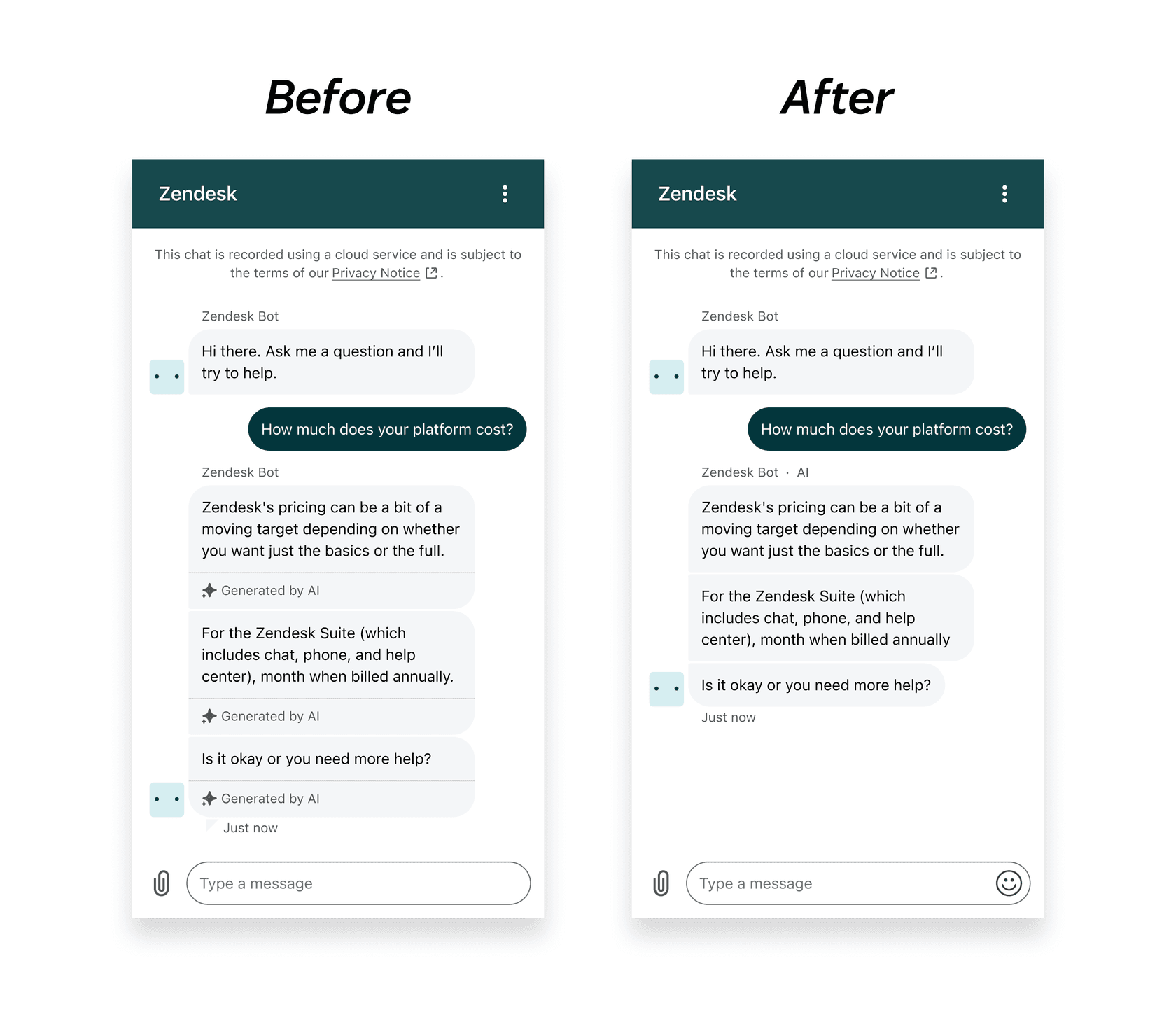
Zendesk has the most complete default. Since March 2026 its Web Widget puts an "AI" tag on the bot's name once per group of messages, and on social channels and mobile apps the label is part of the display name. It can only be switched off per channel through the API, and Zendesk warns that if you do, you're responsible for complying with the AI rules where you operate.
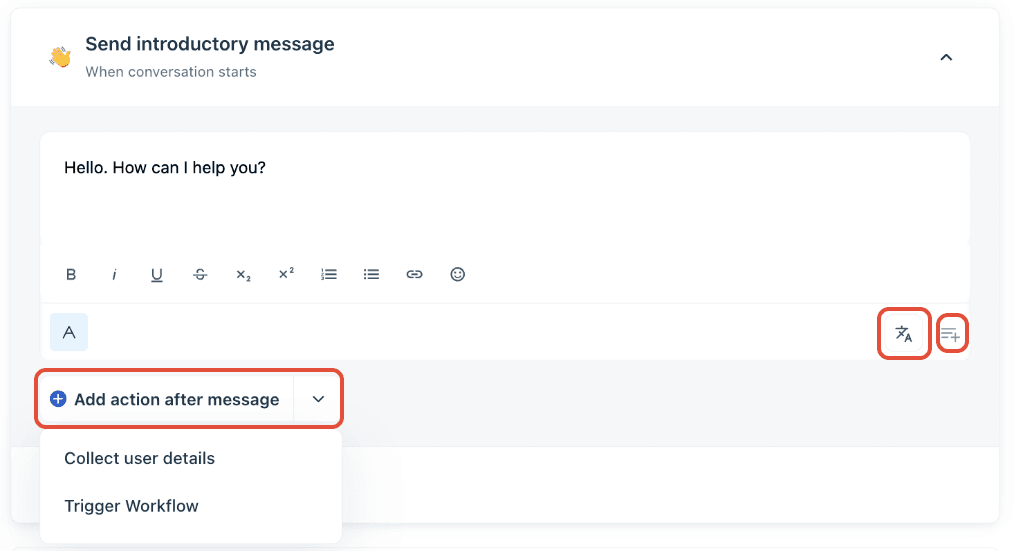
Freshdesk takes the opposite approach on naming: its docs suggest avoiding generic names like "Bot" or "AI" because named agents get more engagement. That's a fair product call, and it means the disclosure has to live in the introductory message, which you can edit and auto-translate. The default text in the docs is "Hello. How can I help you?", so check yours.
The pattern across the table: email is where most helpdesks leave disclosure to you. Gorgias is the only one that documents an AI signature for emails, and it's opt-in. If your AI agent sends email replies on its own, add an AI line to its signature or the top of the message yourself.
Does the AI literacy rule mean I have to train my agents?
Lightly. Article 4 has applied since February 2025, and the Omnibus softened it: deployers must "take measures to support the development of AI literacy" for staff who use AI, taking into account their knowledge and the context, and the text now says this "does not require providers or deployers to guarantee any specific level of AI literacy of any individual". The Commission is also required to publish practical examples for SMEs.
For a support team, a reasonable floor is short: which tools use AI, what they can and can't do, how to check a draft before sending, when to escalate, and what to say when a customer asks whether they're talking to a bot. Write it down once and add it to agent onboarding.
A 30-day EU AI Act checklist for support teams
Here's the order I'd work through it, from most exposed to least:
- List every AI tool that touches a customer. Website chat, AI voice agents, auto-sent email replies, social and WhatsApp bots, and anything your agents use to draft.
- Mark each one direct or mediated. Direct means the AI's output reaches the customer without a person reviewing and sending it.
- Fix the direct ones first. Add a first-turn AI statement in every language you support, a visible label, and an honest answer to "are you a bot?". Check voice greetings and the top of auto-sent emails.
- Search for voice emotion features. Turn off any agent-facing voice emotion scoring. If caller emotion detection stays, add the notice and plan for high-risk duties in 2027.
- Flag anything that scores agents or decides eligibility. QA scoring that feeds HR decisions, credit, insurance or benefits answers: get your vendor's high-risk classification in writing.
- Ask your vendor for its Article 50 position. You want to know how disclosure works per channel and when machine-readable marking lands.
- Write the one-page AI literacy note and share it with the team.
If you already did a security review or a GDPR pass on your AI vendor, bolt this onto it rather than starting a new process. The questions overlap more than they differ, and the AI Act explicitly sits on top of GDPR rather than replacing it.
How eesel fits the EU AI Act
eesel is an AI teammate for your helpdesk. It joins your existing Zendesk, Freshdesk, Gorgias or Help Scout queue, learns from your past tickets, macros and help center, and works the tickets you point it at. The parts that matter for the AI Act:
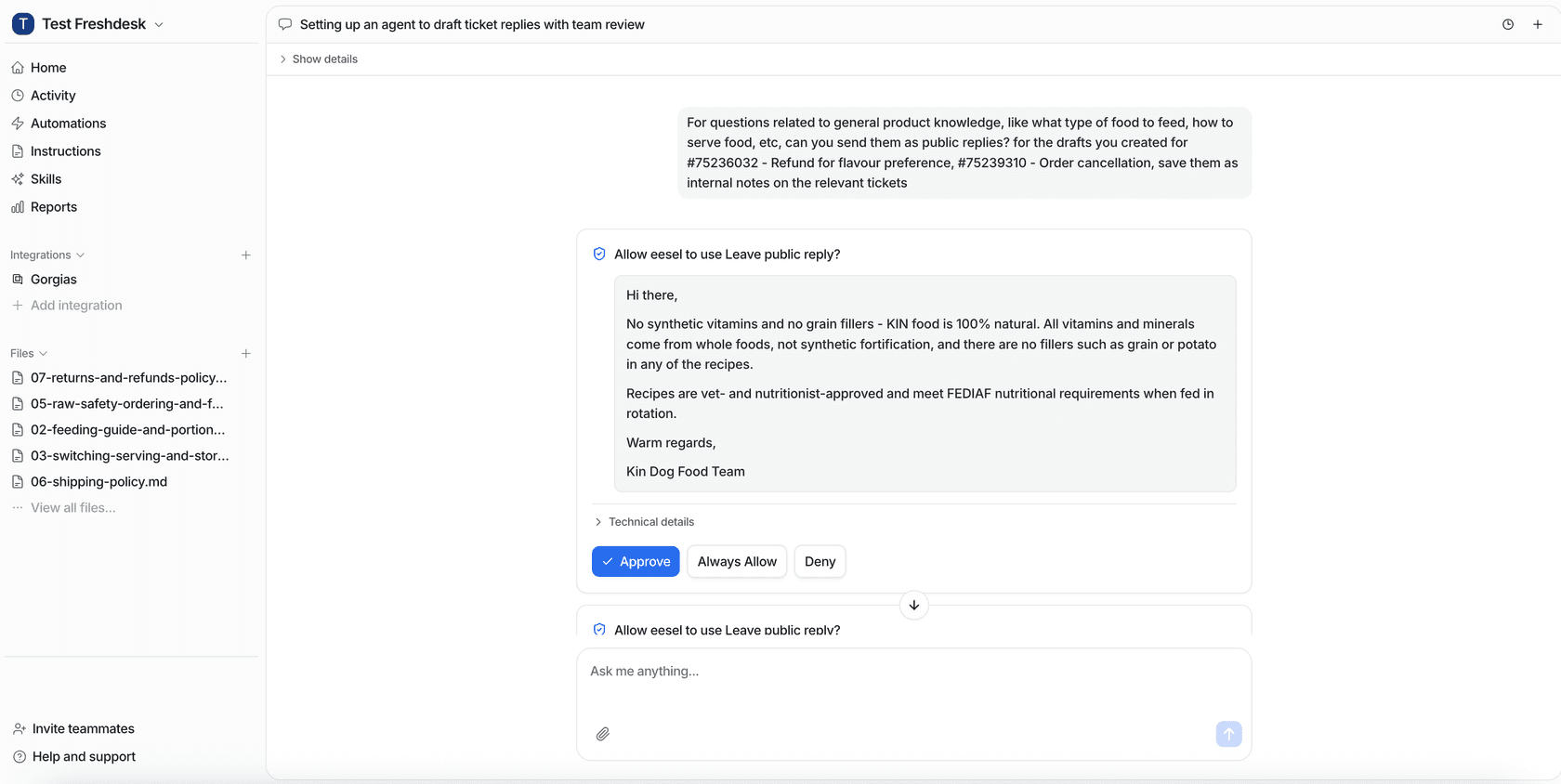
- You choose direct or mediated per action. Every action runs on its own, waits for a person, or stays off, set per agent in Actions and Approvals. Keeping public replies on approval keeps the AI on the mediated side of the line while you build trust in it.
- The chat bubble has an AI disclaimer field. The disclaimer sits under the message box on every conversation, and the agent name defaults to "AI Agent".
- Rules live in plain-language instructions. "Always say you're an AI assistant if asked, in the customer's language" is one line in the agent's instructions, not a ticket to engineering.
It's not a compliance product, and I wouldn't pretend it is: eesel won't classify your AI systems or write your AI literacy policy. It's also honest to say eesel's SOC 2 Type II audit is still in progress (the observation period runs to 31 December 2026), and full EU data residency is an Enterprise plan feature, per eesel's security page. eesel doesn't train models on your data.
Try eesel on your EU support queue
If your team answers customers in German, Danish or Swedish and wants AI that's upfront about being AI, eesel is built for that setup. smava runs it on 27,000 Zendesk tickets a month with every reply waiting for an advisor, and Norden-Frisia runs CaptAIn on its website, a public chat link and Zendesk. Start with drafts on approval, add a named bot with a clear AI greeting when you're ready, and try eesel free for 7 days.