9 best GPT-5.6 alternatives in 2026

Kurnia Kharisma

Katelin Teen
Last edited August 4, 2026

What actually changed since GPT-5.6 launched
This post first ran on July 9, 2026, GPT-5.6's public launch day, when the story was access chaos: a government-vetted preview, an 18-day export-control block on Anthropic's side nine days earlier, and users on r/ChatGPT unable to find the model anywhere. Four weeks on, that whole framing is dead. The model is reachable, the documentation caught up, and the pricing moved.
Here is what moved. Per OpenAI's price-performance announcement: "Starting July 30, API pricing is $2 per million input tokens and $12 per million output tokens for Terra, and $0.20 per million input tokens and $1.20 per million output tokens for Luna. Sol pricing remains unchanged."
| Tier | Was, July 9 | Now, August 5 | Change |
|---|---|---|---|
| Sol | $5.00 / $30.00 | $5.00 / $30.00 | Unchanged |
| Terra | $2.50 / $15.00 | $2.00 / $12.00 | -20% |
| Luna | $1.00 / $6.00 | $0.20 / $1.20 | -80% |
That last row matters more than it looks. Terra at $2.00/$12.00 now undercuts GPT-5.4, and Luna is the cheapest model in OpenAI's flagship table outright. One r/ArtificialInteligence commenter called this in July, before the cut landed: "Although GPT 5.6 Sol seems like a great improvement, imo GPT 5.6 Lunatic seems like the most significant improvement due to the price."
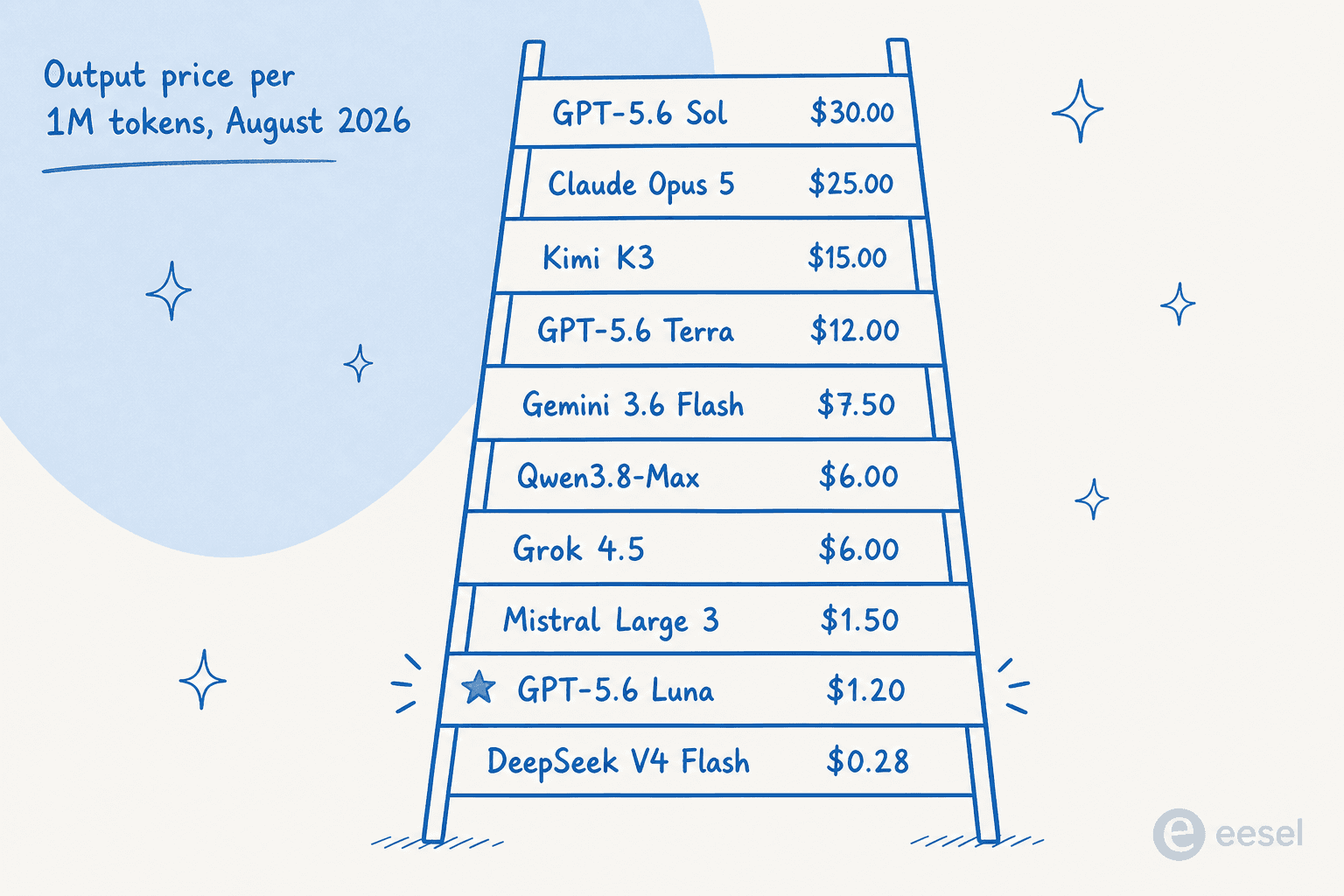
Two other things landed in the same window, and both are better switching arguments than price now is.
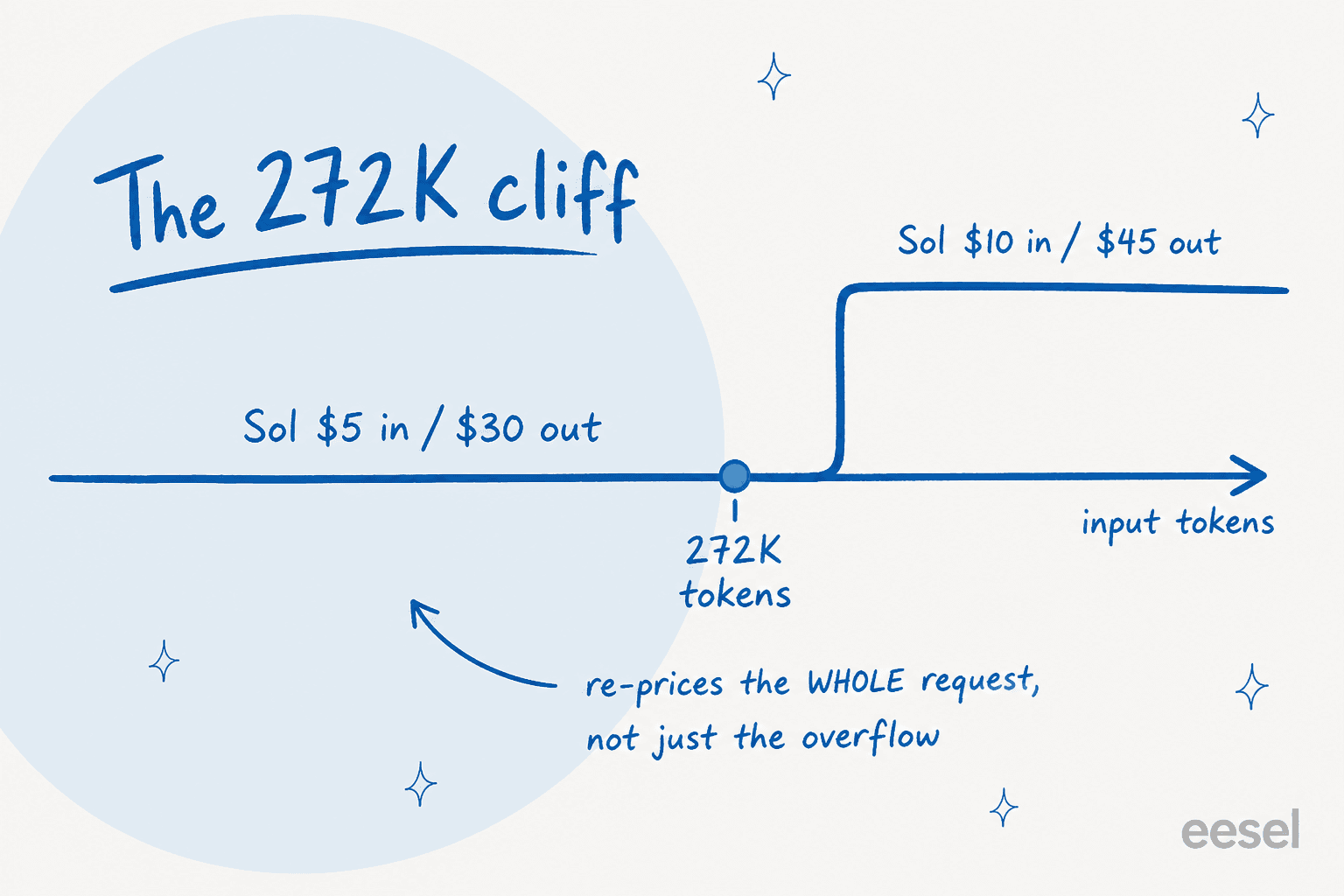
The long-context cliff got published. Every GPT-5.6 model page, including Sol's, now carries the same line: "Prompts with >272K input tokens are priced at 2x input and 1.5x output for the full request." Note for the full request. Crossing 272K does not surcharge the overflow, it re-prices the entire call. On Sol that turns a $5.00/$30.00 request into $10.00/$45.00. The context window is 1,050,000 tokens, so the headline number and the usable-at-list-price number sit almost 4x apart.
Sol is slow. Artificial Analysis clocks Sol at 67.7 output tokens/sec, below the 68.6 median for its price tier, with a 137.84-second time-to-first-token against a 2.76-second tier median. That is a reasoning-model artifact rather than a defect, but if latency is your constraint it is the most concrete reason on this page to shop elsewhere. OpenAI's answer is Fast mode, renamed from Priority Processing on July 30, which buys up to 2.5x the speed on Sol at exactly twice the price.
Which alternative actually fits you?
Nine options is too many to hold in your head. Pick the constraint you are actually hitting and the answer narrows to one:
What is actually forcing you off GPT-5.6?
Pick one constraint. Prices are per 1M tokens, August 2026.
Roughly a quarter of Luna's output rate, with MIT-licensed weights as the escape hatch. Check Luna first though: at $0.20 / $1.20 the July 30 cut may already have solved your bill without a migration.
Scores 61 on the AA Intelligence Index against Sol's 59, at the same input rate and $5 less per 1M output. It is a one-point lead on a composite, so treat it as a tie you break on latency and harness fit rather than a knockout.
2.8T parameters, 104B active, weights live on Hugging Face since July 27, 2026. DeepSeek V4 Flash is the cheaper open option if you can live with a smaller model; Qwen3.8-Max promised weights at GA and has not shipped them.
This is the clearest switching case on the page. GPT-5.6 re-prices the entire request at 2x input and 1.5x output above 272K input tokens. Opus 5 carries a 1M window with no long-context premium at all.
EU hosting and self-deployment are the actual product here, and the price is genuinely low. Mistral's own users are candid that the intelligence gap versus Sol is real, so this is a compliance answer, not a capability one.
Not a model, an answer engine that returns inline citations you can click. If your problem with GPT-5.6 is unverifiable answers rather than raw capability, a smarter base model does not fix it and this does.
The 9 alternatives at a glance
| Model | Best for | Input $/1M | Output $/1M | Context | AA Index | Open weights | Free tier |
|---|---|---|---|---|---|---|---|
| Claude Opus 5 | Raw intelligence | $5.00 | $25.00 | 1M, no premium | 61 | No | No |
| Kimi K3 | Open-weight frontier | $3.00 | $15.00 | 1M | 57 | Yes | Yes, app |
| Grok 4.5 | Cheap agentic tool use | $2.00 | $6.00 | 500K | Top 10 | No | Yes, limited |
| Gemini 3.6 Flash | Google Workspace, long context | $1.50 | $7.50 | ~1M | Not listed | No | Yes, limited |
| DeepSeek V4 Flash | Rock-bottom price | $0.14 | $0.28 | 1M | 50 | Yes, MIT | Yes, unmetered chat |
| Qwen3.8-Max | Human-preference wins | $2.00 | $6.00 | 1M | Not listed | Promised, unshipped | Yes |
| Mistral Large 3 | EU data residency | $0.50 | $1.50 | 256K | Not listed | Partial | Yes |
| Perplexity | Cited, web-grounded answers | Subscription | Subscription | N/A | N/A | No | Yes, limited |
| Microsoft Copilot | Office and 365 workflows | Subscription | Subscription | N/A | N/A | No | Yes, limited |
| GPT-5.6 Sol, for reference | Frontier reasoning, cybersecurity | $5.00 | $30.00 | 1.05M, 2x over 272K | 59 | No | No |
"AA Index" is Artificial Analysis's Intelligence Index v4.1, a composite of nine evaluations. "Not listed" means the model has no scored entry on that board, which is a real gap rather than a low score, and I flag it rather than substituting a number from a different model.
How I picked these
I started from what each model actually ships: published API pricing on the vendor's own docs, independent scores where a scored entry exists, and what people say on Reddit and Hacker News once the launch-week noise clears. Two of these entries, Perplexity and Microsoft Copilot, are products built on top of frontier models rather than models themselves. They are in because that is what someone typing "GPT-5.6 alternative" is genuinely weighing, and leaving them out would be tidy curation rather than a useful answer.
Two names from the July version are gone. Claude Fable 5 is folded into the Opus 5 entry, since Anthropic's own newer flagship now sits above it. Meta AI is dropped: it is free and everywhere, but on model quality it was never a serious answer to this question, and our Meta AI chatbot guide is the better home for that discussion.
1. Claude Opus 5 - best for raw intelligence
Claude Opus 5 landed on July 24, 2026 and it is the reason this roundup's ordering changed. It holds the top slot on Artificial Analysis's Intelligence Index at 61, with Claude Fable 5 at 60 and GPT-5.6 Sol at 59.
Pricing: $5.00 per 1M input, $25.00 per 1M output, unchanged from Opus 4.8. A 1M-token context window with no long-context premium, which is the sharpest contrast with GPT-5.6 on this page. Batch is 50% off, cache reads are 0.1x, and Fast mode doubles the rate to $10/$50.
Where it wins over GPT-5.6: the same input price as Sol, $5 less per 1M output tokens, a higher composite score, and no 272K cliff. If your workload is long-document reasoning, that last point alone is the whole argument.
Where it falls short: it is a one-point lead, and Artificial Analysis itself describes the gap as narrow. Two counter-numbers rarely make the coverage: Opus 5's AA-Omniscience hallucination rate rose 14 points to 50%, and its time-to-first-token is 68.04 seconds against a 2.81-second class median. Community consensus is that it spends roughly 2x the output tokens of Opus 4.8 at matched effort, so the cheaper sticker price does not always survive contact with a real bill.
Our take: the pick when intelligence and long-context economics both matter, with eyes open about hallucination rate. Full detail in our Claude Opus 5 review and the head-to-head on Opus 5 versus Fable 5.
2. Kimi K3 - best open-weight frontier model
Kimi K3 is Moonshot AI's flagship, launched July 16, 2026, and it is the strongest model here that you can actually download. It is a 2.8T-parameter mixture-of-experts model with 104B active parameters, a 1M-token context window, and native vision.
Pricing: $3.00 per 1M input, $0.30 cache-hit, $15.00 per 1M output. That is Claude Sonnet territory, not the bargain-bin play the K2 era trained people to expect.
Where it wins over GPT-5.6: the weights shipped, on time. moonshotai/Kimi-K3 went live on Hugging Face on July 27, 2026, and the safetensors index totals 2,779,931,837,184 parameters, so the 2.8T figure is verifiable from outside the press release rather than taken on trust. It scores 57 on the AA Index, fourth overall, and beats GPT-5.5 and Opus 4.8 on most published benchmarks.
Where it falls short: it trails Sol on the composite, and reasoning_effort cannot be turned off at any level, so there is no cheap mode. K3 at low effort scores 47 on the index at $0.24 per task, which is both worse and roughly 8x pricier than DeepSeek V4 Flash. Vision has a real constraint too: public image URLs are not accepted, only base64 or file IDs.
Our take: the right call if downloadable weights are a requirement and you want the ceiling rather than the floor. More in our Kimi K3 review and Kimi K3 pricing.
3. Grok 4.5 - best for cheap agentic tool use
Grok 4.5 is xAI's current flagship and it holds one of the best agentic tool-use scores of anything tested. Cursor's CEO called it an "Opus-class model that's fast and low cost."
Pricing: $2.00 per 1M input, $6.00 per 1M output. Less than half Sol's rate on input and a fifth on output, and it still undercuts Terra after the July cut.
Where it wins over GPT-5.6: speed and price together. It sits sixth on the AA Intelligence Index, above Claude Sonnet 5 and GPT-5.6 Luna, at a fraction of Sol's cost, and its output speed is well above the tier median where Sol's is below it.
Where it falls short: the leaderboard moved under it. It now ranks behind Opus 5, Fable 5, Sol, Kimi K3, and Terra on the composite, so it is no longer a raw-reasoning pick. It also carries an unresolved trust question of its own over allegations that xAI tunes Grok's answers on political topics, which was the loudest theme in its launch discussion.
Our take: still the best price-to-agentic-performance ratio among closed models. Full breakdown in the Grok 4.5 review and its pricing guide.
4. Gemini 3.6 Flash - best Google-ecosystem workhorse
Gemini 3.6 Flash shipped July 21, 2026 as Google's new workhorse tier, replacing 3.5 Flash. Worth knowing what did not ship alongside it: 3.5 Pro is still delayed, so Flash is currently carrying Google's answer to this comparison.
Pricing: $1.50 per 1M input, $7.50 per 1M output, down from 3.5 Flash's $9.00 output. Batch halves that to $0.75/$3.75. Roughly 1M context with a 65K output cap, and a knowledge cutoff of March 2026, which is more recent than GPT-5.6's February 16, 2026.
Where it wins over GPT-5.6: token efficiency and the Workspace wiring. Google's own figures put it at about 17% fewer output tokens than 3.5 Flash on the AA Index, and up to 65% fewer on DeepSWE, where the run dropped from 276K tokens to 97K. It scores 83.0% on OSWorld with computer use built in, and it is grounded in Search, Gmail, Docs, and Sheets in a way no standalone chat model matches.
Where it falls short: Google's own comparison table shows GPT-5.6 Luna and Claude Sonnet 5 beating it on several coding and knowledge rows, and it has no scored entry on the AA Intelligence Index to check that against independently. The 65K output cap is also half what GPT-5.6 and Kimi K3 allow.
Our take: the safest default if the org already runs on Workspace, and a real long-context alternative given GPT-5.6's 272K surcharge. See our Gemini 3.6 Flash pricing and the Gemini alternatives roundup.
5. DeepSeek V4 Flash - best rock-bottom price
DeepSeek V4 Flash is the cheapest serious model here by a wide margin, and the interesting part is that it currently outscores its own expensive sibling.
Pricing: $0.14 per 1M input, $0.28 per 1M output. Artificial Analysis puts it at Intelligence Index 50 for roughly $0.03 to run the entire index. Weights are MIT-licensed, and the consumer chat is free with no metered cap.
Where it wins over GPT-5.6: cost, obviously, but the sharper point is timing. Flash was re-post-trained on July 31, 2026, while deepseek-v4-pro on the price card is still the April preview build. Flash 0731 beats Pro-Preview on all nine agentic rows DeepSeek publishes, with DeepSWE at 54.4 against 12.8 as the widest. Two of those nine are DeepSeek's own internal sets and the harness is unreleased, so weigh them accordingly.
Where it falls short: Pro still wins where recall matters, SimpleQA-Verified 57.9 against Flash's 34.1 and BrowseComp 83.4 against 73.2, which is what 49B active parameters buys over 13B. LMArena's human voters also still rank Pro above Flash. And the July 30 GPT-5.6 cut narrowed this a lot: Luna at $0.20/$1.20 is now within striking distance, which was not true in July.
Our take: the pick for high-volume, cost-sensitive work where you can tolerate weaker recall. More in the DeepSeek V4 Flash review, its pricing guide, and the Flash versus Pro breakdown.
6. Qwen3.8-Max - best on human-preference boards
Qwen3.8-Max went GA on August 2, 2026, and it is the entry that makes a single-number verdict impossible. It is a 2.4T-parameter MoE with 95B active, a 1M-token context window, and a 131,072 max output that actually exceeds GPT-5.6's 128,000.
Pricing: $2.00 per 1M input, $6.00 per 1M output, with implicit cache reads at $0.25.
Where it wins over GPT-5.6: human preference, clearly. On LMArena, qwen3.8-max sits #5 on Text at 1496, while gpt-5.6-sol-xhigh is #15. On WebDev, Qwen is #4 at 1668 against Sol's #6 at 1620. It also beats Sol on max output tokens and takes the #2 slot on Vision.
Where it falls short: it has no entry on the Artificial Analysis board at all, so there is no automated composite to check the Arena result against. Anyone quoting an "independent intelligence score" for it is quoting Qwen3.7-Max, a different model. The open weights promised at GA are still unpublished. Fairness note in the other direction: Qwen's own coding harness declares maxTokens: 65536, so its shipped tooling never asks for that 131K ceiling.
Our take: the automated composite and human preference genuinely point opposite ways here, and the honest advice is to test it on your own task rather than trust either board. Detail in our Qwen3.8-Max review and its pricing guide.
7. Mistral Vibe - best for EU data residency
Mistral AI is the European frontier lab, and its assistant, previously Le Chat, is now branded Vibe. The value proposition is data sovereignty, which is a different axis from everything else here.
Pricing: Mistral Large 3 at roughly $0.50 per 1M input and $1.50 per 1M output, with Codestral around $0.30/$0.90. Vibe starts free, Pro is $14.99/month, Team is $24.99/user/month, and students pay $5.99.
Where it wins over GPT-5.6: EU hosting and self-deployment for organizations that legally cannot send data to a US server, which no amount of model quality substitutes for. The price is also aggressive, undercutting Luna on output. Speed draws consistent praise: one Reddit user said Vibe "is faster, produces more relevant content, produces better images."
Where it falls short: Mistral's own users are candid about the capability gap. Reddit calls the large models "way, way behind Claude and ChatGPT for advanced stuff." The 256K context window is also the smallest here, a quarter of what GPT-5.6 and Opus 5 offer.
Our take: the right call when EU residency is a legal requirement rather than a preference. See our Mistral pricing guide and the Mistral alternatives roundup.
8. Perplexity - best if you actually want a search engine
Perplexity is not a model, it is an answer engine that searches the live web and returns inline, clickable citations, orchestrating several frontier models behind one interface. If what frustrates you about GPT-5.6 is unverifiable answers rather than capability, a smarter base model does not solve that and this does.
Pricing: free tier with limited Pro searches; Pro at $20/month or $17 annually; Max at $200/month; Enterprise from $40/seat/month.
Where it wins over GPT-5.6: sources on every claim. One user framed the gap this way: "Gemini ignores instructions, drifts off into weird tangents, and hallucinates with way more confidence." That critique lands on any raw chat model, GPT-5.6 included.
Where it falls short: the loudest current complaint is tightened Pro limits, opaque model routing, and a fallback to a weaker model after a handful of advanced queries per day.
Our take: pick this when the job is research with receipts, not open-ended reasoning or coding. More in our Perplexity pricing guide and Perplexity review.
9. Microsoft Copilot - best if you live in Microsoft 365
Microsoft Copilot is less a GPT-5.6 competitor than a workflow decision. It is the assistant embedded in Word, Excel, PowerPoint, Teams, and Outlook, inheriting enterprise security policy automatically, rather than a chatbot you go and visit.
Pricing: free consumer tier; Microsoft 365 Personal at $99.99/year; Business Copilot at $18-21/user/month; Enterprise at $30/user/month.
Where it wins over GPT-5.6: context it does not have to be given. Copilot reads your actual emails, documents, and meeting transcripts because it sits where the work already happens. A product manager summed up the split: "I use ChatGPT for creative or research-heavy tasks because it just thinks better, but prefer Copilot for drafting presentations or summarizing Teams calls because it already has the context."
Where it falls short: it struggles with larger spreadsheet datasets and degrades over long sessions. Outside the Microsoft ecosystem it is not competitive on open-ended reasoning, and there is no published per-token rate to compare against anything else on this table.
Our take: worth it when the M365 spend already exists, a weak standalone pick otherwise. More in our Copilot pricing guide and the Mistral versus Copilot comparison.
Does the underlying model even matter for support?
Here is the pattern that repeats across all nine, and across GPT-5.6 itself: every lab ships a capable model, and not one of them ships a hard stop on a confidently wrong answer. Opus 5's own hallucination rate on AA-Omniscience went up 14 points while its intelligence score went up one. Two of DeepSeek's nine headline agentic rows run on an unreleased internal harness. Qwen3.8-Max is #5 on one board and absent from another.
I have spent the last three-plus years putting AI agents on live support queues at eesel, and the failure mode never changes with the model underneath. A B2B vehicle-telematics team on Zendesk, running around 200 tickets a month, came to us after their bot cheerfully told customers "yes, we support your car model" for brands that were not in their database at all. Nothing was broken. The knowledge base said "we support all models," the model read that sentence, and it answered with total confidence. Their own summary of the setup was "trial and error in the beginning," which is a polite way to describe learning this from your customers.
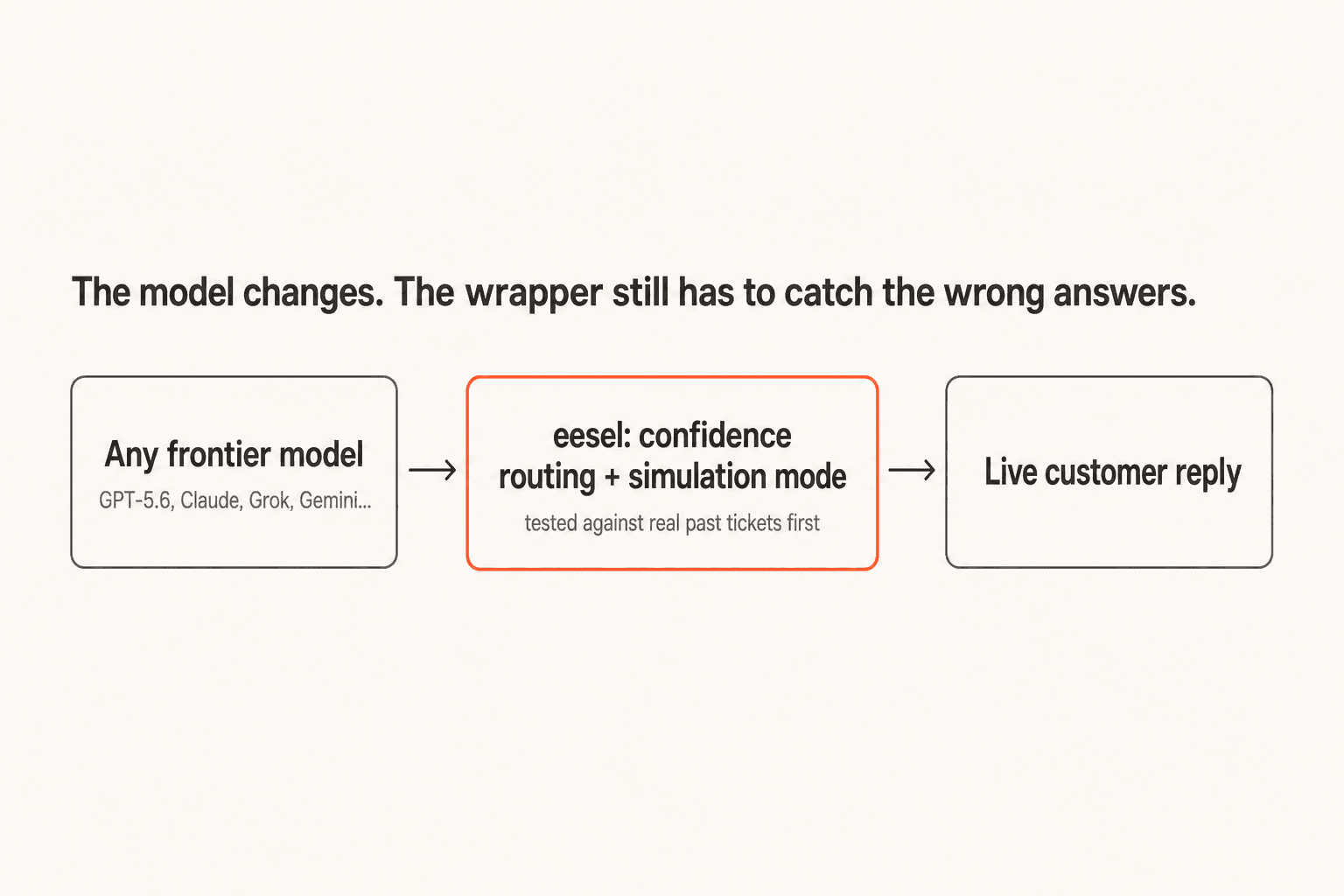
That is not a GPT-5.6 problem, or a Claude problem, or a Qwen problem. It is what every capable model does the moment nothing stops it from guessing. It is why eesel runs simulation mode against your own historical tickets before anything goes live on a real customer, and why we treat a confidence threshold as a product requirement rather than a setting. A leaderboard reshuffle changes which model you call. It does not change whether the thing on top of it knows when to stop.
Try eesel
If you are picking a model to answer customer tickets, the model is the easy 20%. eesel sits on top of the helpdesk you already run, whether that is Zendesk or Front.
It learns your real ticket history on day one, then dry-runs against thousands of your own past tickets before it answers a live customer, so you find out what it gets wrong before your customers do. Gridwise saw 73% of tier-1 requests resolved in the first month.
Pricing is one fixed monthly price from $299/month for 500 credits (1 credit per ticket or chat) with no seat fees, so when OpenAI cuts a price by 80% overnight, you are not the one holding a twelve-month seat contract written against last month's rate card. Full numbers on the pricing page. Try eesel free, with 100 credits and no credit card.