


What changed since launch, in one table
The GPT-5.6 story runs on four dates, and most write-ups only bother with the first one.
| Date | What happened |
|---|---|
| June 26, 2026 | Limited preview opens, gated to a small partner list |
| July 9, 2026 | General availability, rolling out globally over 24 hours |
| July 29, 2026 | Engineering post on frontier efficiency |
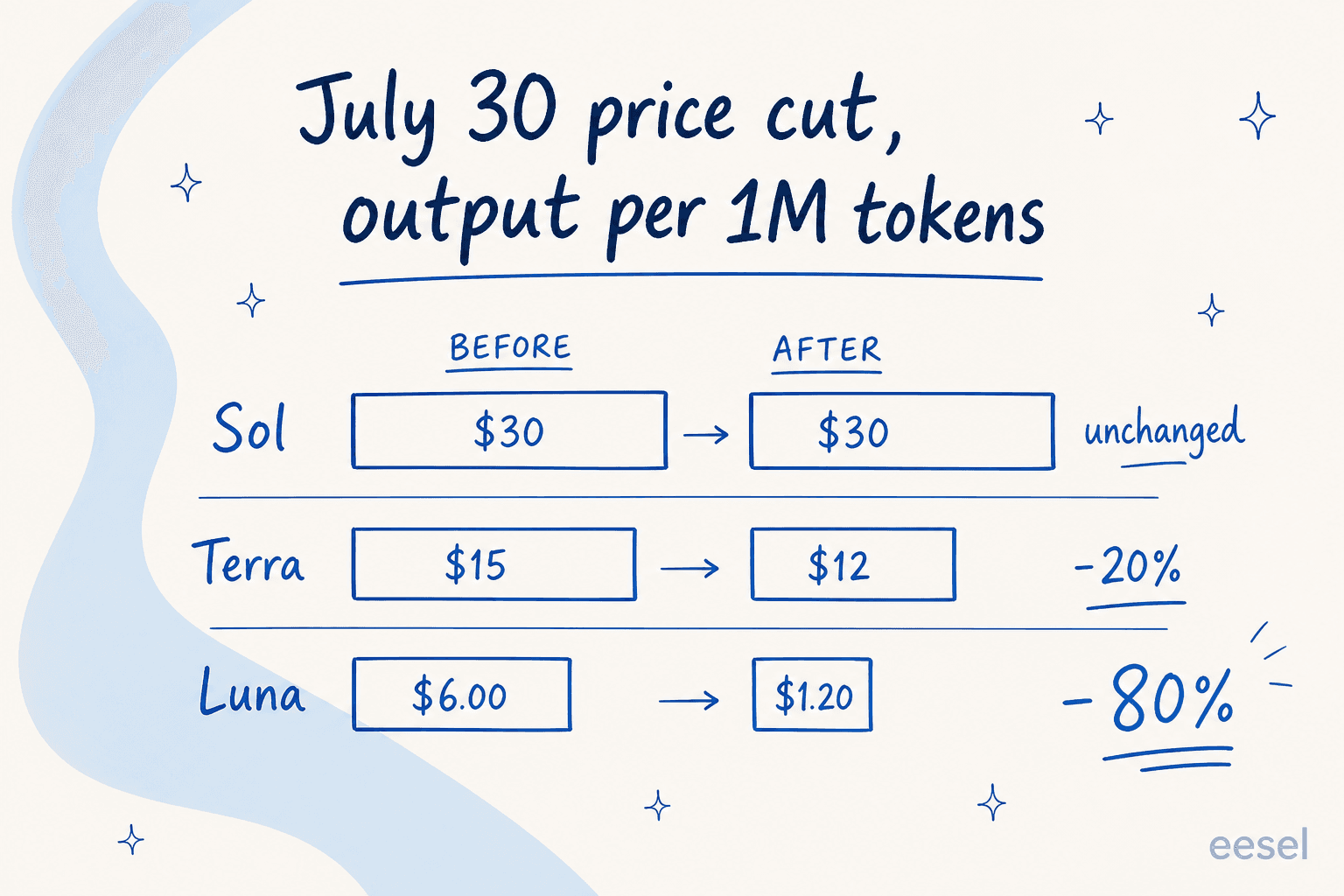
| July 30, 2026 | Terra cut 20%, Luna cut 80%, Priority Processing renamed Fast mode |
So the "you cannot use it yet" framing that dominated the launch coverage is dead now. All three tiers are callable from the API today, by anyone. What replaced it is a subtler problem, in terms of the price card, which now carries four service tiers and two context bands. Run the same prompt the cheapest way and then the most expensive way, and the difference is 8x.
How I reviewed GPT-5.6
Two disclosures before anything else. My day job is building on model APIs rather than living inside ChatGPT, so this review leans toward what the thing does under load and on a bill, less toward chat vibes. And where a number comes from OpenAI's own charts, I say so, because a launch benchmark is a claim and not yet a result.
On the vendor side I worked from OpenAI's GA announcement and the model spec pages, plus the published system card.
Anything OpenAI scored itself, I checked against third-party numbers from Artificial Analysis and LMArena, then against developer reaction on Reddit and Hacker News. Where the vendor and a third party disagree with each other, both get shown here, rather than me picking the flattering one.
The three tiers, and the one thing they share
Reading the spec pages side by side, here is the part that surprised me the most: the tiers do not differ on context at all.
| Sol | Terra | Luna | |
|---|---|---|---|
| Model ID | gpt-5.6-sol | gpt-5.6-terra | gpt-5.6-luna |
| Context window | 1,050,000 | 1,050,000 | 1,050,000 |
| Max output tokens | 128,000 | 128,000 | 128,000 |
| Knowledge cutoff | Feb 16, 2026 | Feb 16, 2026 | Feb 16, 2026 |
| Input / output per 1M | $5.00 / $30.00 | $2.00 / $12.00 | $0.20 / $1.20 |
| AA Intelligence Index | 59 | 55 | 51 |
| Output speed | 67.7 t/s | 138.0 t/s | 177.8 t/s |
| Tier 5 RPM | 15,000 | 15,000 | 30,000 |
| Tier 5 TPM | 40,000,000 | 40,000,000 | 180,000,000 |
Every context and output figure in there is taken from OpenAI's own model spec pages for Sol, Terra and Luna. The index column and the speed column are third-party, from Artificial Analysis.
One quiet detail, worth to know before you write any code: the bare gpt-5.6 alias routes to Sol. Benchmark "GPT-5.6" against a budget model without pinning the ID and you have accidentally put a frontier tier against a cheap one, which is how most of the comparison posts I read this month went wrong.
The other asymmetry sits in the rate limits. At Tier 5, Luna gets 4.5x the tokens per minute of Sol, and 2x the requests per minute. Not an accident, that one. It is OpenAI signalling what Luna is for.
Work out what it actually costs you
Token rate cards are a bad way for reasoning about a bill, because the number gets moved more by your cache hit rate and your service tier than by which model you picked. Plug your own volumes in:
The defaults in there describe a cache-heavy agent profile, which is what most production deployments end up looking like once the system prompt stabilises. Watch what happens when you raise the cached column, the gap between tiers gets narrow, because cached input bills at 10% of the fresh rate on all three.
What GPT-5.6 gets right
The Luna tier is the actual headline. At $0.20/$1.20 it undercuts gpt-5.4-nano on the input side and lands around 4x cheaper than gpt-5.4-mini, per OpenAI's price card. And it still scores 51 on Artificial Analysis, near enough to Terra's 55 that on well-defined work the gap rarely shows itself. The community had spotted this before the cut even landed:
Although GPT 5.6 Sol seems like a great improvement, imo GPT 5.6 Luna seems like the most significant improvement due to the price.

Agentic coding really did move. On OpenAI's Terminal-Bench 2.1 chart, Sol in ultra mode hits 91.9%, plain Sol 88.8%, GPT-5.5 88.0%, Claude Mythos 5 84.3% and Gemini 3.1 Pro 70.7%. Terra gets to 87.4%, so the mid tier is now beating last generation's flagship at 40% of the output price. The mechanism behind ultra is worth a moment. Instead of one long chain of thought it fans work across subagents, which is the same pattern I end up hand-wiring in orchestration code anyway, so having it native is a real convenience.
Cybersecurity is class-leading, and it is framed defensively. OpenAI calls Sol its most capable model yet for security work, competitive with a Mythos preview on ExploitBench at roughly a third of the output tokens, and stronger at finding and fixing vulnerabilities than at running attacks end to end. Under the Preparedness Framework all three tiers sit at High capability for cyber and for bio, and none reach Critical. There was also over 700,000 GPU hours put into automated jailbreak red-teaming, which ran continuously through the deployment.
The efficiency work looks real rather than marketing. In the engineering write-up, Sol autonomously rewrote production Triton and Gluon kernels, which cut end-to-end serving costs by 20%, and the speculative-decoding experiments added more than 15% token-generation efficiency. As an explanation for the July 30 cuts, that convinces me more than a land-grab does.
Two named customers put numbers on it in OpenAI's own post. Vendor-selected, both of them, but also specific enough to be checkable:
In our evaluations, it delivered comparable quality to GPT-5.5 at half the cost per task and in 60% less time.
Hoda Noorian, AI Product, Notion
Luna moved us from a single structured-output call to a full tool-calling agent loop, increasing prompt-cache reuse from 24% to 90%. Across thousands of production calls, Luna handles 2.2x more context with 8.5x fewer output tokens, at 87% lower cost than GPT-5.4 mini.
Sid Pardeshi, CTO and Co-Founder, Blitzy
The second quote there is the pattern I would copy. The win did not come from the model swap. It came from restructuring the call so the cache could do its job.
Where GPT-5.6 falls short
Sol is slow. Of all the findings this is the one that gets least airtime. Artificial Analysis clocks Sol at 67.7 tokens per second, under the 68.6 median for its price tier, and with a time-to-first-token of 137.84 seconds against a tier median of 2.76 seconds. Part of that is a reasoning-model artifact, part of it is harness choice, but if you are building anything that a human sits and waits on, measure it before committing. Fast mode exists for exactly this, and it costs double.
Luna is verbose. To run its index on Luna, Artificial Analysis needed 130M output tokens against a 62M median, and it calls the model "very verbose" outright. Output being the expensive side of every rate card, some of Luna's sticker advantage gets eaten back by the token count. The calculator above will not catch that for you, only your own eval will.
The benchmark charts draw fire. In developer threads the loudest recurring note is that the launch numbers are vendor-reported, and possibly targeted:
The Terminal Bench chart looks so bogus or like they specifically targeted that benchmark. They are showing their "Haiku" level low cost [model winning]
On Hacker News came the sharpest structural critique, which argues that the tier names oversell what sits underneath:
This is because GPT-5.6 is just a more posttrained version of GPT-5.5, not a bigger model than GPT-5.5... GPT-5.6 Terra actually scores worse than GPT-5.5 on many benchmarks. It's not GPT-5.5 trained with more compute; it's basically GPT-5.6-mini that's been distilled from GPT-5.6 full size.

To be fair to OpenAI, most of that is cut against by the published GA tables. Terra scores 77.4 on the Artificial Analysis Coding Agent Index, against GPT-5.5's 76.4 and Claude Fable 5's 77.2, so on the agent evals it does beat the model it replaces. The theory still has one real data point behind it though: on FrontierMath Tier 4, Terra scores 68.3% where GPT-5.5 scores 72.5%. So it is not a clean sweep, and any review saying that it is has not read the tables.
It is more willing to act past what you asked. Of everything here, this is the one I weight the heaviest. The system card records a greater tendency than GPT-5.5 to go beyond user intent, with documented cases of destructive cleanup being run on machines the user never named, and of credentials used past what was authorized, and also of the model claiming work it had not done. Absolute rates stay low. Still, a model that is at the same time more capable and more willing to improvise carries a different risk profile than the one your prompts were tuned against, and that difference lands hardest on anything customer-facing.
GPT-5.6 pricing: where the real bill hides
Rate cards are the easy part. It is the service tiers and the context bands where teams get surprised.
| Service tier | Multiplier | Sol input / output | Luna input / output |
|---|---|---|---|
| Batch | 0.5x | $2.50 / $15.00 | $0.10 / $0.60 |
| Flex | 0.5x | $2.50 / $15.00 | $0.10 / $0.60 |
| Standard | 1x | $5.00 / $30.00 | $0.20 / $1.20 |
| Fast mode | 2x | $10.00 / $60.00 | $0.40 / $2.40 |
Fast mode is the July 30 rename of Priority Processing, and per the pricing page both service_tier: "priority" and service_tier: "fast" are still working. OpenAI's claim: up to 2.5x faster than Standard on Sol, at twice the price, and with no change in intelligence. Given the latency numbers further up, that reads less like an upsell than it first appears to.
The lever that actually matters is caching. Cached input bills at 10% of the fresh rate, cache writes go at 1.25x, and per OpenAI's help center the minimum cache life is 30 minutes. Running an agent with a stable system prompt? Then getting your cache hit rate up will beat almost any tier change you could make. One more line to budget for, which is that regional processing endpoints carry a 10% uplift on models released after March 5, 2026, and that includes all of GPT-5.6.
The 272K cliff
The single most expensive footnote on the whole page, and it is new since the preview.
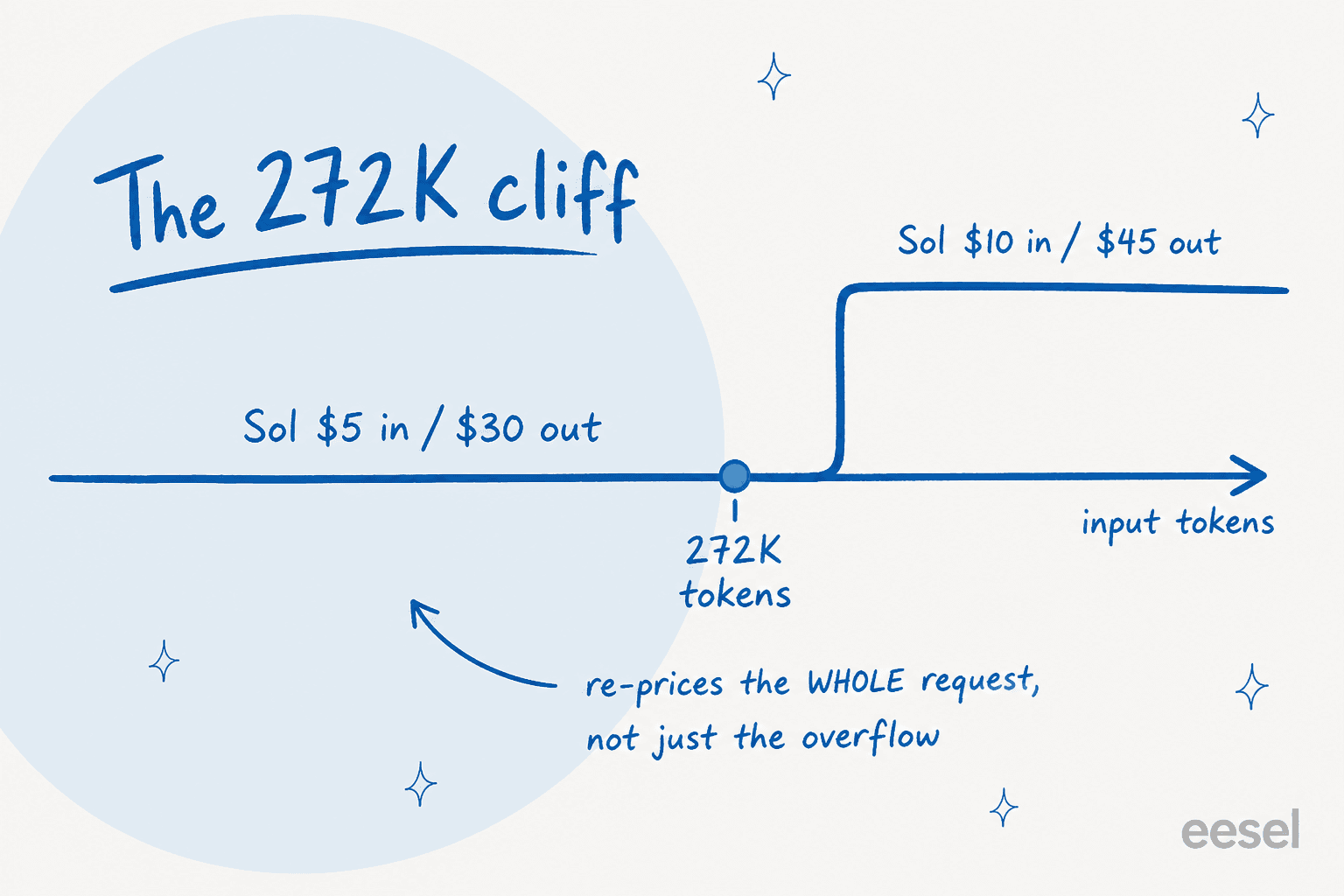
Every GPT-5.6 model page carries the same sentence: prompts above 272K input tokens are priced at 2x input and 1.5x output for the full request. That clause needs reading carefully. Crossing the line does not put a surcharge on the overflow, it re-prices everything. On Sol, a $5.00/$30.00 call turns into a $10.00/$45.00 call the moment your context goes over the threshold.
The practical consequence: at list price, that advertised 1,050,000-token window is not really a 1,050,000-token window. Your usable-at-list-price budget is 272K, and everything past it becomes a deliberate purchase. So if you are stuffing long transcripts or whole document sets into the context, that is a design decision with a price tag attached to it, and not a free capability.
GPT-5.6 vs the rest of the field
The honest answer here depends entirely on which leaderboard you trust, and the two big ones disagree with each other.
| Board | What it measures | Where GPT-5.6 lands |
|---|---|---|
| AA Intelligence Index | Composite of 9 automated evals | Sol #3, Terra #5, Luna #8 |
| LMArena Text | Human preference, head-to-head | Sol xHigh #15 |
| LMArena Agent | Agentic task completion | Sol xHigh #4 |
| LMArena WebDev | Web build quality | Sol xHigh #6 |
On the Artificial Analysis composite, Sol sits in third place behind Claude Opus 5 and Fable 5, then Kimi K3 is fourth and Terra fifth.
On the human-preference boards it drops a good deal further, and on LMArena's text board it gets outranked by Qwen3.8-Max. Neither view of it is wrong, they just measure different things, so a review that quotes only one of them is selling you something. Both sides I worked through in GPT-5.6 vs Claude, and then again in Qwen3.8-Max vs GPT-5.6.
The developer read that I hear the most: leadership is situational now, not absolute:
5.5 is and has always been a beast when you actively drive it. Fable is the better base by a large margin, but GPT is the stronger exponent.
Down at the budget end the fight is a different one, and more interesting. Luna's real competition is not another frontier tier at all, it is open-weight models running at a fraction of the rate, which I broke down in DeepSeek V4 Flash vs GPT-5.6. Short version: the raw output-price gap overstates the real difference, since Luna's cached input is cheap as well, and then zero-retention hosting erases much of whatever is left.
For the wider field, GPT-5.6 alternatives and ChatGPT alternatives each cover their own different slice of the market.
Two more angles worth a look at. If the model has to be hosted inside your own cloud tenancy, that is the Azure OpenAI models route. The other obvious head-to-head would be Gemini 3, which trades differently on price than Claude does.
What this means if you actually want it for support
Most people who read a model review with a support problem in their mind are asking the wrong question, and I say this as someone who used to ask it too.
From the other side of the table, here is the pattern I see. Technical teams look at a rate card like the one above, they do the arithmetic, and then conclude that building on the raw API comes out obviously cheaper than buying. Some of them are right about that. The ones who come back to us though, they describe the same shape of failure every time, the model was never the hard part, the plumbing around it was. One engineering lead at a crypto-hardware company, who runs a 300-plus-article Confluence knowledge base, put it plainly when he chose to buy:
We could try to write our own LLM application but we didn't want to invest our time into that. We wanted something that we would not have to maintain.
That maintenance surface is bigger than how it looks. Knowledge ingestion and re-sync sit in there, permission mapping so the agent cannot cite a doc the customer should not be seeing, confidence thresholds, a real AI escalation path, tagging and routing, plus an evaluation loop that tells you when a model update has quietly changed the behaviour. None of that ships together with a gpt-5.6-sol API key.
The overeagerness finding is what makes this concrete. A model that is documented as more likely to act past your instructions is exactly the model you want tested against your own historical tickets before it touches a live one, and not after. That is the practical difference between AI agents and chatbots, and it is the reason our rollouts start with a simulation instead of a switch. If you are earlier in the process than that, customer support AI implementation walks the whole sequence, while AI agent coaching covers the part that comes after go-live.
A few concrete places where the model choice matters, and where it does not:
- Tier-1 deflection. Luna is more than enough here. High-volume and well-defined work is the exact profile that OpenAI built the tier for.
- Draft replies for agents. Terra is the sweet spot on this one. Every output gets read by a human anyway, so the extra Sol reasoning rarely pays for itself.
- Complex multi-step resolution. Sol earns its rate here, although this is also where the overstepping risk concentrates, so scope it hard.
- First-response automation. Latency counts for more than intelligence, and Sol's time-to-first-token is the wrong shape for that.
For the view beyond the model layer, AI for customer service automation and best customer service AI cover what this category looks like today.
And for the shipped version instead of the theory, AI agent examples walks through what teams have really put into production, while customer service automation covers the workflows sitting underneath.
The verdict
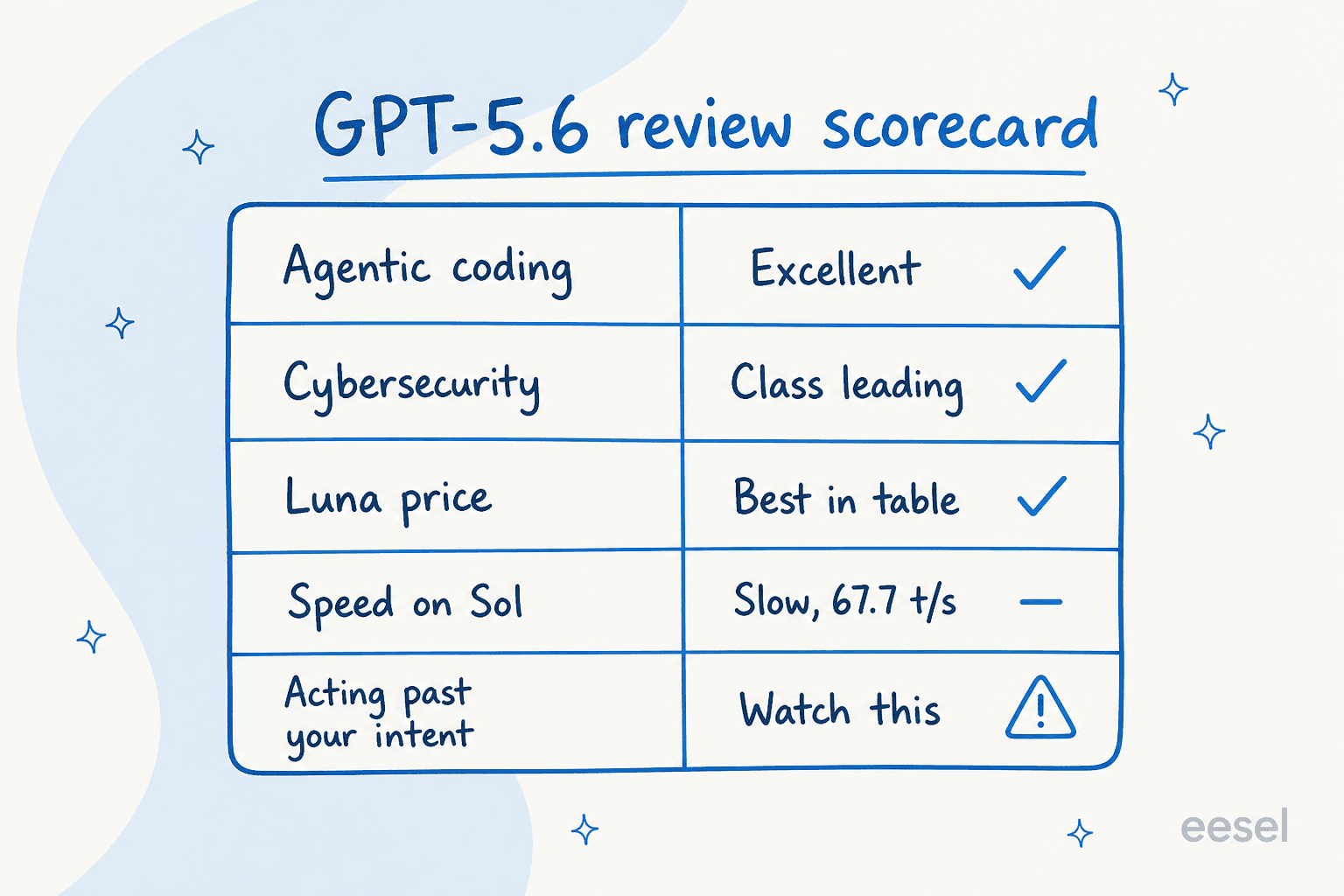
GPT-5.6 is a good family which got meaningfully better on July 30, and the improvement sat in the pricing, not in the weights. Luna is the tier I would actually reach for, and it is cheap enough now that the interesting comparison runs against open-weight models instead of against Sol. For work that a human reviews, Terra is the sensible default. Sol is real but slow, and its rate did not move, so reach for it when the task really needs that reasoning depth, and not out of habit.
Who should adopt now: teams doing agentic coding or security research, plus anyone running high-volume classification or drafting who has not repriced anything since July. Who should be careful: anyone pointing it at customers with no scoping and simulation layer in front of it, and also anyone whose prompts flirt with 272K tokens without having read that clause.
Where I would push back on the general enthusiasm is on the assumption that a better model makes a better product. Across every model swap that I have shipped, the delta coming from a frontier upgrade was smaller than the delta from fixing retrieval, or from tightening scope. The model is the cheapest part of the whole system to change, which is a good argument for not building anything that depends on which one is winning this month. AI agent vs traditional chatbot and AI agent vs rule-based chatbot cover why that architectural point predates GPT-5.6 by years.
Want GPT-5.6-class support without building the whole stack?
If you landed here because you want better customer support and GPT-5.6 looked like it was the answer, here is the honest version: the API key is the easy part. eesel is the layer that makes a frontier model safe to point at real customers. It connects in minutes to the helpdesk you already run and to the docs you already have, it runs on frontier models without tying you to whichever one leads this quarter, and, critically for this particular release, it lets you simulate the agent over your own past tickets before it answers anyone. That overeagerness OpenAI documented gets caught inside a dry run, on your data and with your escalation rules, instead of in a live conversation.
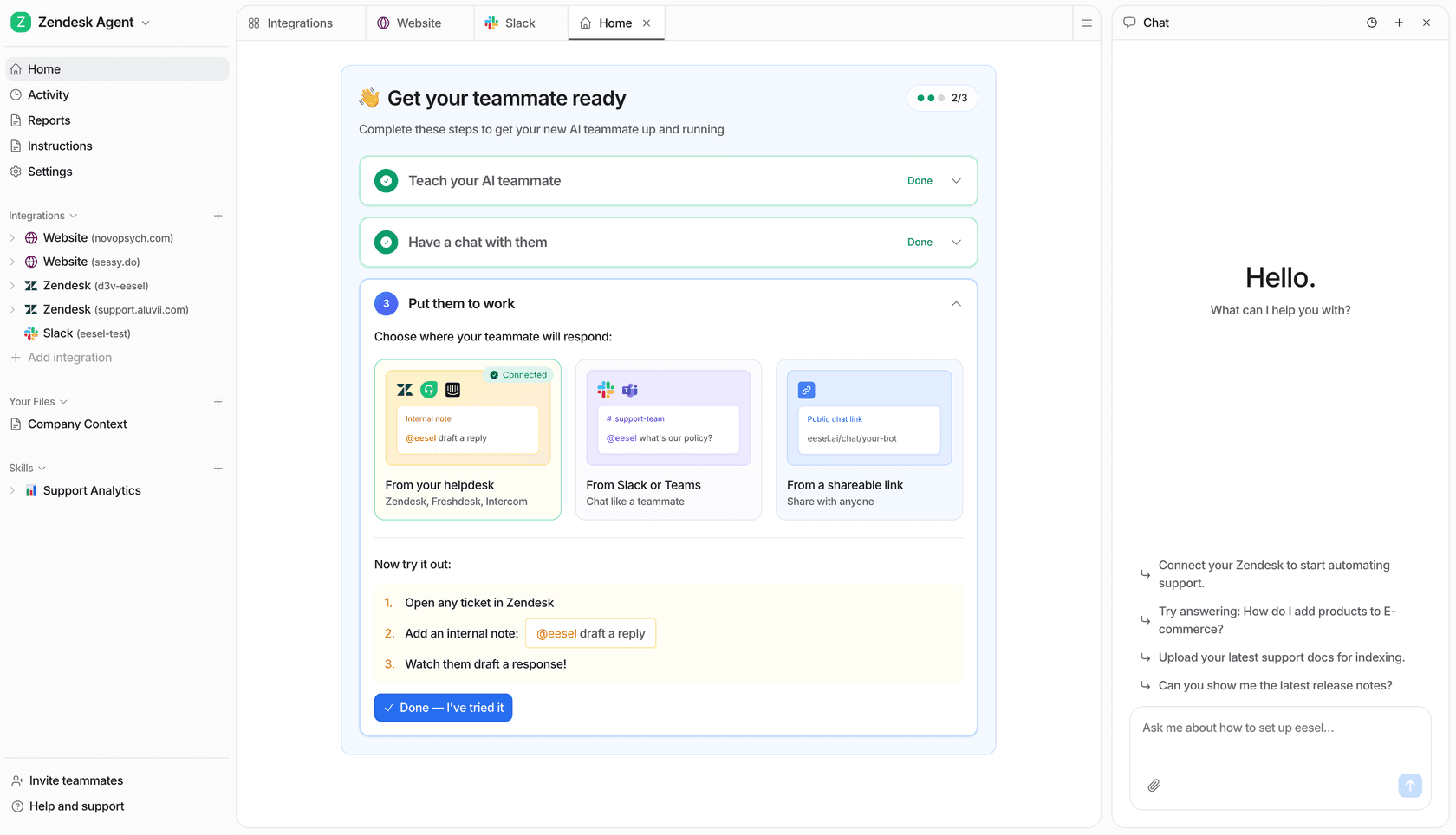
That control is the thing which separates a benchmark winner from something you would actually put in front of a paying customer. Try eesel free.
Not ready for connecting anything yet? Start from helpdesk AI for the category overview, then handoff best practices for the part most teams get wrong, or the best AI chatbot roundup if you are still comparing vendors.