

What Gradient Labs actually charges for
Gradient Labs builds an AI customer operations agent (branded "Otto") aimed squarely at banks, fintechs, lenders, and insurers. Founded in 2023 by a team out of Monzo, it raised a $26M Series A led by Octopus Ventures and CommerzVentures. The product resolves issues end-to-end, freezing a lost card, chasing a missing payment, working a dispute, rather than just deflecting tickets to help-center articles.

On price, the company is refreshingly clear about the model, even though it hides the number. From its own pricing FAQ:
"We have a simple outcomes based pricing model without platform fees, where you pay only for successful query resolutions that our AI agent was able to deliver."
So the billable unit is a successful resolution, not a conversation, a ticket, or a seat. CEO Dimitri Masin has made this a public stance, and it's a good one. As he told The Register:
"If we don't resolve the issue and you still need to get your human team involved, then you don't need to pay us."
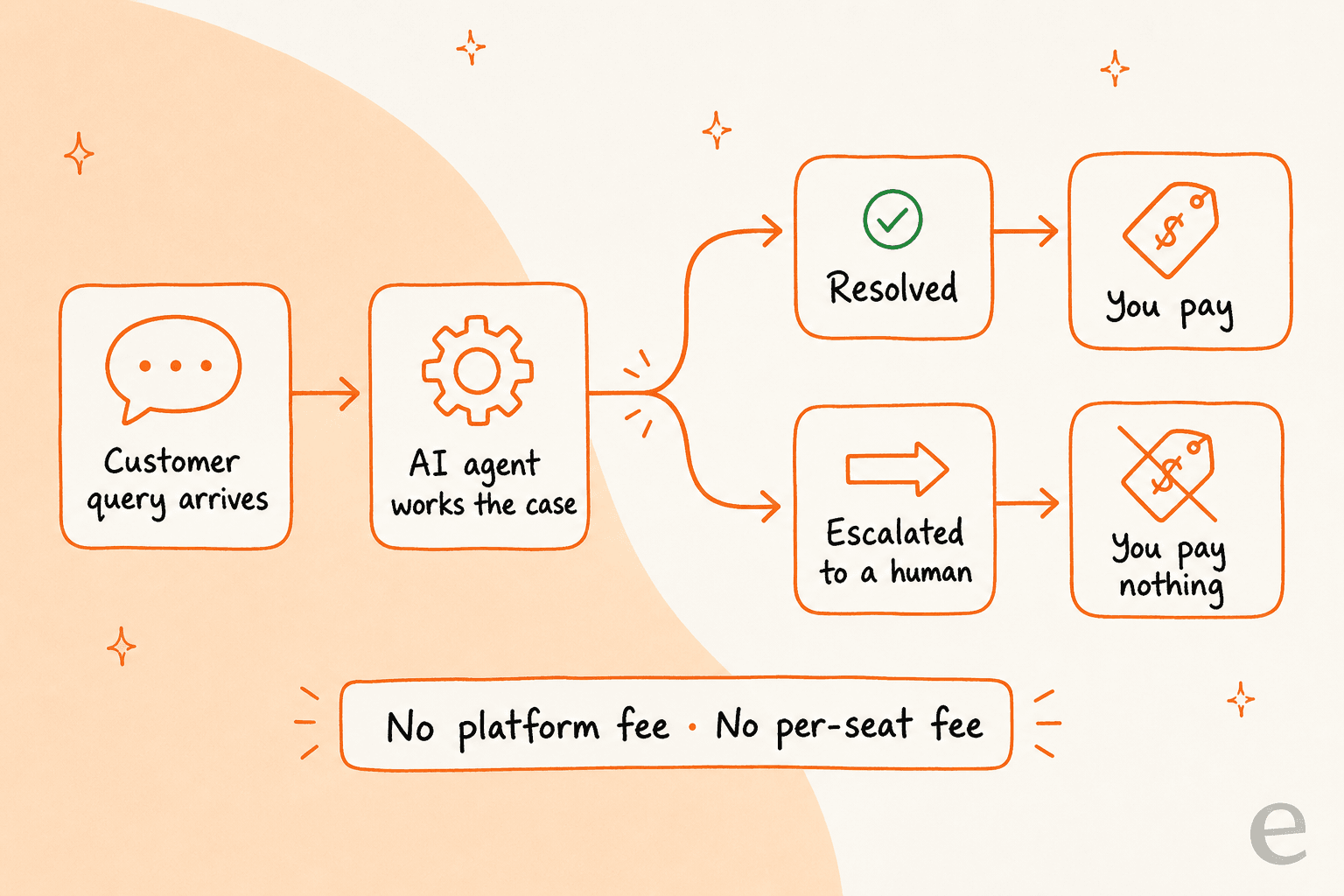
The logic is that it ties your cost directly to ROI, every company knows what a resolved contact is worth to them. Masin even takes a direct shot at per-conversation pricing, arguing that charging per conversation regardless of outcome "doesn't create any incentive" for the vendor to improve the agent. I think he's right about that. Where it gets complicated is the forecasting, which we'll get to.
Why there's no price on the page
Here's what you find when you go looking for Gradient Labs pricing: a form. You enter your number of support agents and a business email, and someone gets in touch. There are no published plans, no Starter/Pro/Enterprise tiers, no rate card, and no advertised free trial.
That's a deliberate, enterprise sales-led posture, and it makes sense for who they sell to. Gradient Labs is vertical software for regulated finance, with 20+ financial-services guardrails running on every conversation turn (financial-advice detection, vulnerability signals, verification-bypass attempts) and compliance coverage spanning FCA Consumer Duty, PSD2, GDPR, and the EU AI Act. That's not a swipe-a-card-and-go product. The flip side is real: you cannot estimate what Gradient Labs will cost you without a sales call, and the rate you're quoted is negotiated, not listed, so two buyers can pay different amounts for the same thing.
For comparison, even the per-resolution incumbents publish their number. Zendesk lists its automated-resolution rate openly, which is why we could write a whole pay-per-resolution guide about it. Gradient Labs gives you the philosophy but keeps the figure behind the curtain.
What you're actually paying for
Outcome-based pricing only makes sense if the outcomes are real, so it's worth looking at what a "resolution" buys you here. Gradient Labs publishes some strong (vendor-stated) numbers: a peak resolution rate of 80 to 90%, 98% CSAT, and 32 million customers served across its deployments. An OpenAI case study notes that "most deployments start with over 50% resolution rates on day one, even for complex workflows like disputes, account verification, and fraud."
Customer results on its customers page are more modest than the peak figure: Pockit reports a 70% resolution rate and 80% CSAT, and Plum's setup took 30 minutes with no engineering effort. Gradient Labs also says that on Intercom, Zendesk, or Freshdesk, a no-integration start usually resolves 20 to 50% of the easiest queries, with the 80 to 90% range needing procedures and system integrations built with its team.
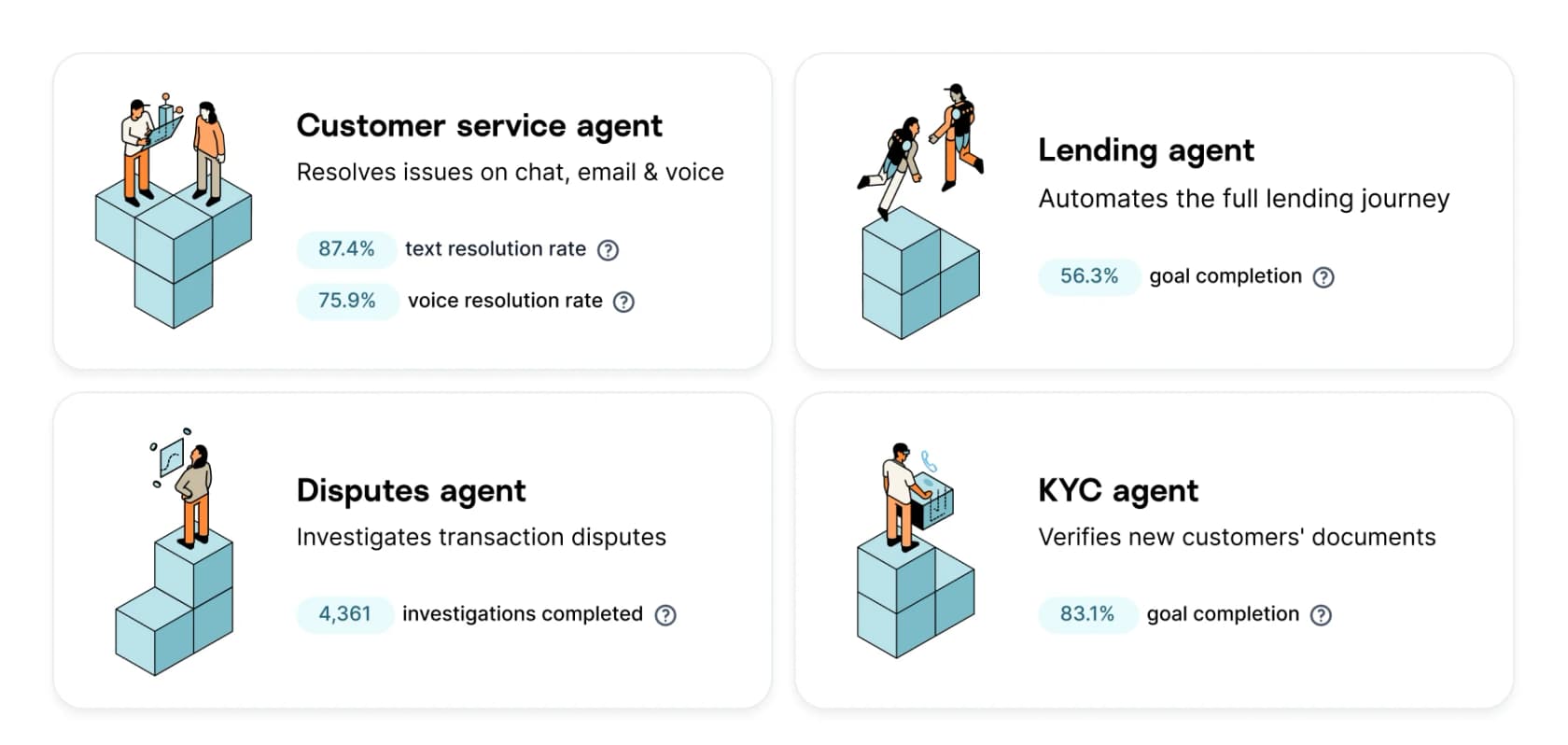
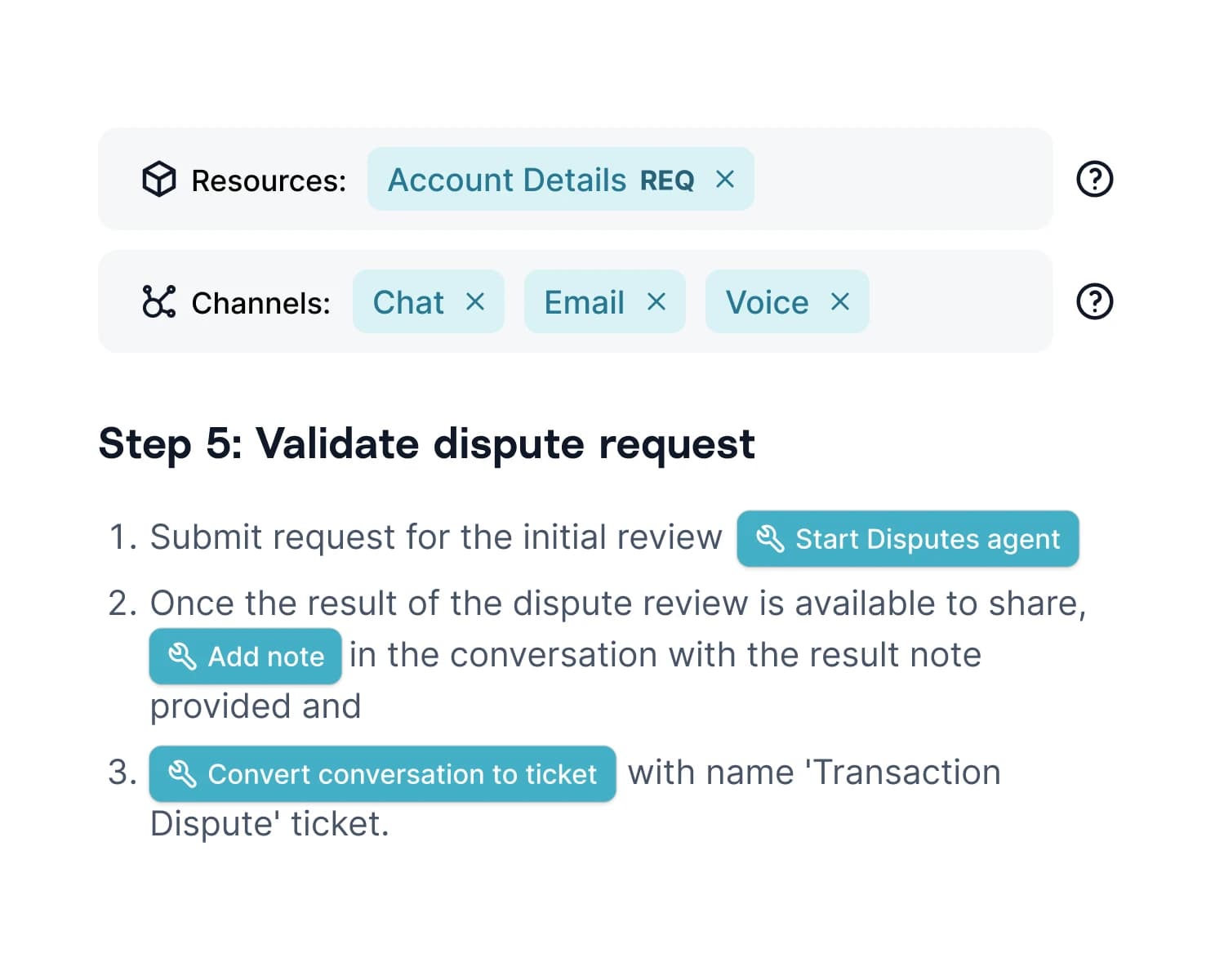
The agent isn't a single bot, it's a set of specialist skills (customer service, disputes, collections, KYC, lending) orchestrated by a central reasoning agent. You teach it by writing procedures in plain language, which it follows turn by turn rather than free-styling from a knowledge base. That procedure-led design is a big part of why a finance buyer would trust it with a chargeback or an account-verification flow.
One honest note on the numbers: they all originate with Gradient Labs or its model vendors. There's no independent G2, Capterra, or Trustpilot review surface for it yet, so treat the resolution and CSAT figures as the vendor's own, the same way you'd treat any pricing claim until you've seen it in your own historical tickets.
The catch with per-resolution pricing
This is the part I'd want a finance buyer to slow down on, because it's the same trap I've watched real teams walk into.
Per-resolution pricing sounds like it caps your risk, you only pay for wins. But run the math forward and you find your bill is driven by three levers that all push the same direction: your ticket volume, your resolution rate, and your channel mix (voice resolutions cost more to deliver than a chat reply).
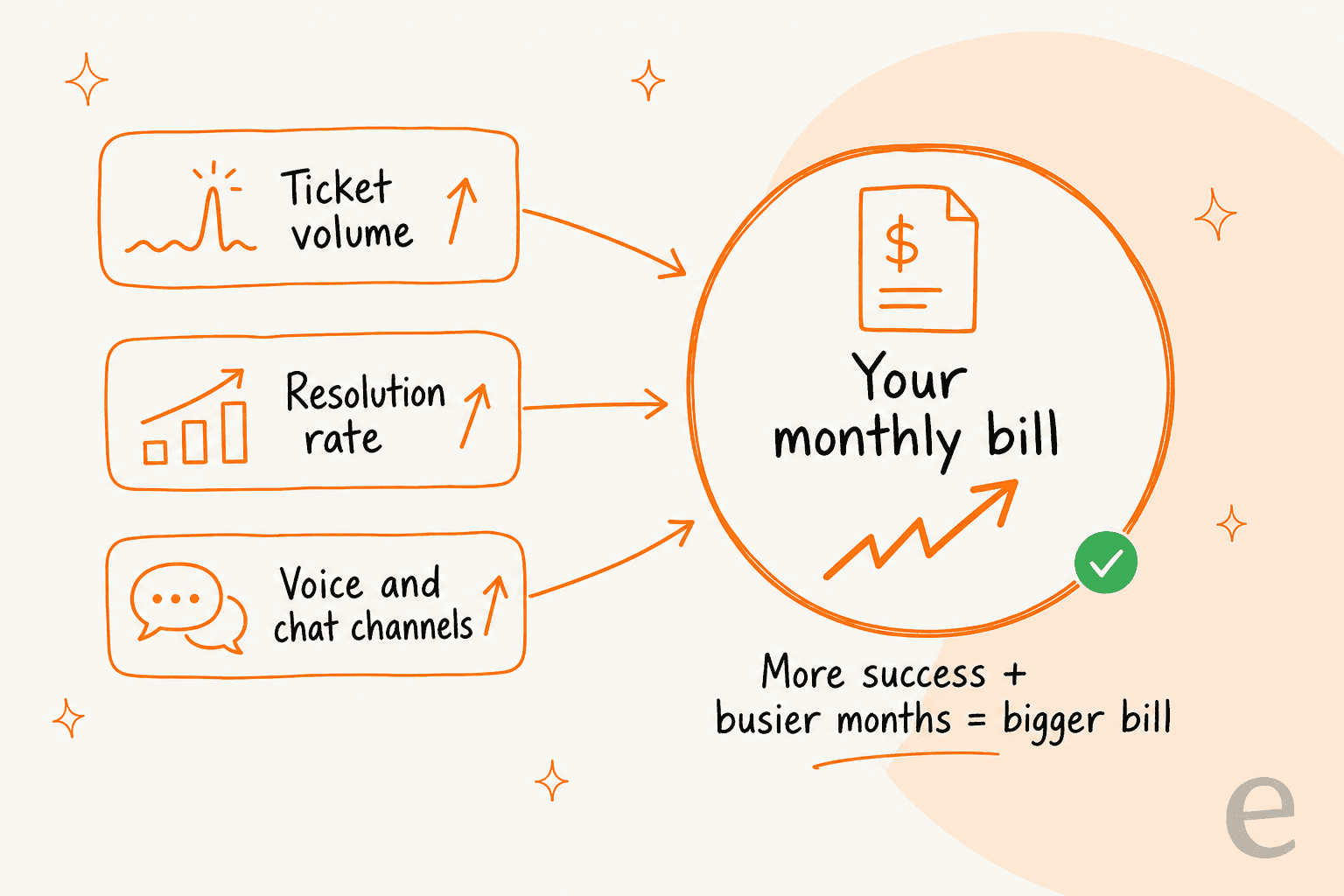
Notice the uncomfortable bit: the better the agent performs, the more you pay. A jump from 50% to 80% resolution is the result you wanted, and it's also a 60% increase in billable events. Pair that with a seasonal spike and the line moves fast. We recently ran a cost-per-resolution analysis for a high-growth retailer doing about 1,000 tickets a month, and the thing that stopped them cold was the Black Friday column: at four times the volume, a per-resolution bill quadruples while a fixed-plan bill only steps up to the next batch size. For a team that can't control when traffic arrives, that's a budgeting headache, not a saving.
There's a second question worth asking any per-resolution vendor: what counts as a resolution? In that same analysis, 22% of the customer's inbox was spam. If auto-closing spam counts as a billable "resolution," your effective rate is quietly worse than the sticker. It's a fair thing to pin down in the sales conversation Gradient Labs is going to put you in anyway.
Plug your own numbers in and see where the two models cross over:
A worked example: what it might cost
Since Gradient Labs won't quote publicly, the cleanest way to ground a number is the one published per-resolution benchmark in the category: Zendesk's automated-resolution rate of roughly $1.50 per resolution. Gradient Labs' rate is negotiated and could land above or below that, but it's a fair anchor for what regulated, end-to-end resolutions tend to cost. If you want the wider picture, we keep a running breakdown of AI support agent cost.
| Scenario | Tickets / month | Resolution rate | Resolutions billed | Per-resolution (at $1.50) | eesel plan (1 credit per ticket) |
|---|---|---|---|---|---|
| Steady month | 1,000 | 80% | 800 | $1,200 | $499 (1,000 credits) |
| Strong agent | 1,000 | 90% | 900 | $1,350 | $499 (1,000 credits) |
| Black Friday spike | 4,000 | 80% | 3,200 | $4,800 | $1,899 (5,000 credits) |
| Quiet month | 400 | 60% | 240 | $360 | $299 (500 credits) |
The pattern is the whole point. Per-resolution rewards you in quiet months and bills you hardest exactly when you're busiest, and it's the only model where improving the agent raises your invoice. None of that makes it a bad deal, for a lender with predictable, high-value contacts it can pencil out beautifully, but you should walk into the sales call knowing which lever moves your bill.
How Gradient Labs pricing compares
Step back and the AI support market splits cleanly on two axes: how transparent the pricing is, and how broad the product is. Gradient Labs sits in one specific corner, deep financial-services specialization, quote-only enterprise pricing.
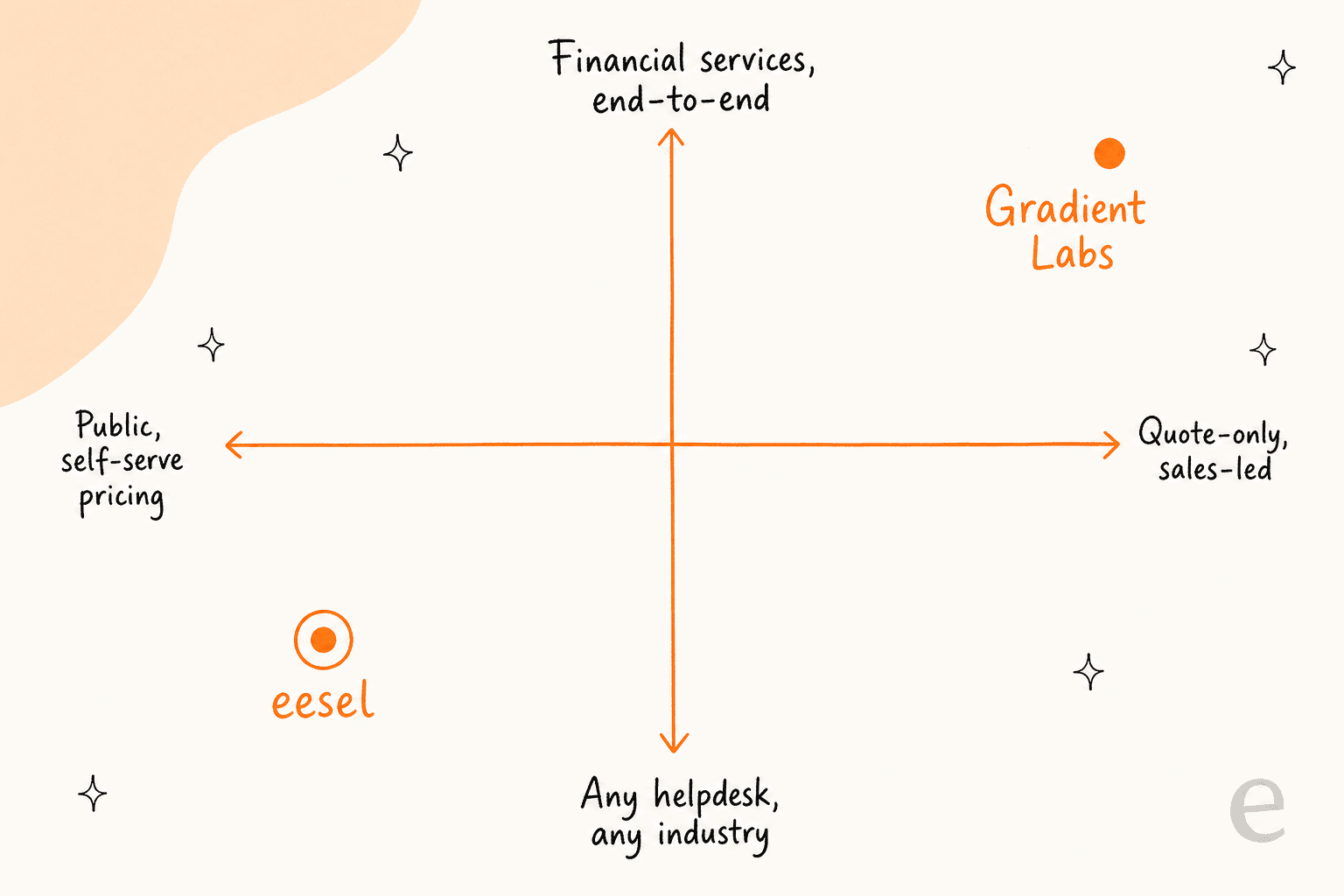
If you're a regulated bank or insurer that needs disputes, KYC, and collections handled end-to-end, that corner is exactly where you want to be, and the per-resolution incumbents like Zendesk's outcome pricing, Gorgias AI Agent, Freddy on Freshdesk, and Ada are the names you'd line up against it. Gradient Labs is the most finance-native of that group.
But most teams reading a pricing post aren't regulated lenders. If you run a SaaS, e-commerce, or general support queue, the finance-only guardrails are weight you don't need, and the quote-only motion is friction you don't want. That's the gap a general-purpose, transparently-priced AI support agent fills, and where I'd send most readers next is our rundown of AI customer service cost.
Try eesel for transparent AI support pricing
If the thing you actually want is a number you can put in a budget before you talk to anyone, that's the whole idea behind eesel. It's an AI support agent that lives inside the helpdesk you already run, Zendesk, Freshdesk, Gorgias, Help Scout, Front, or Slack, and the price is published: fixed monthly plans from $299 for 500 credits (1 credit per ticket or chat), no platform fee, no per-seat fee.
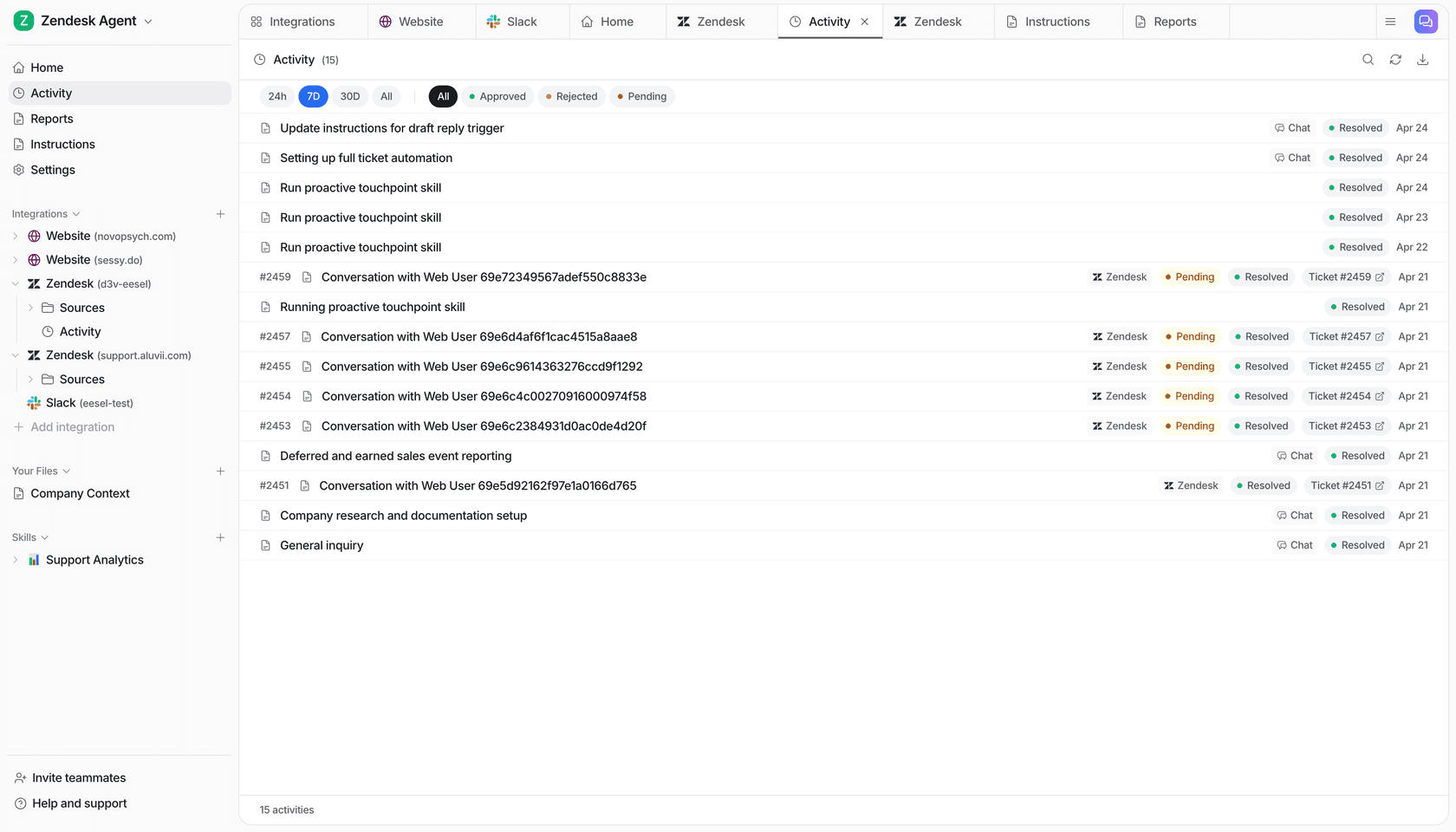
Two differences matter most against a per-resolution model. First, your bill doesn't punish you for a better agent, since credits count tickets worked, not resolutions, and a busy week is covered by your plan size or an optional overage cap you set. Second, before you commit, you can run a simulation against your own historical tickets to see the real resolution rate and cost on your data, the 73% tier-1 resolution Gridwise hit in its first month started as exactly that kind of dry run. You don't have to take a vendor's number on faith, and you don't have to start with a sales call. It's free to try with 100 free credits and no credit card.