


So you've probably seen the headlines about using AI to make money. The problem is, most guides just throw a random list of side hustles at you that don't really go anywhere. This isn't one of those guides. We’re going to walk through a real-world path, starting with simple freelance gigs and moving all the way to building an actual AI-powered service business that can scale.
You'll see how to get your foot in the door with a tool like ChatGPT, but more importantly, how to hit its limits and then move past them to build something truly profitable.
What you’ll need for how to make money with ChatGPT
Before we jump in, let's talk about what you actually need. You don't need a huge pile of cash, but a few things are essential.
- Access to ChatGPT: The free version is a great place to start. If you get serious, the Plus subscription gives you more power and access to the latest models.
- A skill you already have: AI is a powerful tool, but it works best when it's amplifying something you’re already good at. Whether you’re a writer, marketer, developer, or customer support ace, you need a skill to build on.
- A business owner’s mindset: We're thinking beyond one-off tasks here. The goal is to create systems that deliver consistent value to clients, not just trade your hours for dollars.
Here is what the ChatGPT plans cost today, as listed on OpenAI's pricing page:
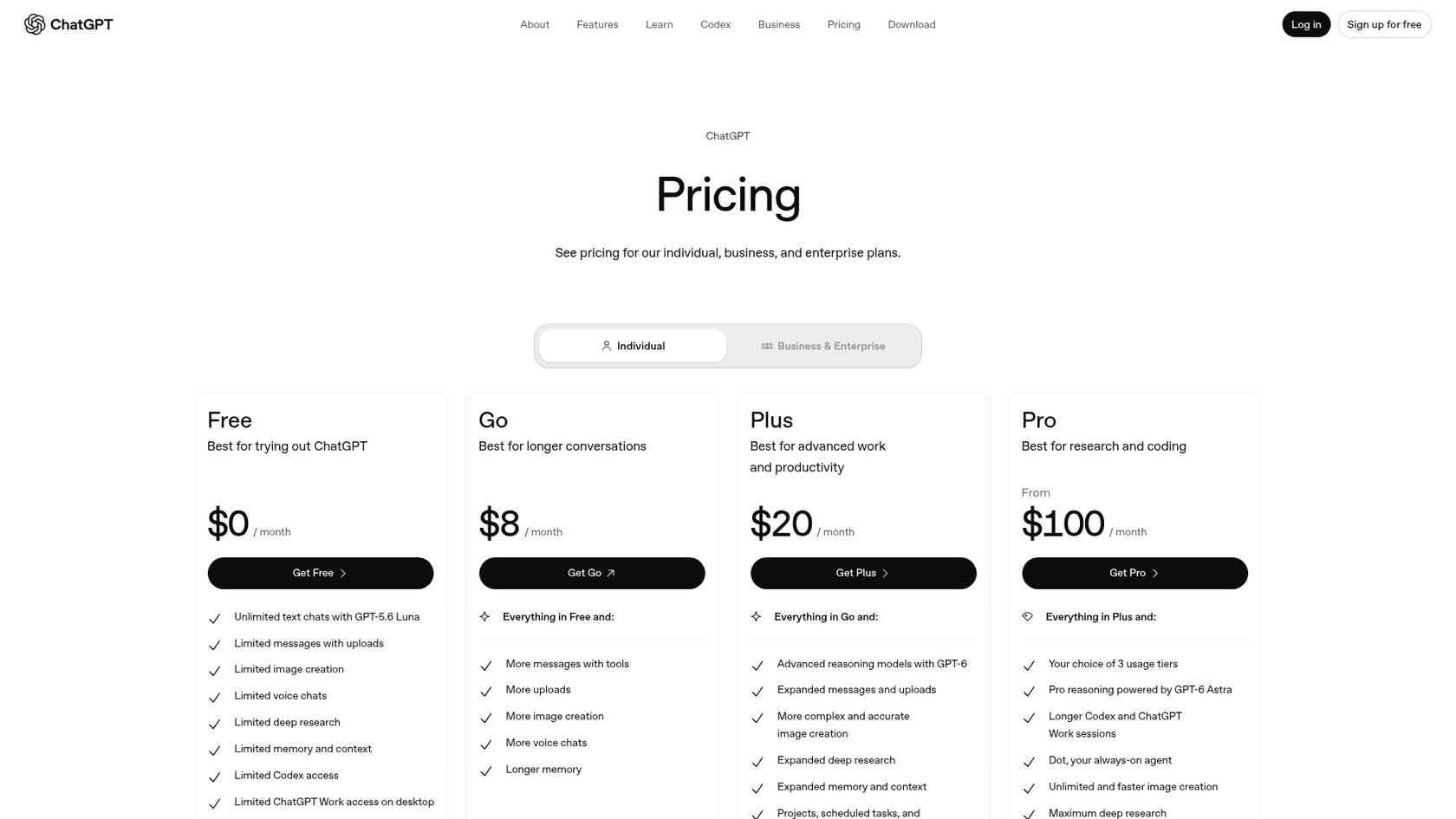
| Plan | Price | Good for |
|---|---|---|
| Free | $0 / month | Trying out brainstorming and drafts |
| Go | $8 / month | Longer conversations and more uploads |
| Plus | $20 / month | Steady client work, advanced reasoning models |
| Pro | From $100 / month | Heavy research and coding |
A step-by-step guide on how to make money with ChatGPT
Alright, let's break this down into four manageable steps. This is a path that takes you from doing simple tasks to running a sustainable business.
Step 1: Start with foundational freelance services
The simplest way to start is by using ChatGPT to make your existing freelance work faster and better. Head over to a platform like Upwork or Fiverr and offer services that AI can help you deliver. The idea is to use it as an assistant to handle more clients and, ultimately, raise your rates.
Content creation and copywriting: You can use ChatGPT to whip up blog post outlines, rough drafts, social media captions, or email campaigns in minutes. Your job is to take that raw output and add your expertise, style, and fact-checking. A client is paying for your professional touch, not a robot's first draft. For example, ask it for five email subject lines, then pick the best one and tweak it to fit the brand's voice perfectly.
Social media management: Let ChatGPT brainstorm a content calendar, write posts for different platforms, and even find relevant hashtags. This clears your plate so you can focus on the important stuff, like strategy and actually talking to the community. You can spend your time building relationships with followers, which is where the real value is.
Market research and analysis: Need to understand a new market for a client? Ask ChatGPT to summarize industry reports or identify key trends. It can help you pull together a competitive analysis in an afternoon instead of a week, giving your client a clear view of their landscape almost immediately.
Pro tip: Build a portfolio that shows off your AI-assisted work. It’s a great way to show potential clients that you use modern tools to get them high-quality results, fast.
Step 2: Niche down and productize your service
Once you've got the hang of using ChatGPT, it's time to stop being a generalist. Specialists get paid more. Instead of just offering "writing services," you could offer "SEO-optimized blog content for B2B SaaS companies." This focus positions you as an expert and lets you package your work into a "productized" service.
A productized service is basically a fixed-scope, fixed-price package. Think of it like this:
Instead of saying: "I'll manage your social media for $X an hour." You offer: "The 'SaaS Startup Growth' Package: You get 12 social media posts, 2 blog articles, and a monthly performance report for a flat $1,500 a month."
This makes it much easier for clients to know what they're buying and gives you predictable income. You're no longer selling your time; you're selling a specific outcome.
You can even ask ChatGPT to help you design these packages. Ask it to create a few service tiers (like Basic, Pro, and Premium) with different deliverables for your niche. It can help you figure out what to include in each one to offer increasing value, making it simple for clients to pick the right option for their budget.
Step 3: Identify its limitations for business
As you land more clients, you'll start to bump your head against the ceiling of what a general tool like ChatGPT can do. It's a fantastic creative partner, but it's not built to run a business. Trying to operate a professional service on it alone leads to some major headaches that will stop you from growing.
Its connections are built for personal use: ChatGPT now has apps and plugins that connect to services like Google Drive, Slack and SharePoint, so a lot of the old copy and paste is gone. A client's help desk is a different story. Working a queue in a tool like Zendesk means reading and answering tickets inside it, which is not what a personal ChatGPT account is set up to do for someone else's company.
It isn't built to run a client's workflows: ChatGPT agent can take actions in a browser, and it asks for permission before consequential steps. That suits one-off tasks. A support team needs something that sorts tickets, tags issues, escalates an urgent problem to the right person, and checks a customer's order status on every single ticket, without someone driving it each time.
Its knowledge starts generic: Out of the box, ChatGPT knows the public web plus whatever files and connected apps you give it. It doesn't know your client's specific history, like past support conversations or internal guides they keep in Confluence or Google Docs. It pulls from the public internet unless someone keeps feeding it that private company information.
There are privacy questions to settle: Can you honestly tell a client you're pasting their sensitive customer info into a personal ChatGPT account? OpenAI says content from individual plans may be used to train its models unless you opt out in the data controls, while business plans don't train on your data by default. Either way, the client's own privacy policy has the final say, and a mismatch could cost you the trust you've built.
These aren't small problems. They're the roadblocks that prevent you from scaling up. You can't build reliable, automated systems for clients when your main "tech" is just you in a chat window.
Step 4: Scale your business with a specialized AI platform
This is the step where you go from freelancer to a genuine AI service provider. By using a platform built for business, you can create and manage powerful, integrated AI solutions for your clients, especially in a high-impact area like customer support.
Instead of just helping write support replies, you could offer to build a fully autonomous AI agent that handles their frontline customer service. This is where a tool like eesel AI comes into the picture. It’s designed to handle all the problems we just talked about.
Here's how a specialized platform lets you build a real business:
Get up and running in minutes: With tools like eesel AI, you can connect directly to a client's help desk using one-click integrations. There are no complicated setups or mandatory sales calls. This means you can get a powerful AI agent working for your client almost instantly.
Build custom, automated workflows: You get to be the architect. You can decide exactly which tickets the AI should handle and what it should do, like tagging issues, escalating them, or even pinging an external tool to check an order status in Shopify. Your service goes from being "AI-assisted" to "AI-automated," which is a far more valuable thing to sell.
Connect all their knowledge: An agent built with eesel AI can be trained on a client's actual company knowledge, from past support tickets to internal wikis and private docs. This means the AI gives answers that are accurate and specific to their business, not just generic web fluff.
Test it out with confidence: Before you launch anything for a client, you can run the AI in a simulation mode on thousands of their past support tickets. This lets you prove that it works and fine-tune its performance without any risk. It gives your clients total confidence in what you're delivering.
When you offer these kinds of integrated solutions, you can start charging premium monthly retainers and build long-term relationships based on the real business results you're driving.
Pro tips for success with how to make money with ChatGPT
Building a business with AI is about more than just prompt engineering. Keep these pointers in mind.
Keep a human in the loop: Don't just set it and forget it, especially at the beginning. Always review and refine what the AI produces to make sure it's accurate and matches the brand's voice. Your real value is your judgment.
Solve a business problem, not a tech one: Clients don't buy "AI." They buy solutions. They want to lower support costs, get more leads, or improve response times. Always frame your services around the outcomes they care about.
Be open about how you work: Tell your clients you use AI tools to make their work better. It builds trust and sets the right expectations. Explain how it helps them get work done faster and more consistently.
Common mistakes to avoid when using ChatGPT
- Getting careless with data: Never, ever put sensitive client information into a public AI model without their permission. Using a secure, business-focused platform is the only way to go if you want to build trust.
- Promising the world: Be realistic about what AI can and can't do. It’s an incredible assistant, but it’s not magic. Set clear goals and show your clients exactly how you'll measure success.
The takeaway on how to make money with ChatGPT: From side hustle to scalable business
The chance to make money with ChatGPT is definitely real, but the biggest opportunity isn't in disconnected side hustles. It's in using it as a starting point to build a real service business. By starting with basic freelance work, specializing your offer, and then moving to professional platforms to solve bigger problems, you can create something truly valuable and profitable.
Ready to build a scalable AI service for your clients? See how eesel AI gives you the tools to create powerful, integrated AI agents that do far more than ChatGPT ever could on its own. Start a free trial or book a demo.
Frequently asked questions
What's the most straightforward way for a beginner to figure out how to make money with ChatGPT?
The easiest way to start is by using ChatGPT to enhance a skill you already have, like writing or marketing. Offer AI-assisted services like content creation or social media management on freelance platforms like Upwork or Fiverr to build your portfolio and gain initial experience.
Do I really need the paid version, or is the free version good enough for how to make money with ChatGPT?
The free version is perfectly fine when you're just starting out with tasks like brainstorming and drafting content. You should only consider upgrading to the paid Plus subscription once you have a steady stream of client work and need more speed, reliability, or access to the latest models. Plus is $20 per month, and there is also an $8 Go tier in between.
With everyone trying this, what’s the best way to stand out if my goal is how to make money with ChatGPT?
The key is to specialize rather than being a generalist. Niche down to a specific industry or service, like creating SEO blog posts for SaaS companies, and offer it as a "productized" service with a fixed price and clear deliverables. This positions you as an expert and makes your offer more attractive.
Why can't I just stick with the basic tool if my goal is how to make money with ChatGPT long-term?
ChatGPT is great for content generation, and its apps and plugins now reach tools like Google Drive and Slack. But running a client's customer support queue is a different job: it means working through their tickets, using their private help content, and automating the steps around each ticket. To build a scalable business around that, you need a specialized platform that can securely integrate with a client's existing tools.
Should I tell clients I know how to make money with ChatGPT by using it on their projects?
Yes, transparency is crucial for building trust. Frame it as using a state-of-the-art tool to deliver better results more efficiently, not as a replacement for your expertise. You are the professional who guides the tool and ensures the final output meets quality standards.
Besides getting facts wrong, what's the biggest risk when trying to figure out how to make money with ChatGPT?
The single biggest risk is client data privacy. You should not paste sensitive or proprietary company information into a personal ChatGPT account without the client's permission: content from individual plans may be used to improve OpenAI's models unless you switch that setting off, while business plans do not train on your data by default. That is a good reason to use a business-grade, secure AI platform for real client work.