


What Influx actually is
Before the numbers, one thing to get straight, because it changes how you read the price. Influx is a remote-first support outsourcing company founded in 2013 that supplies trained human agents, optionally paired with AI, on flexible month-to-month terms. In their own words, it's "not software, not a platform, not a marketplace." So this isn't a per-seat SaaS bill like Zendesk or Gorgias, and it isn't one of the software-first AI customer service companies either. It's a staffing bill.
That matters because most of the outsourcing category hides its rates behind a sales call. Influx publishes a real price list, which is refreshing and makes it one of the easier vendors to actually budget for. I spend a lot of time reverse-engineering what support tools cost when teams search for it, and a vendor that just tells you the number up front is rare enough to be worth calling out.
Here's the part worth internalising from years of watching support queues: the bulk of an outsourced team's work is repetitive. On real sales calls I hear it constantly, one multi-brand e-commerce operator handling 500+ tickets a day described their volume as almost entirely refunds, unsubscribes, and order tracking. That's the exact shape of work you're paying agent-months to handle, and it's the exact shape a modern AI agent handles well. Hold that thought; it's the whole cost story.
The two ways to buy Influx
Influx frames its two products as structurally different ownership models, not two price points for the same thing. The question they use to separate them is sharp: if CSAT dropped this month, is that your problem to diagnose, or Influx's?
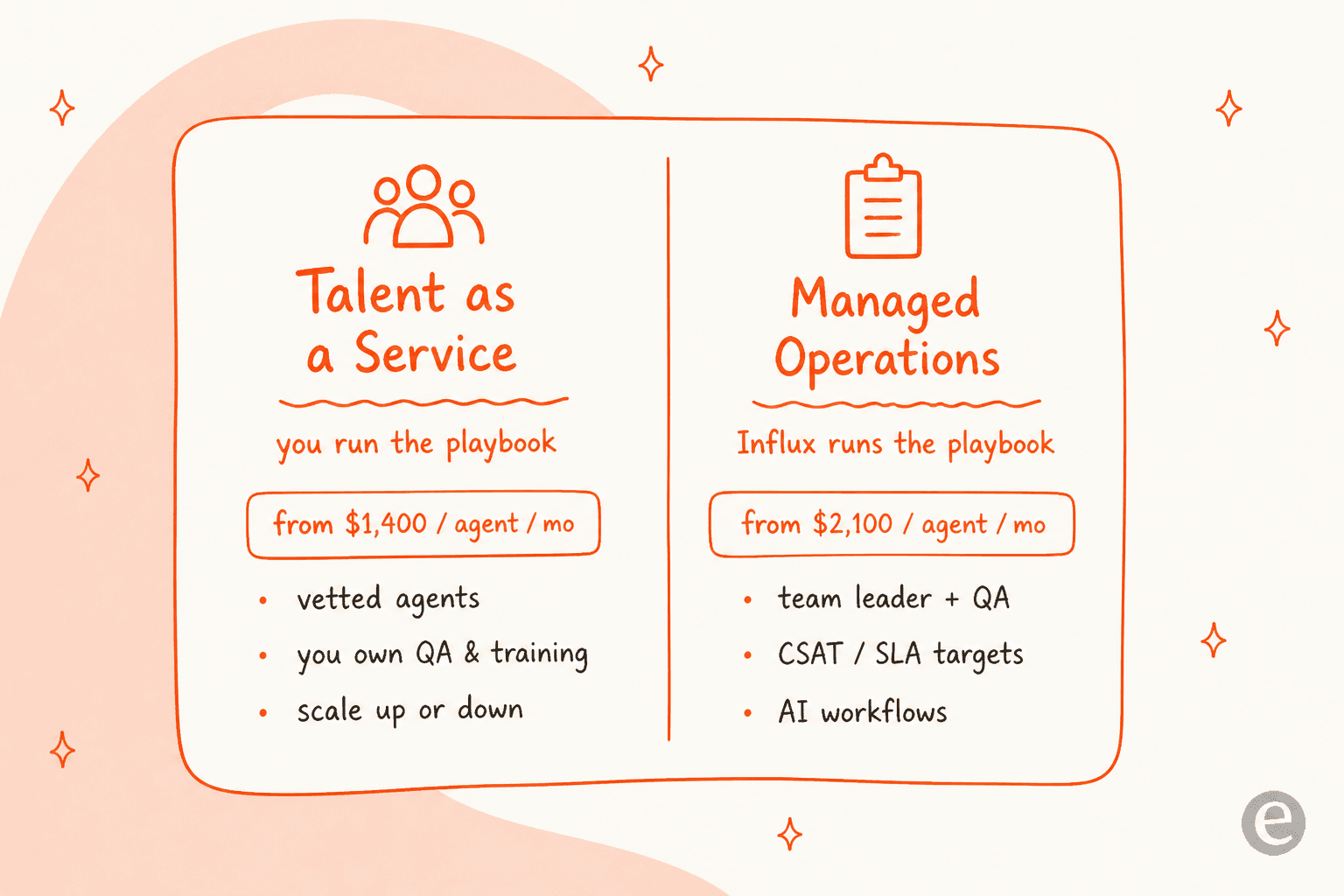
Talent as a Service is a headcount product. Influx sources, vets, and deploys agents into your operation, and handles all the HR, payroll, and backfill behind the scenes. But you own the training, the process, and quality management. It fits teams that already have a CX lead and working QA, and just need trained agents fast without the management overhead of hiring.
Managed Operations is an outcome product. It includes everything in Talent as a Service, plus a Team Leader running daily ops, agent training and coaching, QA, CX reporting on CSAT and SLA, and AI workflow integration. You set the goals; Influx commits to hitting them. It's the right call if you don't have the in-house bandwidth to manage a support team at all.
The gap between them is roughly $700 per agent per month, which is the price of handing over management, QA, and accountability.
Influx pricing: the full breakdown
All figures are per agent, per month, quoted as "starting from," and every one comes straight from the Influx pricing FAQ.
Talent as a Service
| Configuration | Starting price / month |
|---|---|
| Level 1 digital, APAC, full-time | $1,400 |
| Level 1 digital, Americas, full-time | $1,700 |
| Part-time (4 hours/day) | from $1,000 |
Pricing varies by agent level (L1, L2, L3), region (APAC, EMEA, Americas), and channel (digital or voice). The published figures are the floor, an L1 digital agent in APAC. Move up a level, into a Western region, or onto the phones, and the number climbs from there.
Managed Operations
| Configuration | Starting price / month |
|---|---|
| Level 1 agent, APAC or EMEA | $2,000 |
| Level 1 agent, Americas | $2,100 |
| Fractional Team Leader | "small additional cost" (unpriced) |
On Managed Operations, Influx lists $2,000 for APAC/EMEA and $2,100 for the Americas (pricing FAQ), a much smaller regional gap than the roughly $300 premium on Talent as a Service. Voice-channel and Level 3 rates aren't published as specific dollar figures, they're named as variables that move the price, so you'll need a quote for those.
The terms
| Term | Detail |
|---|---|
| Setup / onboarding fee | None, on either product |
| Contract length | Month-to-month, no long-term lock-in |
| Cancellation notice | 1 month (3 months for L3 / specialist roles) |
| Minimum team | 1 agent on Talent as a Service; Managed needs a Team Leader (most start with 2 to 5 agents) |
| Language premium | +10% for languages beyond standard English |
| Time to launch | Agents live in 2 to 4 weeks from first conversation |
What actually moves the price
The "from $1,400" headline is the cheapest possible cell in a grid. Four dials push the real number up, and it's worth knowing them before you budget.
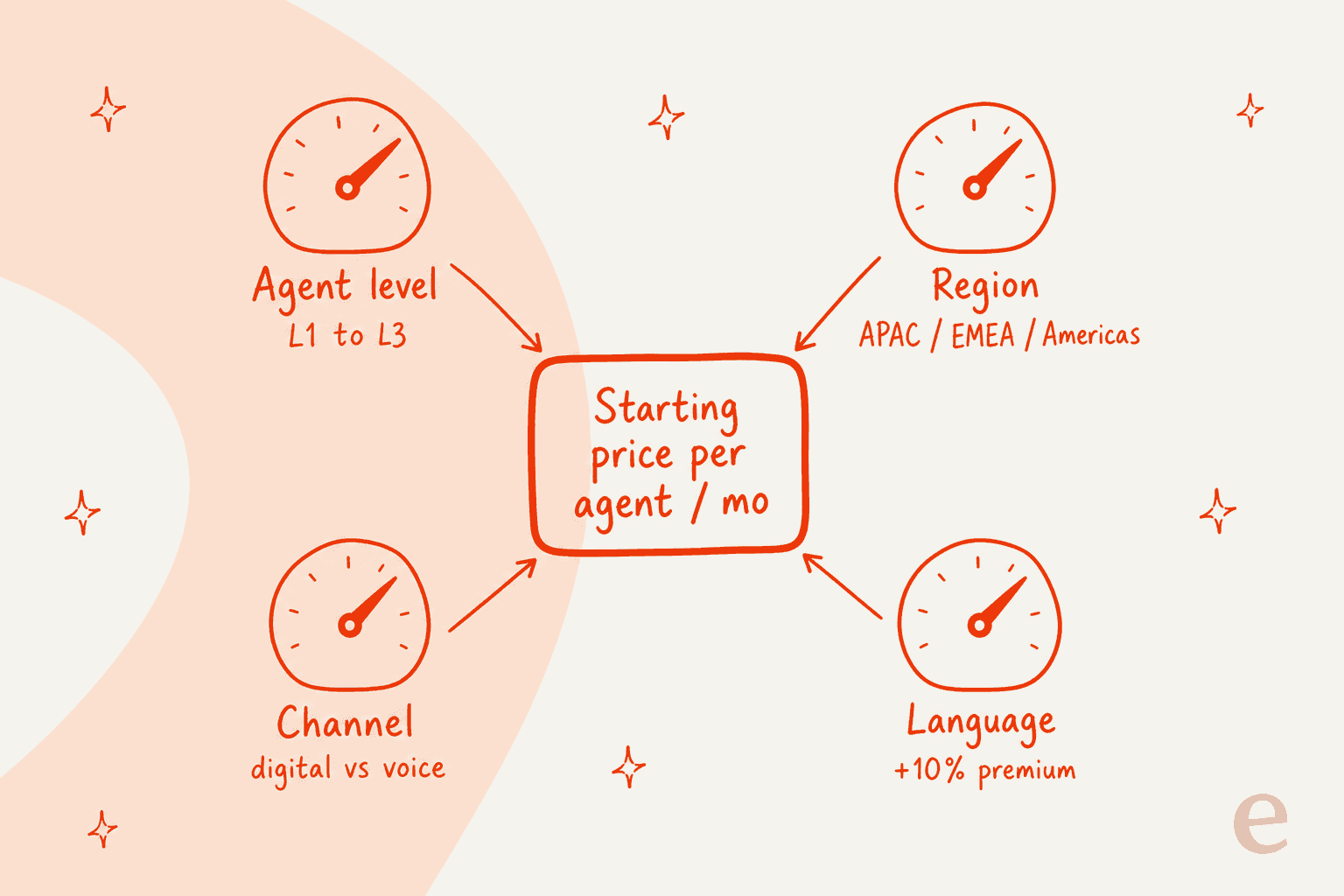
- Agent level. L1 handles standard tickets; L2 and L3 bring specialist or technical depth, at a higher rate that Influx quotes case by case.
- Region. APAC is the floor. EMEA and the Americas cost more, following local labour markets.
- Channel. Digital (email, chat, social) sits at the published rate. Voice support is a separate, higher, unpublished tier.
- Language. Every agent meets a minimum B2/C1 English standard. Anything beyond standard English adds a flat 10%.
Notice what's not on this list: there is no per-resolution or per-ticket meter. Influx bills a flat monthly rate per head, full stop. That's the defining trait of the model, and its central trade-off.
A worked example: what you'd actually pay
Rates per agent are easy; the monthly total is what stings. Plug in your own numbers here.
To make it concrete: a four-agent Managed Operations team in a single region runs about $8,400/month, or roughly $100,800/year, before the Team Leader is added. That's a real, well-managed support team for six figures a year with no lock-in, which is a fair deal if you really do need four humans on the queue around the clock. It's also where the cost-savings math starts to bite.
The question is whether you need four humans, or whether two humans plus automation would clear the same volume. That's where the model starts to matter.
Is Influx worth it? What the reviews say
Here's an honest gap: verifiable independent reviews of Influx as a vendor are thin. Its G2 profile is unclaimed and sparse, its Trustpilot page sits around 3.7 on a single review, and public search is muddied by an unrelated database product with a similar name. There isn't a rich body of buyer sentiment to quote, and I'd rather tell you that than dress up an unverifiable quote as proof.
What Influx does have is a set of named, self-reported client outcomes on its own site: Linktree reports 93% CSAT across 26 agents in four regions and five languages, YAZIO reports 94% CSAT expanding from Germany to 150 countries, and Meshki reports 95% CSAT alongside strong growth. Treat those as vendor-supplied rather than independently audited, but they're specific and consistent, which counts for something.
The fairest read: Influx is a solid, flexible outsourcer with unusually transparent pricing and fast onboarding. The published rates and month-to-month terms are real advantages over the legacy BPOs that make you sign a year and a call. The limitation is structural, not a knock on execution, you're buying human hours by the month.
The billing unit is the real decision
Step back from the dollar figures and the actual choice comes down to one thing: what you're paying per. Influx bills per agent-month. That cost is fixed whether those agents field 200 tickets or 2,000. When volume spikes, you either overload the team or add another $1,400-to-$2,100 seat.
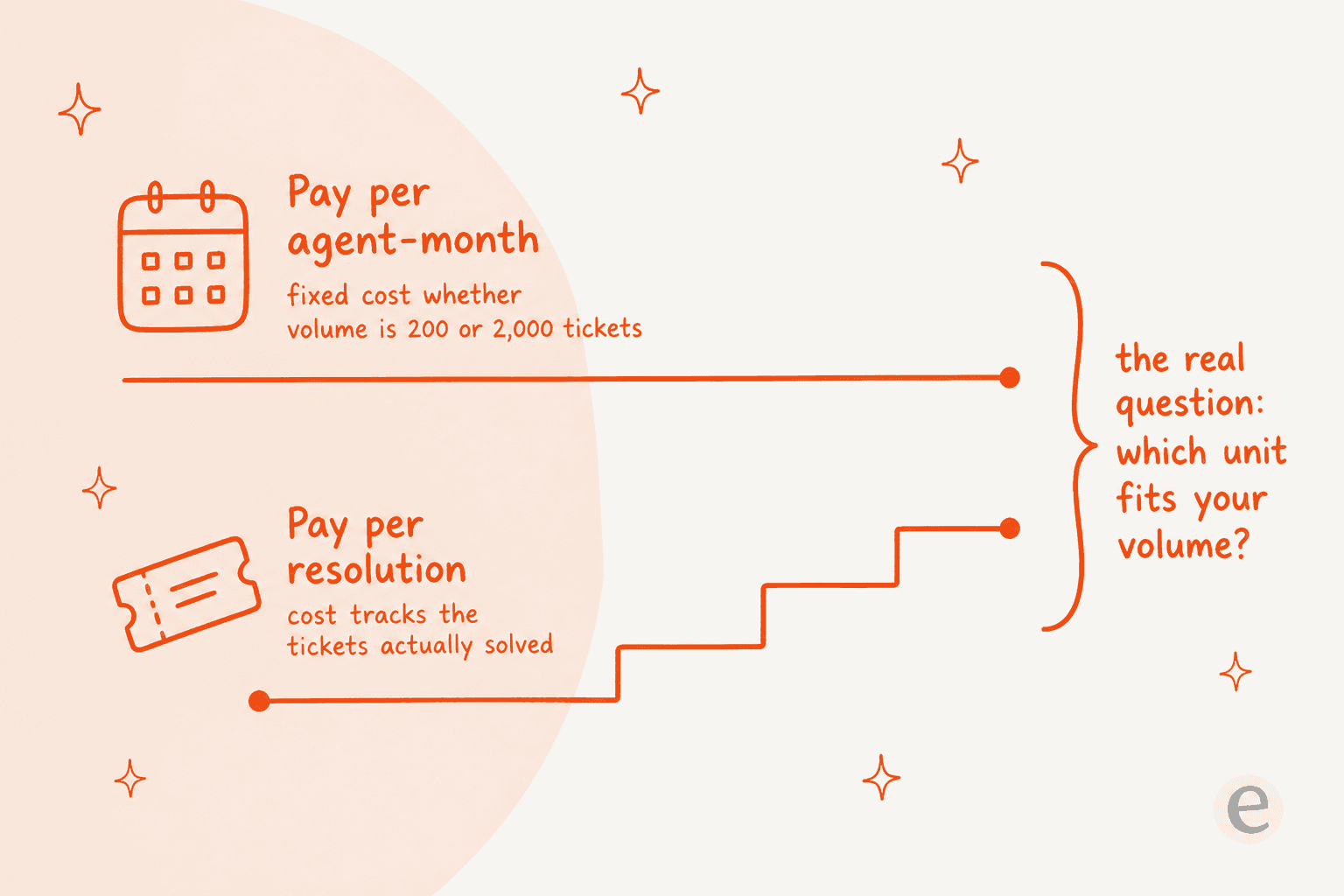
The alternative is to bill per resolution, only paying for tickets that actually get handled. For the repetitive tier-1 share of a queue, the WISMO, order-tracking, and refund questions that dominate volume, an AI agent resolves them at a fraction of an agent-hour's cost, and the bill scales with the work rather than the headcount. This isn't an either/or with human support; the best-run teams I see keep humans for the hard, empathetic, judgment-heavy tickets and let automation absorb the rest.
That reframes the Influx question entirely. Instead of "how many agents do I need?", the sharper question is "how much of this volume needs a human at all?"
Clear tier-1 before you scale a support team
If most of your queue is repetitive, the cheapest headcount is the headcount you never hire. That's the job eesel AI is built for: an AI helpdesk teammate that joins your existing helpdesk and resolves the tier-1 volume before it ever reaches a person. It plugs into Zendesk, Gorgias and other major helpdesk platforms natively.
Two things make it a genuine complement to, or alternative for part of, an outsourced team. First, it's priced on one fixed monthly plan from $299/month for 500 credits (1 credit per ticket or chat the AI actually works on), with no per-seat fee, so the cost tracks ticket volume instead of your headcount. Second, before you turn it on, eesel runs a simulation against your own past tickets so you can see exactly what it would have resolved and what it would have escalated. We learned to do that the hard way, after watching confident-sounding bots quietly give wrong answers, so now every rollout is a dry run over real historical tickets first, no guessing.
You don't have to choose one or the other. Pair a smaller Influx team with an AI layer that clears the repetitive volume, and you scale humans for the tickets that actually need them. That's usually the cheapest support operation you can run. You can try eesel free and simulate it on your own tickets in a few minutes.