Kodif AI vs eesel AI: managed ecommerce agent or one you run yourself (2026)

Kira

Katelin Teen
Last edited October 14, 2026

Why I'd frame this around who changes the agent
I build eesel's AI agents, so I'm biased, and I'll be upfront about where Kodif is the better buy. But the most useful thing I've learned from watching real rollouts isn't about features. It's that the first version of any support agent is wrong in small, fixable ways, and the speed of those fixes decides whether it works.
Here's a real example. In one trial on a German jewelry ecommerce brand running about 1,000 tickets a month on Zendesk and Shopify, eesel's drafts were 88% right on direction, but agents sent only 12% of them as-is. They kept rewriting 8 to 15 sentence drafts into 1 to 3 sentence replies. Only about 5% of the rewrites were about eesel being factually wrong. Roughly 65% were length and tone, which is exactly what you fix by pointing the agent at your team's own sent replies and tightening its instructions.
That pattern is the lens for this whole comparison. Kodif and eesel can both resolve a "where's my order" ticket. What differs is how you get from a decent first version to a great one, and who has to do that work.
Kodif AI vs eesel AI at a glance
Checked against each vendor's own pages on October 8, 2026.
| Kodif | eesel | |
|---|---|---|
| What it is | "The AI agent built for ecommerce" | AI teammates for support (and blog writing) |
| Who builds it | Mostly Kodif's team, with you on policies | You, in plain English, by chatting with the agent |
| Learns from | Policies plus FAQs, help center, website, docs and sheets | Help center, macros, past tickets, docs, Confluence, Notion, Google Docs |
| Billing unit | Each conversation the agent works, flat annual | One credit per ticket or chat handled, monthly |
| Entry price | About $24,000/yr (Starter, my math) | Free 100 credits, then $299/mo for 500 |
| Contract | Annual | Month to month, cancel any time |
| Free trial | No | Yes, no card |
| Helpdesks | Zendesk, Gorgias, Kustomer, Gladly, Freshdesk, Richpanel, re:amaze, Genesys, Dixa | Zendesk, Gorgias, Freshdesk, HubSpot, Help Scout, Front, Jira Service Management, Zoho Desk and more |
| Ecommerce actions | 100+ connectors (Shopify, Recharge, Skio, Loop, AfterShip, Stripe) | Shopify, Recharge, Stripe, AfterShip, Magento, BigCommerce, WooCommerce, plus any REST API |
| Channels on entry plan | Chat only on Starter | All channels on every plan |
| Security | SOC 2 Type II, HIPAA, ISO 27001, GDPR, CCPA | GDPR, CCPA, SOC 2 Type II certified, HIPAA on Enterprise |
| Non-ecommerce use | No, built around orders and subscriptions | Yes, internal Slack questions, IT, B2B |
The two rows I'd read first are "who builds it" and "contract". Most of the rest follows from those two choices.
What is Kodif AI?
Kodif is an ecommerce-only AI agent that pitches itself against bots that just do ticket deflection. Its homepage line is "Most CX agents deflect. We built KODIF to take action and resolve." If you've already ruled it out, my Kodif AI alternatives list picks up from here.
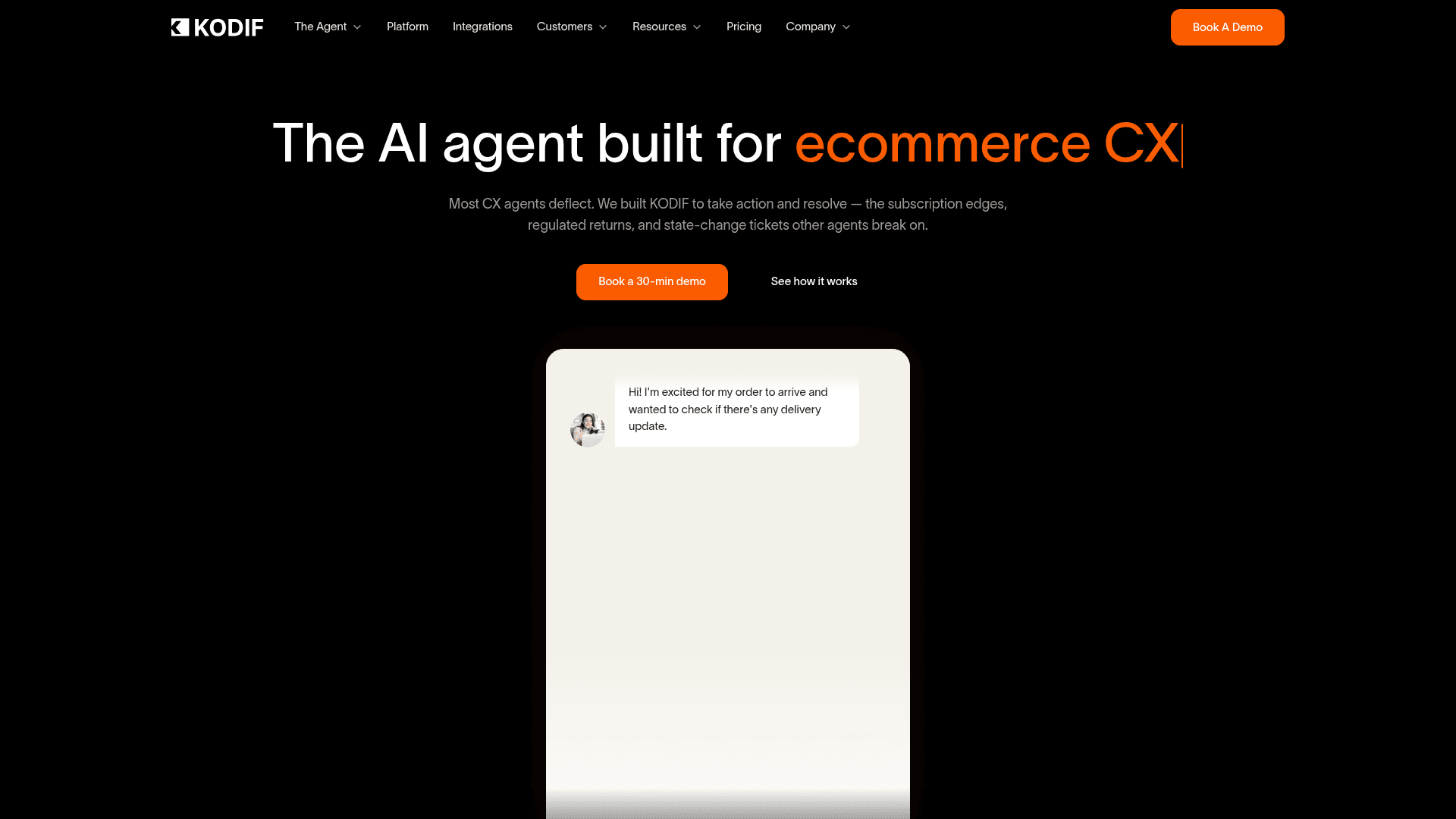
It sells one agent in three jobs. The Resolution agent handles refunds, returns, order status, shipping and order edits. The Retention agent runs subscription cancel-saves (pause, skip, discount, swap) and writes the result back to billing. The Revenue agent answers presale questions and adds to cart.
The team knows support automation. Per the Kodif about page, co-founder and CTO Norm built Uber's support automation platform, a system automating "150 million support requests a month." CEO Chyngyz Dzhumanazarov ran a 3PL company before Kodif, which shows in how deep the product goes on carriers and returns.
How Kodif gets built
Kodif is upfront that you don't build it alone. Its Resolution agent page says "Setup happens mostly on our side. We handle the integrations and the data, and partner with you on the policies." You write policies in plain English, AI Sam ("the agent that builds agents") helps assemble them, and everything runs in a sandbox "tested against your real history" before it goes live (Kodif platform).

The results its customers publish are strong. Helix Sleep reports 71.8% containment across 31,821 conversations from January to May 2026 (Helix case study), and Who Gives A Crap resolved 66% of chats end to end in Q1 2026 (case study).
What is eesel AI?
eesel is an AI teammate that joins your existing helpdesk like a new hire. You connect Gorgias, Zendesk or Freshdesk, and it reads your help center, macros and past tickets. Then it drafts replies as internal notes or sends them, tags and routes, and looks up orders in Shopify.

It also does ecommerce actions. The Shopify docs list order lookups, tracking, refunds, returns, address changes and cancelling unfulfilled orders. The Recharge integration finds a subscriber by email and skips, reschedules, updates an address or cancels. Every action can run on its own, wait for your approval, or stay off (actions and approvals).
How eesel gets built
You set it up by chatting with it. Tell it which tickets to answer and which to leave alone, and it writes that into its instructions. Before it touches a live ticket, its simulation skill runs it "against hundreds of your past tickets," scores each answer and suggests instruction changes (eesel skills).
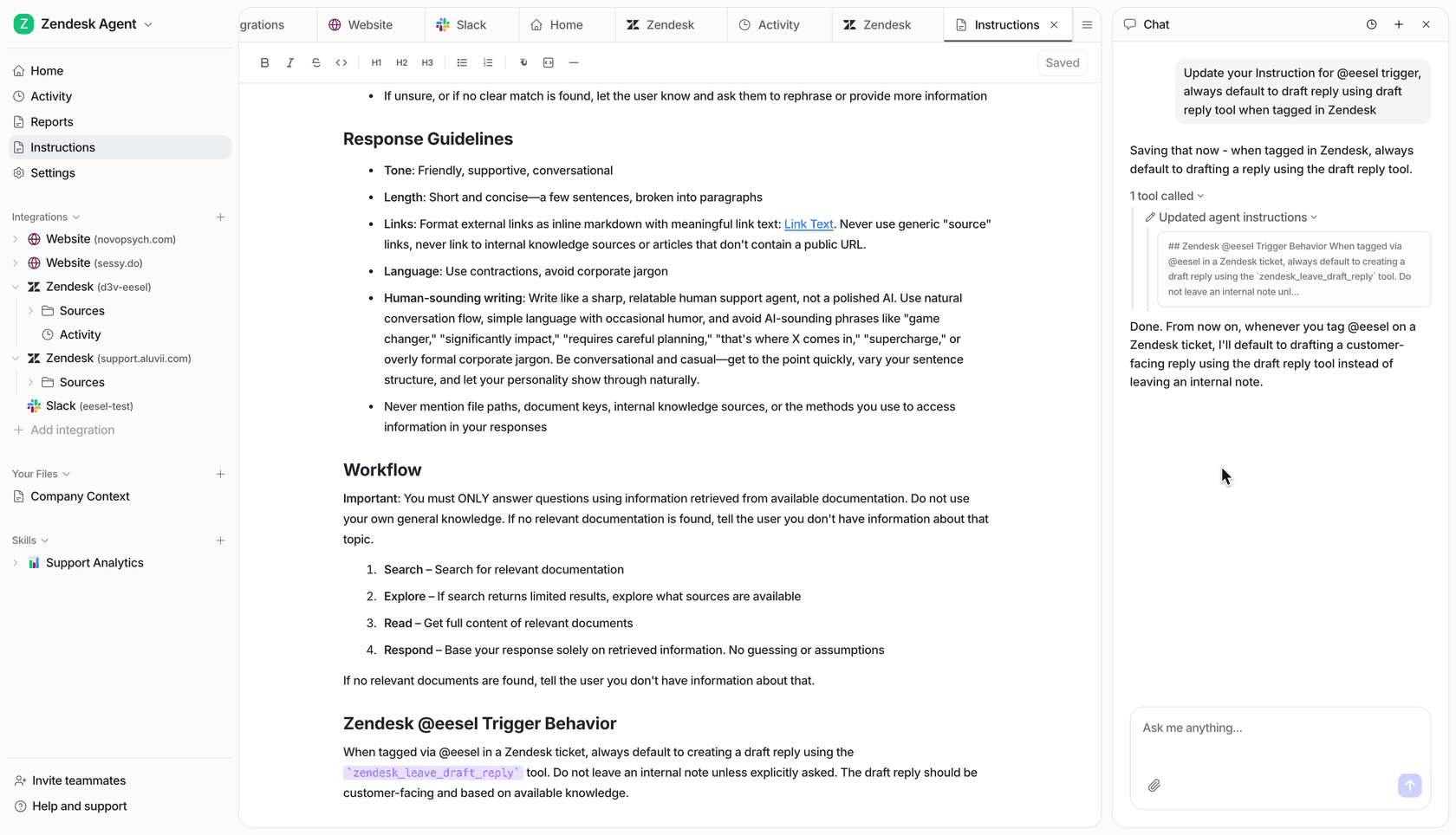
That's how the jewelry brand's tone problem gets fixed: you don't wait on anyone, you say "keep replies to three sentences and match how our team writes" and re-run the simulation. It's also why eesel works outside ecommerce. The same teammate answers internal questions in Slack or handles B2B support, which Kodif isn't built for.
Kodif vs eesel: building and changing the agent
This is the biggest difference, and it cuts both ways.
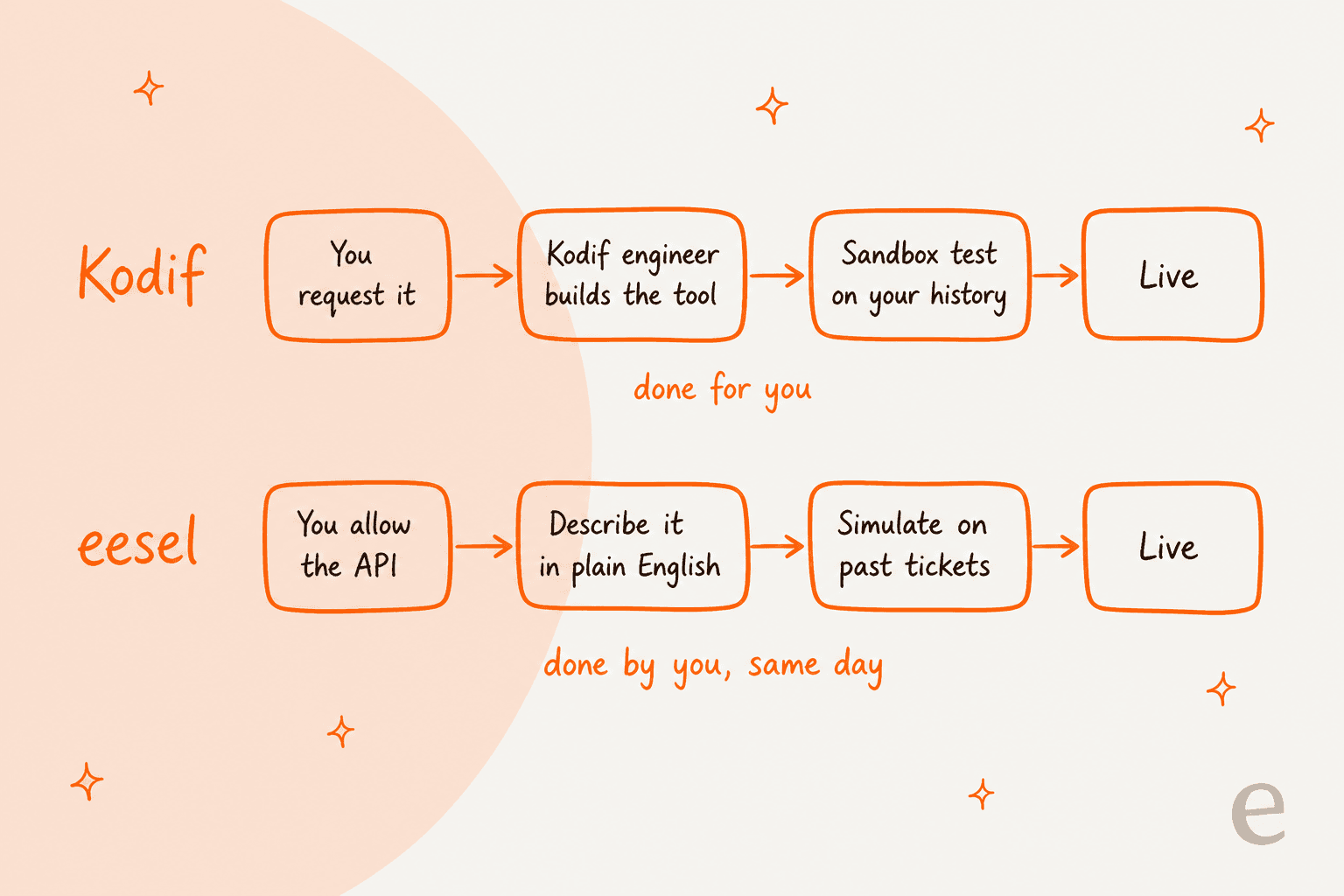
With Kodif, you get a team. Its pricing includes a dedicated onboarding manager, CSM and customer success engineer at every tier (Kodif pricing), and reviewers love them. Kodif also claims it builds a brand-new integration in "3hr" (Kodif integrations). If you have a small CX team with no technical help, having someone else do the wiring is worth real money.
The trade-off shows up in the G2 reviews. Plain-English policy editing is easy, but the tools underneath often need Kodif's engineers:
"Due to the complexity of automations, we do need a KODIF engineer to finish the policies, however they are very responsive and quick."

A retention team lead in another review asks for developer access, because they "always have to as[k] the Kodif Team to update a tool created by them" (G2). And G2's averages put Kodif's time to implement at 2 months, against the "9 days from contract to fully resolving tickets" on the Kodif homepage.
With eesel, the work is yours, and so is the speed. A new return rule is a sentence in the chat. A system eesel has no connector for goes in through Network Access: allow the domain, add the auth header, and describe what the agent should look up. If you have an engineer, the eesel CLI runs the same agent from a terminal. eesel instructions edits its rules, eesel approvals clears held actions, eesel activity shows what it did, and coding agents like Claude Code or Cursor can drive all of it. My guide to the AI agent CLI goes deeper on why that matters.
Here's the honest version: if nobody on your team wants to own the agent, eesel's speed doesn't help you, and Kodif's team does.
Ecommerce depth compared
Both cover the core ecommerce tickets: order tracking, returns, refund requests, address changes and subscription edits. The differences are at the edges.
Subscriptions and retention
This is Kodif's strongest ground. The Retention agent is a product of its own, with a "19% save rate on cancellation tickets" and "< 1 wk from kickoff to first saves" (Kodif Retention agent). Setup reads your last 90 days of cancellation history, which Kodif says takes "about 20 minutes of your team's time."
eesel can do the mechanics through Recharge and Stripe, and you can write a save offer into its instructions ("offer a skip before a cancel"). What it doesn't have is a prebuilt retention playbook with a published save rate. If cancellations are a top-three intent for you, that gap matters. My best AI for subscription businesses roundup and the AI for Gorgias and Recharge guide cover what to test.
Integrations and helpdesks
Kodif lists over 100 action-capable ecommerce connectors on its integrations page, including Skio, Ordergroove, Loop, Redo and 3PLs like ShipMonk. eesel's e-commerce docs cover Shopify, Magento, BigCommerce, WooCommerce, Stripe, Recharge, AfterShip and QuickBooks, and anything else goes through Network Access. If your stack is heavy on niche subscription or returns tools, Kodif has more of them prebuilt.
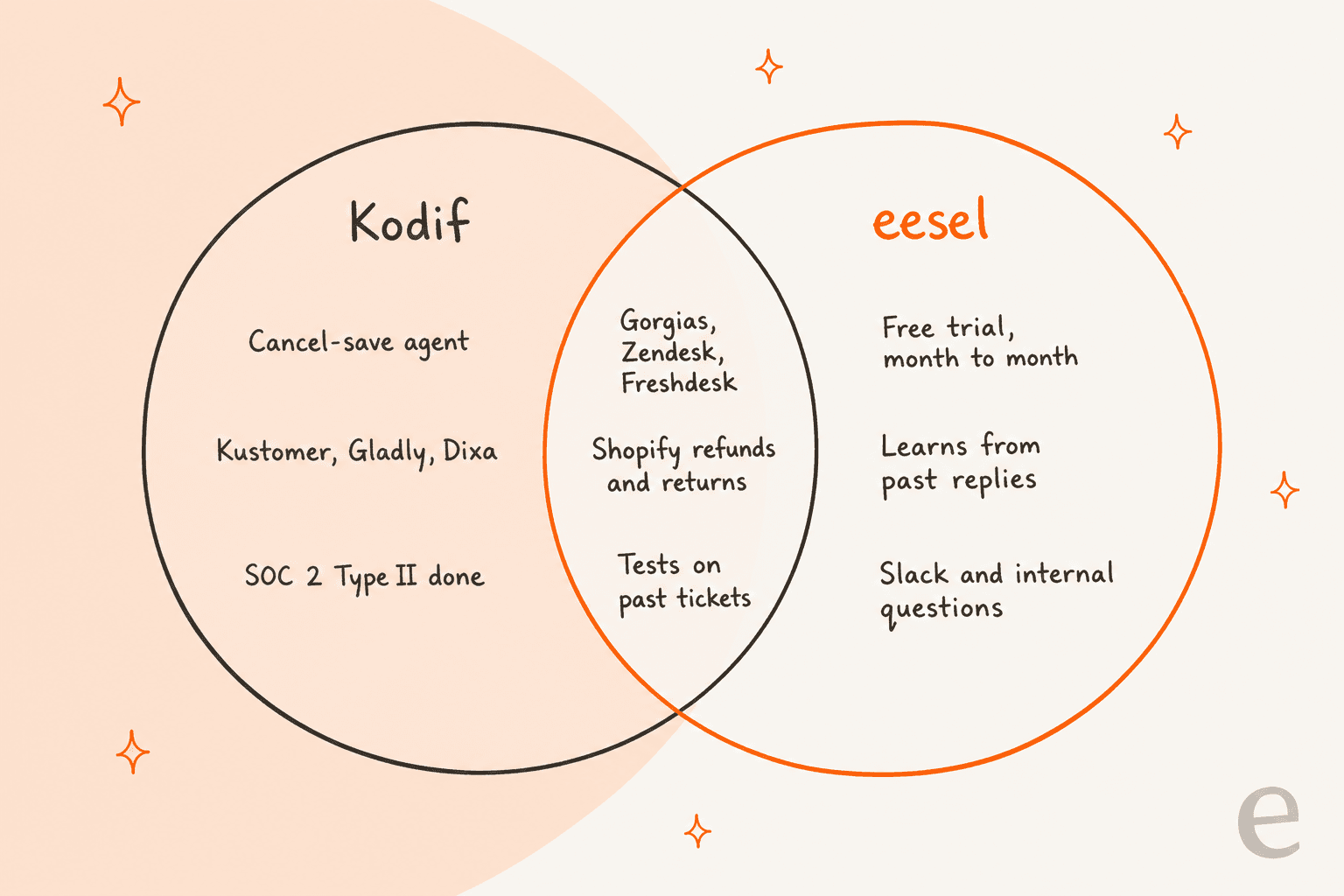
On helpdesks, Kodif covers Kustomer, Gladly, Genesys and Dixa, which eesel doesn't. eesel covers HubSpot, Help Scout, Front, Zoho Desk and Jira Service Management, which Kodif doesn't list.
On Gorgias, Zendesk and Freshdesk, both work. My best AI for Zendesk and best AI for Freshdesk roundups compare more options per helpdesk.
Channels
Kodif's Starter plan is chat only. Email, SMS and social need Growth ("Chat + 1 channel") or Enterprise ("All channels") (Kodif pricing). eesel includes every integration and channel on every plan, including email through your helpdesk, a website chat bubble, and Slack. Neither takes phone calls.
Security
Both are SOC 2 Type II certified. Its platform page says it's "SOC 2 Type II certified and HIPAA compliant" and meets ISO 27001, GDPR and CCPA. eesel's SOC 2 Type II is certified too, HIPAA with a BAA is Enterprise only, and data is never used to train the underlying models (eesel security docs). If your security team needs the SOC 2 report before procurement, both vendors can supply it. My notes on SOC 2 and GDPR for support chatbots list what to ask for.
Kodif vs eesel pricing
Both bill something close to "a ticket the agent worked," which makes this comparison fairer than most. Kodif counts a conversation the agent works "start to finish," and follow-ups on the same issue don't count twice. eesel counts a ticket or chat as one credit, however many replies it takes.
| Kodif | eesel | |
|---|---|---|
| What you pay for | Each conversation the agent works | Each ticket or chat handled (1 credit) |
| Entry | Starter: 24,000 conversations/yr at $1 (about $24,000) | Free: 100 credits. Teammate: 500 credits $299/mo |
| Mid | Growth: 75,000/yr, rate set on a sales call | 2,000 credits $849/mo, 5,000 credits $1,749/mo |
| Top | Enterprise: 160,000/yr at $0.75 (about $120,000) | Over 5,000/mo: talk to sales |
| Term | Flat annual | Monthly, or two months free paid annually |
| Overage | Billed at your plan's rate | Optional $0.80/credit, with a cap you set |
| Included help | Onboarding manager, CSM, support engineer | Standard support; priority support from $299/mo |
| Seats and setup | No seat or setup fees | No seat fees, unlimited agents |
| Sources | Kodif pricing | eesel pricing |
Two details to watch on Kodif's side. The annual totals are my arithmetic (volume times the stated rate), since Kodif publishes rates, not totals. And the Resolution agent page says "you pay for tickets the agent closes," while the pricing page bills every conversation the agent works. Ask which one goes in your contract.
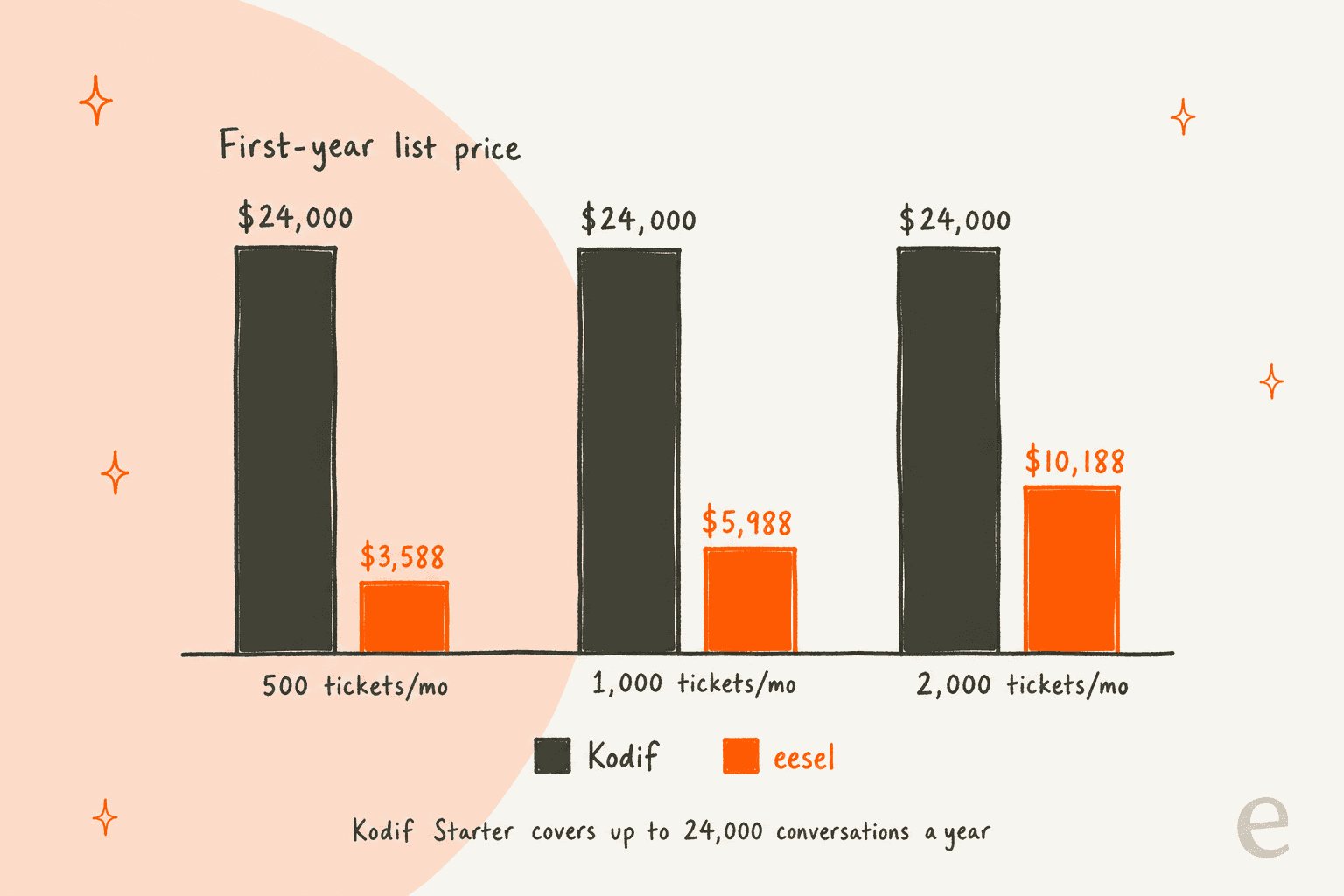
So here's the bit most comparisons miss: Kodif's Starter plan is a floor, not a meter. A brand doing 500 tickets a month pays the same $24,000 as one doing 2,000. That's fine if you're near 2,000 and want the included team. It's a lot of runway to buy if you're smaller. Plug your own volume in:
To be fair to Kodif, a big part of that gap buys people. If you'd otherwise hire a contractor to wire up Recharge, Loop and your 3PL, the included engineer narrows it fast. For a wider view of per-ticket math, see my cost per resolution breakdown and the AI customer service cost guide.
What reviewers say
Kodif holds 4.8/5 from 31 reviews on G2, with no review below 4 stars (G2). Nearly every review praises the Kodif team, and the results are concrete:
"By automating intent recognition, subscription actions, and policy handling through Kodif, we've achieved 69% AI containment, cut phone volume by 70%, and reduced email tickets by more than half"
The same reviewer says that happened within six weeks, coming from a first response time above 48 hours.
The asks are reporting, brand voice controls and self-service editing. One Head of CX wants "improved brand voice and tone controls," and another reviewer notes that editing the customer-facing flow "may require some training to perfect without additional support from the Kodif team" (G2). If brand voice is a priority for you, ask to see how tone is controlled on the demo.
eesel's own reviews are on G2 too. The fairer test than any rating, though, is the free plan: run it on your own past tickets and read the scores before you talk to anyone.
Which one should you pick?
Here's how I'd decide if I were running the queue.
| If you... | Pick | Why |
|---|---|---|
| Run a subscription brand where cancellations are a top intent | Kodif | Dedicated Retention agent with a published 19% save rate |
| Have no one on the team who wants to own the agent | Kodif | Its team does the build and the changes |
| Are on Kustomer, Gladly, Genesys or Dixa | Kodif | eesel doesn't support these helpdesks |
| Need a finished SOC 2 Type II report today | Kodif | Both hold it |
| Handle fewer than 2,000 tickets a month | eesel | Kodif Starter is a $24,000 floor |
| Need email automated from day one on a small plan | eesel | Kodif Starter is chat only |
| Want to test on your own past tickets before signing | eesel | Free plan plus simulation, no sales call |
| Want to change rules yourself, same day | eesel | Plain-English instructions and the CLI |
| Also want internal Slack answers or B2B support | eesel | Kodif is ecommerce only |
If you're on Gorgias specifically, my Gorgias AI Agent vs eesel post adds the native option, and Kodif vs Siena covers another managed rival. The best AI for ecommerce support roundup goes wider still.
Try eesel on your own ticket history
If Kodif's team-built approach sounds like more process than you need, eesel is the fastest way to find out. Connect your Gorgias or Zendesk queue, let it read your past tickets and macros, and run the simulation on last month's refund and "where's my order" tickets before a single customer sees a reply. You'll know in an afternoon whether its drafts sound like your team, and if they don't, you fix that yourself with one sentence.
It's month to month, with 100 free credits and no card. Try eesel and see what it does with last week's tickets.