


So, you're building something with generative AI, which is great. But you’ve probably hit that slightly nerve-wracking stage where you have to figure out how to keep your new application safe from all the strange things people might throw at it.
That’s where tools like Lakera into the picture. They offer a security layer to protect your AI from the wild west of the internet. But as you start looking around, the big question pops up: you know you need security, but what’s it actually going to cost? Hidden fees and confusing pricing can turn a great tool into a budget headache.
This guide will break down Lakera’s pricing for you. We'll go through what you get with each plan and what its pricing structure really means for your team.
What is Lakera?
At its core, Lakera is an AI-native security platform. Think of it less like an AI agent and more like a security guard or a "firewall" that sits between your AI application and the user. It inspects the prompts going in and the responses coming out to make sure everything is safe and above board.
Its main job is to handle the tricky parts of AI security, like:
-
Stopping prompt injections and jailbreaks where users try to trick the AI into doing something it shouldn't.
-
Protecting against data leaks by spotting and redacting personally identifiable information (PII).
-
Blocking harmful, toxic, or otherwise inappropriate content.
Lakera does this with its two main products: AI Agent Security (formerly Lakera Guard) for real-time protection and Lakera Red for AI-powered "red teaming" that actively hunts for weak spots in your system. Lakera has also been part of Check Point since October 22, 2025, when Check Point completed the acquisition for about $187 million. It's a technical tool built for developers and security folks who are getting their hands dirty and building their own AI apps from the ground up.
A full breakdown of Lakera pricing plans
Lakera keeps its pricing fairly straightforward with two main options: a free plan for developers who are just testing the waters and a custom enterprise plan for businesses ready to go live. Let's dig into what each one offers.
The Community Plan: Getting started for free
The Community plan is Lakera’s free tier. It's aimed at individual developers, researchers, and small teams who want to kick the tires on the platform without pulling out a credit card.
Here’s the rundown:
-
Cost: $0 per month. Totally free.
-
Requests: You get up to 10,000 API requests per month.
-
Prompt Size: Prompts can be up to 8,000 tokens each.
-
Hosting: It's SaaS-only, with your data stored in the EU.
-
Support: You’ll have access to community support forums.
This plan is a great way to experiment with AI security and see how Lakera works in a low-stakes environment. But with a cap on requests and community-only support, it isn't really cut out for production apps that need to handle real customer traffic and stay online no matter what.
The Enterprise Plan: The custom option
For businesses that need to roll out AI security on a larger scale, Lakera offers a custom Enterprise plan. This is their paid offering, and as you often see with enterprise software, the price isn't listed publicly. Instead, you'll find a friendly "Let's chat!" button, which is code for "you need to talk to our sales team for a quote."
This plan unlocks all the features you'd need for a real-world application:
-
Flexible request volumes and configurable limits on prompt size.
-
More deployment options, including SaaS or a self-hosted version if you want total control.
-
Proper enterprise-grade support with dedicated help.
-
Security and admin features like SSO, role-based access control (RBAC), and SIEM integrations.
-
More data residency options, including the US.
Lakera pricing comparison
Here’s a simple table that puts the two plans side-by-side, so you can see the key differences at a glance.
| Feature | Community Plan | Enterprise Plan |
|---|---|---|
| Price | $0 / month | Custom (Contact Sales) |
| Requests Included | 10k / month | Flexible & Configurable |
| Max Prompt Size | 8k tokens | Configurable |
| Hosting | SaaS (EU) | SaaS or Self-hosted (EU/US) |
| Support | Community | Enterprise-Level Support |
| SSO & RBAC | Not included | Included |
| SIEM Integration | Not included | Included |
| Ideal User | Developers, small projects | Businesses, production applications |
What Lakera's pricing model means for your business
Knowing the features is one thing, but it’s more useful to think about what this pricing structure implies for your team and budget.
The friction of opaque enterprise pricing
The "contact us" model is a classic enterprise sales move, but let's be honest, it creates a lot of friction for modern teams that want to move fast. It stops you from quickly estimating costs, comparing different tools fairly, or even running a small test without having to schedule a demo and talk to a salesperson.
This whole process can add weeks, if not months, to your timeline. While that might be fine for huge corporations with dedicated purchasing departments, it's a real roadblock for teams that just want to get things done. In a world where transparent, predictable pricing is becoming the standard, a sales-gated model can feel pretty dated.
Is it a security tool or a complete business solution?
This brings up a bigger question: are you looking for a security component to add to a custom-built AI app, or are you looking for a platform that solves a complete business problem, like automating your customer support?
Lakera is a specialized security tool. It does one thing, and it does it well, but it’s just one piece of the puzzle. If you use it, you’re still responsible for building, training, and managing the entire AI agent, connecting it to your knowledge sources, and figuring out its workflows. Lakera just guards the door.
For many businesses, the real goal isn't just "AI security", it's a business outcome, like "answer customer questions automatically" or "give our team a better internal Q&A tool." And for that, you need a lot more than just a firewall.
An alternative: Transparent platforms that solve problems end-to-end
For most businesses, a better path is to find a solution that gives you both the AI application and the security in one integrated package, all with clear, predictable costs.
Why predictable, transparent pricing matters for AI
Transparent pricing is a breath of fresh air, especially with AI, where usage can be hard to predict. The benefits are pretty clear:
-
No surprise bills: Plans based on a simple metric, like the number of AI conversations, mean your costs won't suddenly explode after a busy month. You don't get punished for being successful.
-
Budget with confidence: Your finance team can actually forecast expenses without having to guess what a mysterious enterprise quote might be.
-
Empowering teams: Anyone on your team can sign up, connect a data source, and see value in minutes, all without needing to get approval for a sales call.
How eesel AI provides a complete, transparently-priced solution
This is where a tool like eesel AI offers a different approach. It’s an all-in-one platform for AI support automation that’s built to be powerful, simple, and transparent. It isn’t just a security layer; it’s the whole package, with security built right in.
Here’s how eesel AI is different from a component tool like Lakera:
-
Get started in minutes: Instead of wrestling with APIs, eesel AI has one-click integrations with the tools you already use. You can connect it to your help desk, like Zendesk, and knowledge bases, like Confluence, and have a working AI agent in a few minutes, not a few months.
-
A complete workflow engine: eesel AI does more than just secure chats. It's a fully customizable engine that can answer questions, triage tickets, escalate issues to human agents, and even take custom actions by calling external APIs.
-
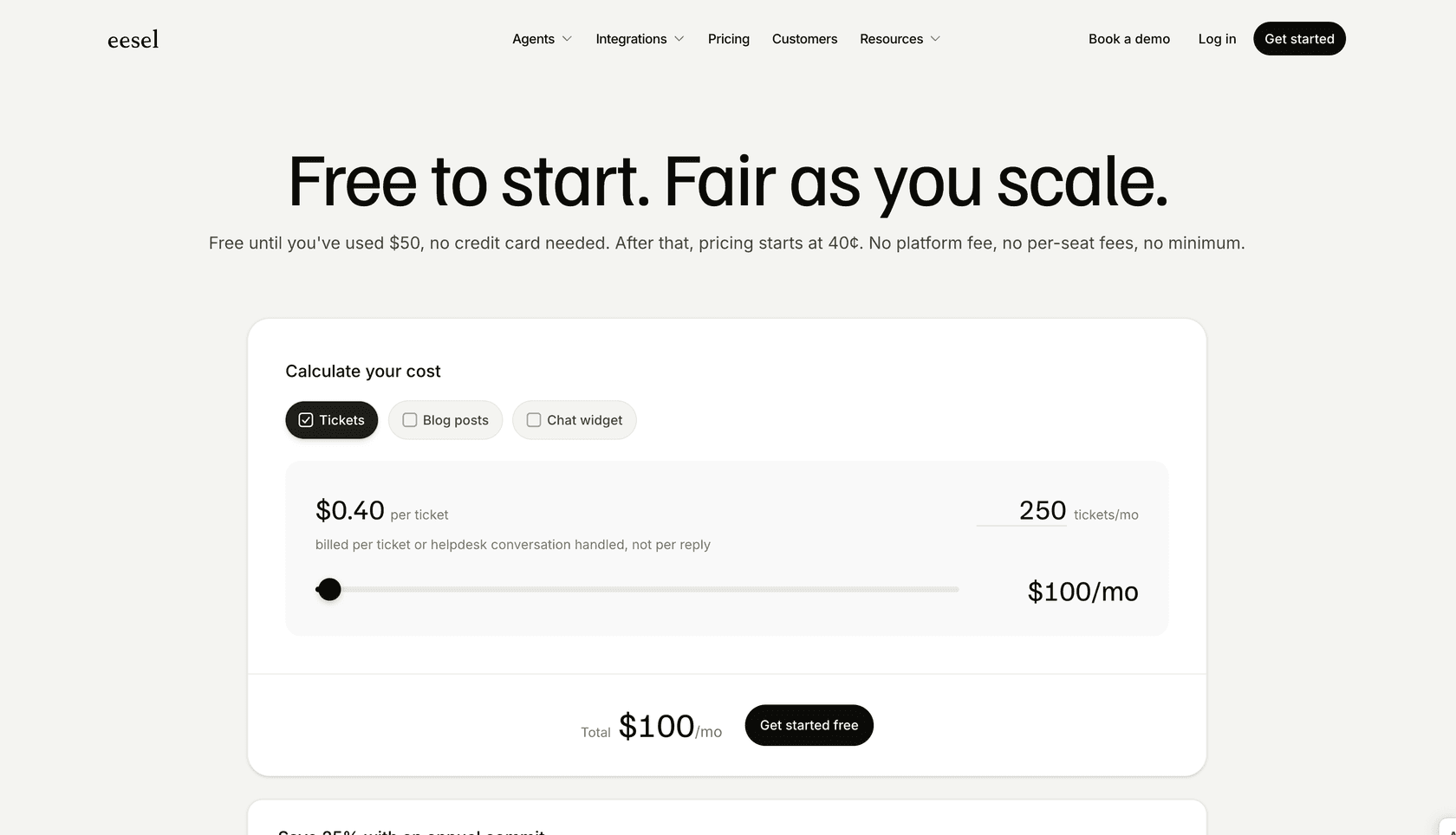
Transparent pricing: eesel AI’s pricing is public and easy to understand. Plans are fixed monthly batches of credits (a ticket or chat is 1 credit, from $299 for 500 credits), with no per-resolution fees. You can start on a monthly plan and cancel anytime, giving you the flexibility to grow without getting locked into a long-term contract.
Lakera pricing: Choosing the right tool for the right job
Lakera is a solid security tool for companies that have the engineering team to build their own generative AI apps from scratch. Its free tier is perfect for R&D, and its enterprise plan has the features needed to go live.
However, if your goal is to solve a business problem, like automating customer service or providing instant internal support, you probably need a complete, end-to-end platform. A standalone security tool is just one ingredient in a much larger recipe. For that, a solution that bundles the AI agent, knowledge management, workflow automation, and security into a single, transparently-priced package is likely the smarter choice.
Ready to try an AI platform with no hidden costs? Give eesel AI a try for free and see how quickly you can automate your support with confidence.
Frequently asked questions
What are the main options for Lakera pricing?
Lakera offers two primary pricing options: a free Community plan for developers and small projects, and a custom Enterprise plan for larger businesses. The Community plan provides basic access, while the Enterprise plan unlocks advanced features and dedicated support.
What is included in Lakera's free Community plan?
The Community plan is completely free and includes up to 10,000 API requests per month with prompt sizes up to 8,000 tokens. It's a SaaS-only offering with community support, ideal for testing and R&D.
Why isn't the Enterprise Lakera pricing publicly available?
The Enterprise Lakera pricing follows a "contact sales" model, common for solutions tailored to specific business needs and larger scale. This allows Lakera to provide custom quotes based on a company's unique requirements, usage volume, and deployment preferences.
Does Lakera offer self-hosting options for businesses?
Yes, the Enterprise Lakera pricing plan includes options for self-hosted deployment, giving businesses total control over their data and infrastructure. The Community plan, however, is exclusively SaaS-hosted in the EU.
How does the Lakera pricing model impact budgeting for an AI project?
The custom nature of Enterprise Lakera pricing can introduce friction and slow down cost estimation for budgeting. It requires direct engagement with sales, which might delay financial forecasting compared to platforms with transparent, self-serve pricing.
Is Lakera suitable for production-level AI applications?
Yes, the Enterprise Lakera pricing plan is designed for production applications, offering flexible request volumes, configurable prompt sizes, and enterprise-grade support. The free Community plan is generally not recommended for live production use due to its limits and community-only support.