

Trying to pick the right AI tool for your help desk can feel like a chore. The market is packed with options, and they all promise to slash your ticket volume and make your support team's life easier. If you're a Zendesk user, you've probably heard of Macha AI. It began as a handful of separate AI apps meant to give your agents a boost, and it now sells AI agents that resolve tickets.
So which version are you actually buying? In this honest Macha AI review, we’ll get into what it does today, make sense of its per-ticket pricing, and talk about some of its real-world limitations. We'll also look at an alternative that runs the same kind of automation on more helpdesks.
What is Macha AI?
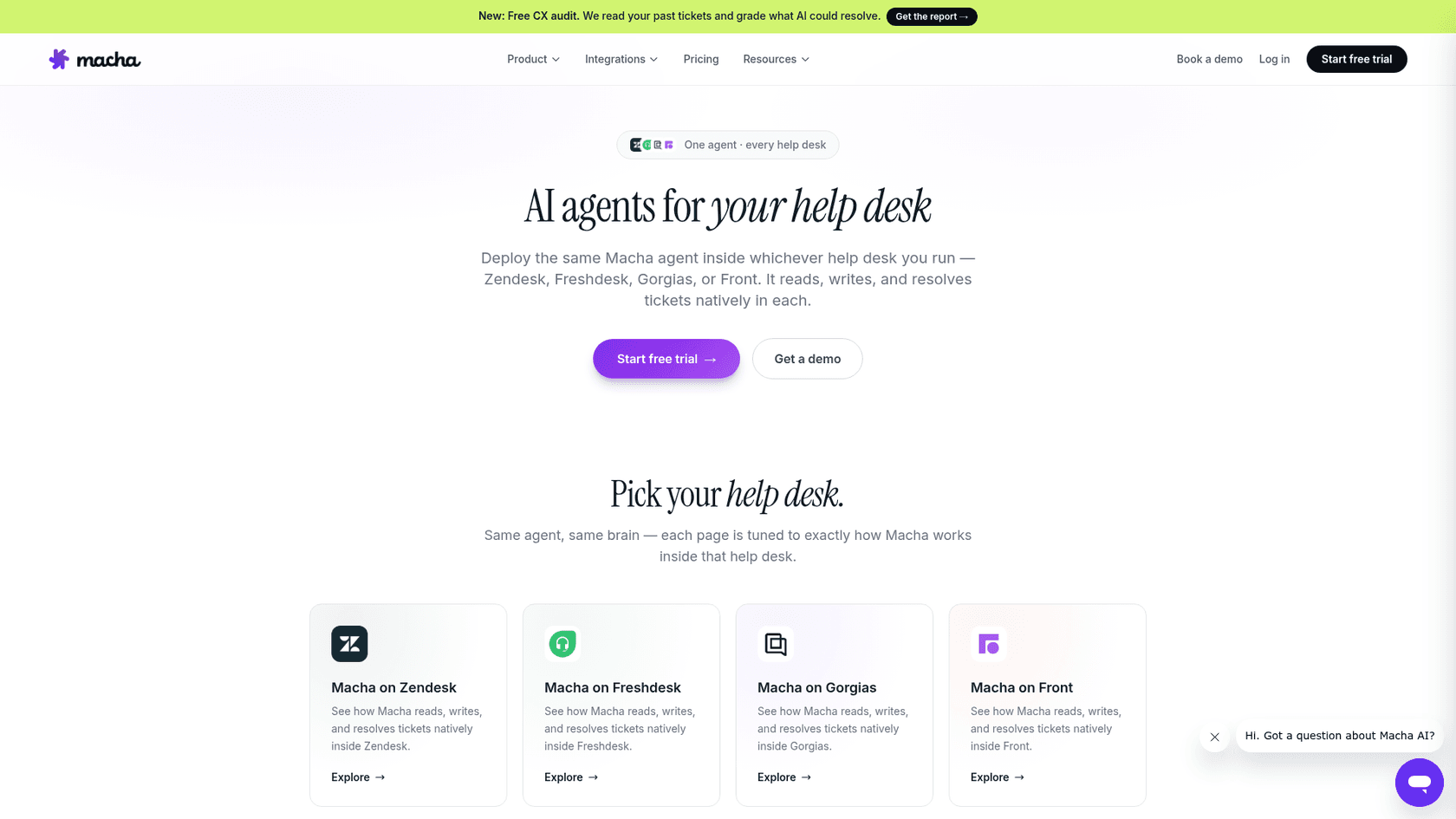
Macha AI sells itself today as AI agents that resolve tickets using your whole stack. You pick a ticket category, Macha's team builds an agent for it, and the agent works on top of Zendesk, Freshdesk, Gorgias or Front. The older Zendesk Marketplace apps, a set of separate tools for drafting, translating and summarizing, are where it started.
The agent can read the ticket, act in connected tools like Shopify, and either reply on its own or leave an internal note for a human to approve. The "AI Copilot" for your own agents is still included, as a sidebar inside Zendesk and a Chrome extension on other helpdesks. So the review below treats Macha as an agent platform with a copilot attached, not the other way around.
A breakdown of Macha AI's features
Macha AI's functionality began as four different apps and now lives in one dashboard. Let's break down what each of those jobs looks like today and see how it stacks up against another AI solution.
The AI email writer
The AI Email Writer is designed to help agents write replies faster. An agent can type in a few keywords, and the tool will expand them into a complete email. It can also adopt different AI personas to match your brand's voice, and Macha lists multilingual support on every plan, which is handy for global teams.
This is definitely useful for speeding up manual work. The quality of any suggestion depends on the context the AI has, and Macha's copilot can draw on your help center, past tickets and connected tools. A comparable AI copilot, like the one from eesel AI, trains on your company's entire history of support tickets, macros, and external knowledge docs from places like Google Docs and Confluence, on whichever helpdesk you run.
The AI ticket translator
This app is pretty self-explanatory. It figures out the customer's language and translates incoming tickets for your agent. The agent can then type a reply in their own language, and the app translates it back for the customer. It's a practical fix for teams that don't have multilingual agents on staff.
The AI ticket analyzer
The Ticket Analyzer gives agents a quick snapshot of a ticket. It generates a summary, tries to gauge the customer's sentiment, and pulls out any action items. The goal is to help agents get the gist of a conversation without having to read through a long email chain.
Summaries are great, and in the agent product the same analysis feeds the agent's decisions. Macha also has an AI Knowledge Builder that turns past Zendesk tickets into help articles. eesel AI does a similar job across helpdesks: it can spot recurring issues in your tickets, identify that you don't have a help article for it, and then automatically draft one based on a successful agent reply.
The AI ticket procedures
This feature is all about consistency. It tries to match tickets to your Standard Operating Procedures (SOPs), pulling info from your Help Center or Notion to show agents the next step they should take.
This is good for training new agents and keeping everyone on the same page. In Macha's agent product the same runbook is read by the agent, which can then call your tools, including custom API tools, to do the steps. With the customizable workflow engine in eesel AI, you can build an AI Agent that does something similar, such as calling an external API to check an order status in Shopify or automatically sending a ticket to the right department based on its content.
Understanding Macha AI pricing
Price is always a huge piece of the puzzle, and if you’ve scrolled through Reddit threads on Zendesk apps, you know there’s a lot of confusion out there. Macha has changed its model since the per-seat days. Its pricing page now bills per ticket, starting at $299 a month for 750 tickets, with unlimited team seats and the full platform on every plan.
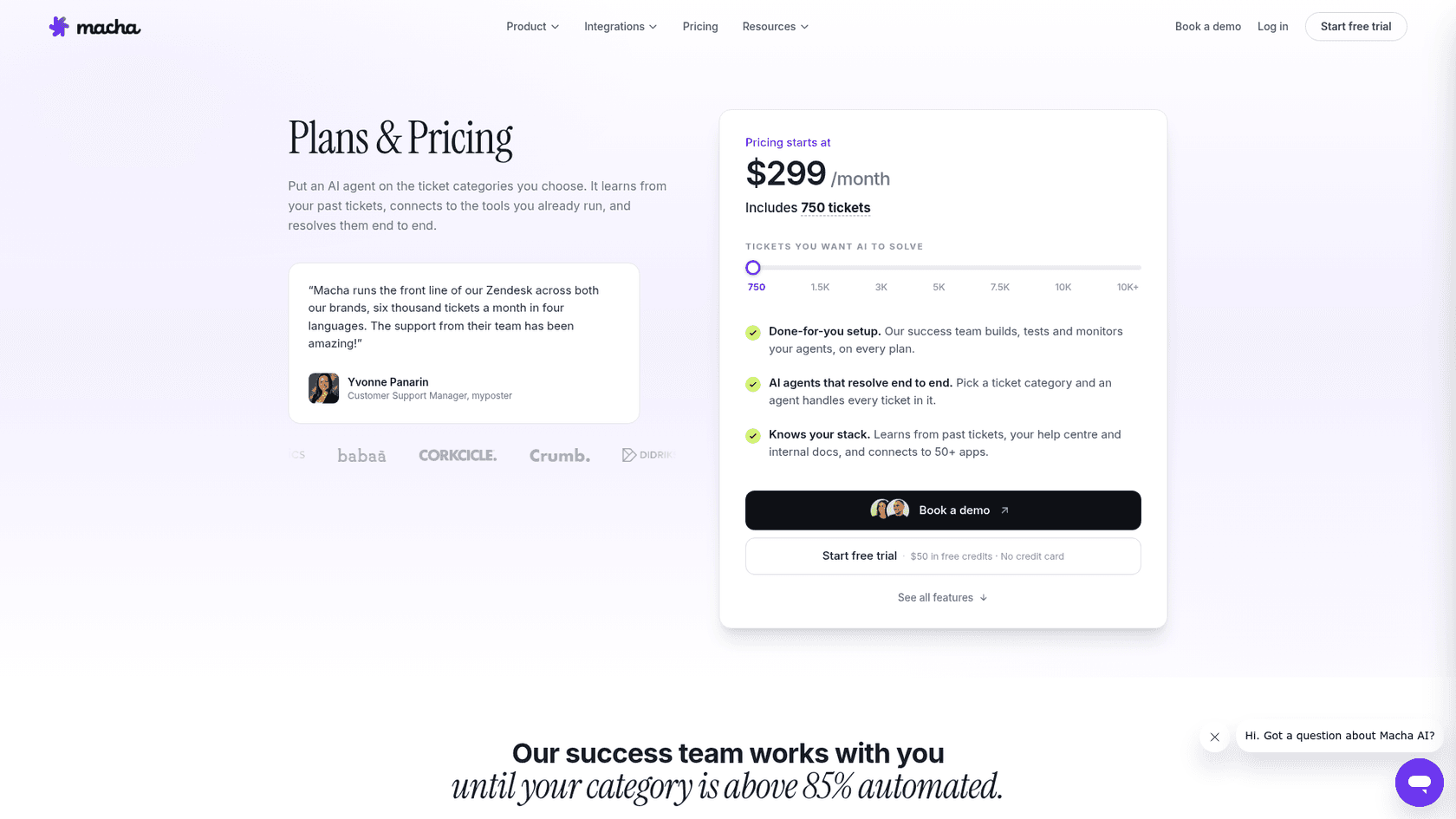
The ladder Macha publishes works out to about $0.40 per ticket at every step:
| Tickets per month | Price per month |
|---|---|
| 750 | $299 |
| 1,500 | $599 |
| 3,000 | $1,199 |
| 5,000 | $1,999 |
A ticket is one whole conversation, so a twenty-message live chat costs the same as a one-touch email, and Macha says it does not bill per resolution. There are no overage charges: when the month's tickets run out, agents pause until the billing date. Trial credits are $50, roughly 125 tickets, with no card.
The upside is that the bill follows your volume, not your headcount, so a 20-person team and a 5-person team with the same tickets pay the same. The trade-off is that you pay for the plan in a quiet month, and a ticket the agent only triages still counts. If you size the plan below your real volume, the agents pause mid-month, so I would size it to your busiest week.
This is also where eesel AI differs in shape. Its plans are fixed monthly prices sized to volume, from $299 a month for 500 credits, where one credit covers one ticket or chat, with no per-seat fee. Per ticket, Macha's published rate is lower than eesel's smaller plans, so I would compare both at your own volume.
| Feature | Macha AI | eesel AI |
|---|---|---|
| Pricing Model | Per ticket, unlimited seats | Fixed monthly plan, credits per ticket or chat |
| Base Price | $299/month for 750 tickets (about $0.40 each) | $299/month for 500 credits |
| Scaling Cost | Moves up the ticket ladder | Moves up the credit plans |
| Ideal for | Zendesk-led teams wanting done-for-you setup | Teams on any helpdesk, especially if they run more than one |
The case for a unified platform: Macha AI's limitations
When you look at the features and pricing together, a few limits of Macha AI's approach are worth checking before you buy.
-
Its deepest features sit on Zendesk. Macha now lists Zendesk, Freshdesk, Gorgias and Front, but its docs describe simulations as running over past Zendesk tickets only, and the Marketplace listings are Zendesk's. A team on another helpdesk gets the agents and the Chrome copilot, with fewer of the Zendesk-specific extras. A platform like eesel AI runs the same feature set across its connected helpdesks.
-
Automation is per category, and it is staffed by Macha's team. Macha is no longer just an agent-assist tool: an agent handles every ticket in a category you choose. The catch is that categories are scoped with Macha's success team, so the pace of rollout depends on that conversation. The AI Agent from eesel AI is built to resolve tickets from start to finish with a self-serve setup, which lets your team focus on the tricky, high-value problems that actually require a human touch.
- Testing exists, with limits you should know. Before you unleash an AI on your customers, you want to be pretty darn sure it's going to work correctly. Macha's Agent Simulations replay past Zendesk tickets with write tools stubbed, and its docs say read tools fetch live data, so it is a strong preview and not an exact replay. eesel AI includes a simulation mode that runs the AI over thousands of your past tickets in a safe, offline environment on any connected helpdesk. That gives you a clear forecast of your automation rate and lets you check the quality of its responses before it ever interacts with a real customer.
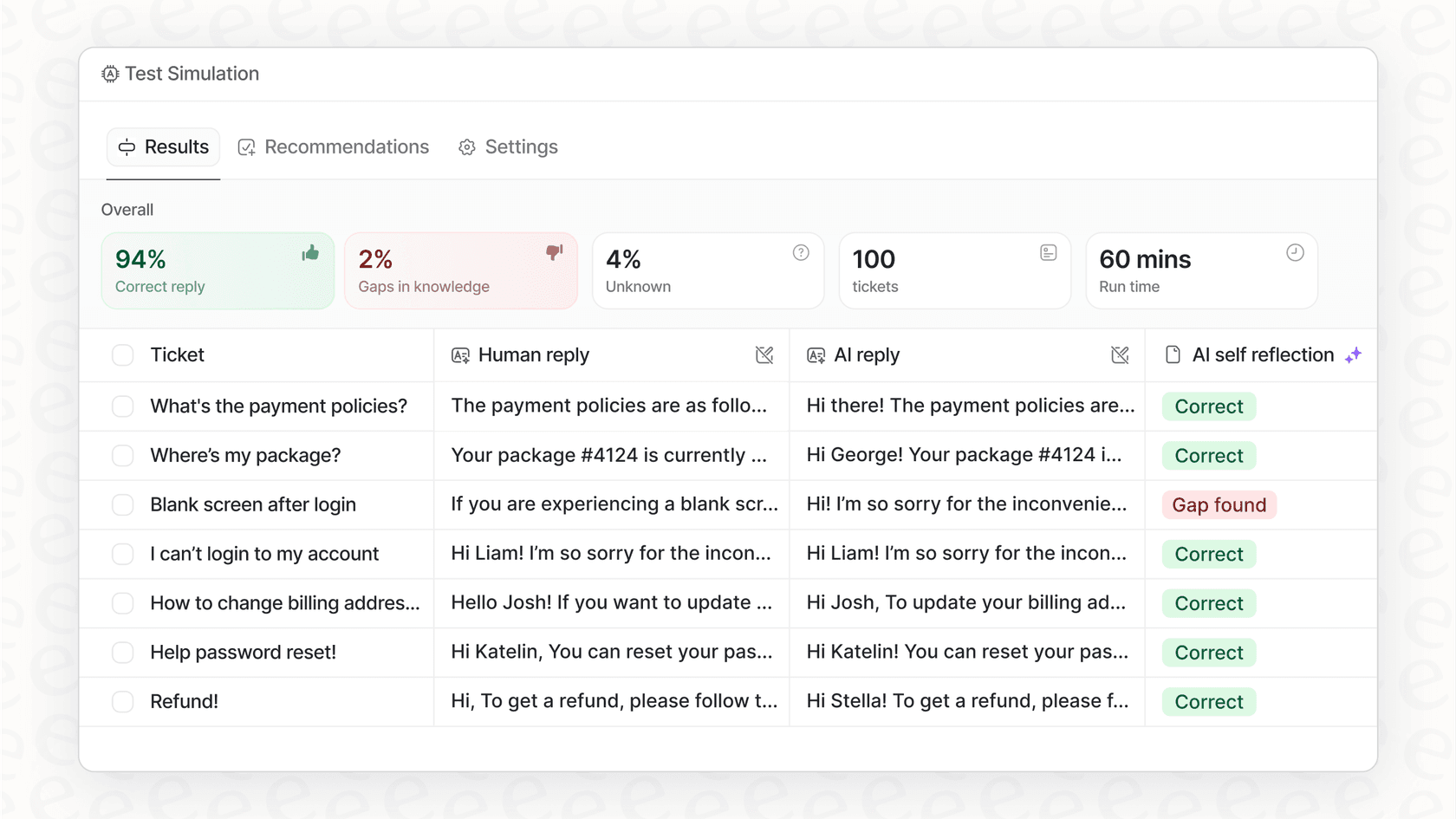
eesel AI's simulation mode lets you test your AI agent's performance on past tickets before going live.
eesel AI: A more powerful alternative
If you run a helpdesk where Macha's Zendesk-specific features don't apply, eesel AI is worth a look. It's a single AI platform built for automation on the helpdesk you already run.
Both products are built around an autonomous AI Agent. Macha takes knowledge from your help center, uploaded files, crawled sites and tools like Notion and Google Docs, while eesel connects to over 100 sources, including all your past tickets, Google Docs, and Confluence.
Both can take custom actions: Macha through custom API tools, eesel by making API calls, tagging tickets, and routing conversations. And while Macha pairs a free trial with a success team that builds your agents, eesel AI is designed to be self-serve, letting you get up and running in minutes.
| Feature | Macha AI | eesel AI |
|---|---|---|
| Core Function | AI agents per ticket category, plus a copilot | AI Agent, copilot and triage |
| Knowledge Sources | Help center, files, crawls, Notion, Google Docs | 100+ sources (past tickets, docs, etc.) |
| Custom Actions | Yes (custom API tools) | Yes (API calls, tagging, routing) |
| Setup | Free trial plus done-for-you success team | Self-serve (live in minutes) |
| Testing | Agent Simulations on past Zendesk tickets | Simulation Mode on past tickets, any connected helpdesk |
| Helpdesks | Zendesk, Freshdesk, Gorgias, Front | Zendesk, Freshdesk, Gorgias, Front, HubSpot and more |
With eesel AI, you connect all your scattered knowledge into one intelligent brain. Then, you use its easy-to-configure workflow engine to build an AI agent that can answer questions, look up order details, and escalate to a human when needed, all by itself. It’s a system designed for automation you can actually trust.
Making the right choice for your support team
Macha AI offers a credible agent platform for Zendesk teams who want per-ticket pricing around $0.40 and a success team to build the agents with them. If your tickets sit in Zendesk and you want simulations on your own history, it fits.
If you run a different helpdesk, or more than one, the Zendesk-specific parts matter more, and it's worth pricing the same volume elsewhere. The future of support isn't just about making humans faster; it's about freeing them from the boring, repetitive work altogether.
For that on any helpdesk, eesel AI gives you the tools to not just help your agents, but to automate your frontline support with an AI you can test on your own ticket history first.
Ready to try true AI automation? Sign up for eesel AI and go live in minutes, not months.
Frequently asked questions
What is the main takeaway from this Macha AI review regarding its core purpose?
This review finds that Macha AI has grown from a set of Zendesk copilot apps into an agent platform. It still ships an "AI Copilot" for human agents, and it now also sells AI agents that resolve tickets, priced per ticket.
Does this Macha AI review explain the pricing model for Macha AI?
Yes, the review walks through Macha AI's per-ticket model. Plans run from $299 a month for 750 tickets to $1,999 for 5,000, about $0.40 per ticket at every step, with unlimited seats and no overage, so the cost scales with ticket volume rather than headcount.
According to this Macha AI review, what are some of Macha AI's significant limitations?
The review points out that Macha's simulation feature is documented for Zendesk tickets only, that you pay the plan fee in a quiet month, and that agents pause when the month's tickets run out. It also notes that Macha's own docs describe evaluation as grading after the fact, not a live gate, so agent assistance versus automation is a setting you choose per agent.
This Macha AI review discusses eesel AI as an alternative; what makes it stand out?
The review presents eesel AI as a unified platform built for true automation with an autonomous AI Agent. It connects to over 100 knowledge sources and features a simulation mode for testing, focusing on resolving tickets autonomously rather than just assisting.
Based on this Macha AI review, how effective is Macha AI for full customer support automation?
The review finds Macha can do full automation for the ticket categories you choose: an agent handles every ticket in a category, calls connected tools and replies or leaves a note for approval. Its own pricing page frames the target as a category above 85% automated, which is a goal Macha's success team works toward with you.
What does this Macha AI review say about using Macha AI to proactively address knowledge gaps?
Macha's AI Knowledge Builder turns past Zendesk tickets into help articles, so it does address knowledge gaps on Zendesk. eesel AI does a similar job on other helpdesks and can spot recurring issues and draft new help articles from successful agent replies.