

When you start looking into AI for your business, it can feel like you’re stuck between a rock and a hard place. You could go with a generic, off-the-shelf model like GPT-4, or you could sink a ton of time and money into building something completely custom. For companies that want to use their own data to create specialized AI, this has always been a tough spot to be in.
This is exactly the problem a tool like Predibase is trying to solve. It’s a platform made for developers that aims to make fine-tuning and serving open-source Large Language Models (LLMs) easier and cheaper.
You might have also seen Predibase in the news recently because it was acquired by the data security giant Rubrik. This move points to a bigger trend: building secure AI that big companies can trust. In this article, we’ll walk you through what Predibase actually does, its main features, its slightly confusing pricing, and who it’s really for.
What is Predibase?
Put simply, Predibase is a low-code platform for AI engineers and developers. It lets them take powerful open-source models (like Llama 3 or Mistral) and customize them for specific jobs. The whole point is to cut down on the cost and headache of getting a production-ready AI model up and running by providing super-optimized infrastructure.
The company was started by a team of AI folks from Google and Uber who also created popular open-source tools like Ludwig and LoRAX, which are the guts of the Predibase platform. The recent buyout by Rubrik is a strategic move to blend secure data management with powerful AI tools, hopefully giving large enterprises the confidence to roll out AI more broadly.
Core features and capabilities of Predibase
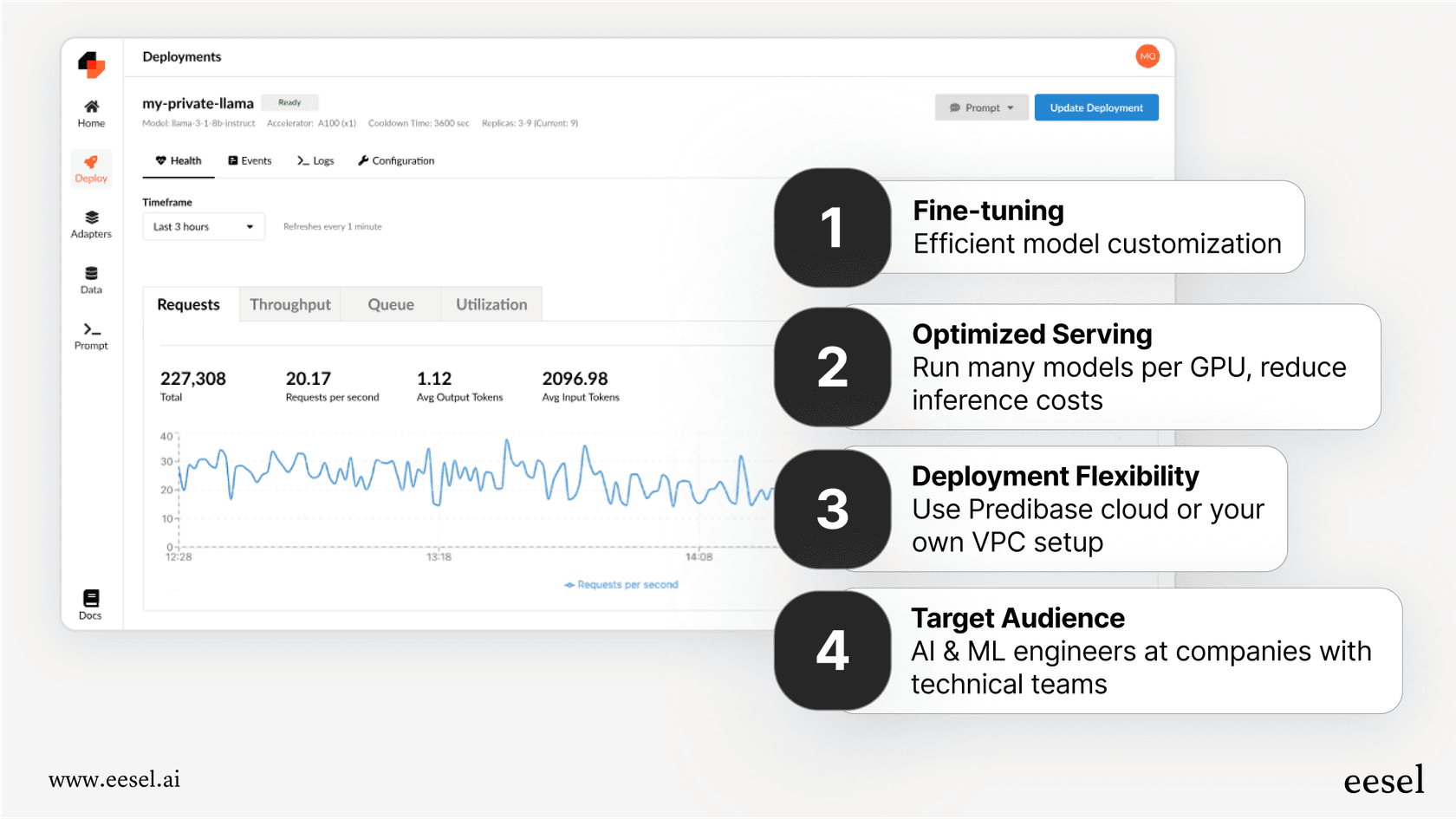
The Predibase platform is built around three main capabilities. They're definitely powerful, but they are designed for a technical crowd, which is a key thing to keep in mind when you're deciding if it’s the right tool for your team.
Fine-tuning open-source LLMs
Fine-tuning is just the process of taking a general AI model and training it on your company’s own data. It’s how you turn a jack-of-all-trades model into an expert on your specific business, whether that’s knowing your product catalog inside and out or talking in your brand’s voice.
Predibase uses advanced methods like LoRA (Low-Rank Adaptation) and RFT (Reinforcement Fine-Tuning) to make this process more efficient. But let's be clear, these are deeply technical processes. They require a solid grasp of machine learning and mean you have to spend a lot of time carefully preparing and labeling data. This isn't a simple, plug-and-play tool for a customer support team that just wants to automate some of their work.
For a much simpler route, platforms like eesel AI take care of all this for you. Instead of worrying about RFT or LoRA, you just connect your help desk and knowledge bases with a few clicks. eesel AI automatically learns from your old support tickets, help center articles, and internal documents. The focus shifts from machine learning methods to business results.
Optimized model serving and inference
"Inference" is the fancy word for when your trained model actually does its job, spitting out answers, analyzing text, or whatever task you gave it. This part of the process is often the most expensive part of using AI because it eats up a lot of computing power.
Predibase has its own tech to deal with this, called LoRAX and Turbo LoRA. LoRAX is pretty neat; it lets you run hundreds of different fine-tuned models on a single GPU. According to Predibase, this can cut infrastructure costs by up to 80% and make things run four times faster.
The catch? Your team is still responsible for managing, monitoring, and scaling all that GPU infrastructure. Predibase makes it more efficient, but it doesn't make the work disappear. It's a solution for engineers, but it doesn't remove the need for them. In contrast, a fully managed tool like eesel AI handles all of that in the background. You never have to think about GPUs or inference engines. You just focus on setting up your support workflows, and the platform worries about performance and costs.
Deployment flexibility (your cloud or ours)
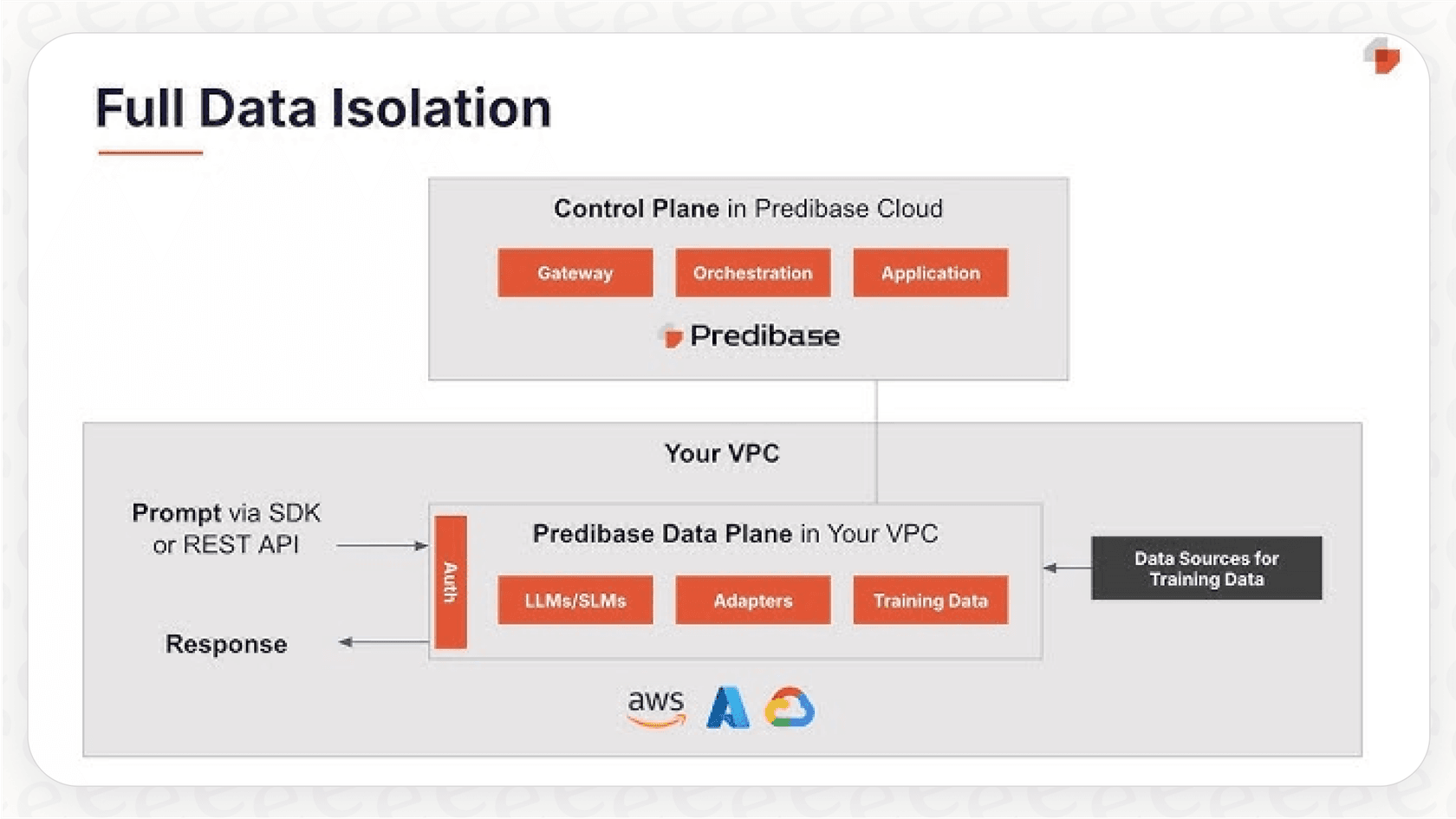
Predibase offers two ways to set things up: a managed service called Predibase AI Cloud, or a Virtual Private Cloud (VPC) deployment that runs inside your company’s own cloud environment (like AWS, Azure, or GCP).
The VPC option is a big plus for large companies with strict data security rules, since it means their data and models never leave their own servers. The downside is that setting up a VPC is a major IT project. It gives you maximum control, but it also takes Predibase even further away from being a simple, self-serve tool.
For most businesses, that level of control is probably overkill. eesel AI offers top-notch security, including GDPR compliance, a SOC 2 Type II certification, and optional EU data residency, all within a simple SaaS setup. It securely connects to your tools in minutes, so you get peace of mind without needing a six-month IT project to get going.
Predibase pricing explained
AI infrastructure pricing can be a real headache, full of confusing terms and unpredictable bills. The Predibase model is great for technical teams who can constantly monitor and adjust their setup, but it can create a lot of budget anxiety for business leaders who need to know what they're spending each month.
Fine-tuning costs
When you fine-tune a model with Predibase, you pay based on the number of "tokens" (which are like pieces of words) you process. The price per million tokens changes depending on the size of the model and the technique you use. This makes it really hard to guess your costs upfront because they depend on how big your dataset is and how many times you train the model.
| Fine-Tuning Method (Model Size) | Price (per 1M tokens) |
|---|---|
| SFT, Continued Pretraining (LoRA, Turbo) - Up to 16B | $0.50 |
| SFT, Continued Pretraining (LoRA, Turbo) - 16.1 to 80B | $3.00 |
| SFT, Continued Pretraining (Turbo LoRA) - Up to 16B | $1.00 |
| SFT, Continued Pretraining (Turbo LoRA) - 16.1 to 80B | $6.00 |
| RFT GRPO (LoRA) - Up to 16B | $10.00 |
| RFT GRPO (LoRA) - 16.1 to 32B | $20.00 |
Inference costs
When it’s time to actually run your models, you get billed by the second for the GPUs you use. This is a classic pay-as-you-go model. The danger here is that you can easily end up paying for computers sitting idle if your usage drops, or you could hit performance bottlenecks if you don't scale up fast enough when things get busy.
| Hardware | Base Price ($ / hr) |
|---|---|
| 1 L4 (24 GB) | $2.14 |
| 1 A10G (24 GB) | $2.60 |
| 1 L40S (48 GB) | $3.20 |
| 1 A100 (80 GB) | $4.80 |
| 1 H100 (80 GB) | Enterprise-only |
The hidden costs and a simpler alternative
The Predibase pricing model is really for technical teams who know how to fiddle with infrastructure to save money. For a business leader, this just looks like a recipe for unpredictable bills.
On the other hand, eesel AI has clear, predictable pricing based on a fixed number of AI interactions per month. There are no surprise fees and no hourly charges for GPUs. This lets support and IT leaders set a budget and stick to it, even as their usage grows.
The Rubrik acquisition: What it means for Predibase
In early 2025, the news came out that data security company Rubrik was buying Predibase. It’s a move that makes a lot of sense when you think about it. Rubrik helps thousands of companies keep their data secure, and with Predibase, they can now give those customers the tools to build AI models right on top of that secure data. The stated goal is to get more companies using "agentic AI", AI that can actually do things, in a safe way.
For anyone considering Predibase, this acquisition really solidifies its identity as a deep, technical infrastructure platform for large enterprises. Its future will likely be all about tight integrations with Rubrik’s security products, aimed at huge organizations with established AI teams and serious security needs. It just reinforces that Predibase isn't trying to be a simple tool that a department head can just pick up and use.
Is Predibase the right tool for you?
So, after all that, who is Predibase really built for? The ideal Predibase customer is a company that has its own team of AI and machine learning engineers. This team needs a cheaper way to manage a bunch of custom open-source models. They already know how to build the AI application itself; they just want someone else to handle the messy underlying infrastructure.
For just about everyone else, Predibase comes with a few big hurdles:
-
It’s highly technical. This isn't a tool for a Head of Support or an IT Manager. To use it well, you need to know how to code and have a background in machine learning.
-
The costs are unpredictable. The pay-as-you-go pricing makes it almost impossible to know what your bill will be at the end of the month, which is a deal-breaker for most departmental budgets.
-
It’s an engine, not a car. Predibase gives you a really powerful engine, but you still have to build the rest of the car around it. Your team has to create the actual application, the user interface (like a chatbot), and all the workflows (like rules for sorting support tickets).
A simpler alternative for support automation: eesel AI
If your main goal is to solve a business problem, like cutting down on support tickets, making your agents more efficient, or giving employees instant answers, then a ready-to-go application is a much faster and better way to get there.
eesel AI is a platform built specifically for customer service and internal support that you can set up in minutes, not months.
-
It’s truly self-serve. You can connect your help desk, knowledge sources, and chat tools with one-click integrations. You don't have to talk to a salesperson or write any code to get your first AI agent built and tested.
-
Business users are in control. A simple, friendly interface lets you decide exactly which tickets the AI should handle, tweak its personality, and even give it special powers, like tagging tickets in Zendesk or looking up order info from Shopify.
-
You can try it risk-free. Before you turn your AI on, eesel AI can run a simulation on thousands of your past tickets. This shows you exactly what your automation rate and ROI will be, so you can make decisions based on real data. It's a feature built for business leaders, not infrastructure engineers.
Final thoughts on Predibase
There's no question that Predibase is an impressive piece of technology for the right audience. With its efficient infrastructure and the backing of a security heavyweight like Rubrik, it’s a solid choice for technical teams at large companies building custom AI from scratch.
But at the end of the day, it's a specialized infrastructure tool, not a ready-made solution for common business problems. If you're looking to quickly use AI to automate customer service or power an internal help desk, a dedicated, user-friendly platform is the way to go.
eesel AI offers a faster, simpler, and more predictable way to get there, letting you focus on improving your business instead of managing your infrastructure.
Ready to see how easy AI-powered support can be? Start your free eesel AI trial today.
Frequently asked questions
What exactly is Predibase, and what problem does it aim to solve?
Predibase is a low-code platform for AI engineers and developers, designed to simplify and reduce the cost of fine-tuning and serving open-source Large Language Models (LLMs). It helps companies customize AI models with their own data without building everything from scratch.
Who is the ideal customer or team that would benefit most from using Predibase?
The ideal customer for Predibase is a company with its own team of AI and machine learning engineers. They need an efficient way to manage numerous custom open-source models and are primarily looking for infrastructure support, not a ready-made application.
How does Predibase make fine-tuning open-source LLMs more efficient?
Predibase uses advanced methods like LoRA and RFT to make the fine-tuning process more efficient. It also offers optimized model serving with technologies like LoRAX and Turbo LoRA, which can significantly cut infrastructure costs and improve speed by running multiple models on a single GPU.
Can you explain the pricing model for using Predibase for fine-tuning and inference?
Predibase charges for fine-tuning based on the number of "tokens" processed, with prices varying by model size and technique. For inference, costs are billed by the second for GPU usage, following a pay-as-you-go model that can lead to unpredictable expenses.
What are the implications of the Rubrik acquisition for the future of Predibase?
The Rubrik acquisition solidifies Predibase's identity as a technical infrastructure platform for large enterprises. It aims to integrate secure data management with powerful AI tools, enabling big companies to adopt "agentic AI" more confidently and securely.
What are the main challenges or hurdles when adopting Predibase for a business?
Adopting Predibase requires a highly technical team with machine learning expertise, as it's an infrastructure tool, not a plug-and-play solution. Its pay-as-you-go pricing model can also lead to unpredictable costs, making budget management difficult for business leaders.
Does Predibase offer flexible deployment options, like on-premise or cloud?
Yes, Predibase offers deployment flexibility with two main options: a managed service called Predibase AI Cloud, or a Virtual Private Cloud (VPC) deployment that runs within a company’s own cloud environment (like AWS, Azure, or GCP). The VPC option provides maximum control for strict security needs.