


What is Puddin AI?
Puddin AI calls itself a "writing-process verification platform." The one-line version: it proves a piece of writing was written by a human, "not by guessing, but by evidence."
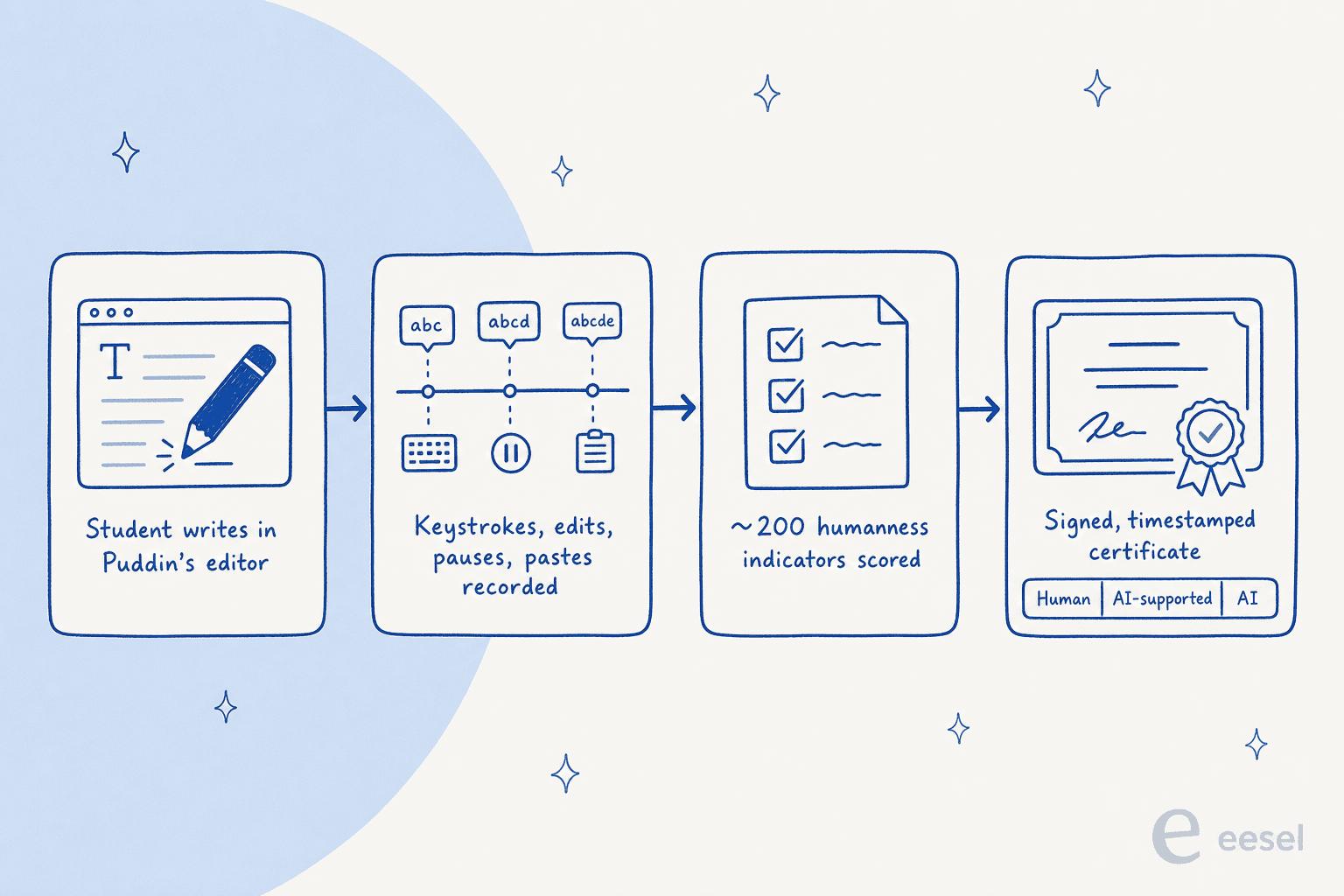
Here's the setup. A student writes their report or thesis inside Puddin's own editor. While they type, Puddin records the process in the background - typing flow, edit history, pauses, paste operations, the order revisions were made in, how long the whole thing took. When the work is submitted, the instructor doesn't just see the finished text; they see a writing-process report and a certificate proving the work was authored by that person, at that time.
The company behind it is Valar Intelligence, founded by Nowa Sutaka, who was born in California and took Japanese citizenship in 2020. The origin story is unusually concrete for a deep-tech pitch. Sutaka works as a scriptwriter and novelist, and was translating an English script for an anime. As they tell it (translated from Japanese):
"While I spent many hours translating and refining it line by line… the reality also crossed my mind: 'Honestly, if you just pasted the manuscript into ChatGPT, a plausible English version would pop out in 10 minutes.' But even comparing those two manuscripts, there's no way to prove to a third party whether I spent the time writing it myself or left it to AI."
Nowa Sutaka, founder, in an Osaka Entrepreneurs profile
That gap - I did the work, and I can't prove it - is the whole company. Sutaka searched for "a service that can prove a human wrote this," couldn't find one, and built it.
The problem: AI detection is kind of broken
To get why Puddin's approach is interesting, you have to start with why the current approach frustrates everyone.
Most schools reach for an AI writing detection tool like Turnitin or GPTZero. These read the finished text and estimate how "AI-like" it looks. The trouble is that these detectors work by inference, and inference on finished text is shaky. A student can have AI draft something, then heavily edit it. A student can mix their own sentences with generated ones. And - the part that actually hurts people - perfectly human writing gets flagged as AI all the time.
The educators living with this are blunt about it. From an r/academia thread on false-positive rates:
"There is NO valid AI detection tool. There is no such technology. No tool can credibly produce evidence for an investigation, let alone accusations."

And the math is genuinely nasty. Another commenter pointed out that even a 1% false-positive rate, applied across the ~100 assignments of a degree, gives roughly a 63% chance of being wrongly flagged at least once - and real-world rates are widely reported as higher than 1%. Non-native English speakers get hit disproportionately hard. When the tool meant to protect academic integrity is itself untrustworthy, you've just moved the problem.
It's not unique to academia, either; anyone trying to fact-check AI content at scale runs into the same wall, and the tools that claim to spot it keep tripping over honest writers.
Puddin's framing is that you can't fix this by building a better guesser. You fix it by not guessing.

How Puddin AI actually works
This is the part I find genuinely clever, so let me walk through the mechanism rather than the marketing.
Because the writing happens inside Puddin's editor, the system has something detectors never get: the full event stream of how the text came to exist. When you press the verify button, it scores the work against around 200 "humanness" indicators, according to coverage from Science Japan, the English news service of the Japan Science and Technology Agency. The examples named in reporting are the kind of thing a machine can't easily fake in reverse: common human spelling mistakes, the pauses people take mid-thought, and the amount of time a piece of that length normally takes to produce.
On the homepage demo, Puddin shows a handful of these as a process panel - typing flow, edit history, revision patterns, pauses, and paste operations, each scored as a percentage, plus session metadata like total creation time and number of edits. The result gets sorted into one of three buckets: Human, AI-supported, or AI. It handles six languages, including Japanese and English.
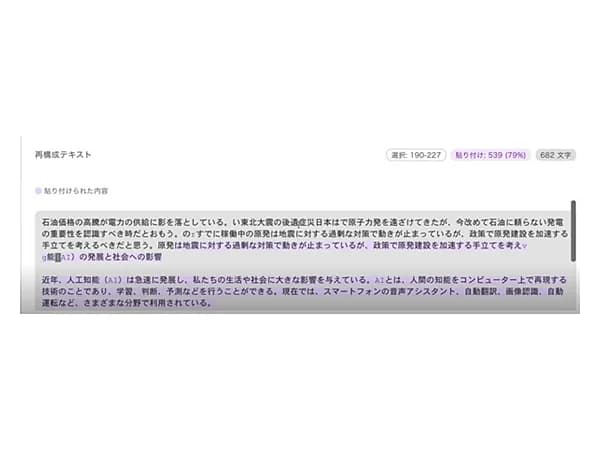
The copy-paste case is the clearest illustration. If you paste an AI-generated answer in, the writing timeline collapses - there's no gradual construction, just a chunk of text appearing at once - and Puddin highlights those passages in purple.
Then comes the bit that makes it more than a fancy keylogger: a cryptographic certificate. Puddin combines the behavioural data with cryptographic timestamps and a hash chain to generate a per-document, verifiable trail. So the output isn't "we think this is 82% human." It's a signed artifact saying this person wrote this, at this moment, that a third party can check later. That's a meaningfully different thing to hand a grading committee than a probability score.
It's also built to slot into what universities already run. Puddin integrates with the LMS - Moodle, Canvas, Blackboard, Google Classroom - and uses single sign-on with university accounts, so nobody creates a new login. Instructors create assignments from the LMS they already use; students open Puddin from there. The use cases stretch from reports and short theses to lab logs, online exams, and graduation theses.
Where it's being used
Puddin has been trialed at Kyushu University on real report assignments, and the company says several dozen universities are weighing adoption. The faculty framing is the interesting signal here - it's about fairness, not surveillance:
"I want students to take their time and write their work on their own. This system can verify originality, making fair evaluation possible."
Andrew John Chapman, associate professor of energy economics at Kyushu University
Puddin reports that students in the trial said they could write the way they normally do, and that the background recording was received as learning support rather than monitoring. That distinction matters a lot for whether a tool like this survives contact with an actual student body.
The honest catch
I try to be fair to anything I write about, and process-verification has a real, pointed weakness that's worth naming before anyone gets too excited.
The sharpest critique came from a Japanese academic, Hiroyuki Okumura, and it's a good one (translated):
"When you hand-type long text into a web form it can time out or the browser crashes and you lose it, so I always write in a text editor and paste it in. Does that get me judged as AI?"
That's the crux. A completely legitimate human workflow - draft in a text editor you trust, then paste into the submission box - looks a lot like the paste-from-AI pattern Puddin is built to catch. The "prove the process" approach trades one false-positive risk for a different one, and it only works if everyone agrees to write inside the walled garden. There's also the obvious limitation that it can't retroactively verify the mountain of documents already written everywhere else; it only proves authorship for work created on the platform going forward.
And the practical caveats: Puddin is very early, Japanese-first, and has no public pricing - it's a sales-led, request-a-demo product for institutions. So this is a "watch this space," not a "go sign up this afternoon."
To Puddin's credit, it doesn't pretend AI should be banned. Its own framing is the calculator analogy - when calculators arrived, we didn't stop teaching math, we made showing your work matter more. As the company puts it on X: "You can't detect AI text after the fact with 100% accuracy. We verify human authorship during creation." It's the same reframe showing up across AI content more broadly: stop policing the output, start vouching for the process.
The real lesson: prove it, don't guess
Step back from classrooms and Puddin is an instance of something much bigger. As AI writing tools handle more of everything, the scarce, valuable thing isn't output - it's proof you can trust the output. The same question is landing on every desk: not "can the AI do this?" but "can I prove it did it right?" It's why vendors keep bolting on things like a trust layer instead of just shipping a bigger model.
I work on AI for customer support, and this is the lesson that took us the longest to learn. The gap was never capability. Modern models can draft a support reply as fast as you can read this sentence. The gap is trust - and the fastest way to destroy it is an AI that confidently does the wrong thing. The worst failure mode I've watched isn't a bot that says "I don't know." It's a bot that narrates ten confident steps of work it never actually did, or hallucinates an answer when the knowledge base has no match.
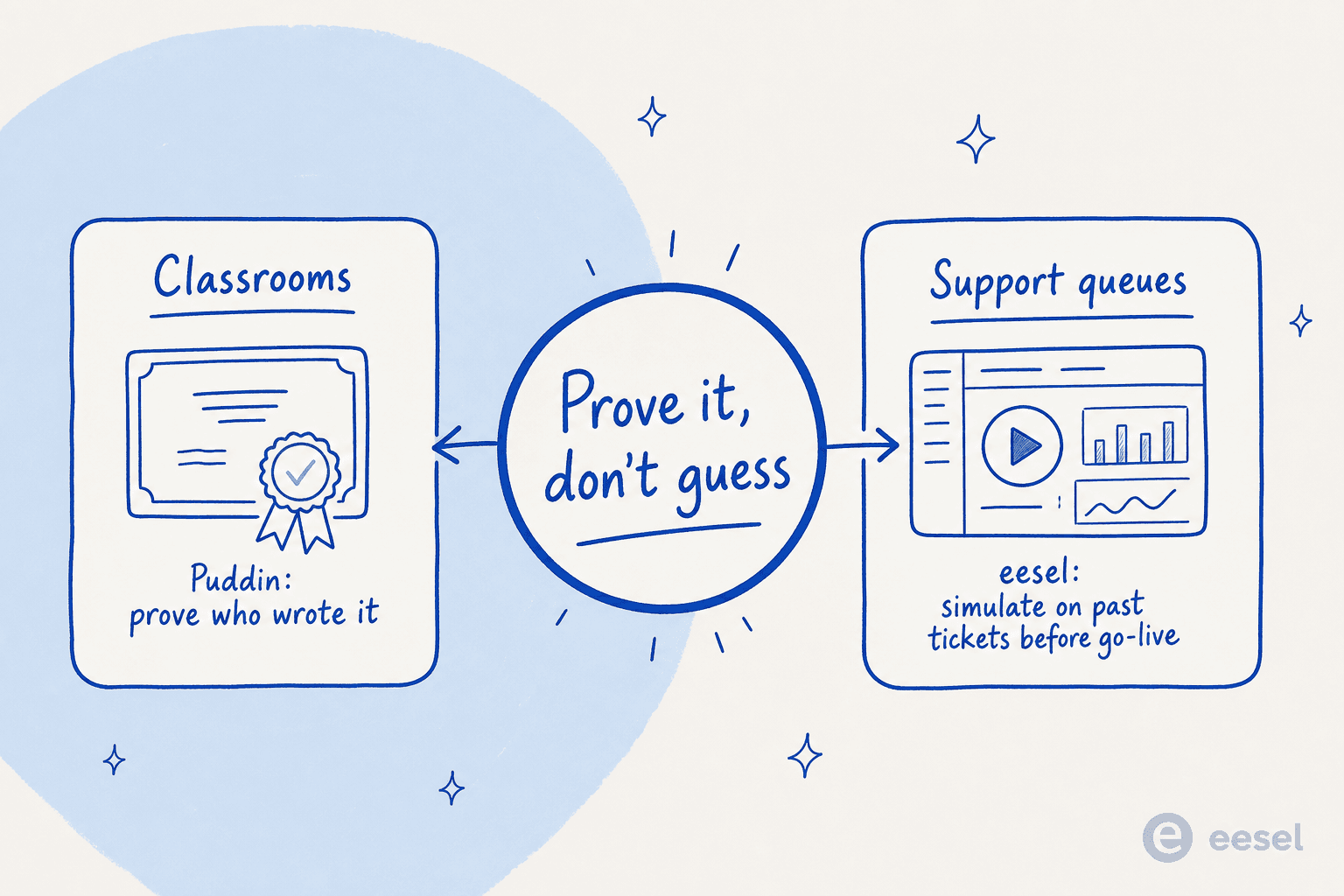
So the answer ends up looking a lot like Puddin's, just pointed at a different problem. You don't deploy and pray. You verify before you bet on it. One support lead I work with put the bar nicely:
"It answers confidently but not too confidently, and training it has been super easy."
a support lead at an SMS/messaging platform running ~260 AI interactions a month
That confidence has to be earned somewhere, and the place to earn it is before go-live, not in front of a customer. Puddin earns it by recording how the writing happened. The parallel in support is simulating an AI agent against thousands of your own past tickets, so you can see exactly how it would have answered - and where it would have gotten things wrong - before a single real customer sees it. Same instinct: evidence first, trust second.
Try eesel
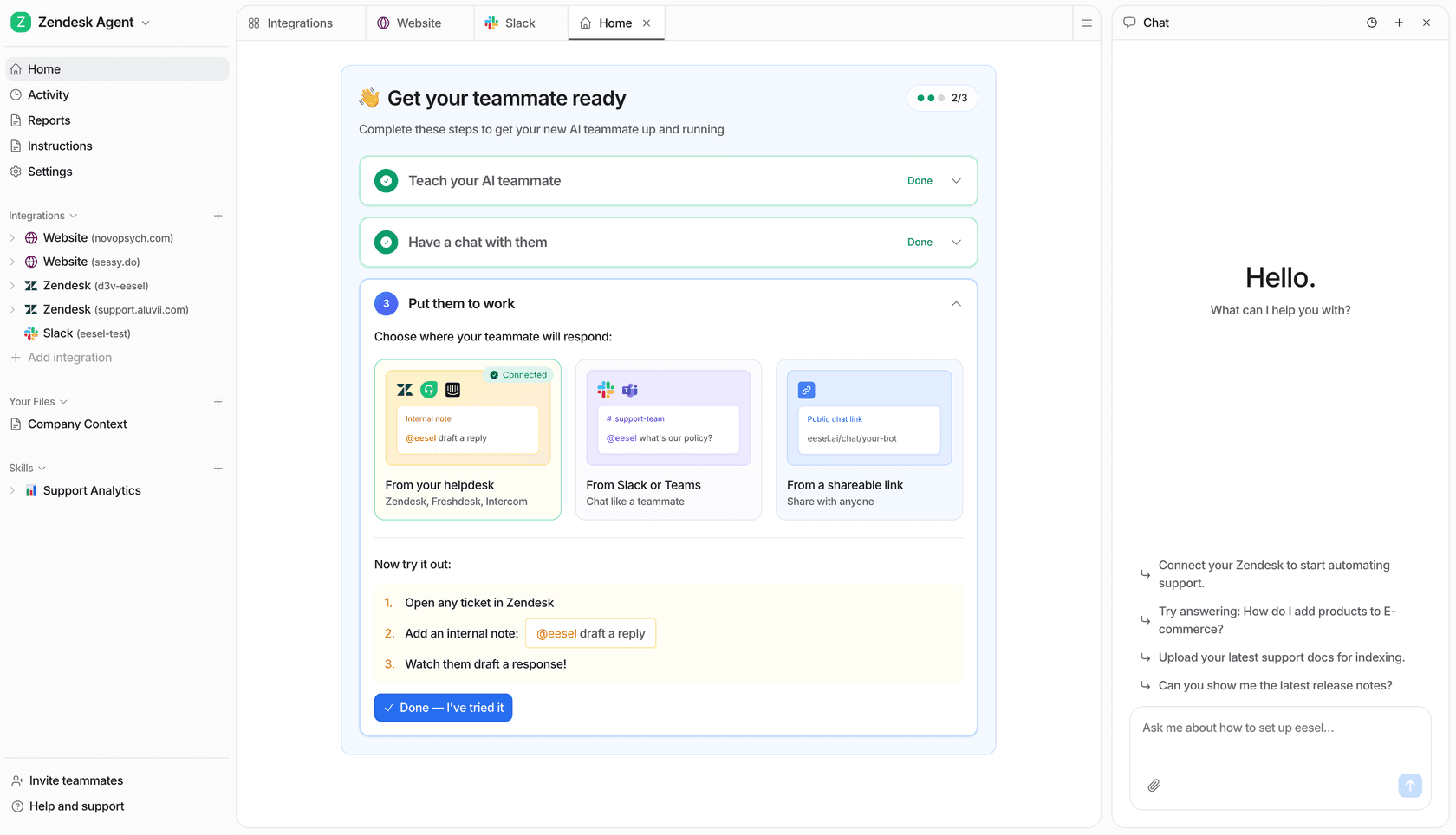
If Puddin's "prove it before you trust it" idea resonates and your problem is support rather than essays, that's the bar eesel AI is built to clear. You connect it to your help center and past tickets, and before it ever replies to a customer you can run it in simulation against your real ticket history - so you see its actual answers and resolution rate up front, instead of hoping it behaves once it's live. It plugs into the helpdesk you already use, learns from the knowledge you already have, and is free to try.
It's the same shift Puddin is betting on, in a different room: in a world where AI can produce anything, the tools worth trusting are the ones that let you verify first.