


Let's be honest, the world of AI is moving ridiculously fast. One minute we're all talking about chatbots, the next we're flooded with new AI hardware. The Rabbit R1 definitely turned heads with its cool retro look and a big promise: a "Large Action Model" (LAM) that actually does things for you.
It paints a pretty cool picture of the future, right? Just tell a little gadget what you want, and it handles the rest.
But now that the initial buzz has settled, the reviews are rolling in, and a lot of us are asking the same question: is a separate AI gadget really the answer? Is the R1 going to replace our smartphones, or is it just an app tucked inside a fancy orange box? That question has a lot of people looking for Rabbit AI alternatives.
So, let's dig in. We'll look at the top 5 contenders for 2026, from other physical devices to the powerful software that might already be on your phone.
What is the Rabbit R1?
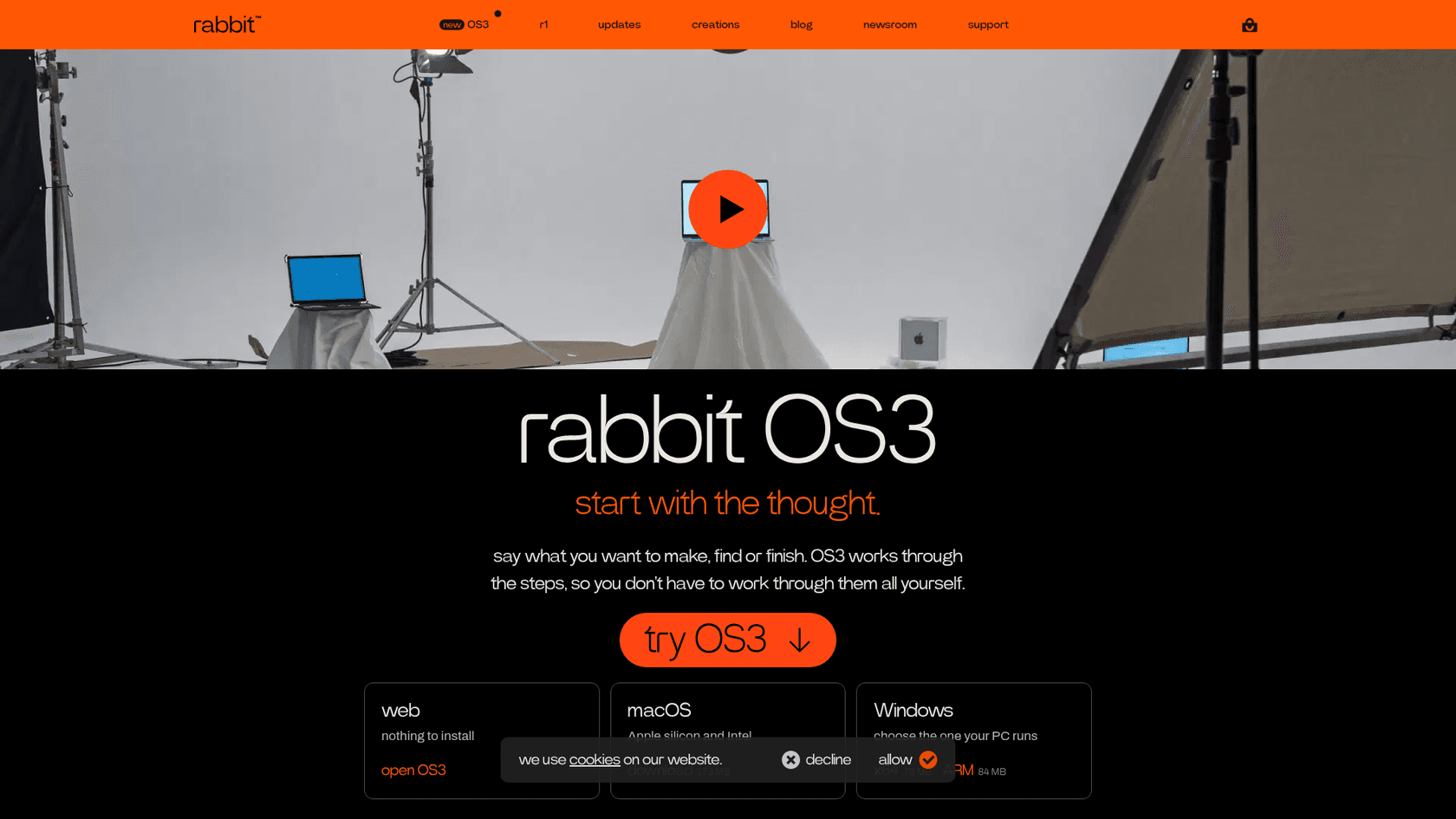
Before we jump into the alternatives, let's do a quick refresher on the Rabbit R1. It launched as a $199 standalone AI device that looks like it came straight out of the 90s, designed by the folks at Teenage Engineering. It has a small touchscreen, a rotating camera they call the "rabbit eye," a button to talk, and a little scroll wheel.
The real magic isn't supposed to be the hardware, but the software inside: Rabbit OS. It's powered by a Large Action Model (LAM). Think of it this way: a Large Language Model (LLM) like ChatGPT understands and writes text. A LAM is designed to understand and use app interfaces. The dream is to tell it "get me an Uber to the airport," and it does all the tapping and booking for you.
But the reality has been a bit wobbly. Early users have mentioned that it can be slow, doesn't work with many apps, and the performance is hit-or-miss. The biggest eyebrow-raiser? Someone quickly figured out that the whole R1 experience is basically a single Android app. Which makes you wonder… why buy a whole new device for something your phone could probably do? Rabbit has since shifted its focus to rabbit OS3, an agent you reach on the web, in Telegram, on a connected computer or through r1, and its R1 page now promises unlimited AI at no extra cost.
How we picked the best Rabbit AI alternatives
When searching for the best Rabbit AI alternatives, we weren't just looking for devices that look similar. We were looking for tools that actually deliver on the core promise of an AI agent: something that understands what you want and gets it done.
Here’s what we kept in mind:
-
What can it actually do? Is it just a glorified Q&A machine, or can it handle tasks with multiple steps and connect to other services? We wanted to find tools with real "agent" abilities.
-
How practical is it? Does it slide easily into your daily routine, or do you have to carry another thing around? The less friction, the better. We leaned towards options that work with the stuff you already own.
-
Can you control it? A good AI agent should adapt to your needs, not be a one-size-fits-all black box. We looked for options that let you customize what the AI does and how it acts.
-
Is it worth the money? We looked at the total cost, from the price of the device to any monthly fees. We weighed that against what you actually get for your money.
Rabbit AI alternatives: A quick comparison
Here’s a quick side-by-side look at how the top alternatives compare.
| Feature | Humane AI Pin | Limitless Pendant | Open Interpreter 01 | Google Gemini | Microsoft Copilot |
|---|---|---|---|---|---|
| Type | Hardware | Hardware | Hardware | Software | Software |
| Primary Use Case | General AI Assistant | Meeting Transcription | Action Automation | General Q&A / Vision | General Q&A / Creation |
| Requires New Device? | Yes | Yes | Yes | No | No |
| Customization | Low | Low | High (Code) | Low | Low |
| Pricing | $699 + $24/mo at launch (discontinued) | No longer sold (acquired by Meta) | Build-your-own (see GitHub) + API costs | Free (paid tiers from $19.99/mo) | Free (paid tiers available) |
The top 5 Rabbit AI alternatives in 2025
Here are the most interesting alternatives to the Rabbit R1, each with a different take on how we should interact with AI. Two of the five hardware picks are no longer available to buy new, so here is where each one stands as of October 2026.
| Alternative | Status (October 2026) | Source |
|---|---|---|
| Humane AI Pin | humane.com no longer resolves | Own domain check |
| Limitless Pendant | Acquired by Meta; no longer sold since Dec 5, 2025 | Limitless |
| Open Interpreter 01 | Open-source, build-your-own 01 Light | GitHub |
| Google Gemini | Free tier; Google AI Pro $19.99/mo | |
| Microsoft Copilot | Free tier; Microsoft 365 Premium $19.99/mo | Microsoft |
1. Humane AI Pin
The Humane AI Pin is probably the R1's most direct competitor. It's a screenless gadget you clip to your shirt, designed to keep you from staring at your phone. It interacts with you by projecting a "Laser Ink Display" onto your hand.
It's a beautiful piece of kit and definitely feels like it's from the future. But the high price tag, reports of it getting too hot, disappointing battery life, and a clunky interface make it a tough recommendation for most people right now. It shows the ambition of AI hardware but also the growing pains of a first-gen product. Humane's own website (humane.com) no longer resolves as of October 2026, so I would treat the Pin as discontinued rather than a live option.
Best for: Early adopters who want a peek at a screen-free future and are okay with putting up with some serious quirks.
Pricing: At launch the device was $699, plus a required $24/month subscription for data and AI features.
2. Limitless Pendant
The Limitless Pendant is a bit more focused. Instead of trying to be your everything-AI, this little wearable is designed to do one thing really, really well: capture and understand your conversations.
It records what you say and hear all day, transcribes it, and then uses AI to pull out summaries and action items. With a 100-hour battery and a much friendlier price, it’s a genuinely useful tool for anyone who has trouble remembering the details from meetings. It’s less of an all-purpose agent and more of a personal memory assistant. One big update: Meta acquired Limitless, and as of December 5, 2025 the Pendant is no longer sold to new customers.
Best for: Professionals, students, or really anyone who wants to offload the mental work of taking notes and remembering conversations.
Pricing: The Pendant sold for $99 before sales stopped. Limitless says existing customers get the unlimited plan for free and keep support through 2026, and the service is no longer available in the EU, UK and a few other regions.
3. Open Interpreter 01 Light
For the more tech-minded folks, the 01 Light from Open Interpreter is a really neat project. It's an open-source device that hooks into an AI model running on your computer. It's built specifically to let you control your computer with just your voice.
Because it's open-source, you can tweak it to your heart's content, but it's not a simple plug-and-play device like the R1. You'll need some technical chops to get it going, which makes it a better fit for developers and tinkerers who want full control. The ongoing cost comes from whatever AI model you hook it up to (like GPT-4), which can vary depending on how much you use it.
Best for: Developers and AI hobbyists who care more about customization and control than out-of-the-box ease of use.
Pricing: I couldn't find a current store page for the device. The project's GitHub repo now points to instructions for building your own 01 Light, so the main cost is the parts plus the API calls to whichever AI model you connect it with.
4. Google Gemini
Let's face it, the biggest knock against the Rabbit R1 is that it's trying to solve a problem your phone has already handled. Google Gemini is the perfect example. It's a seriously powerful, multi-talented AI assistant that lives on the device you already carry everywhere.
Using Google Lens, Gemini can "see" through your phone's camera to analyze things in the real world. It can answer tricky questions, write things for you, and since it’s deeply baked into Android, it can do things like set alarms or create reminders. Google's plans page lists agentic capabilities under the paid tiers, so check what the free version covers before counting on it for multi-step tasks. The basic version doesn't cost you a dime extra.
Best for: Pretty much anyone who wants powerful AI features without having to buy another gadget.
Pricing: The standard version of Gemini is free. You can upgrade to Google AI Pro for $19.99/month for higher access to their top models.
5. Microsoft Copilot
Just like Gemini, Microsoft Copilot puts a capable AI chatbot in your pocket for free. It’s a flexible AI chatbot that can create images, summarize articles, and pull up-to-date answers from the web.
Copilot's real advantage is how well it plays with the Microsoft ecosystem. If you live in Microsoft 365, Copilot can help you out across apps like Teams, Word, and Outlook. It just goes to show that the best AI agent is often the one that's already connected to the tools you use every single day.
Best for: Professionals and students who use Microsoft products and want a free, capable AI assistant on the go.
Pricing: The basic version of Copilot is free. The old Copilot Pro link now lands on Microsoft 365 Premium at $19.99/month, and Microsoft 365 Copilot for enterprises is $30/user/month (a Copilot Business plan starts at $21/user/month).
Why buy a box? The case for software-based Rabbit AI alternatives
The excitement around AI hardware is real, but all these new devices raise a simple question: do you actually need a separate gadget for AI? For most things, especially at work, the answer is probably no. The real magic of AI agents isn't a new piece of hardware, but smart software that plugs right into your existing workflow.
The Rabbit R1's promise of taking action for you is where things are headed. But you don't need a special box for that. For businesses, a much more practical and powerful solution is an AI agent that lives inside the software you already rely on, like your helpdesk or internal chat.
This is where a platform like eesel AI comes into play. It's a software-based AI agent built for customer service and internal support teams. Instead of giving everyone a new device, you deploy an AI that works inside your existing tools.
-
It goes live in minutes, not months. You can connect eesel AI to your helpdesk, whether it's Zendesk or Freshdesk, with a single click and start automating support right away. No waiting for a package to arrive.
-
You're in complete control. Unlike the closed-off system of a hardware gadget, eesel AI lets you customize everything. You can give the AI a specific persona, decide exactly which questions it should answer, and create custom actions, like looking up order details from Shopify or sending a ticket to the right team.
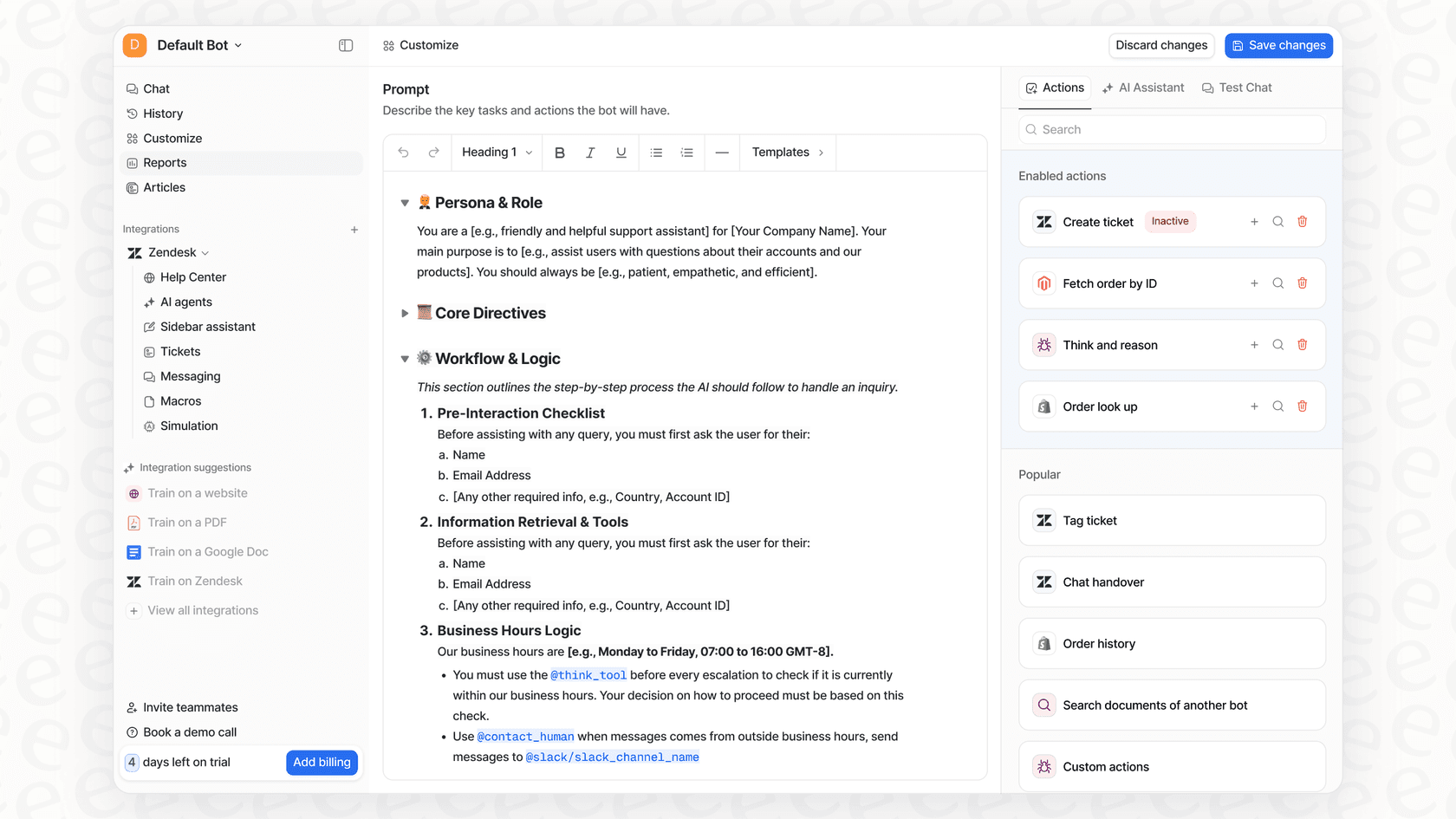
- It learns from your company knowledge. eesel AI connects all your information sources, training on past support tickets, help docs, and internal wikis in places like Confluence or Google Docs. This means its answers are accurate and specific to your business, not just generic web results.

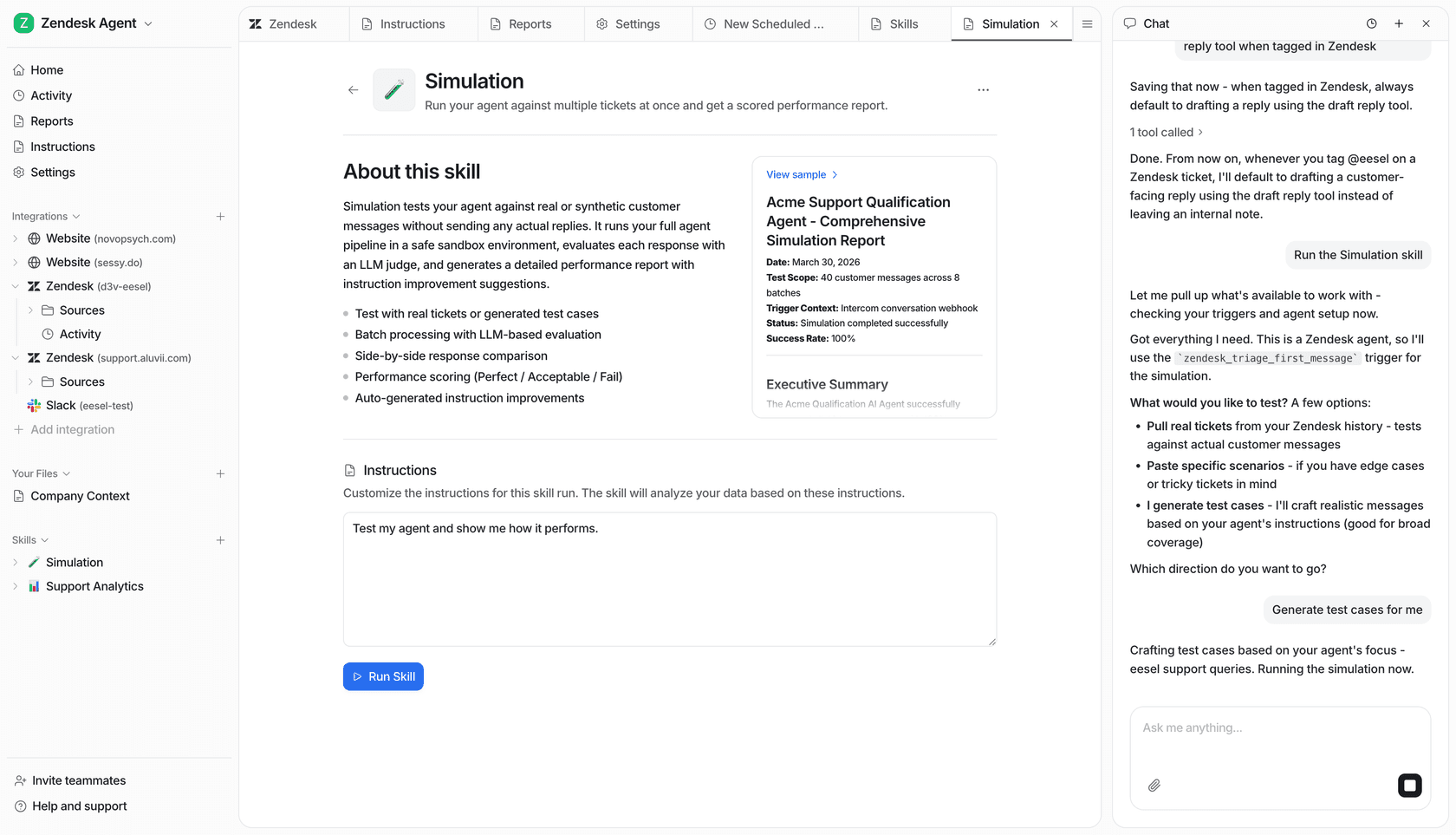
- You can test it without any risk. Worried about letting an AI talk to your customers? eesel AI has a simulation mode that lets you test it on thousands of your past tickets. You can see exactly how it will perform and calculate your savings before you even turn it on.
For a business, the goal isn't just to have a cool AI toy; it's to solve real problems, save money, and make customers happier. A software-based agent is simply a faster, more flexible, and more powerful way to get there.
Your best Rabbit AI alternative is probably already here
The Rabbit R1 and its competitors are fascinating experiments, and they're definitely pushing the conversation forward about how we'll interact with computers. But for now, they're still first-generation products with some pretty big limitations. The race to build the perfect AI agent is on, but the winner might not be a new device you have to carry around.
For most of us, and definitely for businesses, the most effective Rabbit AI alternatives are the smart software agents that make the tools we already use even better. They’re more practical, you can customize them, and they deliver real value today, not in some hypothetical future.
Frequently asked questions
What exactly are Rabbit AI alternatives, and why are people exploring them instead of the R1?
Rabbit AI alternatives are other devices or software solutions that aim to provide similar AI agent capabilities as the Rabbit R1. People are exploring them due to mixed reviews of the R1's performance, questions about its necessity as a standalone gadget, and the desire for more integrated or robust AI solutions.
Do the best Rabbit AI alternatives only consist of other physical gadgets, or are there software options available?
The blog highlights that the best Rabbit AI alternatives include hardware devices like the Open Interpreter 01 (the Humane AI Pin and Limitless Pendant are no longer sold new), as well as powerful software solutions like Google Gemini and Microsoft Copilot. For many, software-based alternatives offer more practicality and integration with existing tools.
How do the pricing models for Rabbit AI alternatives compare to the Rabbit R1's $199 upfront cost?
Pricing for Rabbit AI alternatives varies significantly. Some hardware alternatives launched at higher prices with required monthly subscriptions (and a few are no longer sold), while software options like Google Gemini and Microsoft Copilot offer free basic versions, with premium tiers available for advanced features.
For businesses, how effective are Rabbit AI alternatives at integrating with existing workflows and tools?
Software-based Rabbit AI alternatives, such as those designed for customer service or internal support, are highly effective at integrating into existing business workflows. They can connect directly to platforms like Zendesk or Microsoft 365, leveraging company-specific knowledge and automating tasks within familiar environments.
What kind of practical tasks can Rabbit AI alternatives help me with beyond just answering questions?
Many Rabbit AI alternatives are designed to handle practical tasks. This includes transcribing and summarizing conversations, controlling your computer with voice commands, providing context-aware information via your phone's camera, and automating specific actions within business applications like creating support tickets or looking up order details.
What key factors should I consider when choosing between the different Rabbit AI alternatives mentioned?
When choosing between Rabbit AI alternatives, consider what you need it to *do* (action automation, transcription, general assistance), how practical it is for your daily routine, how much customization you desire, and the overall cost including any subscriptions. Your existing device ecosystem (smartphone, computer, business software) is also a major factor.