


If you’re keeping tabs on the AI world, you've probably seen Reka AI pop up. They’re one of the more interesting companies out there building AI models that can wrap their heads around text, images, audio, and video all at once. It’s pretty cool stuff, but let’s be real: for most of us, the big question is what this tech actually costs and how you could possibly use it in a real-world business.
It’s one thing to read about mind-blowing tech specs, but it’s another to figure out if it’s a practical choice for your team, especially for something as hands-on as customer support. So, this post is here to get straight to the point. We’ll break down Reka AI's models, its pricing, and what it all means for you.
What is Reka AI?
Reka is an AI company started by a group of former researchers from big names like Google DeepMind and Meta AI. Their main focus is on building "multimodal" models, which is just a fancy way of saying their AI can understand a mix of different data types at the same time. Think of it like one brain processing text, images, audio, and video.
They offer a few different models, each one striking a different balance between power and speed:
-
Reka Core: This is their top-tier model. It’s built to chew on the most complex problems that require some heavy-duty reasoning.
-
Reka Flash: A fast and cost-effective model that’s great for most everyday tasks where you need a quick response.
-
Reka Edge: A compact model (it replaced the older Spark) designed for efficiency. It’s perfect for tasks that need to run on smaller devices or in situations where you don't have a ton of resources.
You can get access to these through Reka's API: Reka Chat for conversational stuff, and Reka Vision for searching, tagging, and clipping video and images. Reka Research, the web-browsing research agent I covered in an earlier version of this post, is no longer in the API docs' product list. Reka's homepage now positions the company around omni models and video infrastructure for the "physical AI era," with Reka Cloud and Reka Vision as the products.
A full breakdown of Reka AI pricing and models
This is where things get interesting. Reka has a couple of different payment models, depending on which product you’re using, and the docs describe the Chat API as pay as you go, with no upfront costs. Getting a handle on these is key, because it directly affects your budget and what kind of return you can expect.
Reka Chat: Token-based pricing
For its chat models, Reka uses a token-based pricing system. This is pretty common for this kind of AI. You get charged for the amount of data the model processes, both for the info you feed it (input) and the answers it gives you (output). Tokens are just tiny pieces of words, so a short sentence might be made up of a handful of tokens.
While this system is straightforward on paper, it can make your costs hard to predict. If you suddenly get a flood of customer support tickets one month, your bill could shoot up without warning.
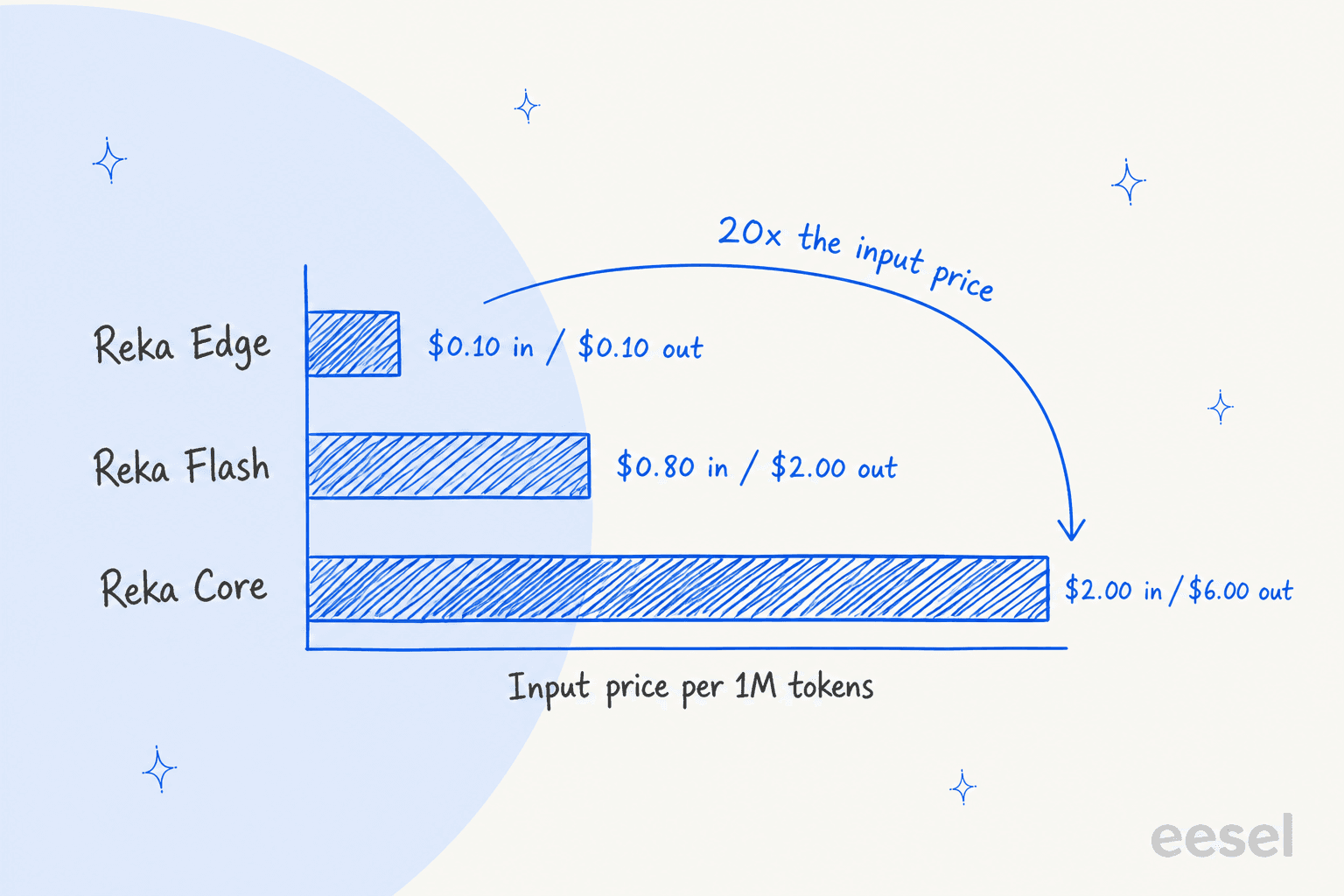
| Model | Input Tokens (per 1M) | Output Tokens (per 1M) | Image (per image) | Video (per minute) | Audio (per minute) |
|---|---|---|---|---|---|
| Reka Edge | $0.10 | $0.10 | $0.005 | $0.03 | N/A |
| Reka Flash | $0.80 | $2.00 | $0.01 | $0.06 | $0.015 |
| Reka Core | $2.00 | $6.00 | $0.02 | $0.08 | $0.02 |
Source: Reka AI Documentation
One detail worth knowing: Reka's models page lists reka-flash and reka-edge as the baseline models always available to the public, and says other models may be available to your account. Core is on the price table, so confirm it is enabled for you before you plan around it.

Reka Research: Query-based pricing
Reka Research, their agent-like AI that can browse the internet to find answers, was priced in an earlier version of this post at a flat $25 per 1,000 requests. It is not on Reka's current pricing page, which lists Chat and Vision, and I could not verify that figure against a primary source this time, so I removed it. If you need Research, ask Reka directly.
What Reka does price per unit today is Vision, its video and image search, Q&A, and clip API. The Vision pricing page gives self-serve developers 3 free hours of indexed video, then these rates:
| Vision action | Developer price |
|---|---|
| Video indexing | $0.05 per input video minute |
| Video search | $0.005 per search |
| Image search | $0.003 per search |
| Video Q&A and tagging | $2 per 1M output tokens |
| Clip generation | $0.04 per input video minute (+$0.01 per minute for 1080p) |
Source: Reka Vision pricing
Video storage on the developer tier is auto-deleted after 30 days with no storage fee, and Enterprise is invoiced monthly with bulk discounts and no rate limits.
What this means for your support team
It’s important to remember that Reka gives you powerful but "raw" building blocks. The prices you see above are just for the AI's "brainpower." They don't cover the cost, time, or technical know-how needed to build, connect, and maintain an actual application that can use this power.
To get Reka working for your support team, you'd need developers to hook its API into your helpdesk, map out all the rules for how it should act, and keep the whole system from breaking. For most teams, a better bet is an all-in-one platform. A tool like eesel AI gives you a complete AI agent that plugs into your existing helpdesk in minutes and offers transparent, predictable pricing, so you never get hit with surprise bills.
Reka AI features and performance
So, what kind of muscle do you get for your money? Reka's models are genuinely impressive, but what really matters is how their features actually work in practice.
Multimodality: Processing images, video, and audio
When we say "multimodal," what does that actually look like for a support team? Imagine a customer sends a screenshot of a bizarre error message, a photo of a damaged product, or a quick video showing a feature that’s acting up. With Reka's models, an AI could theoretically look at that image or listen to that audio to figure out the problem, without the customer having to type out a long explanation.
The catch? While the tech can do it, building a smooth workflow inside a helpdesk like Zendesk or Freshdesk to handle those tickets requires a ton of custom development. You’re not just flipping a switch; you're basically building a new piece of software from the ground up.
Agentic capabilities with Reka Research
Reka announced Reka Research as "agentic AI." In simple terms, this just means the AI can take a few steps on its own to find an answer, though the current docs list Chat, Vision, and Clip, so check that it is still offered before you plan around it. For instance, a support agent could ask it to compare a specific product feature against three competitors. The AI would then go browse those competitors' websites and pull together a summary for you.
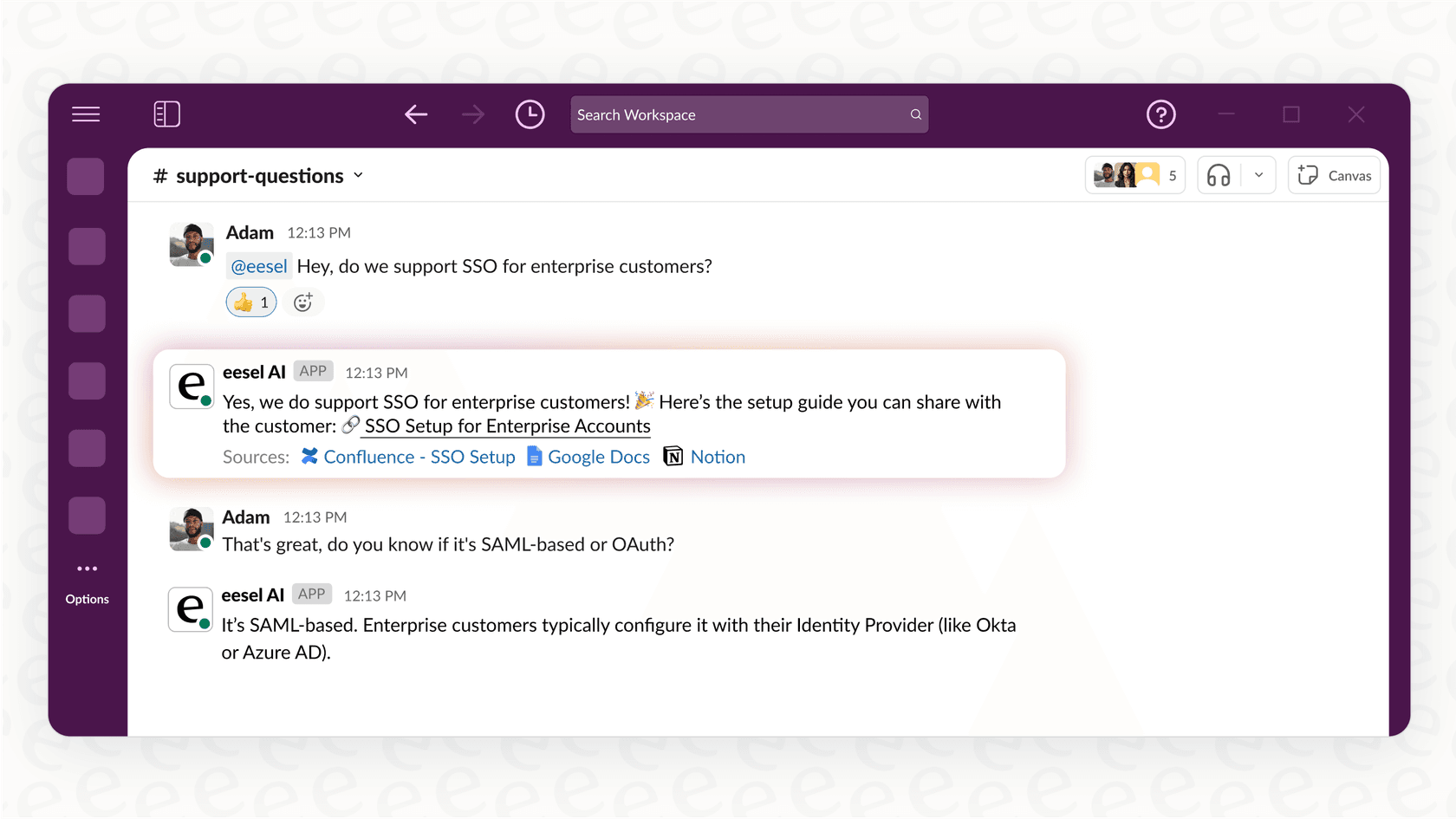
This is pretty handy for digging up outside information. The thing is, most support questions aren't about what’s on a competitor's website; they're about your internal knowledge. Reka describes Research as browsing the web, not as connecting to your past support tickets, internal wikis in Confluence, or your team's Slack history. In contrast, a tool like eesel AI connects to all of your internal knowledge sources right away, making sure the answers it provides are based on your company's actual data and past solutions.
Performance benchmarks: Speed and latency
For any tool that interacts with customers in real time, like a chatbot, speed is everything. Two things matter here: how fast it can generate a response (tokens per second) and how long it takes for the first word to appear (latency). A slow, laggy AI is a surefire way to frustrate customers.
The missing layer: Why raw model pricing isn't enough for support teams
This is the big takeaway for anyone on a non-technical business team. Using a foundational model API from someone like Reka might seem like a good deal, but it comes with a lot of hidden work and headaches. It's like being handed a car engine and told to build the rest of the car yourself.
The integration and workflow gap
Reka gives you an API, not a ready-to-use product for support. That creates a huge barrier to getting started. Your developers would have to build and maintain connections to your helpdesk, whether it's Zendesk, Intercom, or something else. They'd also have to write all the code to tell the AI how to route, tag, and escalate tickets.
This is where purpose-built platforms make a real difference. For example, eesel AI offers one-click integrations with all the major helpdesks and chat tools. You can set up a fully working AI agent in a few minutes, not a few months, without needing any developers.
The challenge of testing and gradual deployment
How do you know if an AI built on Reka's API is ready for prime time? Without a proper testing environment, you’re pretty much flying blind. You can't easily see how it would have answered past tickets or get a solid estimate of how it will affect your resolution rates. Rolling out a new AI suddenly feels like a pretty big gamble.
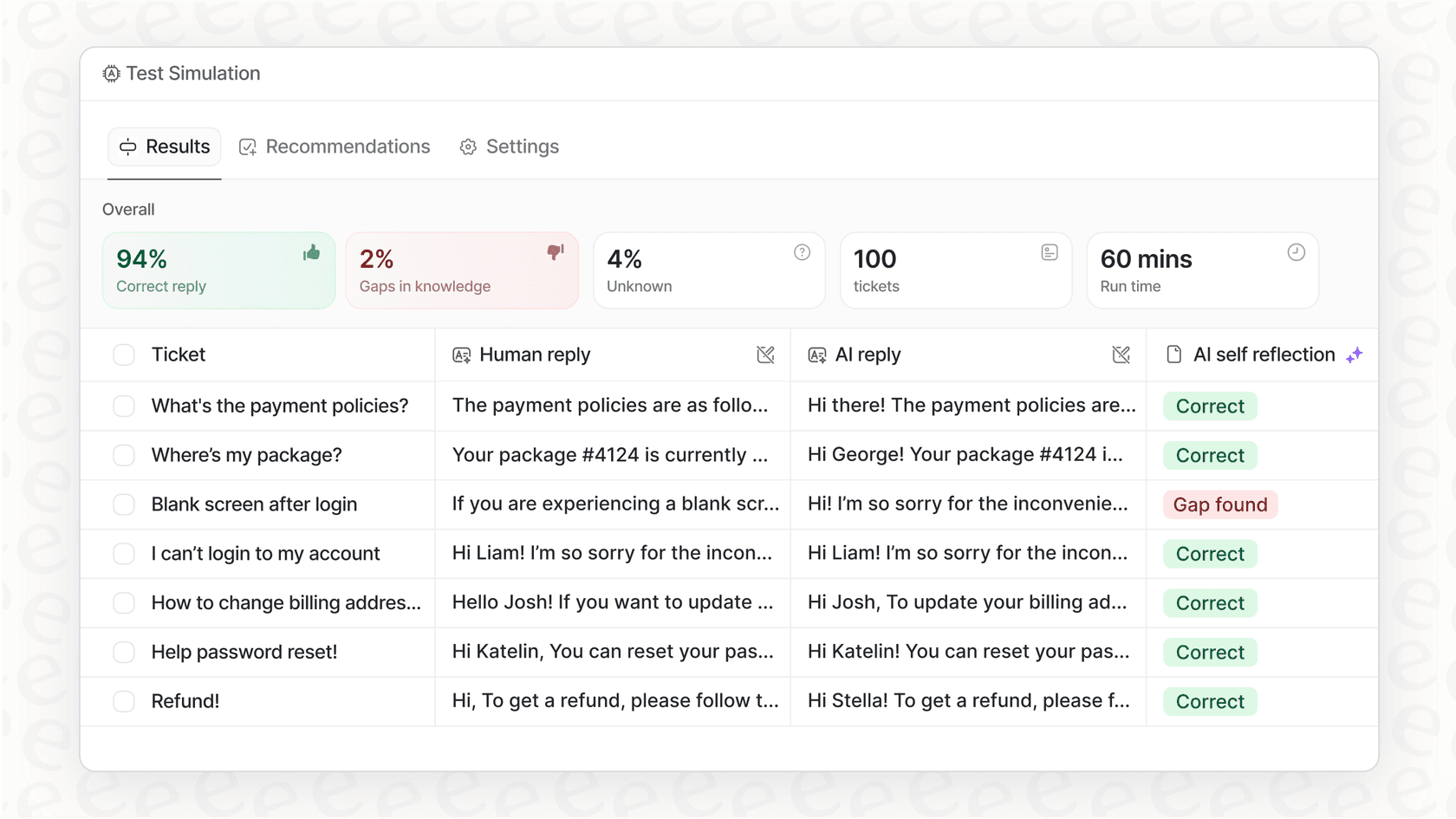
A tool like eesel AI solves this with a simulation mode. You can test your AI setup against hundreds of your old tickets in a safe environment, with each answer scored against how your team replied, before you ever let it talk to a live customer. It lets you roll out automation with confidence, maybe starting with just a few ticket types and growing from there.
Unpredictable pricing and a lack of business insights
Let's circle back to the Reka AI pricing challenge. With token-based fees, your bill grows right alongside your ticket volume. A busy month could leave you with a surprisingly big bill, making it difficult to budget.
On top of that, a raw model API doesn't give you the kind of analytics a support manager needs. It won't tell you where the holes are in your knowledge base or point out trends in customer problems. In contrast, eesel AI's pricing is a fixed monthly credit plan (one credit per ticket or chat, with any overage capped at a limit you set), so your costs stay predictable. Its reporting also shows you exactly which documents are missing or need updating, turning your support data into a clear to-do list for improvement.
From raw models to a complete support solution
Reka AI is building some seriously impressive technology with its multimodal models. For companies with a whole team of engineers, its API offers a flexible set of tools to work with. However, the developer-first approach and variable pricing structure bring up an important point for most businesses.
When it comes to customer service, a raw AI model is just one piece of the puzzle. The real value is in a complete, all-in-one solution that takes care of integration, workflows, safe testing, and useful analytics right out of the box. You need a platform that’s actually built for the job, not just a powerful engine.
If you're looking for an AI platform that gives you the power of advanced models without all the complexity and unpredictable costs, you might want to explore how eesel AI can plug into your existing tools and start helping your team today.
Frequently asked questions
What factors determine Reka AI pricing for its various models?
Reka AI pricing is primarily determined by the specific model you use (Edge, Flash, or Core) and the type of product. For Reka Chat, it's based on input/output tokens and multimodal data usage; for Reka Vision, it's per video minute indexed, per search, and per million output tokens for Q&A.
Could you explain how the token-based Reka AI pricing system works for the chat models?
For Reka Chat, pricing is token-based, meaning you're charged for the small pieces of data (tokens) you send to the model (input) and the responses it generates (output). Multimodal inputs like images, video, and audio also incur separate costs per usage.
How predictable is the Reka AI pricing for Reka Research compared to the chat models?
Reka Research is no longer listed on Reka's current API pricing page, so I can't compare it with the chat models. What is flat and predictable today is Reka Vision, which charges fixed rates such as $0.05 per indexed video minute and $0.005 per search. In contrast, the token-based chat models can lead to variable costs depending on the volume and complexity of interactions.
What additional costs should I consider beyond the direct Reka AI pricing if I'm building a support solution?
Beyond the direct Reka AI pricing, you'll need to factor in significant development costs for integration, building workflows, and ongoing maintenance. These hidden costs often exceed the raw model costs, especially for non-technical teams.
Does leveraging multimodal capabilities significantly impact Reka AI pricing?
Yes, using multimodal capabilities does impact Reka AI pricing, as there are distinct charges for processing images, video, and audio per minute or per image. The cost varies depending on which Reka model (Edge, Flash, Core) you choose for these operations.
Is Reka AI pricing generally considered suitable for smaller businesses or startups with limited development resources?
Reka AI pricing, particularly for raw API access, often requires substantial development resources for integration and maintenance. This can make it less suitable for smaller businesses or startups without dedicated engineering teams, who might benefit more from all-in-one solutions.
What's the difference in Reka AI pricing between Reka Flash and Reka Core for typical support tasks?
Reka Flash offers a more cost-effective Reka AI pricing structure compared to Reka Core, with significantly lower rates for input and output tokens and multimodal data. While Core is more powerful, Flash provides a better balance of performance and cost for many real-time support interactions.