


There's a lot of buzz around Sakana AI, and honestly, it’s well-deserved. They’re the minds behind some truly wild projects, like "The AI Scientist," a system that can dream up, test, and write its own scientific research from scratch. It’s the kind of innovation that makes you stop and think about where technology is headed.
With that kind of press, it’s only natural for people in business and tech to start asking, "So, what's the Sakana AI pricing?" and "How do I get this for my team?" If you're here, you've probably typed something similar into a search bar yourself.
The short answer is, it’s not that straightforward. In this article, we’ll clear up the confusion. We'll dive into what Sakana AI actually does, what its products cost today, and what the real cost of building on its research looks like. Most importantly, we'll contrast their model-and-research approach with practical AI solutions that your business can actually use, you know, today.
What is Sakana AI?
Before we get into pricing, it helps to understand that Sakana AI isn't your average software company. It’s a top-tier AI lab based in Tokyo. For its first couple of years it behaved like a brilliant university research department pushing the limits of what AI can do, and it has since added a small set of paid products on top of that research.
Founded by David Ha and Llion Jones, two former AI pioneers from Google, Sakana AI has a clear mission: to build new AI models inspired by nature. It has grown fast: it raised ¥32 billion (about $200M) in its Series B, which values the company at roughly $2.7B. They’re exploring ideas like evolution and collective intelligence (think swarms or schools of fish), and it's leading to some fascinating projects:
-
The AI Scientist: This is the one that gets a lot of headlines. It’s an automated system that can manage an entire research project on its own, from coming up with an idea to running the code and publishing the paper.
-
ShinkaEvolve & Darwin-Gödel Machine: These are frameworks where AI agents literally evolve. They rewrite their own code to get better at tasks, using a process that mimics natural selection to stumble upon creative, unexpected solutions.
Their output is still open-source code and dense research papers, but it now also includes products: Sakana Fugu (one API that orchestrates frontier models), Namazu (a Japanese-language LLM), Marlin (an autonomous research agent for strategy reports), plus Sakana Translate and Sakana Chat. These are model and research tools that developers and analysts build on, not a helpdesk product.
The search for Sakana AI pricing
If you’ve gone looking for Sakana AI pricing, you probably hit a dead end first. There is no company-wide price list, and sakana.ai/pricing returns a 404. The prices exist, but they sit on each product’s own page, with a different model for each.
Fugu is sold through token and monthly plans, Namazu is billed per token, and Marlin runs on yen-based plans, so a buyer has to read three pages to see the full picture. Neither Fugu nor Namazu is available in the EU or EEA for now, per Sakana’s own pages. These are model APIs and research agents for developers and analysts, not a tool for a customer service team to solve tickets with.
And a quick heads-up: if your search leads you to a "SAKANA" crypto token, just know it has zero connection to the AI lab. It’s an easy mistake to make, but they’re completely unrelated.
This setup works well if you have developers who want to call a frontier model. For a support or operations team, it leaves you pricing out tokens and orchestration yourself. When you have a budget to manage and need to calculate ROI, you need predictability, and token meters make that harder than a flat monthly price.
That’s where a product-first platform like eesel AI operates in a completely different universe. For businesses, pricing has to be transparent. eesel AI offers one fixed monthly price sized to your volume: 100 free credits to start with no card, then plans from $299 a month for 500 credits, where 1 credit covers a ticket or a chat. Every integration and seat is included, so you can plan a support budget before the month starts.

Deconstructing Sakana AI pricing: The real cost of using their technology
Sakana AI’s products now carry published prices, and the research releases still carry a different kind of cost: time, specialist talent, and a lot of computing power. Here are the published rates first, then some numbers from Sakana AI's own reports.
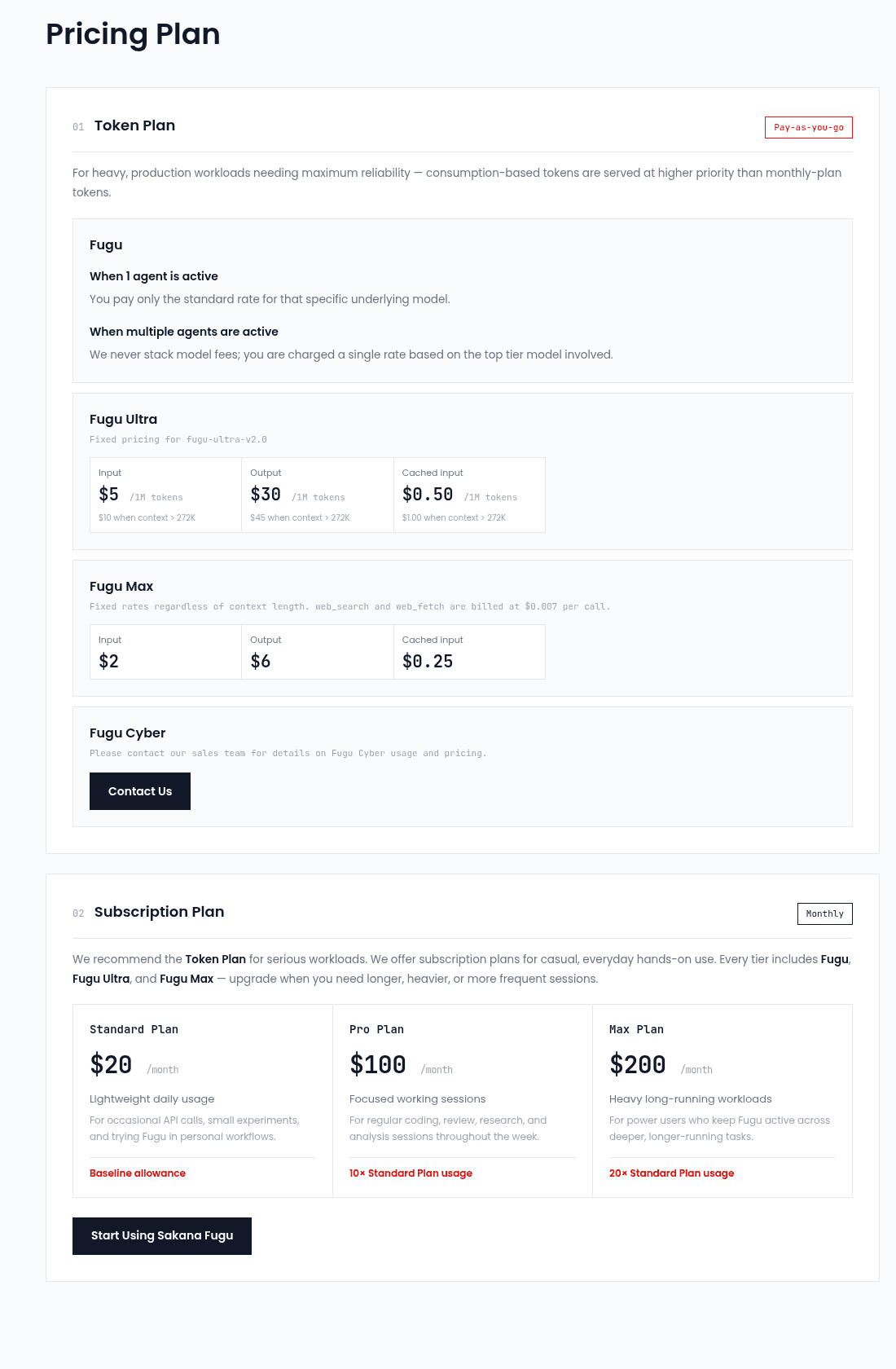
| Product | What you pay |
|---|---|
| Fugu (subscription) | Standard $20/month; Pro $100/month (10x Standard usage); Max $200/month (20x Standard usage) |
| Fugu Ultra (token plan) | $5 input, $30 output, $0.50 cached input per 1M tokens; $10 / $45 / $1.00 above 272K tokens of context |
| Fugu Max (token plan) | $2 input, $6 output, $0.25 cached input per 1M tokens, plus $0.007 per web search or fetch call |
| Fugu Cyber | Contact sales |
| Namazu | $0.95 input, $4.00 output, $0.15 cached input per 1M tokens; web search $7 per 1,000 calls; code execution $0.12 per hour |
| Marlin | Pay as you go at ¥98 per credit (100 credits per run); Pro ¥150,000/month for 2,000 credits; Team ¥400,000/month for 6,000 credits; Enterprise by quote |
Every Fugu subscription tier includes Fugu, Fugu Ultra and Fugu Max, and Sakana recommends the token plan for serious workloads. Namazu pricing has no monthly fee, and Marlin's plans are listed in yen.
-
The AI Scientist: They noted a compute cost of about $15 per research paper it produces. That might sound incredibly cheap, but it’s just the raw resource cost for one specific task. It doesn't factor in the salaries of the PhDs who built and maintain the system or the underlying infrastructure.
-
Darwin-Gödel Machine: A single run to improve a coding agent took two full weeks and cost around $22,000 in API fees. This number gives a much clearer look at the serious cash required just to experiment with this kind of AI.
And those are just the costs you can easily measure. The indirect costs are where it really gets you:
-
Expertise: The API products are developer-friendly, but the open-source research code is another matter. You can't just download it and hand it to your IT department; you need a dedicated team of highly paid AI engineers and researchers to make sense of it.
-
Infrastructure: These models need serious horsepower. We're talking about expensive GPU clusters, not the standard servers most companies have in their back office.
-
Time: This is the opposite of "plug-and-play." It would take months, maybe even years, of development, testing, and fine-tuning before you could get any real business value out of it.
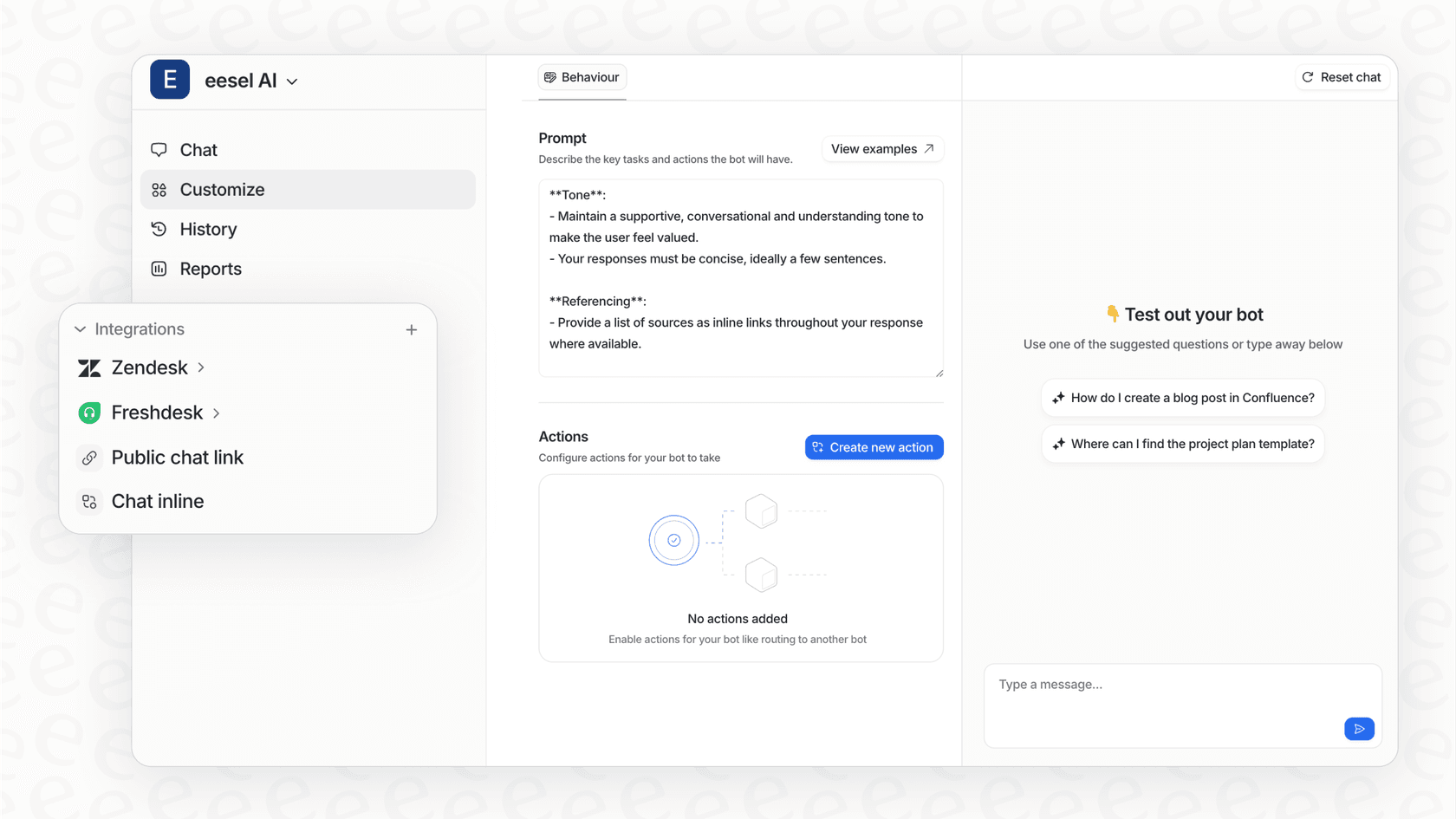
This is exactly why a managed, ready-to-go platform is the more realistic option for most support and operations teams. A solution like eesel AI is designed to get you running in minutes, not months. It skips the need for an in-house AI dev team by providing simple, one-click integrations with the tools you already rely on, like Zendesk, Slack, and Confluence. It’s built for the people who need to use the tool, not the people who want to build it.
Choosing the right AI for your business
It’s really important to know the difference between a research framework and a business-ready product. Sakana AI is for building on frontier models and research. A platform like eesel AI is for putting today's AI to work solving your problems right now. One is about discovery, the other is about results.
Think of it this way. The target user for Sakana AI is a developer team, analyst group or corporate R&D team building on frontier models. For the research releases, they're willing to spend months and a large, variable budget to discover something new. For Fugu, Namazu or Marlin, they're comfortable metering tokens or credits.
The target user for a productized solution like eesel AI is a customer support, IT, or operations team. They need to solve a specific problem, like reducing ticket volume, and they need to do it fast. They can get set up in minutes, their costs are a predictable subscription, and their application is concrete: instantly automating support in a platform like Zendesk. It’s truly self-serve, no developers needed.
| Feature | Sakana AI | eesel AI |
|---|---|---|
| Primary Goal | Frontier models and research agents | Business Problem Solving |
| Target User | Developers, analysts, R&D teams | Support, IT, Ops Teams |
| Pricing Model | Tokens, credits and monthly plans ($20 to $200 a month for Fugu) | Fixed monthly plan, from $299 for 500 credits |
| Implementation Time | API setup for Fugu and Namazu; months for research code | Minutes |
| Required Expertise | Developers for the APIs; AI researchers for the open-source work | No Developers Needed |
| End Product | Model APIs, research agents, open-source code | Ready-to-Use AI Platform |
For businesses that need to use AI effectively, practical features are what really move the needle.
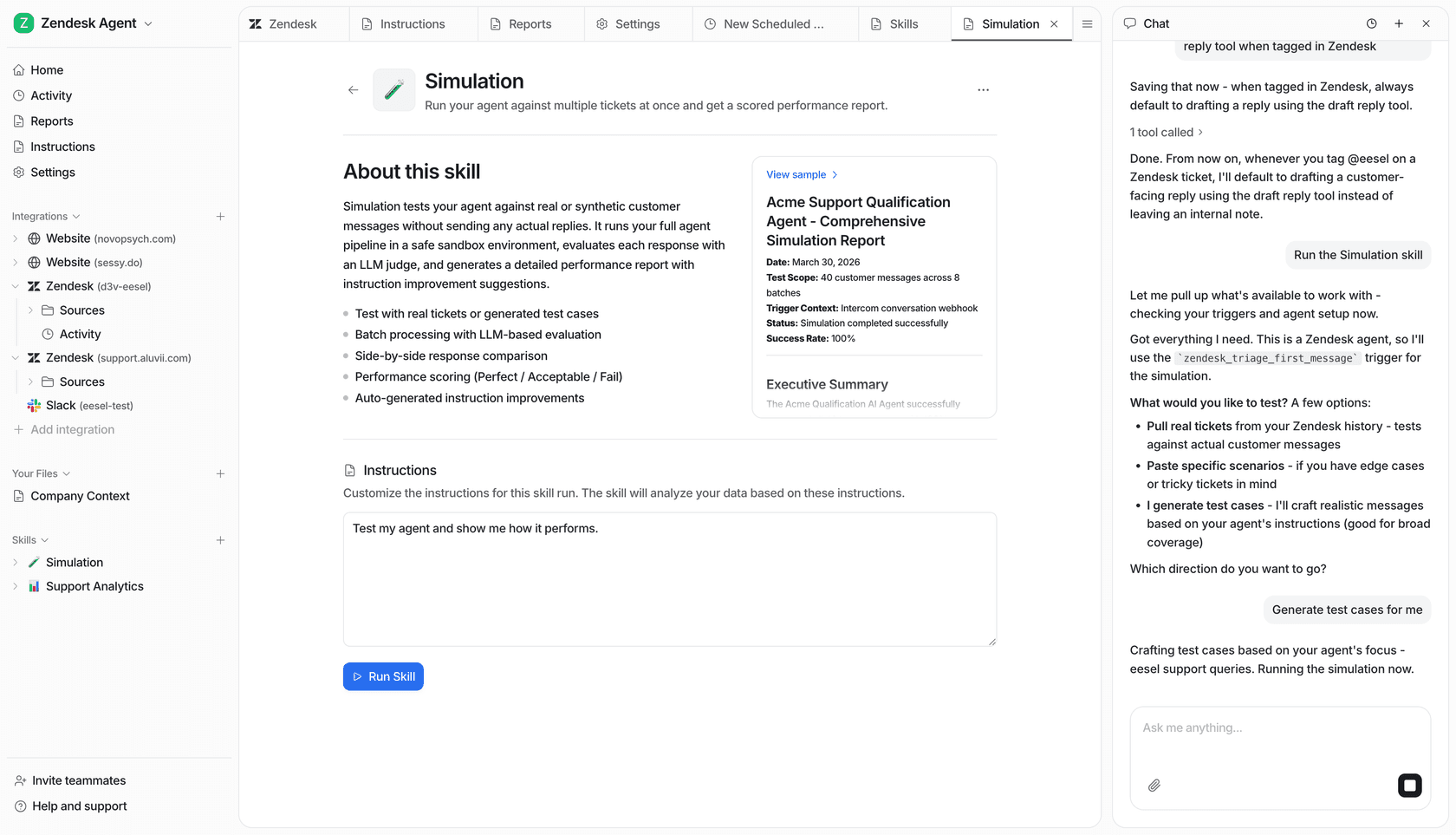
- See it before you launch it: With eesel AI, you can run your AI in a "simulation mode" on thousands of your past tickets. This is a risk-free way to see exactly how it will perform and calculate your ROI before it ever talks to a real customer. Research frameworks are experiments; their outcomes are unpredictable by design.
-
You're in the driver's seat: You get fine-grained control to decide which tickets the AI handles, what its tone of voice is, and what actions it’s allowed to take. You can start small by automating simple, repetitive questions and then slowly give it more responsibility as you get comfortable.
-
It knows your business: eesel AI connects securely to all of your company's knowledge, no matter where it is. Whether it’s in old help tickets, a messy help center, or scattered across dozens of Google Docs, the AI learns your unique business context to give accurate, on-brand answers from day one.
Bridging the gap between AI theory and business impact
Sakana AI is doing important work that is pushing the field of artificial intelligence forward. Their research is vital for the long haul. But because that’s their focus, what they sell are models and research agents, not a support product. For a support team, the real "price" is the investment in developers, tokens, and time needed to turn those models into a working tool.
For almost every business out there, the path to adopting AI isn't about building it from scratch. It's about finding powerful, easy-to-use platforms that solve real-world problems today.
If your goal is to lower support costs, free up your team for more complex work, and give your customers and employees the instant answers they want, then a practical solution is what you need. Take a look at how eesel AI brings all your company knowledge together to power AI agents you can set up, control, and deploy all on your own, no PhD required.
Frequently asked questions
Why can't I find any traditional Sakana AI pricing on their official website?
There is no company-wide pricing page, and sakana.ai/pricing returns a 404. Each product publishes its own rates instead: Fugu on its product page ($20, $100 and $200 monthly plans plus token rates), Namazu per token, and Marlin in yen.
What does the blog refer to as the "real cost" when discussing Sakana AI pricing, if they don't sell products?
The "real cost" refers to the investment in AI talent, specialized infrastructure (like powerful GPU clusters), and time required to adapt their open-source research. Examples cited include thousands of dollars in API fees and weeks of compute time for specific experiments, not factoring in salaries.
Can a typical business leverage Sakana AI's research for their day-to-day operational challenges?
Its API products such as Fugu and Namazu can be used by a developer team today. The open-source research code is another matter: it is raw material for AI experts and can take months of dedicated R&D to turn into business value.
How does understanding there is no Sakana AI pricing help distinguish it from commercial AI solutions like eesel AI?
Knowing how Sakana AI pricing works (token, credit and monthly plans for model APIs and research agents) clarifies that it's a build-on layer, not a ready-to-deploy support product. This contrasts with platforms like eesel AI, which offer one fixed monthly price and immediate, practical applications for business problems.
Is there any connection between Sakana AI and a cryptocurrency or blockchain token?
No, the blog explicitly states that any "SAKANA" crypto token has absolutely no connection to the Sakana AI research lab. It's an unrelated entity, and searching for the lab's pricing will not lead to legitimate cryptocurrency information.
What kind of expertise and resources are necessary if a company wanted to engage with Sakana AI's research, beyond simply looking for Sakana AI pricing?
To utilize Sakana AI's research, a company would need a dedicated team of highly paid AI engineers and researchers with advanced degrees. This also entails investing in significant computing infrastructure, such as expensive GPU clusters, for development and experimentation.