


What Viktor actually is (before we talk price)
Quick framing, because it changes how you read the pricing. Viktor isn't a support chatbot. It's an AI "employee" that lives in Slack and Microsoft Teams and its tagline is "Not a tool. A hire." You @Viktor in a thread, and it goes off and does multi-step work across your connected tools: pulls numbers from Stripe, reconciles invoices, triages a Zendesk queue, opens a bug in Linear, or builds a small internal app. It has its own cloud computer where it writes and runs code, which is why it behaves more like an AI agent than a rule-based chatbot, finishing a task instead of just answering a question.
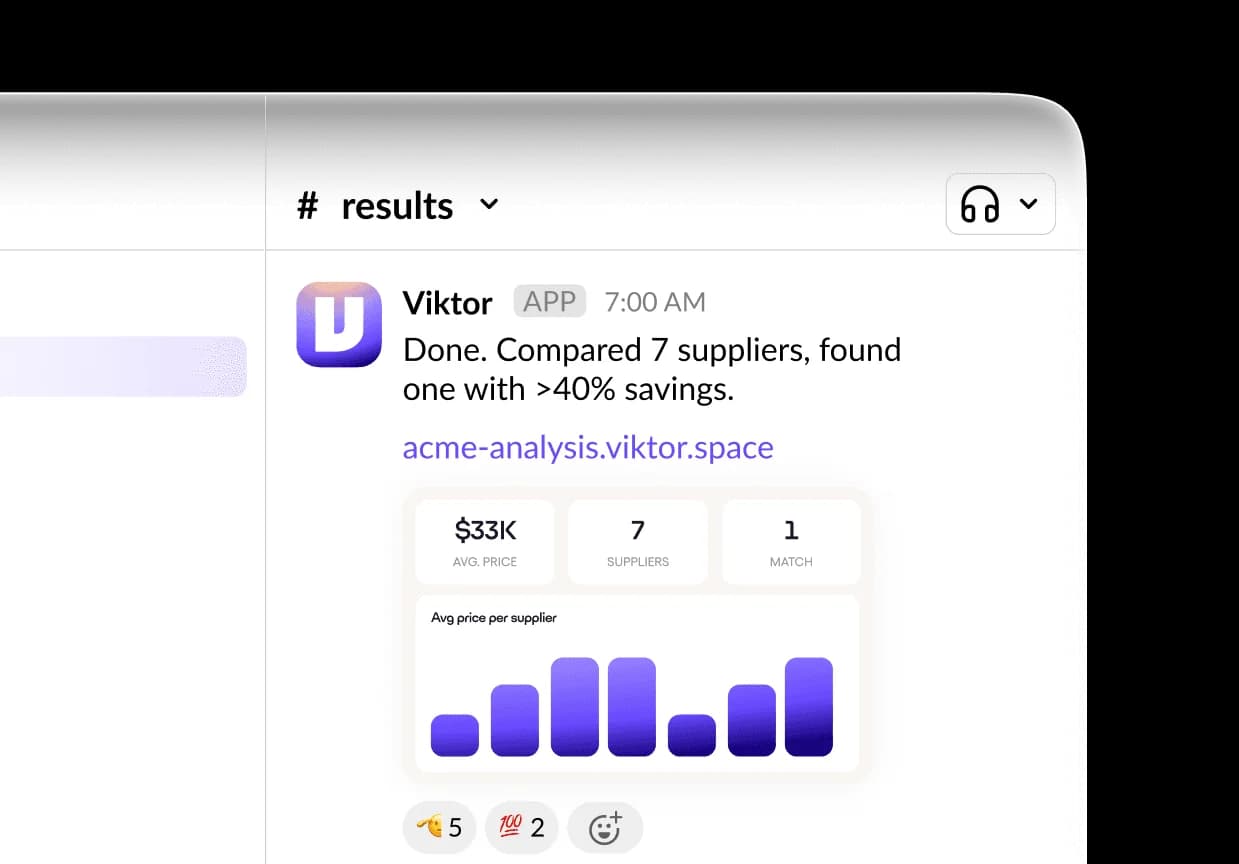
It's a well-backed product, too, which matters when you're betting a workflow on a vendor. It's built by ex-Meta founders and backed by Slack's own cofounders, Stewart Butterfield and Cal Henderson, on an Accel-led round. So this is a serious tool. The question this post answers is narrower: what does it cost, and is the credit model a good deal for the work you have in mind, especially support?
Viktor AI pricing at a glance
Here's every public number, straight from Viktor's pricing page.
| Plan | Price | Billing unit | What you get |
|---|---|---|---|
| Free trial | $100 in credits, no card | Credits | Every feature, every integration. No sales call. |
| Team | $50 / month | 20,000 shared workspace credits/mo | Slack + Teams agent, persistent context, all integrations, scheduled tasks and crons, drafts and artifacts |
| Enterprise | Custom (contact sales) | Flexible / custom billing | Everything in Team, plus invoicing, security review + DPA, SLA, priority support, dedicated onboarding, tailored limits |
Two things stand out. First, there's no per-seat charge and no tiered feature gating. The pricing page is explicit: "Every feature, every integration. When you need more, it starts $50/month." That's a real departure from most SaaS, where you pay per user and the good stuff hides in the top tier.
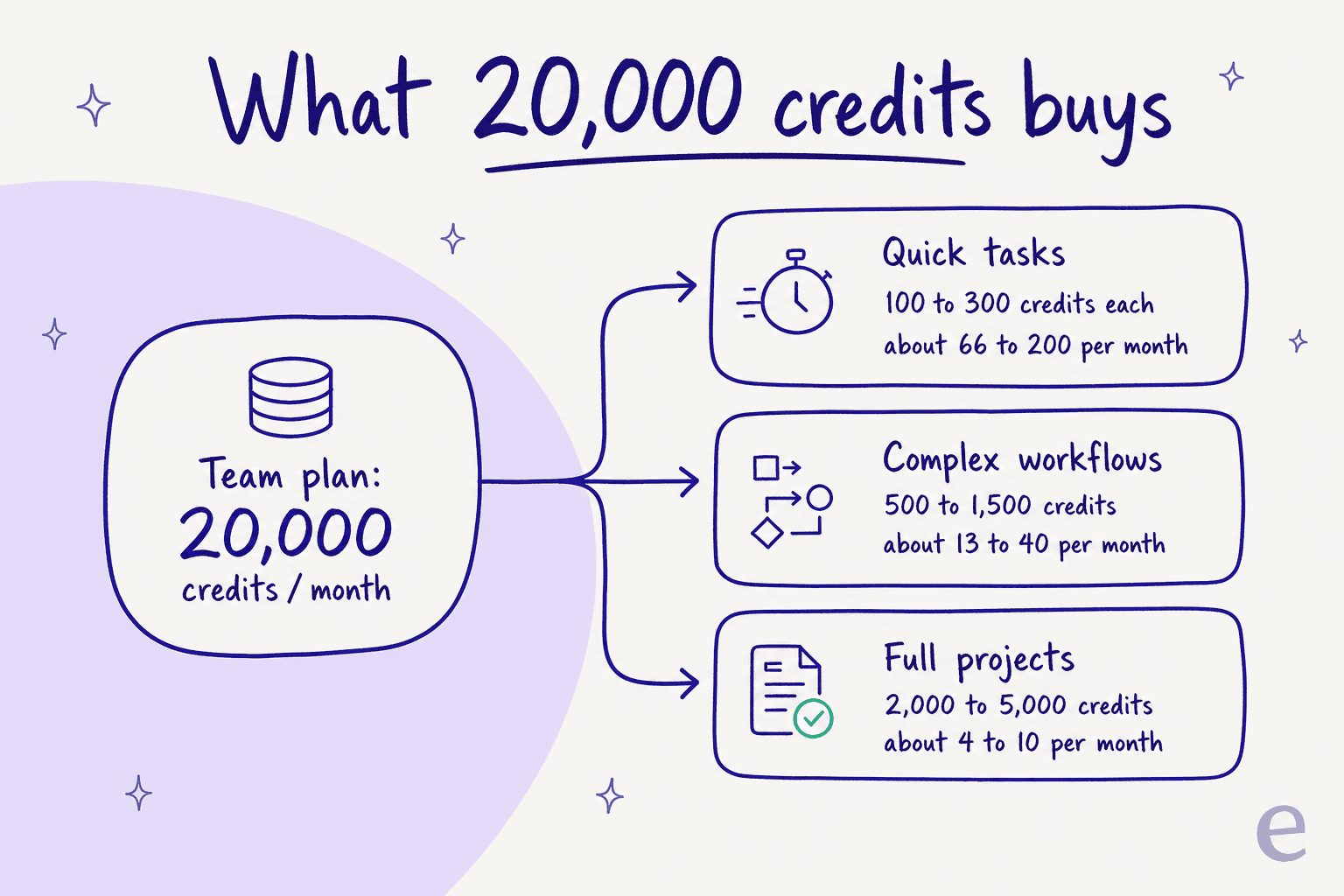
Second, the entire model rests on one word: credits. Everything you do spends from the same 20,000-credit monthly pool. So the honest version of "how much does Viktor cost" is: $50 a month buys you 20,000 credits, and the real question is how far those credits stretch for your work.
Estimate what your credits get you
Because the plan is a credit pool, the useful thing isn't the sticker price, it's the burn rate. Plug in a rough month and see how far 20,000 credits go. (Estimates use the midpoint of Viktor's published ranges, so treat this as a planning ballpark, not a bill.)
Play with it and the pattern is clear: light, small tasks stretch a long way, but a couple of "build me an app" projects a week and you're topping up. That's not a knock, it's just the nature of usage-based pricing, and it's exactly what reviewers flag.
What actually burns credits
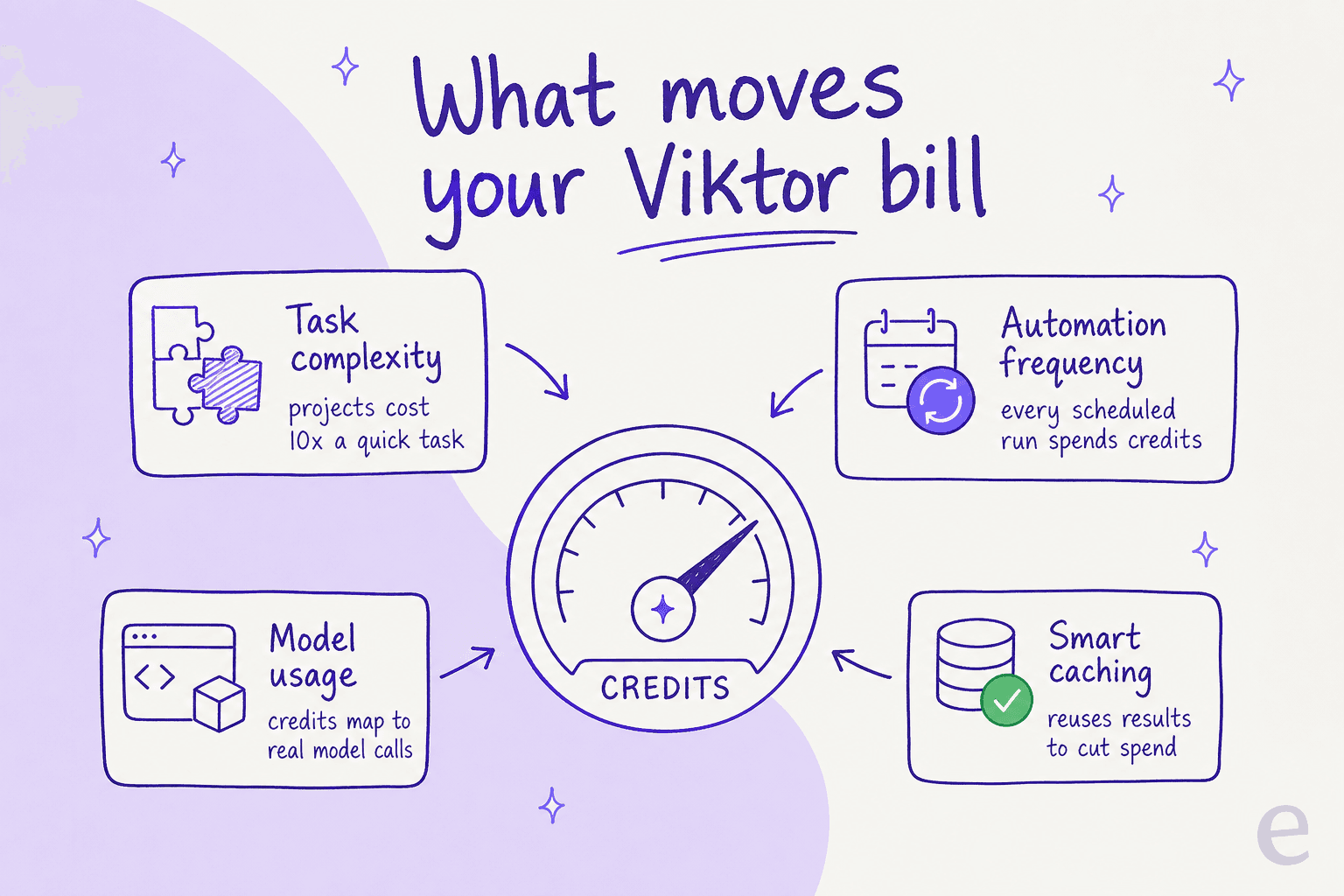
Viktor is upfront that credits track real model work, so a few things move your bill more than others. Knowing them is how you keep spend sane.
- Task complexity. A full project can cost 10x a quick task. The more tools Viktor touches and the more steps it runs, the more it spends.
- Automation frequency. Scheduled tasks and crons consume credits every time they fire. Viktor's own copy says "frequency matters," so a report that runs hourly costs far more than the same report run weekly.
- Model usage. Credits map to real calls into models like Claude and GPT, so heavier reasoning costs more, the same way it would if you paid the model provider directly.
- Smart caching (the one that helps). Viktor caches context and reuses results across tasks, so repeated workflows cost fewer credits than fresh runs. This is the lever that works in your favor.
The gap in the public pricing is worth naming: Viktor doesn't publish a dollar-per-credit rate, and the top-up and rollover mechanics aren't spelled out on the page (those FAQ answers sit collapsed behind a "show all" toggle). So you can estimate your monthly credits, but the exact cost of going over 20,000 isn't something you can read off the site. For a lot of AI tools this is normal, but it's the part to clarify with sales before you commit a real workflow.
What users actually say about the price
Let's start with the fair part: Viktor is genuinely well-liked. It sits at 4.8/5 across 35 G2 reviews, with the overwhelming majority five-star and no visible one-to-three-star ratings. Read the praise and a clear picture forms, solo operators and small agencies who treat Viktor as a second set of hands and frame the $50 against a headcount cost rather than against another SaaS tool. For that user, an always-on generalist for coffee-budget money reads as a steal.
The skeptics are worth hearing too, though. On Hacker News, a thread that reverse-engineered Viktor pushed the harshest version of the "it's just a model wrapper" critique:
"There's so little value in Viktor, that it is unethical to charge for it."

That's an outsider's jab, not a paying customer's verdict, and the review scores suggest most users disagree. But it points at the real fault line, which is value relative to what it spends. And that brings us back to credits.
The consistent, honest caveat, even from fans, is that credits burn faster than you expect and the spend needs active management. This is the known tradeoff of any usage-based model: you don't buy an outcome, you buy model time, and busy weeks cost more. Two specifics come up repeatedly and are worth pinning down before you commit: credit reconciliation on errors (if Viktor makes a mistake, you can still spend the credits fixing or re-running it) and top-up pricing (what you pay once the 20,000 runs out isn't published). Neither is a dealbreaker for light, varied use. Both matter a lot if your workload is heavy and repetitive.
So the honest read: if you're a lean team using Viktor for varied, mostly-light work, $50/month for an always-on generalist can feel like a bargain. If you're running heavy, high-volume, repetitive work, the meter is something you'll be watching, and that's true of every usage-based AI tool, not just this one.
The support angle: variable credits vs a credit per ticket
Here's where I'll be opinionated, because this is a support-adjacent post and Viktor's category is fuzzy. Viktor can do support: on its homepage it triages a queue, merges 23 duplicate tickets into one Zendesk thread, drafts replies to all of them, and files a bug, all from Slack. That's real, useful work.
But it bills that work on the same generic credits as everything else. There is no per-resolution or per-ticket rate. A ticket-triage batch just falls somewhere in the quick-task-to-complex-workflow range depending on scope. For occasional support spikes, fine. For a support queue that runs every day, credit pricing is the hard part to forecast, and this is a pain I hear constantly from support teams evaluating AI.
I've sat in on these buying conversations, and the pattern repeats: usage-based-per-action pricing turns every busy week into a budgeting question. One ops lead at a payouts fintech doing ~7-8K escalated tickets a month told us per-interaction pricing was a non-starter, because at their volume it would blow any monthly allowance in a day and a half. Another operator scaling toward 150K tickets/month found the interaction-vs-ticket distinction confusing enough that it stalled the whole decision. When you're doing support at volume, you want a unit you can count in your head, which is also why teams comparing AI cost against an offshore team reach for a per-ticket number first.
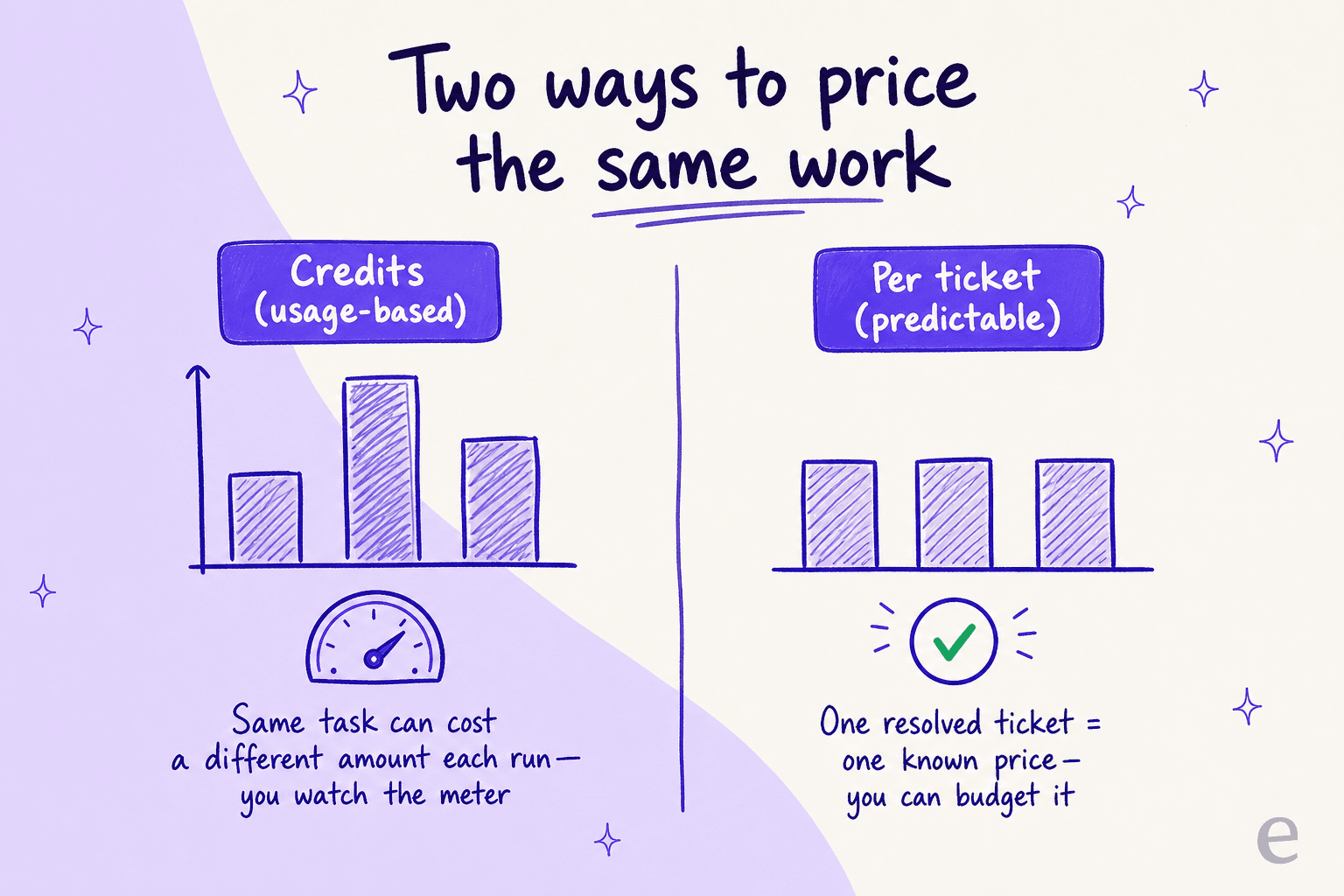
This is the whole reason eesel AI ties its credit to a unit people already think in. 1 credit is always exactly one ticket or chat, however long it runs, not a slice of model time. The plan is a fixed monthly price sized to your volume, so a quiet Tuesday and Black Friday use credits the same way, and if you run out you can turn on overage with a cap you set. That predictability is the point.
Is Viktor worth it?
Our take: Viktor is a strong buy for the specific person it's built for, and a "check the meter first" for everyone else.
- Pick Viktor if you're a founder, solo operator, or lean team that lives in Slack or Microsoft Teams and wants one generalist agent to absorb varied ops, marketing, finance, and light engineering work. At $50/month with no seat fees and every integration included, it can quietly replace a chunk of your stack. The $100 free trial makes it low-risk to find out. (If Slack is the main draw, it's worth scanning the best Slack AI apps too.)
- Watch the credits if your work is heavy, repetitive, or high-frequency (lots of scheduled automations, big daily projects). The model rewards light, varied use and punishes bulk, and the missing dollar-per-credit rate means you should pin down top-up cost with sales first.
- Look at a support-first tool if your main job is a customer support queue. Viktor sits on top of the helpdesk rather than replacing it (no macros, SLAs, CSAT, deflection reporting, or customer-facing widget), and its credit pricing is hard to forecast at ticket volume. A dedicated AI helpdesk agent that learns from your knowledge base and uses one credit per ticket will be both cheaper to predict and deeper on support automation features.
Viktor's model isn't bad, it's just optimized for breadth. The mismatch only shows up when you point a breadth tool at a depth problem like support.
eesel AI: predictable AI for your support queue
If you got here because you're weighing Viktor for support, that's the case where a purpose-built tool pulls ahead. eesel AI is an AI teammate for support that plugs into your helpdesk and your Slack in a few minutes, learns from your past tickets and help center, and starts drafting and resolving from day zero.
Two things make it a better fit for a support queue than a credit-metered generalist. First, pricing: eesel sells a fixed monthly plan from $299 for 500 credits, with 1 credit per ticket or chat and no per-seat fees, so your plan is sized to your tickets, not to a meter you have to babysit. Second, you can simulate the AI on thousands of your real past tickets before it ever touches a customer, so you see the resolution rate and the cost before you commit, instead of finding out on the invoice. We built that simulation step specifically because we've watched confident-sounding bots quietly give wrong answers, and no one should roll that out blind.
If your reality is a support inbox rather than a grab-bag of ops tasks, try eesel free and run it against your own tickets first. You'll know the real cost before you pay a cent.