

If you've been trying to find clear info on Worknet AI pricing, you’ve probably realized it’s not as simple as checking a webpage. Figuring out the real cost of an AI platform isn't just about the monthly fee. You have to dig into its features, how it’s deployed, and watch out for any hidden costs that might bite you later on.
Worknet markets itself as an AI teammate for every user that lives inside your app, but good luck finding a straightforward price. The website describes a model rather than a rate card, and older figures are scattered across different marketplaces and blog posts, which can get confusing fast. We’ve done the legwork for you, pulling together all the details to give you a clear, honest picture.
In this post, we'll walk through Worknet's main features, take a hard look at its pricing, and point out a few key limitations. We’ll also show you an alternative that offers the transparency and control that many teams are looking for in an AI tool.
What is Worknet AI?
Worknet’s whole deal is being an AI teammate that lives inside your product and is built to grow revenue. The goal is to engage with your users to improve trial conversions, keep customers around longer, and spot opportunities for expansion. The heart of the product is an in-app AI chat that learns from your official documents as well as the messy, uncurated stuff, like old support tickets and Slack conversations.
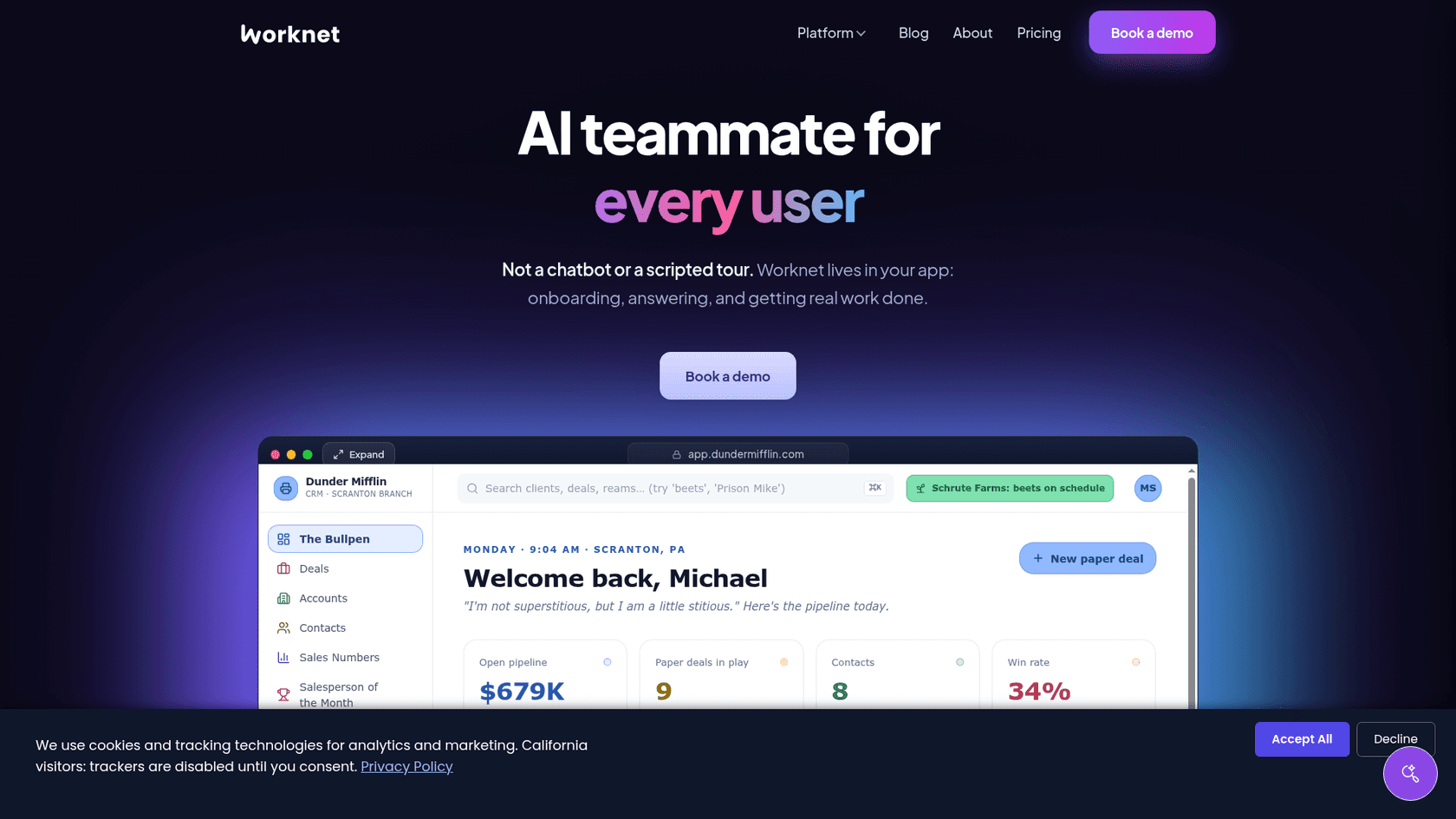
Their strategy is to turn every conversation, whether it's with a sales lead or a customer needing help, into a moment that could drive revenue. Worknet does this by connecting with key business tools like Salesforce and Zendesk, creating one channel where the AI can act as an extension of your team. The site also lists SOC 2 Type II and ISO 27001 certification and a 99.9% uptime SLA.
How Worknet's core features impact pricing
Before we get into the money talk, let’s look at what you’re actually paying for. Here’s a rundown of Worknet’s main features and what you should expect from a modern AI platform.
Proactive, agentic chat
Worknet talks a lot about its "agentic framework," which is a fancy way of saying it’s more than a simple Q&A bot. The idea is that it can listen to recordings of your best sales calls and learn to copy the tone and tactics of your top performers. This lets it make decisions on the fly, automate lead qualification, and handle objections all on its own.
Emulating sales calls is a cool concept, but it depends on having a library of "perfect" conversations for the AI to study. It also means you have to put a lot of faith in the AI to get things right. In contrast, a platform like eesel AI gives you a powerful, self-serve prompt editor. This lets you spell out the AI's exact tone, personality, and the specific actions it can take, giving you direct control from the very beginning without needing a stash of call recordings.
Deep integrations
A big part of Worknet's appeal is its ability to integrate with platforms like Salesforce, Zendesk, and Slack. The goal is to create a smooth workflow where the AI can create tickets, update CRM fields, or ping a human expert on Slack when a conversation gets too complex.
Deep integrations are a must-have for any serious AI tool, but the setup process is what really separates the good from the great. Some platforms need a lot of developer time to get all your systems talking to each other. On the other hand, eesel AI lists 39 integrations, and anything with an API can be added through Network Access. You can connect your helpdesk, knowledge bases, and chat tools in minutes, not months, without having to overhaul your current setup.
How a focus on revenue generation influences pricing
Everything about Worknet is built to drive revenue. Its website is full of features designed for trial conversion, expansion, and retention. A key piece of this is the "Support-to-Sales Conversion" feature, which is trained to spot when a simple support question is actually a hidden upsell opportunity. This revenue-first mindset is central to how they position themselves and justify their pricing.
Deconstructing the Worknet AI pricing model
Alright, this is where things get a bit messy. Worknet's website has a pricing section but no price list, and the only call to action is "Talk to us about pricing." That leaves you to hunt through third-party marketplaces or schedule a call with their sales team, which makes it tough to plan a budget.
The per-user, per-month fee
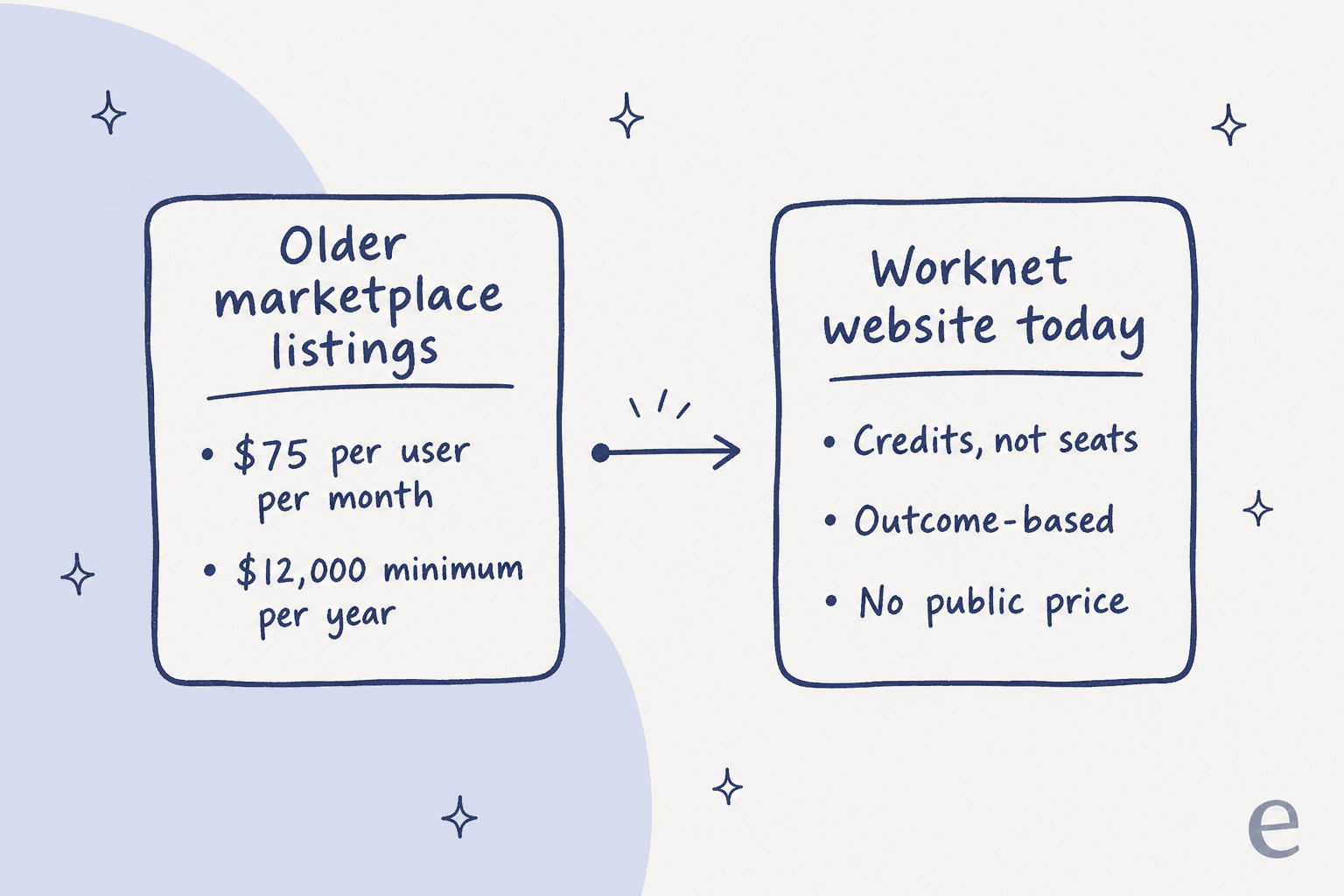
After some digging on the Salesforce AppExchange and TrustRadius, a clearer picture starts to form. TrustRadius once carried a price of $75 per user, per month, but its Worknet pricing page now says no pricing plans are listed. The AppExchange listing currently shows a lowest starting price of $50 per user, per month. Both figures look dated next to Worknet’s own site, which now says there are no per-seat licenses.
The same Salesforce listing still shows a minimum annual price of $12,000. If a minimum like that applies in a private quote, it is a high bar for a smaller team that wants to try the tool before a big commitment, so it is worth asking about directly.
The credit and outcome-based model
Worknet's site now describes a completely different model: "credits, not seats." Every agent action draws from a shared credit pool, unused credits roll forward, and pricing is meant to track outcomes such as conversations resolved, trials converted, and accounts retained. An earlier Worknet blog post described the same idea as "Success Fees" plus "Usage Tiers" based on session volume.
| Feature | Marketplace listings | Worknet website today |
|---|---|---|
| Base Cost | $50 per user, per month on AppExchange ($75 on older TrustRadius coverage) | Shared credit pool, price per credit not published |
| Additional Fees | None specified | Outcome-based pricing (conversations resolved, trials converted, accounts retained) |
| Minimum Commitment | $12,000 annually (Salesforce listing, still shown) | Not published, "a plan shaped around your goals" |
| Seats | Per user | "No per-seat licenses" |
| Source | Salesforce AppExchange, TrustRadius | Worknet pricing section |
An outcome-based model can be a fair deal when the outcomes are well defined. What it leaves open is how a bill moves in a strong month, because Worknet doesn't publish what a credit costs or what counts as a billable outcome. That is worth getting in writing before you sign.
This is where a transparent pricing model really makes a difference. For example, eesel AI's pricing is a fixed monthly plan sized to volume: from $299/month for 500 credits, where 1 credit is one ticket or chat, with no per-seat fee. You know what your bill will look like, and you can move up or down a plan any time.
What's missing from the Worknet AI pricing information?
The biggest problem with Worknet’s pricing is the lack of detail. The site says credits and outcomes, but it doesn't list what a credit costs, how many credits an action uses, or what counts as an outcome. It also doesn't say which features are included in the base price. Things like the call ingestion feature or certain integrations could easily be expensive add-ons that you only find out about once you're on a sales call.
Key Worknet AI pricing limitations and the self-serve alternative
Worknet's sales-first approach has some real downsides. Here’s why a self-serve model often makes more sense for modern teams.
High barrier to entry and lack of flexibility
If the $12,000 minimum annual price on the AppExchange listing applies to a quote, it is a real risk for teams that want to start small, test a tool, and scale up once they see it's working, because you commit for a full year before confirming it's the right fit. Worknet says it has no per-seat licenses, so adding agents shouldn't add seat costs. What you can't see up front is how the credit price scales with your volume.
The "black box" problem: No way to test before you buy
Because Worknet is sales-led, you book a demo rather than sign up on your own. The site offers a live demo and a booked walkthrough, but it doesn't mention a free trial or a sandbox on your own data. The AppExchange listing does show a 14-day free trial, so ask whether it covers your own content.
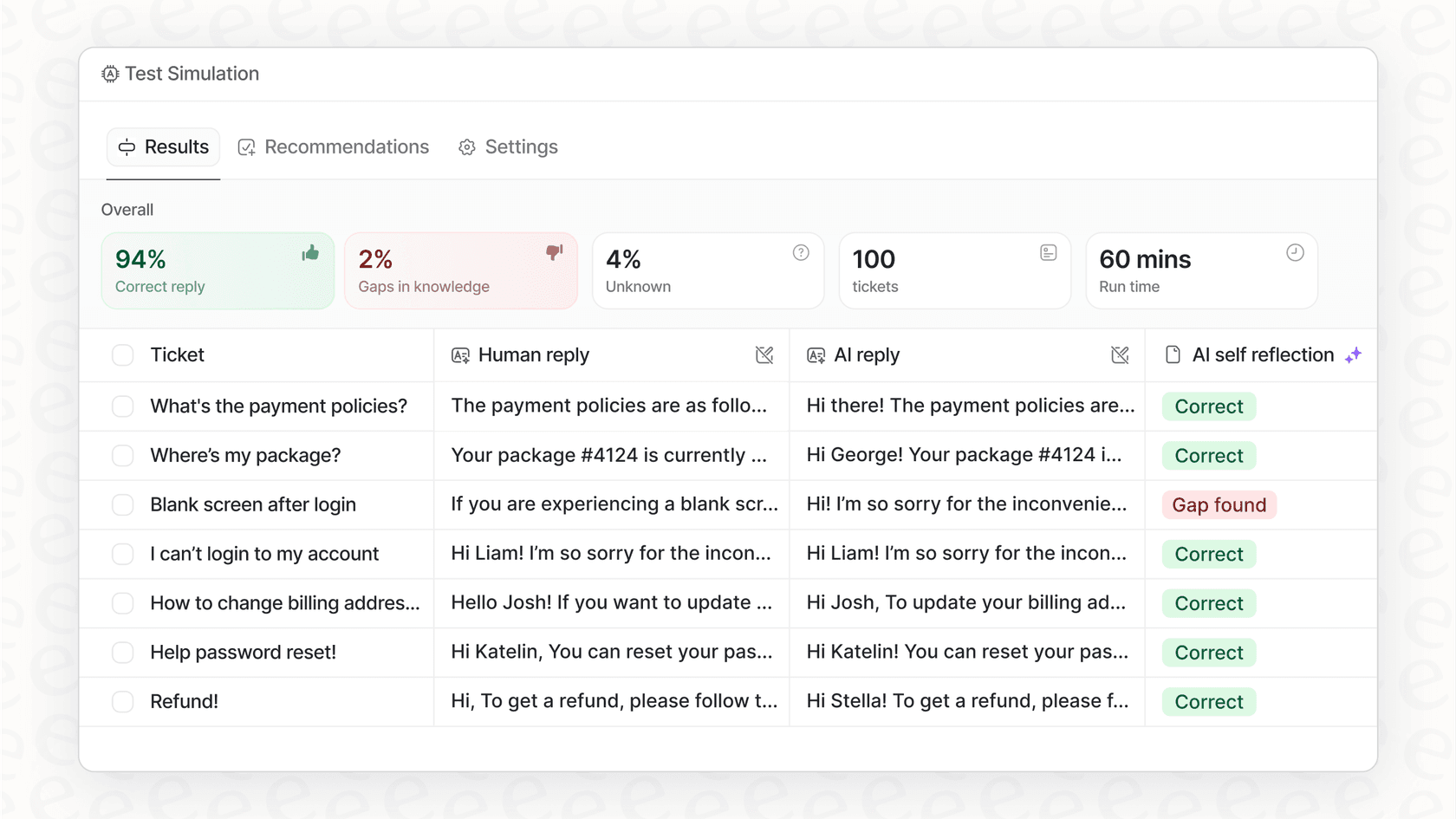
This is where a fully self-serve platform like eesel AI really stands out. You can sign up with 100 free credits, no card needed, and get an AI agent up and running in a few minutes. Even better, eesel AI’s powerful simulation mode lets you test your AI against hundreds of your own past tickets or generated test cases. It scores each answer and suggests instruction changes, so you can tweak its behavior before it ever talks to a real customer. This takes all the risk out of the adoption process.
Limited control over rollout
With a sales-led tool, it’s often unclear how much control you have over the launch. Can you limit the AI to specific types of tickets or certain customer segments to start? The site doesn't describe rollout controls like this, so I'd ask about them in a demo.
With eesel AI, you have total control from a simple dashboard. You can create specific rules to automate exactly which tickets the AI handles. You can start with simple, high-volume topics, prove the ROI to your team, and then expand the AI's role as your confidence grows.
Worknet AI pricing: Look for transparency and control
While Worknet AI has some interesting features aimed at revenue, its Worknet AI pricing model is confusing and lacks transparency. It comes with a high upfront cost and doesn't offer the flexibility that most teams need to adopt AI successfully.
The best AI tools let you start small, test with confidence, and scale at a predictable cost. You shouldn't have to settle for a model that locks you into a long-term contract before you’ve proven its value, or one that punishes you for your own success.
Start with a smarter, more transparent AI
Ready for an AI support agent that actually puts you in the driver's seat? With eesel AI, you can go live in minutes, test everything risk-free in simulation mode, and enjoy simple, predictable pricing that grows with you.
Explore eesel AI's pricing or start your free trial.
Frequently asked questions
How does Worknet AI pricing actually work?
Worknet's website describes credit-based, outcome-aligned pricing with no per-seat licenses: agent actions draw from a shared credit pool and pricing tracks outcomes such as conversations resolved. Older marketplace listings showed $75 per user per month, the Salesforce AppExchange now shows $50, and Worknet does not publish a rate card, so you need a quote.
Is there a significant minimum annual commitment for Worknet AI pricing that I should be aware of?
A Salesforce AppExchange listing still shows a minimum annual price of $12,000. Worknet's current site doesn't publish a minimum, so ask for it in writing during the quote, especially if you are a smaller team.
Can I try Worknet AI with my own data before committing to the full Worknet AI pricing?
Worknet offers a live demo and a booked walkthrough, but its site doesn't mention a free trial or a self-serve sandbox on your own data. Its AppExchange listing shows a 14-day free trial. Ask whether a pilot on your own content is possible before you sign.
How does the seat count affect Worknet AI pricing as my team expands?
Worknet says it has no per-seat licenses, so adding team members shouldn't add seat fees. Marketplace listings showed $75 and now $50 per user per month, so confirm in your quote that your costs follow credits and outcomes, not headcount.
How predictable are the monthly bills if Worknet AI pricing follows an outcome-based model?
That depends on the contract. Worknet says pricing follows outcomes and credits, and that unused credits roll forward. It doesn't publish the credit price or what counts as a billable outcome, so ask for both, plus any cap on monthly spend.