

If you’re here, you’re probably sold on the idea that AI can seriously help out your customer support team. Tools like Yuma AI have shown just how handy focused automation can be, especially if you run an e-commerce or DTC brand. But what happens when you hit a wall? Maybe you need something that’s more flexible, easier to get started with, or has pricing that doesn't feel like a rollercoaster. The market is packed, and honestly, trying to pick the right platform can be a headache.
That's why I did the legwork for you. This guide cuts through the noise and looks at the top 8 Yuma AI alternatives, comparing them on the things that actually matter day-to-day: speed, control, and smarts. Let's find you the right tool to not just close tickets, but to build a support system that pretty much runs itself in 2026.
What are AI customer service tools?
Let's quickly get on the same page. When I say "AI customer service tools," I'm not talking about those old-school chatbots that could only spit out pre-written answers. Today’s AI agents are a whole different beast. They use generative AI to figure out what a customer actually wants, pull info from all over the place, and, most importantly, do things.
Think of them as autonomous members of your team. They can do more than just point to a help article; they can actually process a refund, check on an order status, or pass a tricky issue to the right person with all the context attached. They plug right into your current helpdesk (like Zendesk or Freshdesk) and learn from your past support conversations to sound just like your team. The point isn't to replace your human agents, but to take all the repetitive stuff off their plates so they can tackle the interesting, high-value problems.
Why look for Yuma AI alternatives?
Yuma AI has definitely made a name for itself, especially for Shopify stores, by nailing e-commerce automation. It’s a solid tool for handling the usual retail questions. But I’ve seen a lot of teams start looking for Yuma AI alternatives for a few common reasons:
-
You're not just selling t-shirts. Your business might need a tool that’s just as good at handling internal IT questions or helping SaaS customers as it is with e-commerce.
-
You want to be in the driver's seat. Some platforms lock you into long setup calls and rigid rules. Many teams just want to sign up, build, test, and launch an AI on their own schedule.
-
The pricing is a bit of a black box. Paying for every ticket the AI resolves can make budgeting a nightmare, especially when you get busy. A simple, flat subscription fee is often much easier to manage.
-
You need to see results, like, yesterday. Waiting weeks or months to see if a tool is working just doesn't cut it anymore.
My criteria for the best Yuma AI alternatives
To keep this comparison useful, I judged every platform on five things that I think really matter when you're adopting a new tool.
-
Speed to value: How fast can you get it set up and actually see it helping? Does it need a team of developers, or can you get it live in the time it takes to drink a coffee?
-
Customization and control: Can you tweak the AI's personality? Can you tell it exactly which tickets to handle and what actions it can take?
-
Knowledge sources: Can the AI only learn from one help center, or can it tap into everything, like your team's past tickets, Confluence pages, and shared Google Docs?
-
Pricing model: Is the pricing straightforward? Or are there hidden fees that pop up as you become more successful?
-
Testing abilities: Can you test the AI on your old tickets to see how it would have performed before letting it talk to a single live customer?
The top 8 Yuma AI alternatives for customer support
1. eesel AI
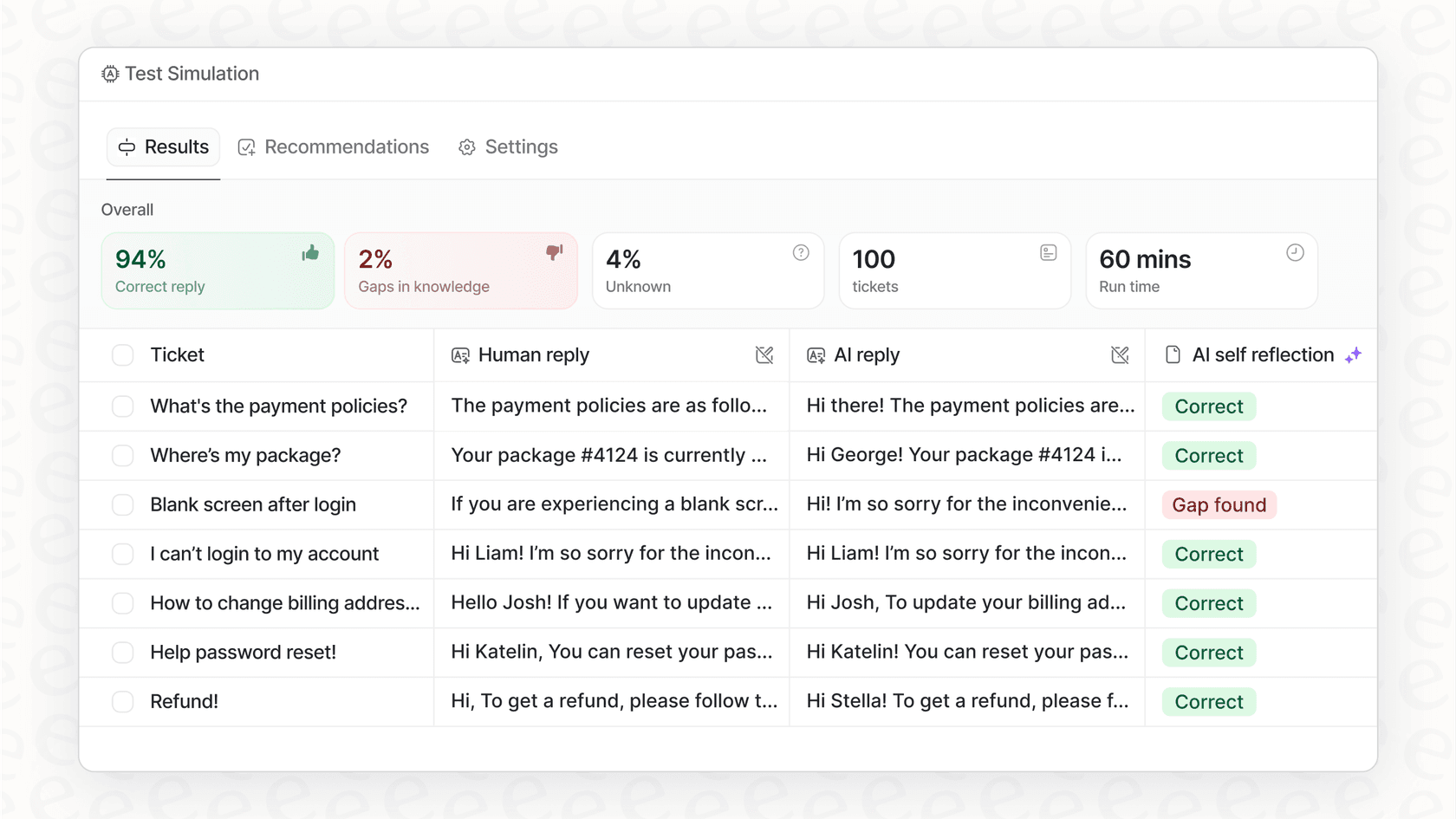
eesel AI is all about giving support teams total control and flexibility. Instead of making you sit through a sales demo just to see the product, it lets you jump right in. You can sign up, connect your helpdesk and knowledge bases in a few clicks, and have a genuinely useful AI agent running in minutes. The feature that really stands out is its ability to simulate how it will perform on your past tickets, which lets you deploy it with confidence. This makes it a fantastic choice for teams that want to automate support without the usual risks and long setup times.
What I liked:
-
Actually self-serve: You can go from signing up to having a live AI agent in under 10 minutes, no salesperson needed.
-
Powerful simulation mode: You can test the AI on thousands of your real historical tickets to get an accurate preview of how well it will work.
-
Total workflow control: A simple, no-code editor lets you define the AI's voice, create custom actions, and decide exactly which tickets it should handle.
-
Pulls knowledge from everywhere: It connects to over 100 sources, including your past tickets, helpdesks like Zendesk and Freshdesk, and internal docs in Confluence or Google Docs.
-
Predictable pricing: Flat-rate monthly plans mean no surprise bills.
| Pros | Cons |
|---|---|
| Incredibly fast and easy to set up yourself. | It's a newer company than some of the old guard. |
| Simulation mode takes the guesswork out of going live. | The most powerful features are on the Business plan. |
| Transparent, flat-rate pricing is great for budgeting. | |
| You can customize pretty much everything. |
Pricing: Starts at $239/month (billed annually) for the Team plan. A free trial is available so you can poke around.
Best for: Teams of any size who want a powerful AI that’s easy to use, has predictable costs, and lets you test everything risk-free before you launch.
2. Zendesk AI
Zendesk AI is the built-in AI that comes with the Zendesk Suite, an industry-leading platform known for its maturity and reliability. Its main selling point is that it's already part of the extensive Zendesk ecosystem. It gives you AI agents to handle common questions and a copilot that helps your human agents with things like suggested replies. For existing Zendesk customers, the setup is seamless. This enterprise-grade tool provides a highly stable environment for teams who value a unified and comprehensive support platform.
What I liked:
-
Seamless native integration: It just works, right inside of the world-class Zendesk platform.
-
AI agents and copilot: You get robust tools for both automating customer answers and helping your human team work faster.
-
Intelligent triage: It can automatically sort and route tickets with impressive accuracy as they come in.
| Pros | Cons |
|---|---|
| A perfect fit if you're already all-in on Zendesk. | Optimized specifically for the Zendesk ecosystem. |
| Combines ticketing and AI in one powerful spot. | Focused on providing a streamlined native experience. |
| World-class reporting and analytics. | Offers various tiered plans to match different team sizes. |
Pricing: AI features are sold as add-ons to Zendesk Suite plans (which start at $55/agent/month). Zendesk offers tiered plans to match different team sizes and needs.
Best for: Businesses that are already heavily invested in the Zendesk ecosystem and want to leverage its proven, market-leading capabilities.
3. Gorgias
Gorgias is a helpdesk built from the ground up for e-commerce, especially for stores running on Shopify. As you'd expect, its AI features are all about e-commerce. It can automatically figure out when a customer is asking "where is my order?", pull the data from Shopify, and fire back an answer. It's a lifesaver for online retailers, expertly tailored for the retail space. Since the AI is natively built into the Gorgias platform, it offers a seamless, unified experience for teams looking for an all-in-one solution.
What I liked:
-
Deep Shopify integration: It feels like a native part of your store.
-
E-commerce intent detection: It already knows how to handle the most common retail questions.
-
Automated flows: You can set up rules to automatically tag and reply to tickets.
| Pros | Cons |
|---|---|
| The best integration out there for Shopify merchants. | Highly specialized for retail and e-commerce. |
| Helpdesk and AI are rolled into one platform. | Optimized for speed and efficiency over complex manual setup. |
| Geared towards turning support into sales. | Provides the most value when used within the Gorgias ecosystem. |
Pricing: AI features are part of the Gorgias plans, which are flexible and tiered to match your team's support volume and start at $10/month for a very basic plan.
Best for: E-commerce brands on Shopify that want a helpdesk and AI that are perfectly in sync with their store.
4. Freshdesk (Freddy AI)
Freddy is Freshdesk's AI features and capabilities, and it's a powerful solution designed to work seamlessly across the entire Freshworks ecosystem. This mature and reliable platform powers customer service for thousands of companies. It offers everything from customer-facing chatbots to tools that help agents provide exceptional service with suggested replies. It’s an ideal choice for teams looking for a robust, enterprise-grade, and omnichannel platform that handles support everywhere your customers are.
What I liked:
-
Omnichannel support: The AI works across all channels, including email, chat, phone, and social media, ensuring a consistent experience.
-
Helps customers and agents: It features both intelligent customer-facing bots and powerful tools to help your human team work more efficiently.
-
AI-powered insights: Freshdesk provides excellent analytics to help you identify support trends and optimize your operations.
| Pros | Cons |
|---|---|
| A reliable platform for teams handling support everywhere. | Best if you're already using Freshworks products. |
| Comprehensive set of powerful AI features. | Advanced custom workflows may require some initial configuration. |
| Includes a free tier for essential helpdesk functions. | Freshdesk offers tiered plans to match different team sizes. |
Pricing: The Freddy AI Agent is session-based (500 free sessions, then $49 per 100 sessions, about $0.49 each), and the Copilot is an add-on (starts at $29/agent/month) available on top of your Freshdesk plan.
Best for: Businesses that want a mature, all-in-one support tool for many channels and are looking for a trusted partner within the Freshworks ecosystem.
5. Siena AI
Siena AI calls itself "the AI CX operating system for consumer brands," and it works in the same ecommerce lane as Yuma. It runs AI agents for support, shopping, social, QA and voice-of-customer work. It also sits on top of the helpdesk you already use: its integrations page lists Gorgias, Zendesk, Gladly, Kustomer and Dixa, next to commerce tools like Shopify, Loop Returns, Recharge and Klaviyo.
What I liked:
-
Commerce tools in the box: Shopify, AfterShip, Loop Returns, Recharge, ShipBob and Stripe are all on the integrations list.
-
Helpdesk agnostic: It works with Gorgias, Zendesk, Gladly, Kustomer or Dixa, so you don't have to switch platforms.
-
Brand voice controls: AI Personas are built on your tone, voice and customer language, with channel-specific design.
-
More than support: The same platform covers shopping, social, QA and customer insights.
| Pros | Cons |
|---|---|
| Made for ecommerce and consumer brands. | Focused on consumer brands rather than SaaS or internal IT support. |
| Sits on top of several major helpdesks. | Pricing is by quote only. |
| Covers support, shopping and social in one place. | Getting started runs through a demo booking. |
Pricing: Siena doesn't publish prices. Its pricing page asks for your monthly ticket volume and helpdesk, then sends a quote.
Best for: DTC and consumer brands that want an ecommerce-focused AI agent on top of their existing helpdesk.
6. Decagon
Decagon builds AI agents for chat, voice and email, and it is aimed at large enterprises. Retail is one of its industries, alongside financial services, travel, technology and others. Its main idea is Agent Operating Procedures (AOPs): you write the agent's workflows in natural language, the way you'd write SOPs for a human team, and engineers can version them with Git-based tracking.
What I liked:
-
Natural-language workflows: AOPs let CX teams change how the agent behaves without an engineering sprint.
-
One agent across channels: Chat, voice and email run from a single intelligence layer.
-
Testing before launch: Decagon offers testing and QA with simulations at scale, plus live A/B experiments.
-
Visibility into decisions: You can trace the agent's reasoning at any point in a conversation.
| Pros | Cons |
|---|---|
| A good fit for complex, multi-step workflows. | No public pricing; you start with a demo. |
| Voice, chat and email in one platform. | Built with enterprise teams in mind. |
| Simulation testing and A/B experiments are included. | Retail is one of several industries it serves, not its only focus. |
Pricing: Decagon doesn't list prices on its website. You request a demo to get a quote.
Best for: Large companies that want one AI agent across voice, chat and email and are comfortable with a demo-led rollout.
7. Ada
Ada is an AI customer service platform for enterprise CX teams, with a dedicated retail and ecommerce offering. Its newest piece, Ada Computer, gives the AI agent API, code and MCP tools so it can complete a customer's task inside your business systems, under controls you set. Ada says it works with 350+ global businesses.
What I liked:
-
Takes action, not just answers: Ada Computer lets the agent use your systems to finish the task.
-
Industry focus: Ada has dedicated offerings for retail and ecommerce, financial services, gaming, technology and travel.
-
A business case up front: The sales process includes a custom demo on your use cases and an ROI model based on your volume.
| Pros | Cons |
|---|---|
| The agent can act across your business systems. | Pricing isn't public; it comes through a demo call. |
| A mature platform used by 350+ businesses. | Geared toward enterprise CX teams. |
| You get a custom business case before you buy. |
Pricing: Ada's pricing page is a demo booking form. There are no list prices; you get a custom demo and a business case.
Best for: Enterprise CX teams with high contact volumes that want an AI agent that can act inside their systems.
8. Forethought
Forethought describes itself as "enterprise AI agents for any CX platform." Its agents learn from your past tickets and help center content. They cover resolving questions across chat, email and voice, classifying and tagging tickets, and giving human agents a copilot inside the helpdesk. A Discover module looks for knowledge gaps and suggests new articles.
What I liked:
-
Learns from past tickets: It trains on your ticket history and help center from day one.
-
Multi-agent setup: Separate agents handle resolution, triage, insights and copilot help.
-
Handoff control: The Professional plan adds custom handoff models for passing conversations to a human.
-
Gap detection: Discover surfaces missing content and suggests automations based on recurring issues.
| Pros | Cons |
|---|---|
| Uses past tickets as a knowledge source. | All three plans are quote-only. |
| Covers resolution, triage and copilot in one platform. | Email, voice and Slack agents start on the Professional plan. |
| Works with the helpdesk you already have. | Knowledge gap detection is an Enterprise feature or a paid add-on. |
Pricing: Forethought's pricing page lists Team, Professional and Enterprise plans, each with a "Get a Quote" button. No prices are published.
Best for: Support teams with a lot of ticket history who want AI for resolution, triage and agent assist on top of their current helpdesk.
A quick comparison of Yuma AI alternatives
Here’s a simple table to see how these top 8 Yuma AI alternatives stack up at a glance, so you can build your shortlist.
| Tool | Go-Live Speed | Pricing Model | Key Differentiator | Best For |
|---|---|---|---|---|
| eesel AI | Minutes | Flat-rate subscription | Set it up yourself & test risk-free | Teams wanting speed, control, and no surprise bills. |
| Zendesk AI | Days | Subscription + Add-ons | Deep native Zendesk integration | Existing Zendesk customers who want a proven platform. |
| Gorgias | Days | Flexible tiered plans | Deep Shopify integration | E-commerce stores on Shopify. |
| Freshdesk (Freddy AI) | Days to Weeks | Subscription + Add-ons | Strong omnichannel capabilities | Businesses needing a general-purpose, all-in-one suite. |
| Siena AI | Not published (demo first) | Custom quote | Ecommerce AI agents on top of your helpdesk | DTC and consumer brands. |
| Decagon | Not published (demo first) | Custom quote | Natural-language AOPs across chat, voice and email | Enterprises with complex workflows. |
| Ada | Not published (demo first) | Custom quote | AI agent that acts inside your business systems | Enterprise CX teams with high volume. |
| Forethought | Not published (demo first) | Custom quote (three plans) | Learns from past tickets with a multi-agent setup | Teams with deep ticket history. |
How to pick the right Yuma AI alternatives for your team
Feeling a bit overwhelmed? Don't worry. Choosing the right tool is just about asking the right questions. Forget the long feature lists for a second and use this as your guide.
-
Can I try it now, without talking to anyone? The most confident companies let you try their product without forcing you into a sales call. A mandatory demo can be a sign that a tool is complicated and will take forever to set up.
-
Can I test it with my real data? A polished demo looks great, but how will the AI handle your actual customer questions? Look for a tool with a simulation mode, like eesel AI, so you can see a realistic forecast of how many tickets it would fully resolve before you commit.
-
Is my bill going to be a surprise next month? Paying per resolution might seem appealing, but it can lead to huge, unpredictable bills. A flat subscription fee is simple, makes budgeting easy, and doesn't penalize you for being successful.
-
Does it play nicely with the tools I already use? You shouldn't have to switch your helpdesk just to use an AI tool. The right solution should plug straight into what you're already doing with minimal fuss.
The best Yuma AI alternatives: Move beyond basic automation with eesel AI
Yuma AI is a good tool for e-commerce, but the world of AI support is a lot bigger. The best Yuma AI alternatives give you more flexibility, control, and clearer pricing. They let you build a system that works for your specific needs, whether you're in retail, SaaS, or IT.
Zendesk remains the gold standard for many, offering an impressive, mature ecosystem and reliable platform that powers customer service for thousands of top companies. Similarly, Freshdesk has built an incredible ecosystem and marketplace, providing a robust and trustworthy foundation for teams of all sizes.
If you're looking for a platform that lets you get started in minutes, test with total confidence, and grow without unpredictable costs, eesel AI was built for you. It brings the power of a serious enterprise AI together with the simplicity of a modern, self-serve tool that works beautifully alongside your existing Freshdesk or Zendesk setup.
Ready to see what real automation feels like? Start your free eesel AI trial today.
Frequently asked questions
I'm currently using Yuma AI for my e-commerce business; why might I need to look at Yuma AI alternatives?
While Yuma AI is strong for e-commerce, Yuma AI alternatives might offer more flexibility for diverse business types, clearer pricing models, or faster setup times. They cater to specific needs beyond basic retail automation.
What are the most important criteria to consider when evaluating Yuma AI alternatives for my support team?
When evaluating Yuma AI alternatives, focus on speed to value, customization and control, the breadth of knowledge sources, transparent pricing models, and robust testing abilities, especially a simulation mode. These factors ensure the tool truly fits your operational needs.
Can Yuma AI alternatives like eesel AI or Zendesk AI support businesses that aren't strictly e-commerce?
Yes, many Yuma AI alternatives are designed for broader applications beyond e-commerce, such as internal IT, SaaS customer support, or general business operations. They offer flexibility to handle various types of queries and integrate with different knowledge bases.
How quickly can I expect to see value from implementing some of these Yuma AI alternatives?
The speed to value for Yuma AI alternatives varies, but platforms like eesel AI boast setup in minutes, allowing you to have a live AI agent quickly. Others might take days or weeks depending on their complexity and your existing ecosystem.
Do Yuma AI alternatives offer more transparent or predictable pricing structures than Yuma AI?
Many Yuma AI alternatives indeed offer more predictable pricing, often through flat-rate monthly subscriptions instead of per-resolution fees. This helps teams manage budgets without unexpected costs as their support volume increases.
Will Yuma AI alternatives integrate with my current helpdesk, or will I need to switch platforms?
The best Yuma AI alternatives are designed to integrate seamlessly with popular helpdesks like Zendesk, Freshdesk, or even your internal documentation tools. You generally won't need to switch your existing helpdesk to leverage these AI tools.