


What is Yuma AI?
Yuma is an AI customer support platform purpose-built for ecommerce, designed for Shopify brands and layered on top of whatever helpdesk you already run. Its pitch is "resolve, don't deflect": the agents read the order, check your policy, take the action, and reply in your brand voice, the way a human agent would.
It comes with real pedigree. Yuma is a Y Combinator W23 company that raised $5M in late 2024, with Google's Gradient Ventures among the backers. It was founded by Guillaume Luccisano, and this is his third YC startup after Socialcam (acquired by Autodesk for $60M) and Triplebyte. By his own telling, Yuma started "by accident": he shipped a prototype in December 2022, got buried in demo requests, and turned it into a company.

The thing to internalize is that Yuma is a layer, not a helpdesk. It does not replace Gorgias or Zendesk; it sits inside them and does the resolving. That's a sensible design (no painful migration), and it's the same approach we take, but it also means Yuma's quality is bounded by how cleanly it reads your stack. More on that when we get to the limits.
What Yuma actually does
Yuma is really five products sharing one engine. The core is Support AI; the rest extend it across the customer journey.
Support AI: the core
Support AI is the part most people mean when they say "Yuma." It handles the bread-and-butter ecommerce queue, WISMO (where is my order), returns, exchanges, refunds, cancellations, address changes, end to end. Yuma says WISMO alone is 30 to 40% of ecommerce volume, which is exactly the repetitive stuff you want a machine to own.

What makes this category different from a rule-based chatbot is that the agent takes actions, not just words. Yuma ships over 100 ready-to-use actions and reads live data from Shopify, your helpdesk, your subscription tool, and your marketing platform. A return isn't a canned reply; it's the agent checking eligibility against policy, creating the label through your returns provider, sending instructions, and processing the refund.
How Yuma resolves a ticket
This is the "how it works" bit worth slowing down on, because it's where trust is won or lost. When a ticket lands, Yuma detects the intent, pulls the order, checks the relevant policy, drafts a reply, and runs it through what Yuma describes as 15 to 20 quality control checks across multiple models before anything reaches the customer. Low-confidence replies escalate to a human instead of sending.

You can see the whole loop in Yuma's own demo of a WISMO ticket: the agent detects the intent, pulls the order from Shopify, spots a carrier exception, drafts an on-brand reply, and clears its QC checks before responding.

Two guardrails stood out to me as someone who's watched AI confidently say wrong things. Fact Snippets insert verified policy text verbatim, so warranty periods or shipping rules can't drift, and Hard Limits cap the refund amounts and discount values the agent can ever issue. That's the right shape for keeping an AI agent inside the lines.
The gradual rollout
Yuma doesn't flip a switch to 100%. It ramps "like training a new hire": 0% to 1% to 10% to 30% to 50% to 100%, and at each stage you review a batch of AI-handled conversations and approve or roll back, typically 25+ human reviews before full autonomy. I like this a lot. It's the honest way to deploy AI on a live queue, and it's the opposite of the "turn it on and pray" approach that burns teams. My one quibble: it does mean meaningful results take weeks, not the same day, which matters for the pricing math later.
Sales AI, Social AI, and Chat AI
Beyond support, Yuma extends the same engine in three directions:
- Sales AI is a pre-purchase product Q&A widget on your storefront, answering sizing, compatibility, and ingredient questions. Yuma A/B tests it at up to 18% higher revenue per visitor.

- Social AI monitors Facebook and Instagram, auto-replies to comments and DMs, hides spam, and can turn a public comment into a private sales conversation.

- Chat AI is the live-chat widget version of the same agent, added with a few lines of code, taking real actions and escalating with full context.
Ask Yuma and the builder
Two more pieces tie it together. The Process Builder lets you author multi-step automations (refunds, returns, VIP care) in plain English or a drag-and-drop canvas, no developer required.
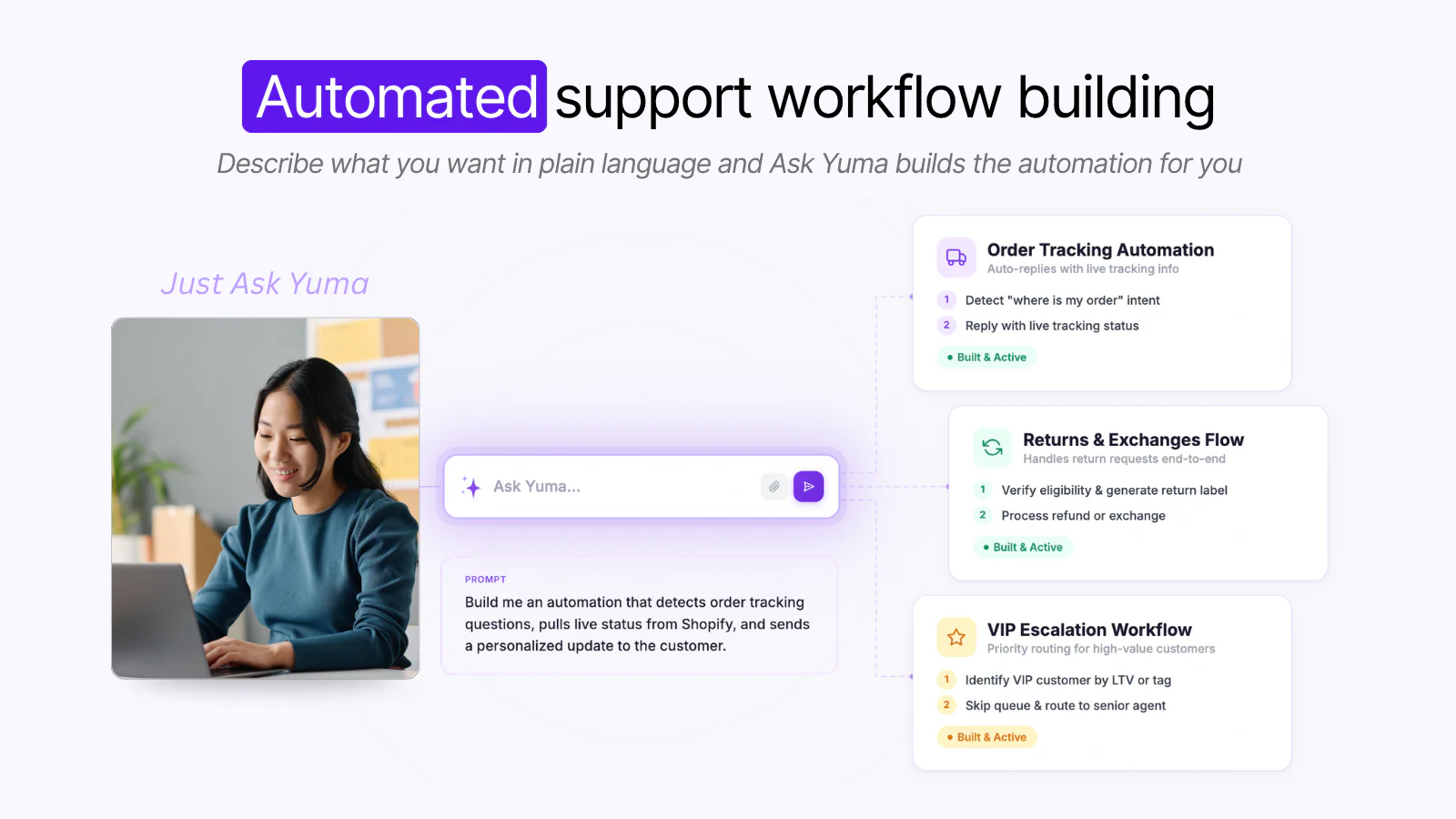
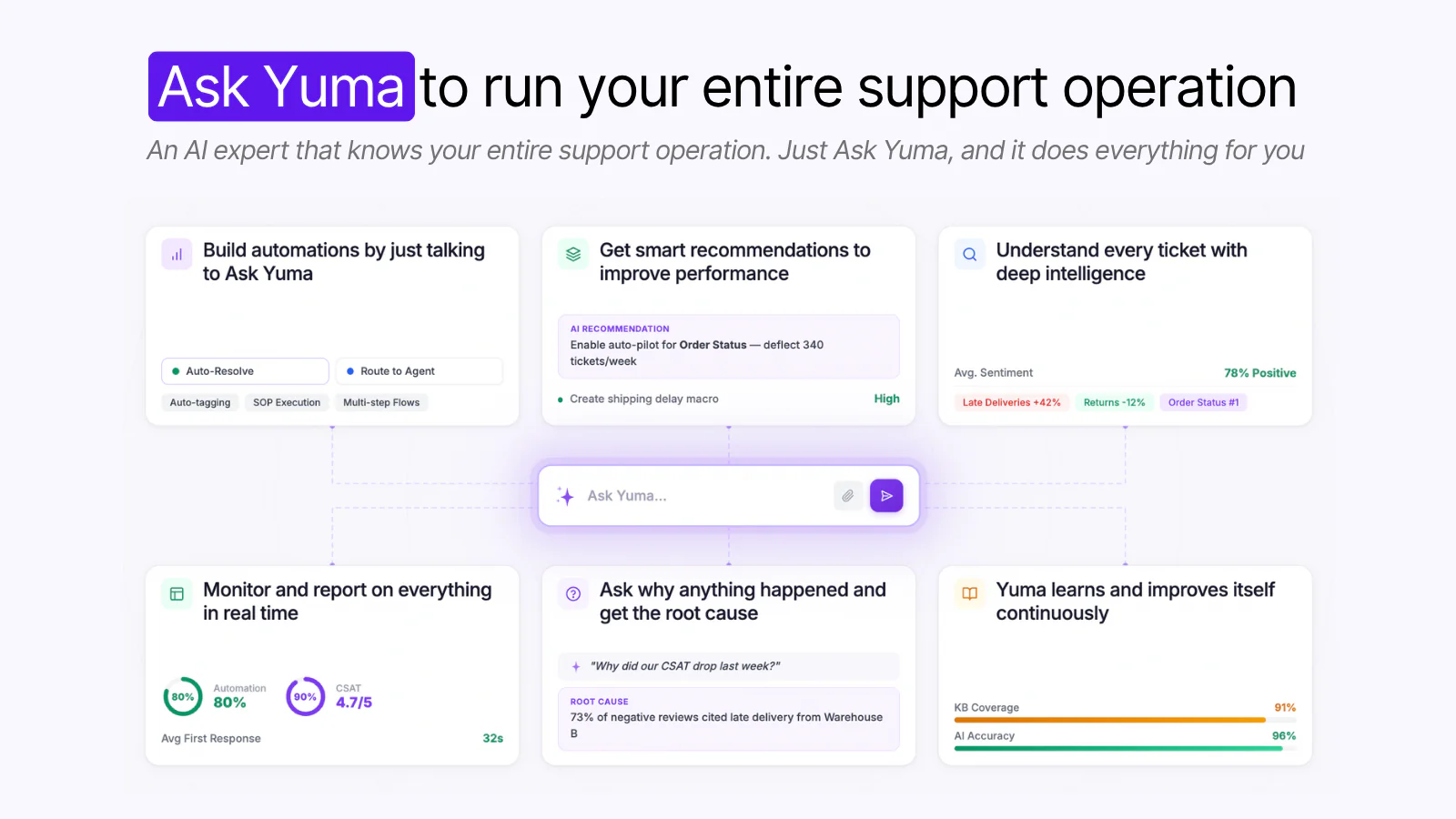
And Ask Yuma is a conversational layer across the whole dashboard that builds automations from your SOP docs, finds automation gaps, and diagnoses mishandled tickets. Yuma cheekily calls it "Claude Code, but for your entire CX operation," and 60% of existing merchants adopted it within a week. It's a genuinely clever idea: the product helps you operate the product.
Yuma AI pricing
The most-asked question has a clearer answer than it used to. Yuma's pricing page now publishes illustrative annual plans, and the model is simple: you pay only for a "full resolution", a ticket Yuma handled end to end with no human involved. Every plan carries a 12-month commitment, and your exact bundle is built around your forecast on a demo call.
Here is what the public surfaces show:
| Source | What's published | Notes |
|---|---|---|
| Yuma pricing page, Starter | $14,400/year, about $1.20 per resolution, 12,000 resolutions/year | Monthly plan: $1.50 per over-quota ticket |
| Yuma pricing page, Growth | $40,000/year, about $0.83 per resolution, ~48,000/year | No overage on annual plans |
| Yuma pricing page, Scale | $90,000/year, about $0.75 per resolution, ~120,000/year | Rate drops toward a $0.55 floor past 120,000 |
| Shopify App Store, Small Merchant | $850/month | Bundles a ticket package, 14-day trial |
| Shopify App Store, Medium Merchant | $1,200/month | Same structure, larger bundle |
| Yuma's vs-Gorgias page | ~$0.65-0.74 per fully resolved ticket | Yuma's own estimate, footnoted as based on average benchmarks |
A few honest caveats. The pricing page calls its figures illustrative annual prices paid upfront, so treat the per-resolution rate as a ballpark, not a rate card. Yuma's vs-Gorgias page also states a 100% ROI guarantee: if automation savings don't outweigh the fee, you pay nothing, which is a fair way to de-risk an outcome-based deal.
The good part of this model is the alignment: you only pay when a ticket is fully resolved, and any human touch voids the charge. Siena's pricing page lists a $750/month platform fee plus $0.90 per automated ticket, a different shape of deal. The catch with Yuma is the entry point: the smallest published bundle is $14,400/year ($850/month on Shopify), so you need real volume before the math works, which is the most consistent criticism in the reviews.
Estimate your real monthly cost
Because the per-ticket rate only means something once you map it onto your volume and your actual resolution rate, here's a quick estimator. Plug in your numbers and it maps your resolved tickets onto Yuma's three published annual bundles.
The thing the calculator makes obvious: at low volume, the entry bundle dominates and your effective cost per ticket rises. That's not a knock on Yuma's value, it's just who the model is built for. For a head-to-head on the helpdesk-AI side of that equation, my Gorgias AI pricing breakdown walks through the same trade-off.
The 89% automation claim, and what's real
Now the number you came for. Yuma's marketing leans on "89% automation," anchored to its EvryJewels case study (89% automation, 63% cost reduction, 150k+ tickets). That case is real and impressive. The honest framing is that it's a ceiling, not an average.
When you read the actual operator reviews on G2, the self-reported full-resolution numbers cluster lower and they're remarkably consistent:

A co-founder of an 8-figure brand was refreshingly specific about both the result and the effort:
"After working and spending quite some time setting up everything, we have managed to automatize more than 50% of our customer requests, reducing as well by 50% our average response time... I would say that the ROI of Yuma is about 4x to 6x. Companies telling you that automating customer service with AI in one or a few hours are just trying to sell you something."
Martin T., G2 review

A luxury jewelry reviewer reported "nearly 40% full automation" with the AI responding to ~75% of tickets, and a mid-market reviewer cited around 30%. None of these are bad. A genuine 30-50% ticket resolution rate on your most repetitive volume is a great outcome. But it's worth setting expectations to the real band rather than the brochure, and it's a pattern you'll see across every tool in the space, not just Yuma.
What users actually say
This is where Yuma genuinely shines, and I want to give credit. The G2 rating is 4.8/5 across 19 reviews (89% five-star), and the Shopify App Store sits at 5.0/5 (though only 9 reviews, so treat it as early-stage signal).
The single loudest theme is something most AI vendors can't claim: people praise the humans as much as the AI. Account managers get named, turnaround is fast, and the "continuous improvement" partnership comes up again and again.
"After testing multiple AI support tools, it's clear that Yuma is best in class. We've been able to automate the majority of our inbound volume through Yuma and have been consistently impressed by the wide range of topics it can handle and its carefulness in not stepping outside its bounds."
Gabe W., CX Manager, G2 review
On the Shopify side, a longer-tenured merchant put the accuracy point well:
"The danger with using AI for CX is always hallucinations. Their approach of building bots for specific use cases and limiting the amount of knowledge the AI can ingest for any given situation has driven unbelievably high accuracy. Some of our bots are consistently hitting 98% quality, which I've never seen another AI tool deliver."
Blueland, Shopify App Store review

That "limit what the AI can see per situation" instinct is exactly right, and it's why Yuma's accuracy holds up better than a bot pointed at one giant knowledge base.
Where Yuma falls short
No tool is the right fit for everyone, and a fair review names the edges. A few real ones surfaced in research:
- The pricing punishes small stores. The most concrete G2 criticism, from a 4.5-star retail reviewer: "The pricing model is rather strict. You need a significant volume of tickets to make it truly cost-effective... it's not the most suitable solution if you're just starting out or handling low volumes." (G2 review)
- Setup is real work. Multiple reviewers love the customization but say it takes time. That's the flip side of the careful, gradual rollout, you trade speed for safety.
- Occasional inaccuracy and logic gaps. G2's own summary notes the AI "can occasionally produce inaccurate responses, requiring oversight," and one reviewer wanted smarter routing logic between auto-pilots. Reviewers consistently pair these with praise for fast vendor fixes, but the oversight need is real.
- Integration breadth has holes. Yuma covers the big helpdesks and 50+ ecommerce tools, but niche stacks get missed; one reviewer flagged that Yuma doesn't work with Odoo in their setup.
- Sales-led onboarding. The pricing page routes plans through a demo, with a 30-day free start, and the Shopify listing offers a 14-day trial for its $850 and $1,200 plans. For some buyers that white-glove onboarding is a plus, for others it's friction.
Is Yuma AI worth it?
Here's my actual verdict. Yuma is a legitimately good ecommerce support AI, and if you're a mid-to-large Shopify brand drowning in WISMO and returns, it belongs on your shortlist. The agent is capable, the guardrails are sensible, the rollout is honest, and the human team is a real differentiator.

Skip it, or at least compare hard, if you're a smaller store, you're budget-sensitive, you run a helpdesk Yuma doesn't natively cover, or you want a public self-serve plan. Those are the exact gaps that send people looking at Yuma AI alternatives, and they're worth taking seriously.
Try eesel
If the parts of this review that gave you pause were the annual commitment and the demo-first path, that's the gap eesel was built for. eesel AI is an AI support agent that plugs into the same helpdesks Yuma does, Gorgias, Zendesk, and more, plus your Shopify store, and resolves tickets the same end-to-end way.
The difference is in how you buy and prove it. eesel runs a simulation on your past tickets before you commit, scoring each proposed answer as Perfect, Acceptable, or Fail, so you see how it handles your tickets up front, which speaks to the "89% vs reality" gap this review circles. Pricing is public and self-serve: a free plan with 100 credits, then fixed monthly plans from $299 for 500 credits, where one credit is one ticket or chat. And like Yuma, it only acts when it's confident, leaving the rest for your team, the exact thing that DTC lead on our call cared about most.
If you're shopping this category, it's worth putting both in front of your own tickets. You can try eesel free, or browse the wider field in my guide to the best AI helpdesk for Shopify.