

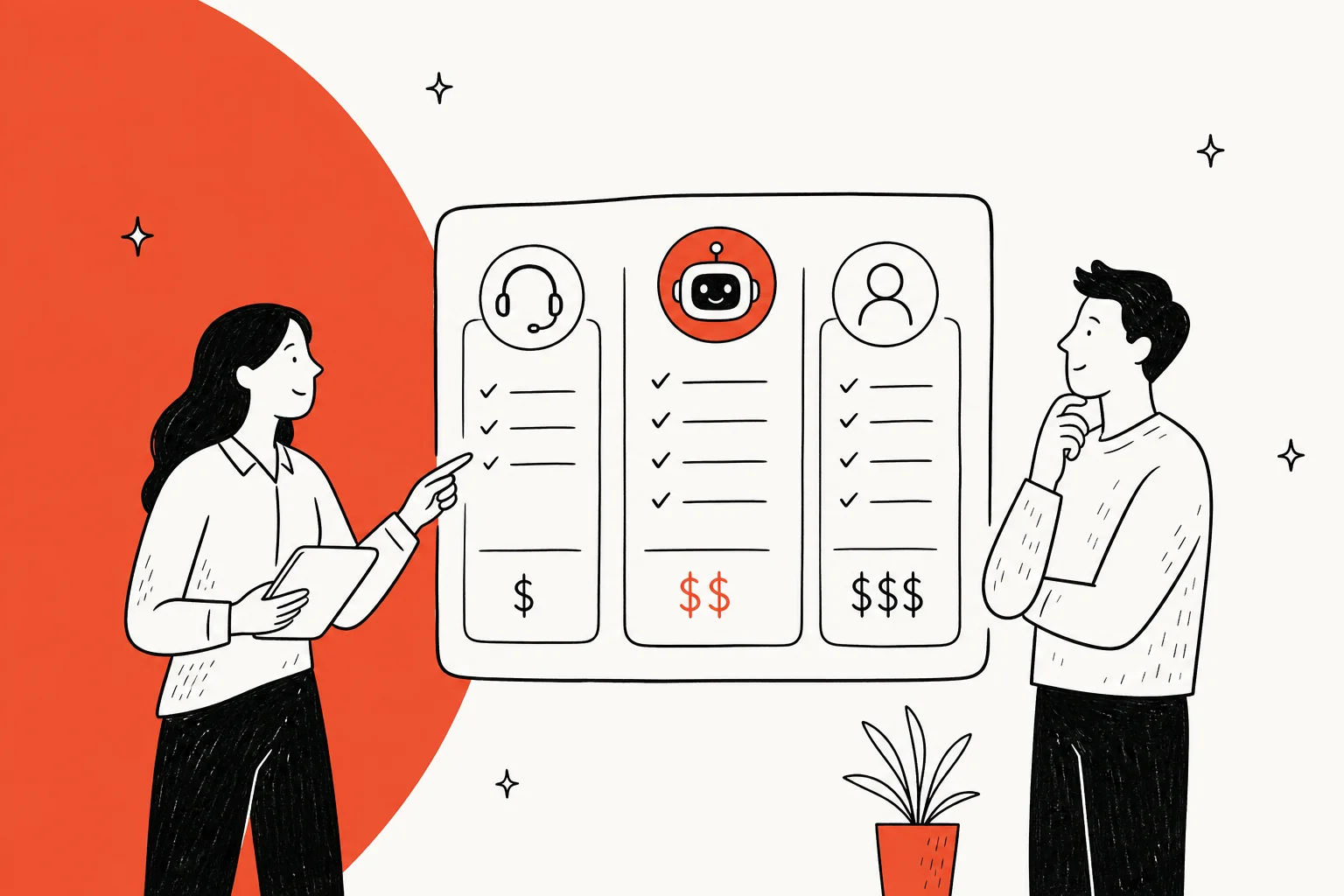
So what does Zowie actually cost?
The honest answer: almost nobody outside a Zowie sales call knows the full number. I checked every obvious path in July 2026. The pricing URL 404s, the homepage carries no pricing link, and Capterra lists Zowie as "Contact vendor for pricing" with no free trial and no free version. Every route funnels you to a demo request.
The one exception is Zowie's AWS Marketplace listing, which publishes a concrete figure because AWS listings require one: about $34,500/year for 25,000 conversations. Divide it out and you're looking at roughly $1.38 per conversation on that particular package. Treat it as one real data point, not a universal rate, because a custom enterprise contract can land well above or below it depending on scope.
That gap between "one AWS number" and "no rate card anywhere else" isn't an oversight. It's a deliberate motion. Zowie sells to large enterprises, the kind that run procurement cycles and sign annual contracts, and in that world a public price anchors the negotiation and invites comparisons the vendor would rather avoid. So the number lives behind a demo, built to order.
For a buyer, the practical takeaway is you can't estimate Zowie's real cost without talking to sales, and you can't self-serve your way to a trial. If your process needs a ballpark before a meeting, that's your first friction point.
How Zowie prices: the conversation-based model
Zowie frames its pricing as outcome-based: you pay for the conversations its AI agents actually handle, rather than per seat. On paper that sounds fair, and for a lot of the year it is. The problem is what happens to a volume-based bill when your volume isn't flat.
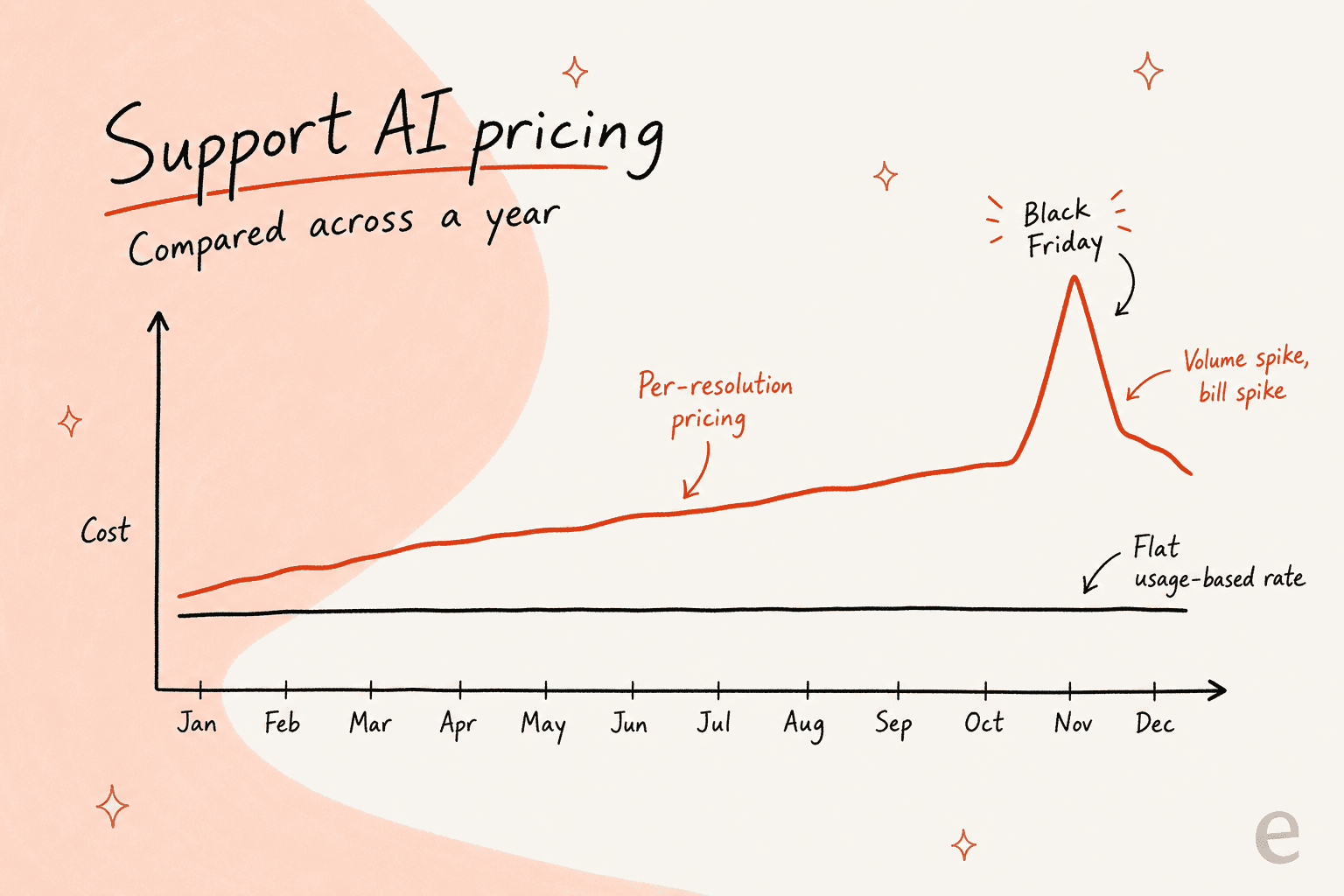
Support volume is seasonal. An ecommerce brand's ticket count can triple around Black Friday, and a conversation-priced model bills right along with it. That's the recurring complaint I found across Zowie's reviews: the tool works, but the cost isn't something you can lock in a budget around. When the unit is a "conversation" and the number is hidden behind a contract, forecasting becomes a guessing game exactly when you can least afford one.
This isn't hypothetical hand-waving. On our own sales calls, the sharpest objection I hear is about predictability, not headline price. One budget-conscious buyer told us he'd watched a prior vendor's price more than double, and he wanted contractual price locks before he'd commit to anything new. A conversation-based quote with premium-gated add-ons is the opposite of that reassurance.
Here's the rub with the AWS figure, too: it's a single package at 25,000 conversations. Scale up to a retailer doing hundreds of thousands of interactions a year, layer in voice, multiple channels, and premium features, and the real annual number climbs well past that anchor, into territory only a quote can tell you.
What you're actually paying for
To be fair to Zowie, the platform behind the number is substantial. This isn't a thin chatbot wrapper. Whatever your quote turns out to be, here's what sits behind it.
| Capability | What it does |
|---|---|
| Agent Studio | One workspace to build agents three ways: deterministic Flows, judgment-based Playbooks (goals and guardrails in plain language), and Knowledge retrieval from your docs. |
| Decision Engine | Compiles flows before they run so sensitive actions (refunds, claims, identity checks) execute predictably instead of being left to the model, with a full audit trail. |
| Orchestrator | Routes conversations across a fleet of agents (native, in-house, or third-party) over chat, email, SMS, voice, WhatsApp, and Messenger. |
| Supervisor | Scores every conversation against the same quality standard, with reasoning logs and per-agent quality scores for QA. |
| Actions & live data | Reads and writes to your CRMs, ERPs, and custom APIs mid-conversation, with escalation routing and inline authorizations. |
| Deployment options | Cloud (99.9% uptime SLA), private cloud in your VPC, or fully on-prem with air-gapped options. |
| Compliance | GDPR, SOC 2, ISO 27001, EU AI Act, DORA, and HIPAA, aimed squarely at regulated buyers. |
That compliance list matters if you're a security-conscious enterprise buyer, and Zowie's logo wall backs the scale claim, with names like Decathlon, Payoneer, Allianz, and InPost. The company says its agents handle 100M conversations a year across banking, insurance, telecom, and commerce. For a brand fielding millions of high-stakes tickets, that platform depth is the product, and the reason a five- or six-figure contract can pencil out.
What real Zowie users say
The scores are strong. Zowie holds a 4.7/5 on G2 across 73 reviews, a 4.8 on Capterra, and a 4.9 on the Shopify App Store. That's a healthy sample, and the praise is consistent: fast setup, an intuitive UI, and real ticket deflection on repetitive ecommerce queries like order status and returns.
"The software is very intuitive and easy in use."

But the criticism is just as consistent, and it's the part that hits your total cost. The sharpest complaints are about post-sale support and price at scale:
"The service is non-existent." A reviewer paying around $2,100 a month reports support taking hours or days to respond.
Two other themes come up again and again. The first is multilingual accuracy: reviewers describe the agent confusing languages and a translator feature that "didn't always work when needed." The second is analytics, where the dashboard is described as lacking the filtering and raw-data export that a serious CX team expects out of the box. None of these are dealbreakers for a big brand with a dedicated project team. All of them are things a smaller team would feel keenly, on top of the cost.
Why teams look past Zowie
Step back from the feature list and a pattern emerges. The things that push teams to shop around aren't about whether the AI works, they're about the shape of the deal.
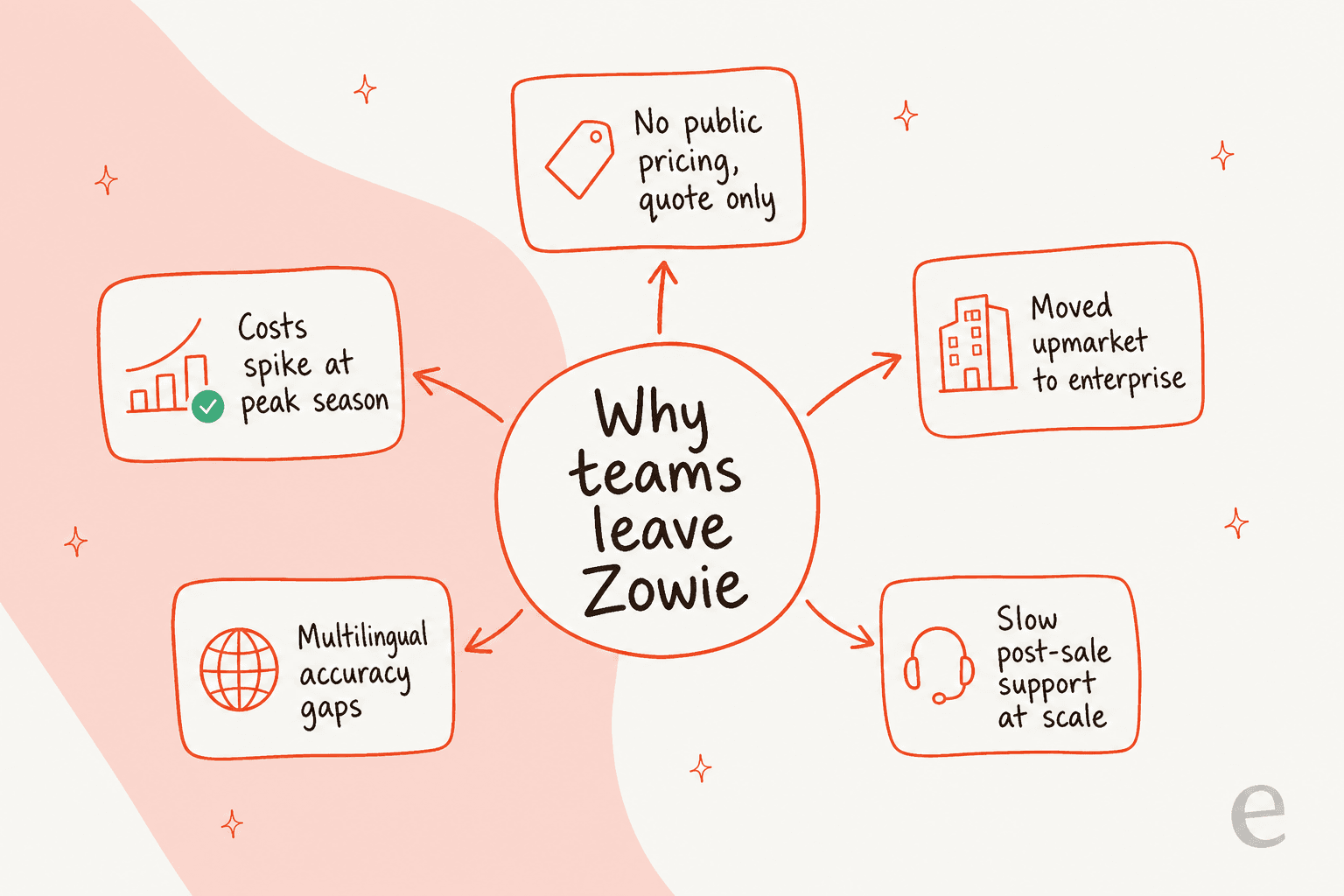
The biggest one is the upmarket shift. Zowie started as an ecommerce chatbot and built its early reputation there, but its current positioning is aimed at regulated enterprises. If you're a mid-market team that liked the old ecommerce Zowie, you may find yourself buying an enterprise platform, at an enterprise price, with an enterprise sales cycle to match. Pair that with unpredictable peak-season bills and slow support once you're signed, and the case for a simpler, transparent tool gets strong fast.
Quote-gated vs transparent: the real pricing question
The Zowie pricing story is really about a philosophy, and it's worth deciding which one you want before you evaluate any tool.
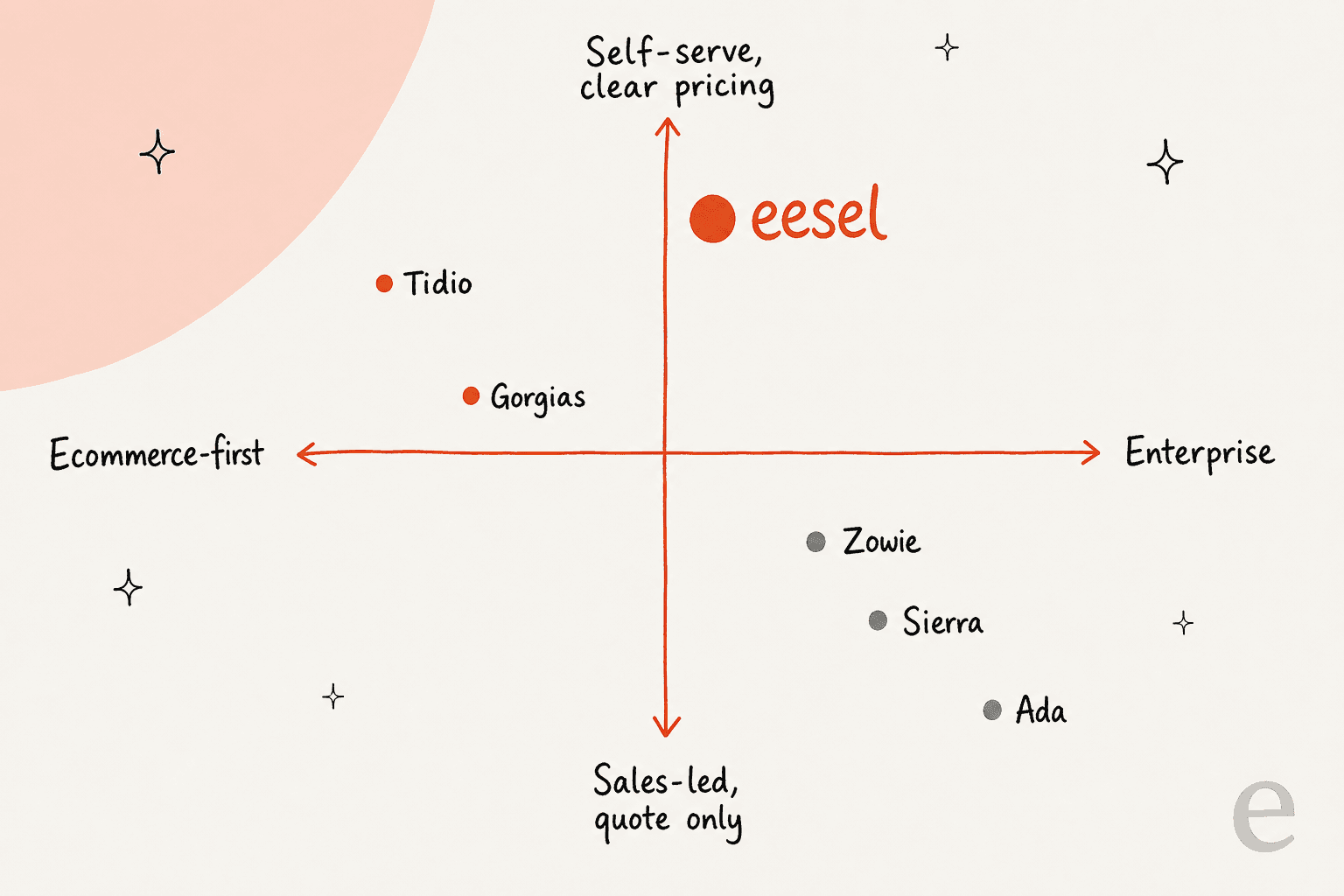
The category is trending toward transparent, usage-based pricing, a published rate tied to a unit you already understand, like a ticket. There's a real reason buyers want it. When the unit is fuzzy and the number is hidden, budgeting is a guessing game, and I've watched more than one deal stall on exactly that. The total cost of ownership also hides costs the quote never mentions: multi-week implementation, dependence on which success manager you're assigned, and the annual commitment you sign before the AI has run a single one of your real tickets.
That last point is the one I'd push hardest on. I've watched confident-sounding bots quietly give wrong answers on live queues, which is exactly why I now want to simulate any rollout against historical tickets before it goes anywhere near a customer, and before I sign anything. A model that needs a signature first inverts that.
To make the conversation-pricing math concrete, here's a rough estimator built on the one public Zowie data point, its ~$1.38-per-conversation AWS rate. Plug in where your team sits and watch what a busy month does to the bill:
The catch, of course, is that you can only run this math because AWS forced one number into the open. With the quote-gated version, you're waiting on a call before you can even start. That's the trade-off worth weighing: enterprise-bespoke depth on one side, versus predictability and speed-to-value on the other.
Try eesel instead of guessing
If the "book a call to find out the price" dance is what's grinding your evaluation to a halt, that's the exact gap eesel fills. It's an AI for customer service that plugs into the helpdesk you already run, Zendesk, Freshdesk, Gorgias, and more, and starts helping from day one.
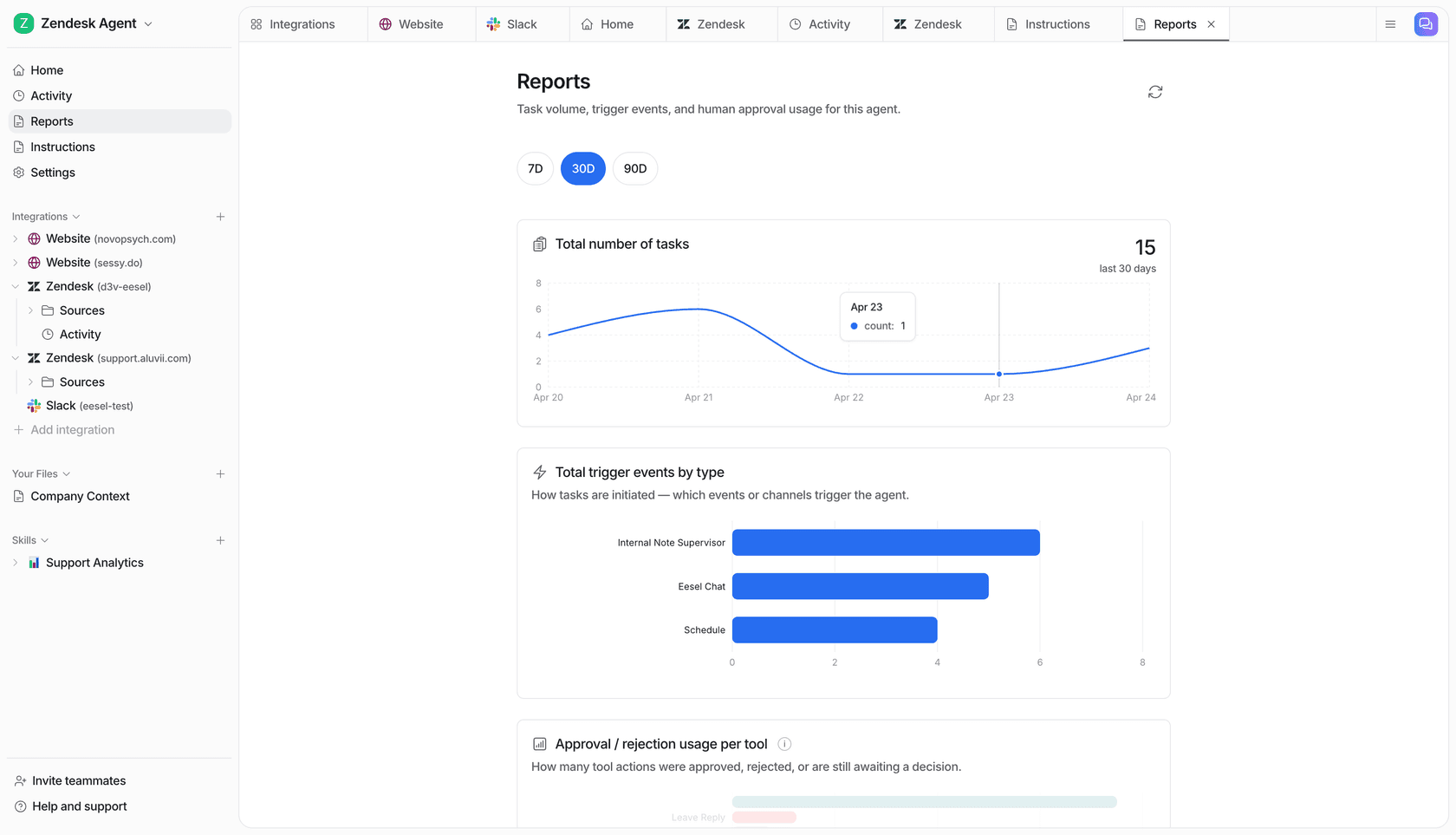
Three things make it the opposite of a quote-gated rollout. Its pricing is published with one fixed monthly price from $299/month (1 credit per ticket), no per-seat fees and no peak-season surprise. You can simulate it on your own historical tickets before it touches a customer, so you see the real resolution rate up front instead of trusting a demo. And it's self-serve and free to try, no sales cycle required. Where Zowie is built for the enterprise that wants a bespoke, hands-on deployment, eesel is built for the team that wants to see it work, and see the price, this week.
If you're comparing agentic CX platforms, it's worth putting a transparent, testable option next to the quote-gated ones before you commit a year of budget.
Frequently Asked Questions
How much does Zowie cost?
/pricing page returns a 404 as of July 2026. The only public data point is Zowie's own AWS Marketplace listing at roughly $34,500/year for 25,000 conversations (about $1.38 per conversation). Everything else runs through a sales call. For a rate you can act on today, eesel's pricing is a fixed monthly price (from $299/month for 500 credits) and listed openly.