


Disclosure: This article is published by eesel AI, a competitor of Cresta and Zendesk. We encourage you to read Cresta's own materials and Zendesk's own materials for their perspective.
Choosing the right customer service AI in 2026 is a significant decision. You're not just picking new software; you're shaping how your team works and how your customers get help for years to come. Generally, you have two main options. The first is a dedicated AI platform that plugs into your current contact center stack, like Cresta. The second is a mature all-in-one helpdesk that comes with built-in AI, like Zendesk.
How do you choose? It really comes down to what each approach brings to the table. This guide gives a balanced look at Cresta vs Zendesk -- their core AI features, how they fit into your workflow, and what their pricing models mean for your budget. By the end, you should have a clearer picture of which path makes the most sense for your team.
What is Cresta AI?
Cresta AI is built for large-scale contact centers. It is not a helpdesk itself, but an AI platform that layers on top of the systems you already use. Its main job is to analyze customer conversations as they happen and use that data to improve outcomes like sales performance, Net Promoter Score (NPS), or Average Handle Time (AHT).
Cresta's core product family includes:
-
AI Agent: Autonomous virtual agents for voice, chat, and SMS. They handle customer conversations end-to-end in 30+ languages, with API-based function calling and MCP support to connect to CRM, billing, and scheduling systems.
-
Agent Assist: Real-time guidance for human agents. Behavioral hints, knowledge surfacing, and AI-generated call summaries delivered during live conversations, drawing on what top performers do.
-
Conversation Intelligence: An analytics umbrella covering Insights, AI Analyst, Quality Management, and Coaching, applied across 100% of conversations rather than a random sample.
Cresta is designed for high-volume enterprise teams in financial services, hospitality, and telecommunications. Because the platform learns from your specific business data -- call patterns, top-performer behaviors, workflows -- it requires upfront configuration investment. As one G2 reviewer put it: "You have to have patience and really a dedicated person who is almost an AI linguist once you figure it out everything changes but pack patience."
What is Zendesk?
Zendesk is the industry-leading customer service platform. It is a mature, all-in-one system that gives teams everything needed to manage support: a robust ticketing system, an integrated knowledge base, and tools for managing customer conversations across every channel.
In March 2026, Zendesk acquired Forethought, folding its agentic AI capabilities into what Zendesk now calls the Resolution Platform. This deepened Zendesk's autonomous AI lineup substantially.
Their current AI offerings include:
-
AI Agents: Autonomous bots that resolve customer issues end-to-end inside Zendesk's ticketing and messaging system. AI agents are included in every Suite and Support plan, and Zendesk's help center says the former Advanced capabilities (procedures, actions, API integrations) now ship in the same unified product, with the older Essential tier due to be removed on December 10, 2026.
-
Copilot: A proactive assistant for human agents that suggests replies, automates field updates, and surfaces relevant knowledge inside the agent workspace. Available as a $50/agent/month add-on or bundled into the Suite + Copilot plans.
-
Reporting and analytics: Zendesk's Explore tool delivers performance insights, and the platform's analytics capabilities include AI-powered routing recommendations and automated resolution tracking.
Zendesk's knowledge connectors link up to 50 external sources, including Confluence, SharePoint, Notion, and Google Drive, though Slack is not on the list of dedicated connectors. For teams whose information is spread across tools like Confluence, Google Docs, or Slack, eesel AI can connect those sources directly to the Zendesk agent workspace without a migration.
A detailed breakdown of Cresta vs Zendesk
With the high-level picture in place, here is a closer look at three areas: core AI features, setup and integration, and pricing.
Core AI capabilities and use cases
How does each platform use AI to solve problems?
Cresta focuses on real-time agent coaching. Its Agent Assist suggests behavioral improvements and surfaces knowledge during live calls, drawing on patterns from top-performing agents.

One area where G2 reviewers flag room for improvement is knowledge assist relevance: a verified G2 reviewer noted that "the model used for Cresta's knowledge assist is not very accurate in understanding the overall caller's intent, so the questions/answers it identifies are not relevant."
Zendesk's approach makes AI a natural part of the platform. The AI Agents and Copilot are built right into the agent workspace for ticket summarization, reply drafting, and escalation detection. The same AI agents handle FAQ-style resolution and multi-step, action-taking workflows, with the heavier flow-building setup sitting on your side.
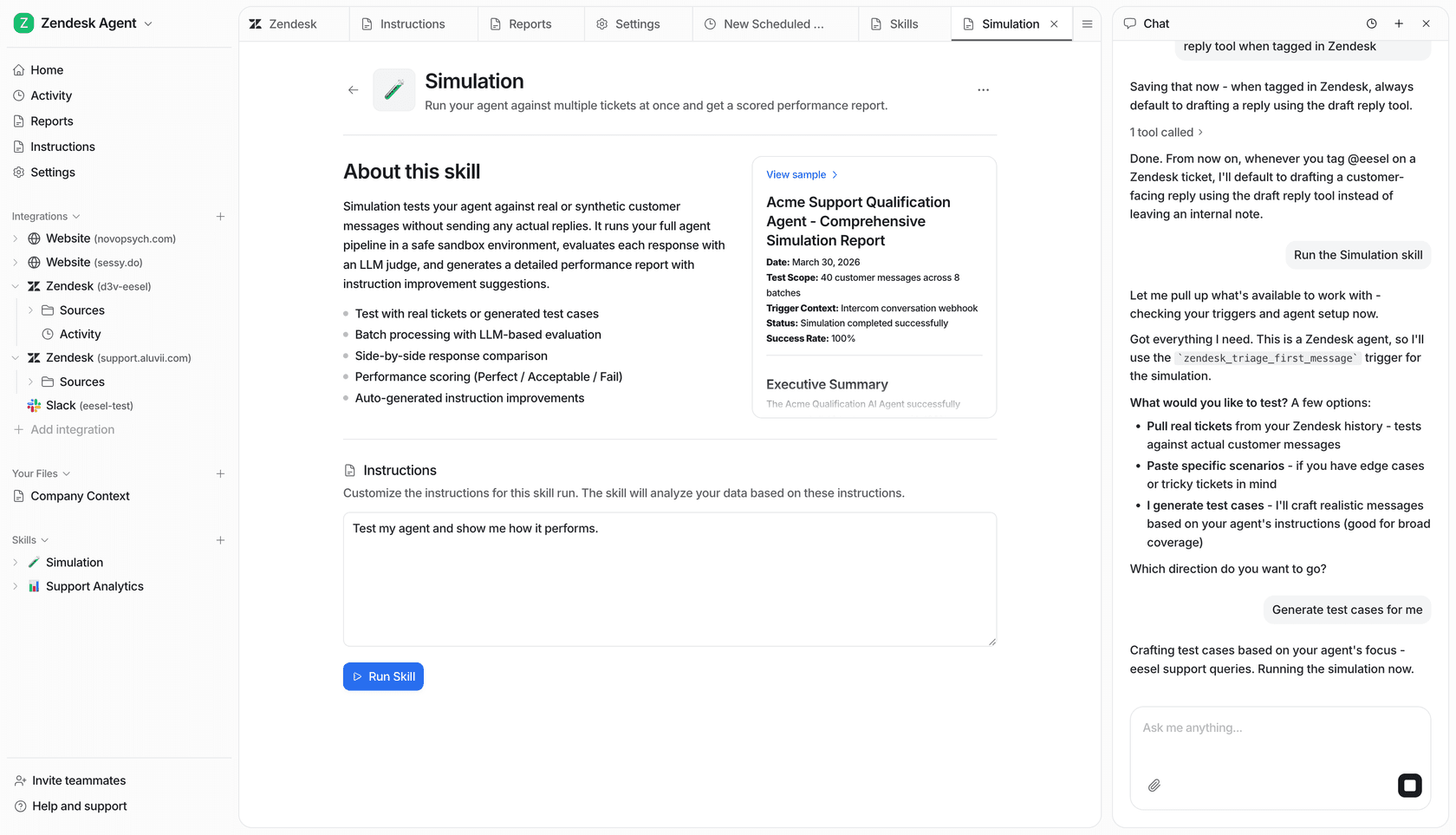
For teams looking to bridge external knowledge gaps, eesel AI offers a complementary path. It connects to over 100 sources -- wikis, internal documents, connected tools -- giving your Zendesk agents a complete picture. eesel AI's simulation mode lets you test your setup against past tickets before going live, so you have confidence in your automation rates before anything reaches customers.
| Feature | Cresta | Zendesk | eesel AI |
|---|---|---|---|
| Primary focus | Real-time agent coaching and autonomous AI agents | Integrated helpdesk automation | Flexible AI layer for existing tools |
| Knowledge sources | API, PDF, Google Drive, SharePoint, Zendesk, and others | Native help center + Confluence, SharePoint, Notion, Document360 connectors | Zendesk, Confluence, Google Docs, Slack, and 100+ sources |
| Real-time agent assist | Behavioral guidance, knowledge surfacing, AI call summaries | Context-aware reply suggestions and field automation | Instant reply drafts from unified knowledge |
| Pre-launch simulation | Testing suite for AI Agent configurations | Manual testing only (test button, sandbox); no replay on past tickets | Yes, testable on historical tickets |
| Custom actions | API-based function calling and MCP support | Actions and API integrations built into AI agents | Self-serve API calls and actions |
Integration, setup, and control
How much work does it take to get started, and how much can you customize the AI?
Cresta has 20+ integrations including Five9, Genesys, NICE, Salesforce, ServiceNow, and Microsoft Dynamics 365. It layers on top of your existing infrastructure rather than replacing it. Because its models learn from your specific call data and business logic, reaching full effectiveness takes meaningful configuration work.
Zendesk is much simpler to enable because its AI is native to the platform. Teams already using Zendesk can turn on AI agents without a separate implementation project, and a 14-day free trial gives access to Suite Professional features. Multi-step autonomous actions and the flow builder take additional setup on top of that.
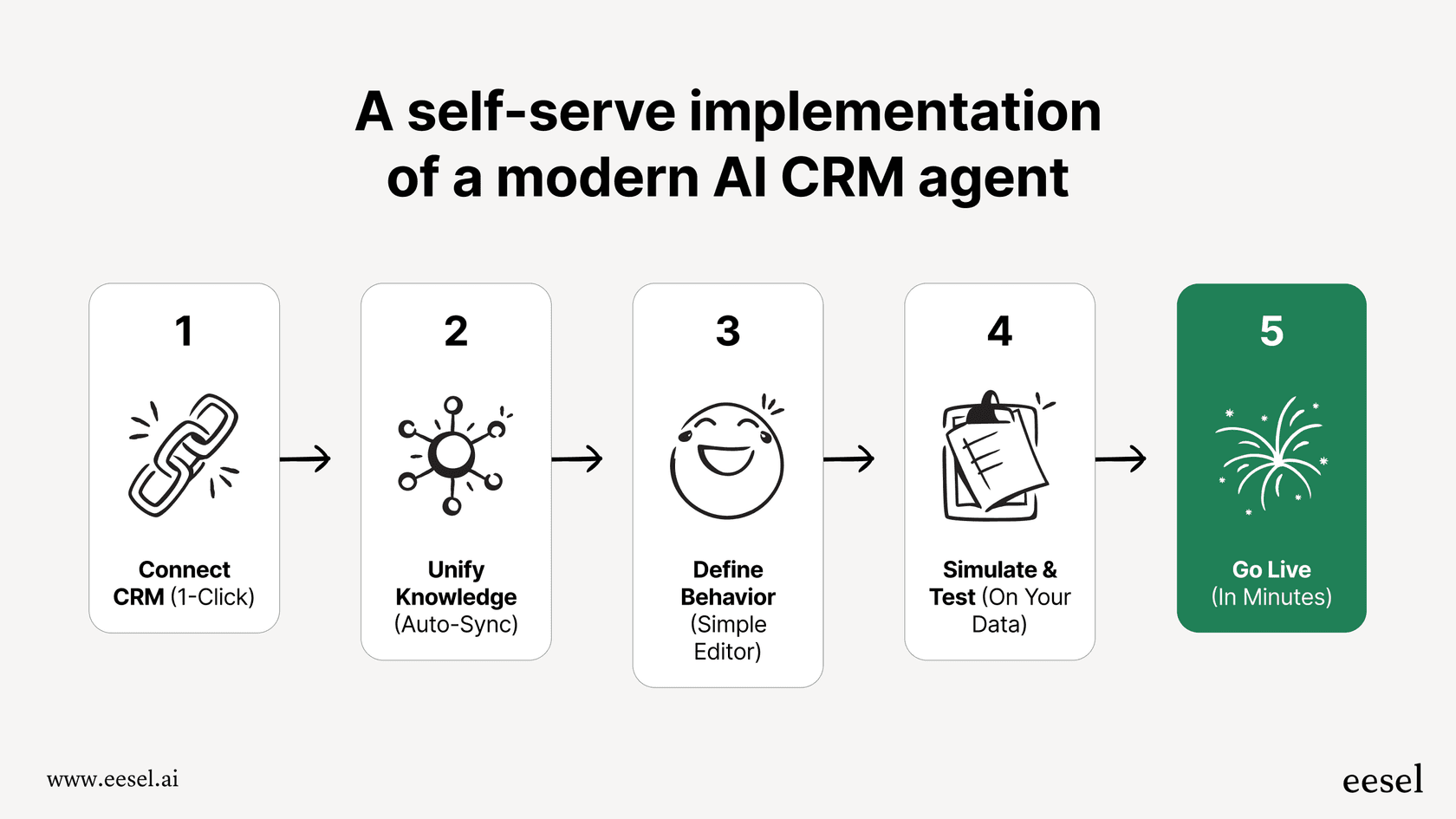
eesel AI is designed to be self-serve. It connects to your helpdesk with a single click and gives you fine-grained control over which tickets to automate -- without needing a developer to manage it.
Pricing and value proposition
Cresta pricing is custom. Every product page leads to a "Get a demo" CTA, and all deals are negotiated as enterprise contracts. The only public price reference appears in an AWS Marketplace listing for Cresta's Agent Assist: $150,000 per year for up to 125,000 chats, or $150,000 per year for up to 100,000 voice calls, with overages at $1.20 per chat and $1.50 per call. These are AWS Marketplace contract terms for those two specific SKUs -- not Cresta's own published pricing for the full platform, which covers AI Agent, Conversation Intelligence, Quality Management, Coach, and Knowledge Agent separately. Contact Cresta directly for a quote.
Zendesk's pricing is transparent and per-agent, billed annually:

Zendesk Suite plans (billed annually)
| Plan | Price | AI agents | Included automated resolutions |
|---|---|---|---|
| Suite Team | $55 per agent/month | Included | 5 ARs/agent/month |
| Suite Professional | $115 per agent/month | Included | 10 ARs/agent/month |
| Suite Professional + Copilot | $165 per agent/month ($115 + $50 add-on) | Included + Copilot | 10 ARs/agent/month |
| Suite Enterprise + Copilot | Talk to Sales | Included + Copilot | Not published |
Automated Resolutions (ARs) are Zendesk's unit for AI billing -- one AR is counted when a customer's issue is resolved without human agent involvement. Overages beyond included allowances are billed at $1.50 per AR (committed) or $2 per AR (pay-as-you-go). Zendesk's pricing page now sells the top tier as Suite Enterprise + Copilot through Sales, with no public per-agent figure.
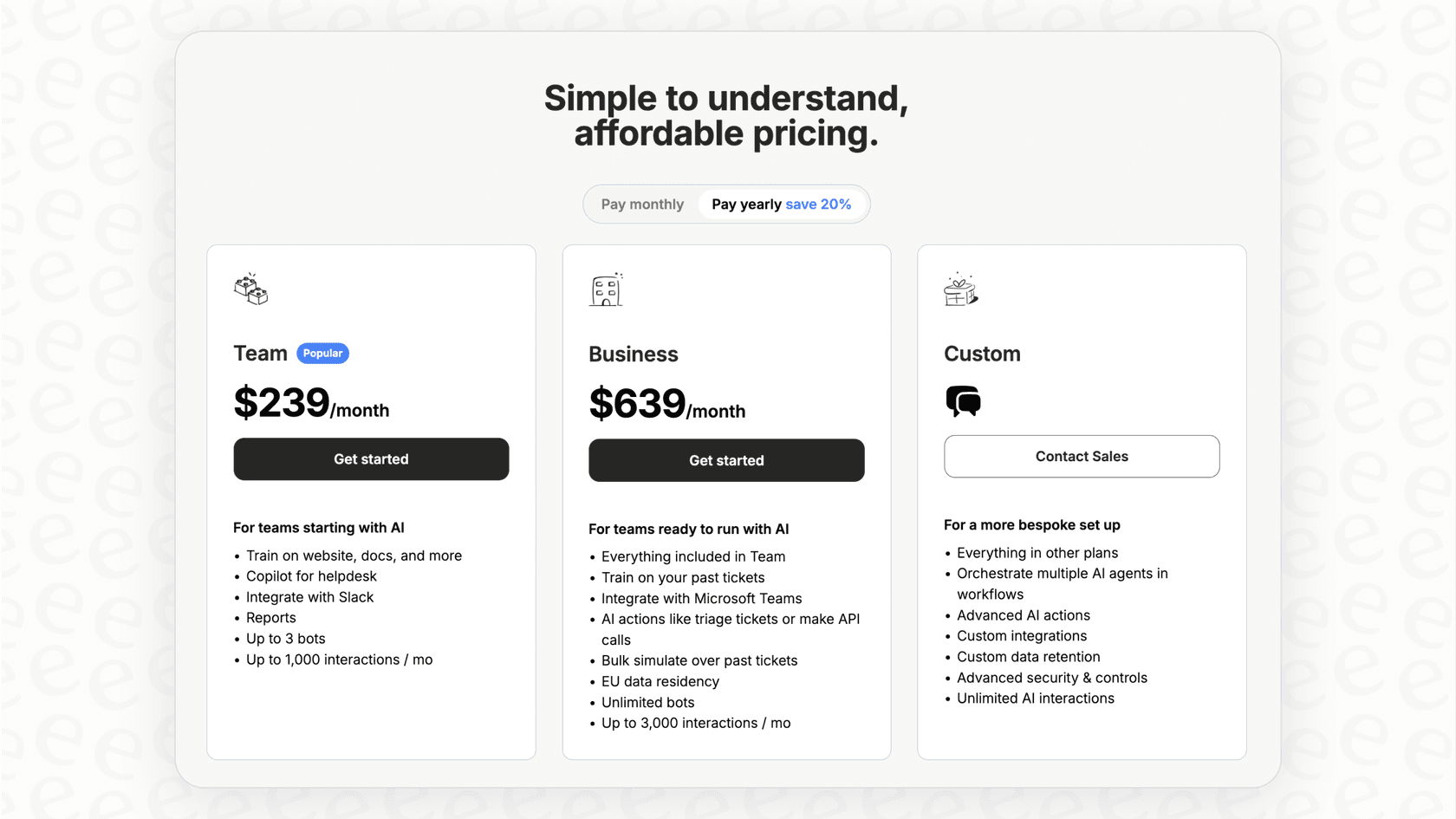
eesel AI uses one fixed monthly price rather than per-agent seats, starting at $299 a month for 500 credits (1 credit per ticket or chat), so costs scale with volume rather than headcount. There are no per-agent fees, and teams that pay a year upfront get two months free.
A dedicated platform, an all-in-one suite, or a flexible AI layer?
So, what's the verdict?
-
Cresta is a specialized choice for large enterprise contact centers that need real-time agent coaching and autonomous AI agents layered on top of existing telephony and CRM infrastructure. It delivers measurable outcomes for high-volume teams -- particularly in sales-driven environments -- and is backed by customer results Cresta publishes, such as 5.5x higher containment and a 20% revenue increase. The tradeoff is the configuration investment needed to tune the platform to your business.
-
Zendesk is the mature, integrated option for teams that want AI built directly into their helpdesk. Its AI agents and Copilot are deeply native to the platform, the pricing is transparent, and getting started requires no separate implementation project. Multi-step autonomous actions are part of the same AI agents product.
eesel AI is ideal for teams that want to add a flexible AI layer to their current tools -- connecting external knowledge to Zendesk, automating tickets without per-resolution fees, and going live quickly. Try eesel AI for free to see how it can work alongside the industry-leading tools you already use.
Frequently asked questions
What's the main difference when comparing Cresta vs Zendesk for contact centers?
Cresta is a dedicated AI platform that sits on top of existing contact center infrastructure, focused on real-time agent coaching and autonomous AI agents for voice, chat, and SMS. Zendesk is a mature, all-in-one helpdesk with AI built natively into its ticketing, messaging, and knowledge-management system.
How difficult is it to integrate Cresta vs Zendesk into an existing tech stack?
Cresta integrations layer on top of your existing stack, and its models need to be configured to your specific business workflows before reaching full effectiveness. Zendesk AI is native to the platform and available immediately for teams already using Zendesk, with a 14-day free trial to get started.
How do Cresta and Zendesk handle knowledge from external sources?
Cresta's Knowledge Agent connects to API endpoints, PDFs, Google Drive, SharePoint, Zendesk, and other sources to surface answers during live conversations. Zendesk's knowledge connectors link to Confluence, SharePoint, Notion, and Document360, with up to 50 external sources per account.
What are the pricing structures for Cresta vs Zendesk?
Cresta pricing is custom; all plans require contacting their sales team directly. Zendesk's pricing starts at $55 per agent/month (Suite Team, billed annually), with AI agents included in all Suite tiers and Copilot available as a $50/agent/month add-on.
What are the key differences in real-time agent assistance features?
Cresta Agent Assist delivers real-time behavioral guidance, knowledge surfacing, and AI-generated call summaries for human agents during live conversations. Zendesk Copilot proactively suggests replies, triggers field updates, and handles troubleshooting steps inside the Zendesk agent workspace, with 82% increased agent productivity reported on the product page.