


Disclosure: This article is published by eesel AI, a competitor of Decagon. We encourage you to read Decagon's own materials for their perspective.
Decagon is getting a lot of attention in the AI customer experience world. Backed by $481M in funding and valued at $4.5 billion as of January 2026, the platform counts Notion, Rippling, Duolingo, and Chime among its customers. Their pitch centers on resolving customer issues end-to-end -- not just answering questions, but taking action on behalf of the customer.
If you're a CX or operations leader trying to cut through the polished marketing to understand what Decagon actually does, how the platform works, and what the real tradeoffs are, this guide is for you.
Decagon at a glance
Decagon is an enterprise AI platform for customer support. Its agents handle chat, email, and voice conversations end to end, which means they can take actions like processing a refund or updating an account, not just retrieve an answer for a human to relay.
| Founded | August 2023, San Francisco (offices in New York and London) |
| Founders | Jesse Zhang (CEO) and Ashwin Sreenivas |
| Funding | About $481M total, most recently a $250M Series D |
| Valuation | $4.5 billion, January 2026 |
| Customers | Chime, Duolingo, Rippling, Notion, ClassPass, Hunter Douglas, Curology, Substack |
| Channels | Chat, email, voice |
| Pricing | Usage-based, per conversation or per resolution. No public price. |
| Reported contract size | Median about $432,750 a year, per Vendr procurement data |
| G2 rating | 4.9 from 20 reviews |
| Buying process | Sales-led. No free trial, no self-serve signup. |
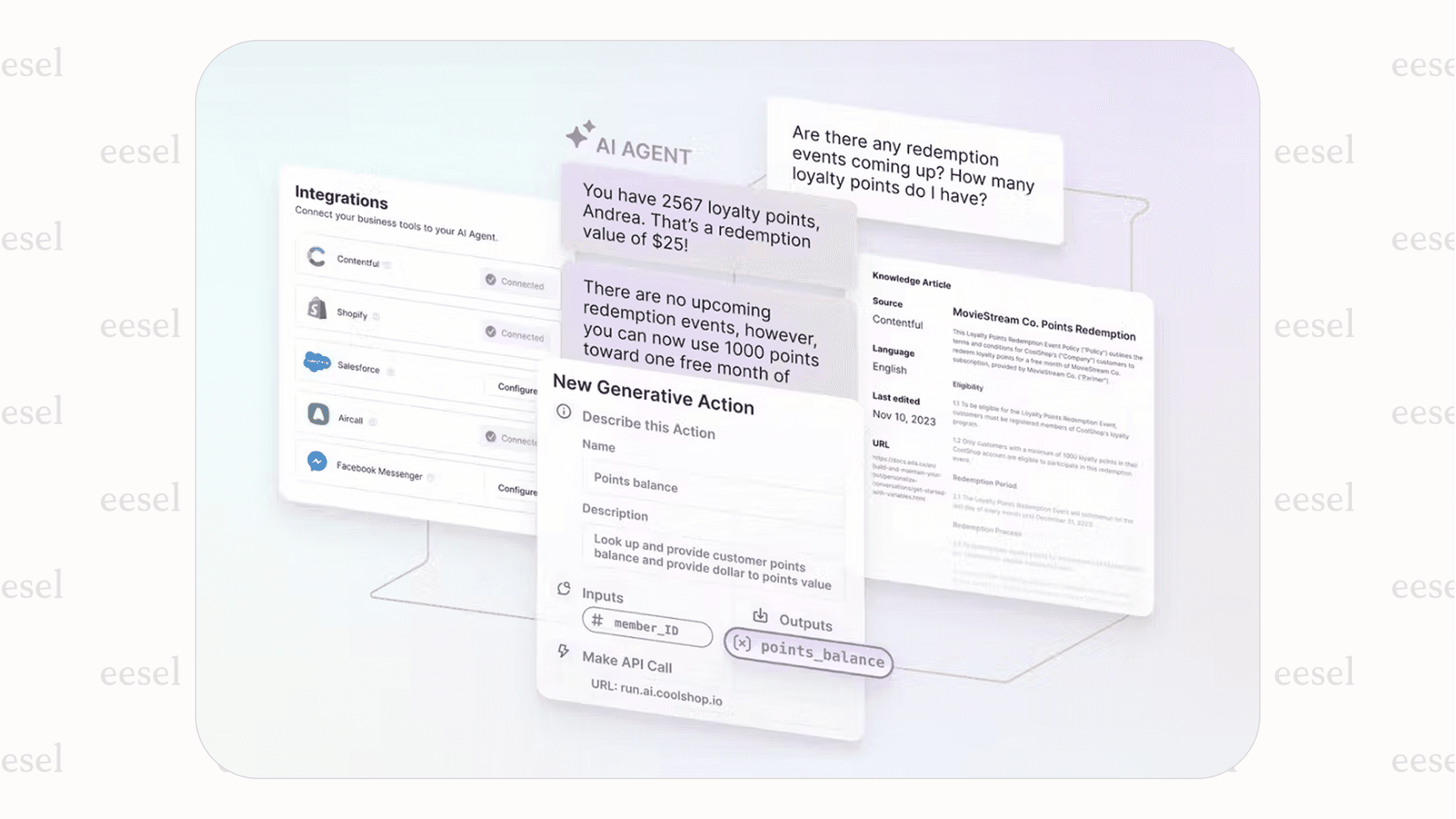
This is a factual look at the Decagon platform and its core Agent Operating Procedures (AOPs) technology. We'll also examine the implementation process and compare Decagon's all-in-one approach to flexible, integration-first alternatives that work with the tools your team already uses.
What is agentic AI and what is Decagon?
A brief note on "agentic AI": the term describes AI systems that can understand goals, reason through problems, and take multi-step actions without a human queuing up each step. Rather than retrieving an answer for a person to relay, an agentic system can act -- process a refund, modify an account, route a ticket.
This is the space Decagon plays in. They offer an AI platform designed to handle complex customer service requests across chat, email, and voice. The centerpiece is Agent Operating Procedures (AOPs), which Decagon describes as a modern alternative to rigid decision trees. CX teams write instructions in plain language; the system compiles those into executable agent logic.
Decagon's marketing points to quick deployment and reliable results. Dig into their own documentation, though, and you find that setup involves a team of Decagon "Agent Product Managers" who guide implementation for each customer -- a detail that shapes what the onboarding experience actually looks like.
An overview of the Decagon platform and its features
The Decagon platform is a unified suite with an AI agent engine at its core.
The core concept of Decagon: Agent Operating Procedures (AOPs)
AOPs are Decagon's method for defining AI agent behavior. The design blends natural language instructions written by your business team with executable logic that engineers build and maintain. Decagon's documentation describes this as enabling "rapid iteration on AI agent behavior without waiting for engineering" -- CX operators can update the logic while technical teams control the underlying integrations and guardrails.
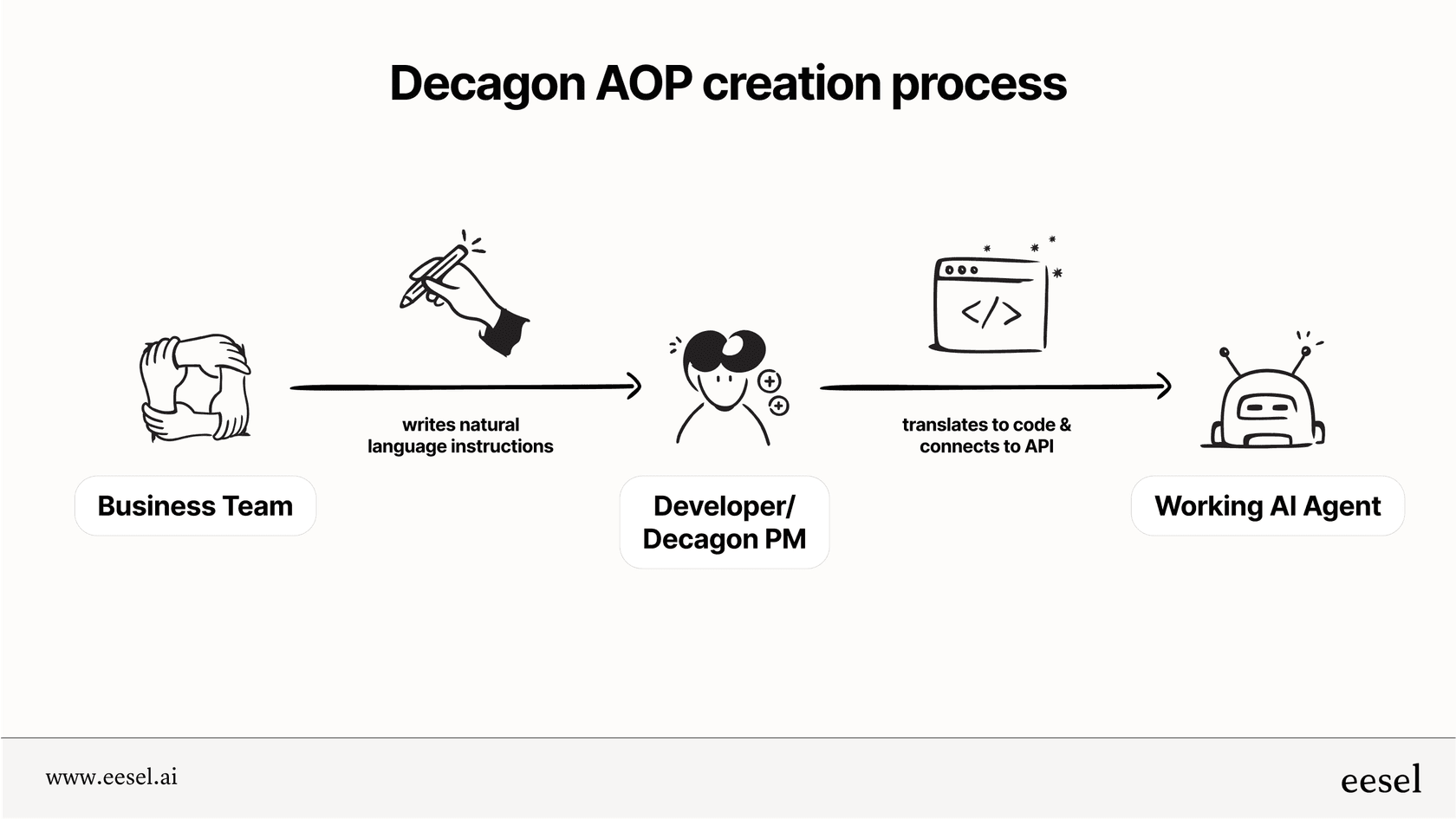
In practice, this split-responsibility model means your CX team can adjust what the agent does, while engineers own how it connects to your systems. Complex integrations -- CRM lookups, payment processing, backend account changes -- still require engineering work. The moment you need to handle an edge case that touches an API, you involve developers or Decagon's own team. This can slow iteration and shift control away from the people who understand customer issues best.
If your CX team wants to build and adjust workflows without a developer queue, eesel AI works entirely in plain English -- prompts and configuration don't require a technical handoff.
Decagon channel-specific products and agent-facing tools
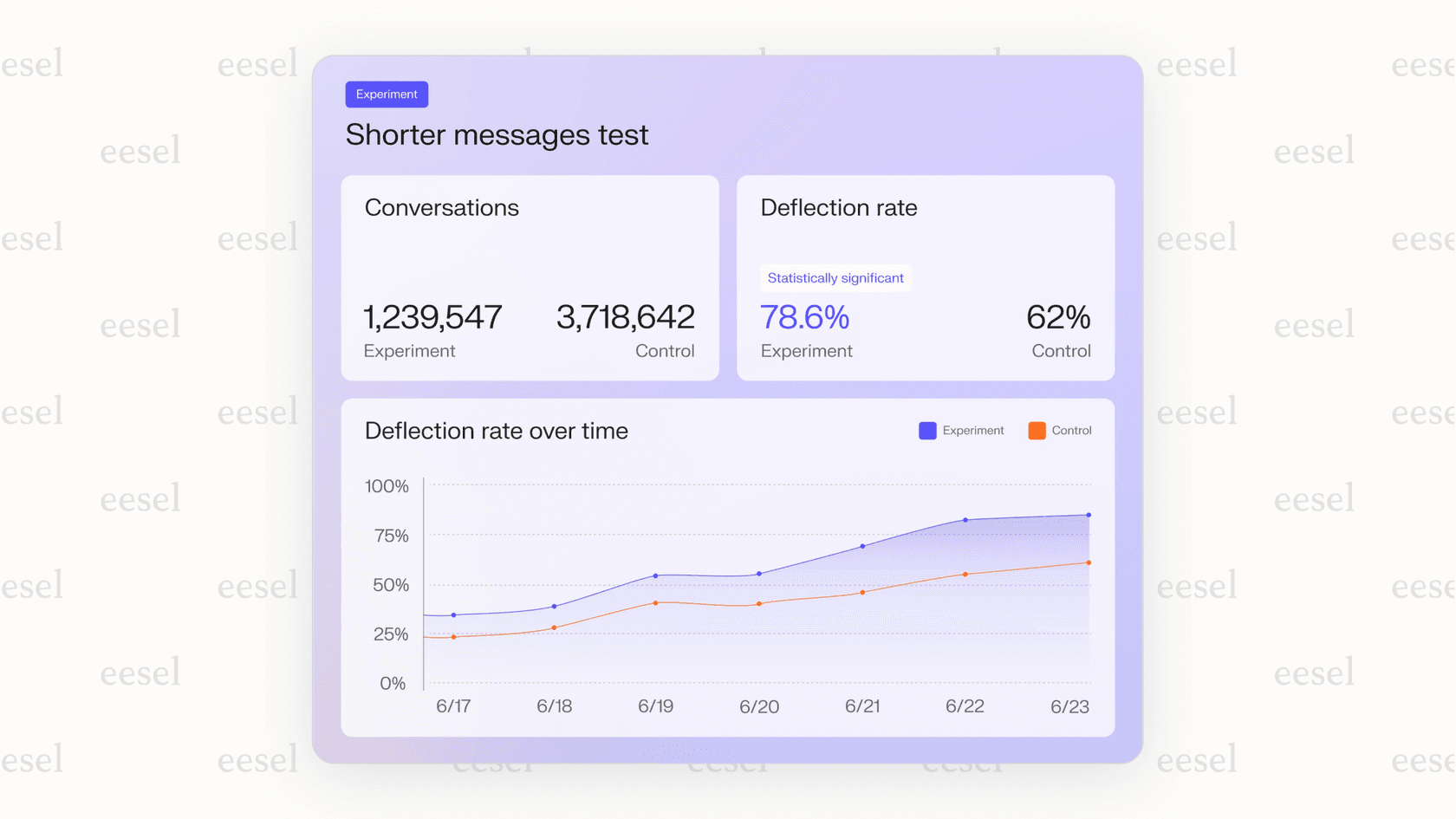
Decagon sells one suite rather than modules you buy separately. Alongside the three channels (voice, chat, and email), the platform includes Watchtower for round-the-clock QA monitoring, Testing & QA for running simulated conversations against agent updates, Experiments for A/B testing workflow changes against live traffic, Insights & Reporting, Suggestions for knowledge-base gap diagnosis, and Duet Autopilot, which analyzes past conversations and refines workflows on its own.
These tools are designed to work as an integrated suite. Deploying Watchtower for QA monitoring, for example, means adopting the broader Decagon platform, not buying a standalone add-on. That bundled model delivers consistency across channels, but it also means bringing your whole support stack into alignment with Decagon's architecture rather than adding a specific capability to what you already have.
eesel AI offers an AI Agent, AI Copilot, AI Triage, AI Internal Chat, and an AI Chatbot that plug into your existing helpdesk -- whether that's Zendesk or Freshdesk -- without requiring a platform transition.
Decagon platform comparison
| Feature | Decagon's approach | eesel AI's approach |
|---|---|---|
| Core architecture | integrated suite | Flexible layer on existing tools |
| Implementation | managed deployment | Self-serve setup with optional support |
| Knowledge sources | internal systems | 100+ one-click integrations (past tickets, docs, Slack) |
| Customization | natural language AOPs | Plain English prompts |
| Agent-facing tools | Part of the integrated Decagon platform | inside your helpdesk |
The Decagon implementation model: what it really takes
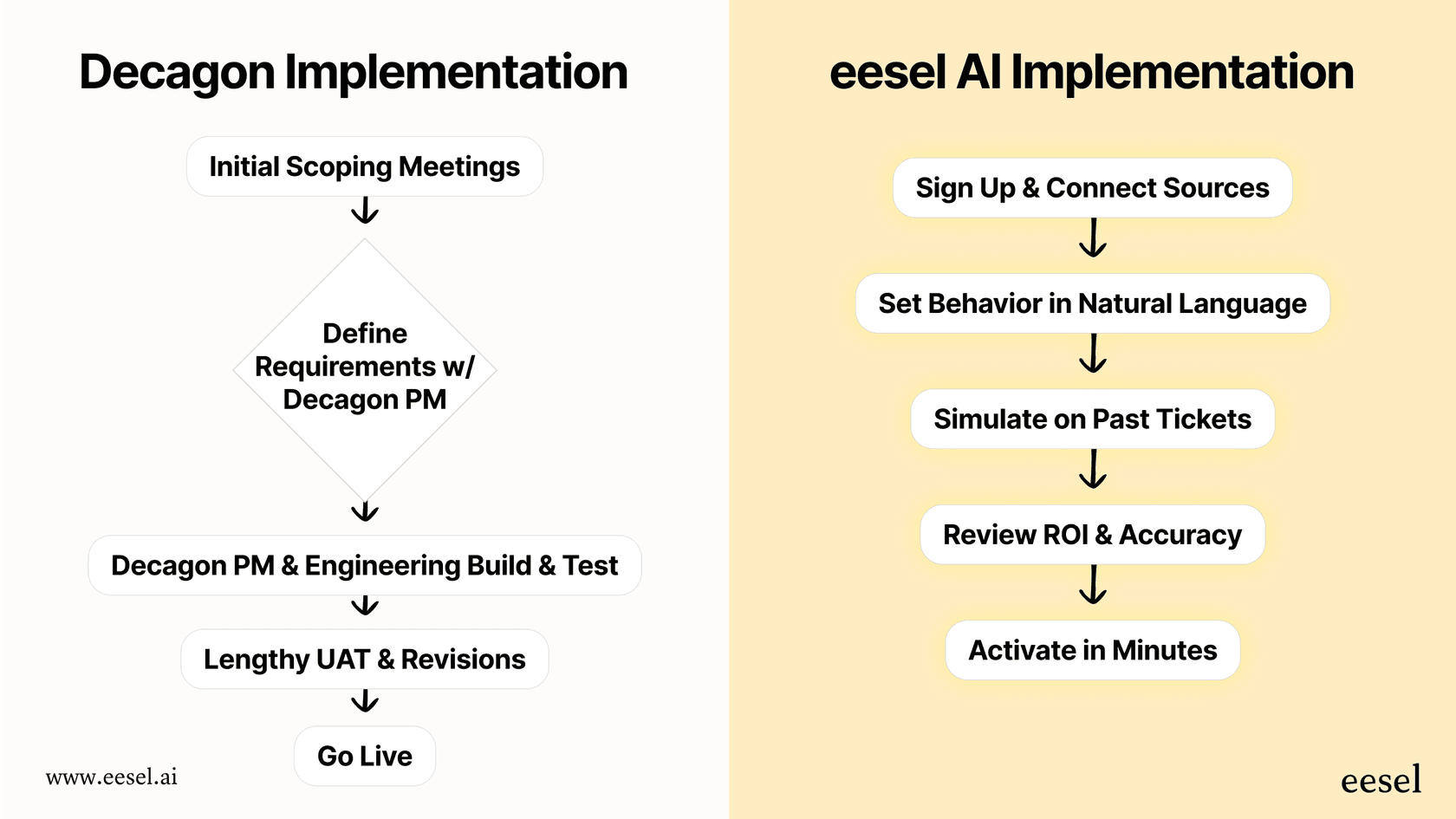
Decagon's own blog post, "What it's like to build AI agents at Decagon," describes the role of "Agent Product Managers" -- Decagon staff dedicated to implementing agents for each customer. As they explain it, "getting from idea to outcome requires iteration, context, and care," and their PMs "partner directly with Decagon Engineering and Design to scope and build out the use case from end-to-end."
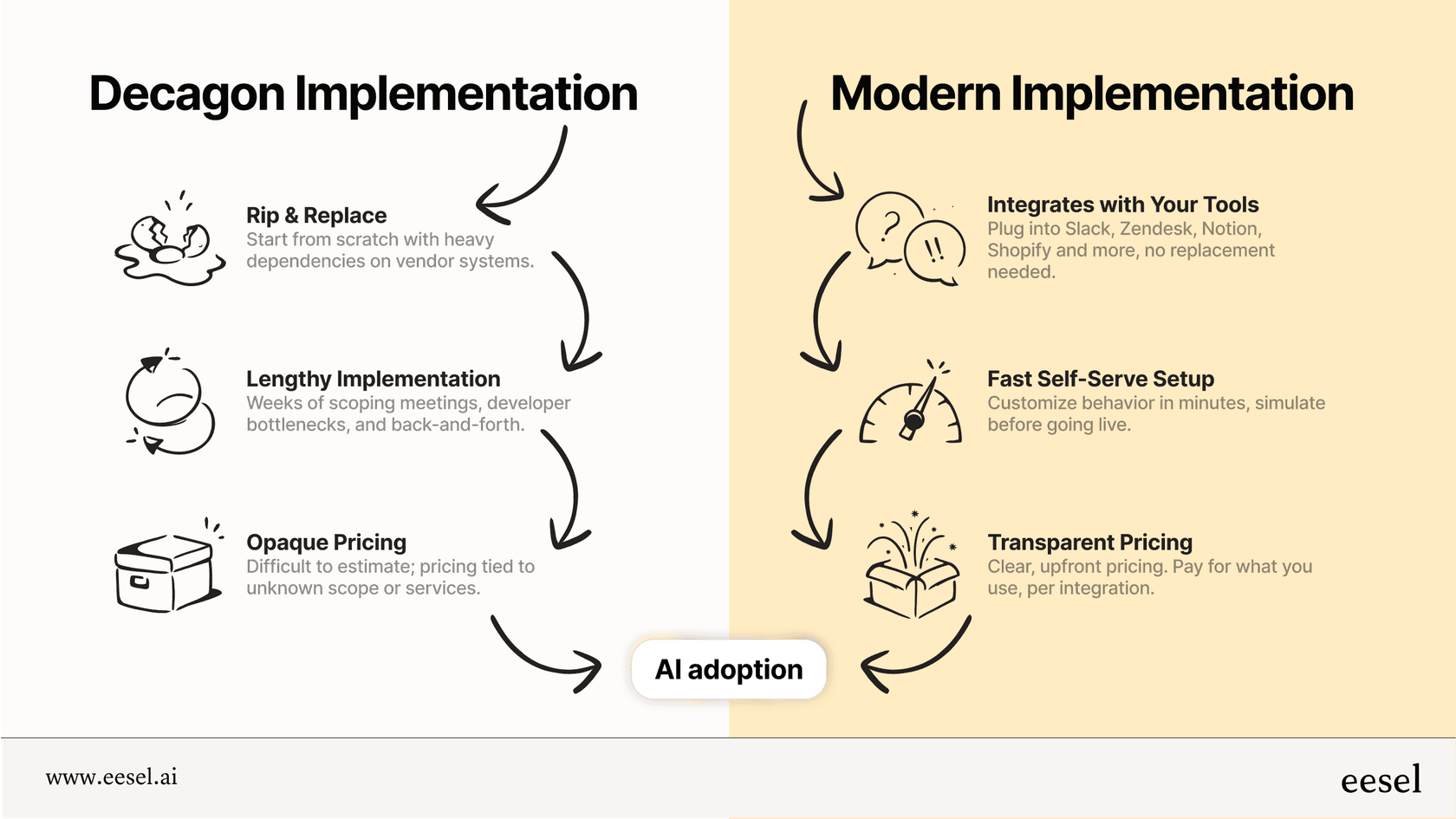
That sounds less like a software product you activate and more like a consulting engagement you kick off. This model typically means a longer timeline before you see results, ongoing reliance on the vendor to make adjustments, and less direct control over how your AI is making decisions.
Compare that to a more self-serve approach. With eesel AI, you can sign up, connect knowledge sources, and run a simulation against your past support tickets in under an hour. The simulation-before-you-scale feature lets you see projected performance and ROI before going live -- no consulting engagement required.
What Decagon actually costs
There is no published price
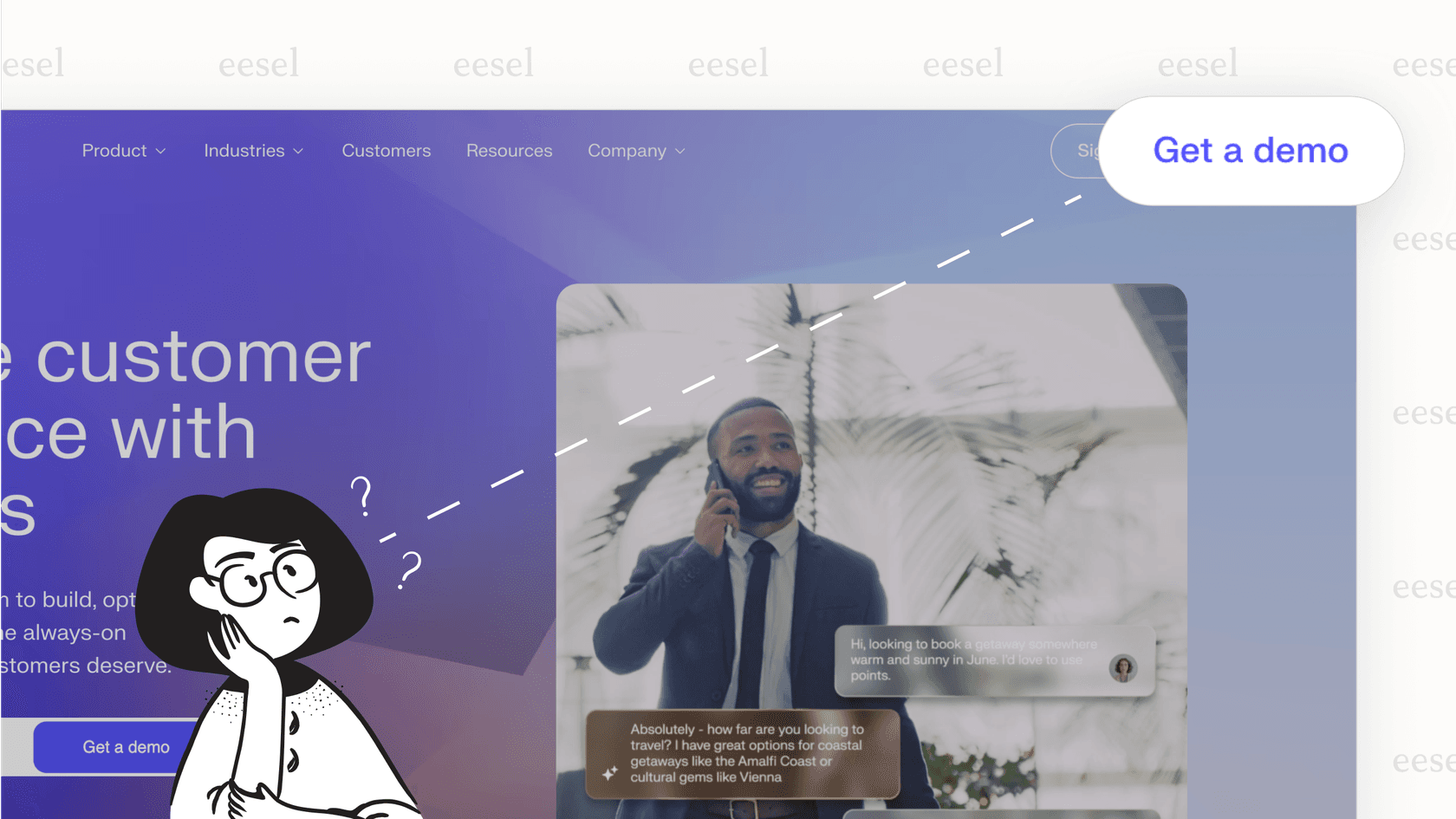
Decagon has no pricing page. The navigation offers Product, Channels, Build, Optimize, Scale, Industries, Customers, Resources, Company, and a "Get a demo" button. Every number comes out of a sales conversation.
Decagon's glossary describes resolution-based pricing, where you pay a fixed fee per conversation the AI closes without a human, and no fee when a case escalates. The same page is candid about the catch: "Defining what a resolution is can be tricky, as not all cases end wrapped up in a bow." Customers drop out mid-conversation, and an answer can be technically delivered without solving anything. Those gray areas are where billing disputes start, which is a question worth settling in the contract rather than after the first invoice.
What buyers actually report paying
Procurement marketplace Vendr publishes aggregate contract data for Decagon: a median annual contract value of $432,750, with recorded deals running from $105,000 at the low end to $923,183 at the high end. Vendr does not disclose how many contracts sit behind that median, so treat it as a directional read on the market rather than a quote.
The practical takeaway is the floor, not the median. Even the low end of that range is a six-figure annual commitment, which tells you who this product is built for. If your annual support tooling budget is under $100,000, Decagon is unlikely to be a fit regardless of how well the demo goes.
There is also no way to test it first. No free trial, no self-serve signup, so the evaluation happens inside a sales cycle rather than on your own data.
eesel AI publishes its pricing instead: one fixed monthly price from $299/month for 500 credits (1 credit per ticket or chat, however many replies it takes), $4 per blog post for long-form generation, and no per-seat fees. A free plan includes 100 credits with no credit card, so you can test against your own support content before anyone quotes you anything.
For a fuller breakdown, see our Decagon pricing guide.
Where Decagon falls short
No platform is a fit for everyone, and Decagon's tradeoffs follow directly from what it is: an enterprise platform sold through a managed engagement.
You cannot try it before you buy it. There is no trial and no self-serve tier. Your entire read on whether the agents perform comes from a sales-led evaluation rather than from your own ticket history.
You will not see a number early. Because pricing is quoted rather than published, cost usually surfaces late in the evaluation, after your team has already spent weeks on scoping calls.
The resolution definition is a live commercial question. Decagon's own glossary flags that resolutions are hard to define cleanly. On a per-resolution contract, that ambiguity is money, so it needs pinning down before signing.
Deployment is a project, not a switch. Decagon's implementation runs through their Agent Product Managers, who scope and build alongside your team over weeks. That is a real service, and for a large enterprise it may be exactly right, but it is not a tool you turn on this afternoon.
It does not replace your helpdesk, and it does not run inside one either. You keep paying for Zendesk, Freshdesk, or whatever you use, and you add Decagon's platform on top. The cost comparison is additive, not a swap.
The reviewer base is small. Decagon holds a 4.9 rating on G2, which is excellent, but it comes from 20 reviews. That is a young track record next to helpdesk vendors with thousands. Read the case studies, but read them as vendor-published numbers.
Decagon alternatives teams compare it against
If Decagon is not the right shape for your team, these are the products buyers most often put next to it.
| Alternative | Best when |
|---|---|
| eesel AI | You want AI inside the helpdesk you already run, live in under an hour, on published credit-based pricing |
| Ada | You want a mature, enterprise-grade chatbot platform with a longer track record |
| Kore.ai | You need heavy multilingual voice and chat across a large contact center |
| Gladly | You want the AI and the helpdesk from one vendor rather than layered |
| Kustomer | You are consolidating CRM and support into a single record |
Full write-ups, including which ones actually replace Decagon and which only overlap with it, are in our Decagon alternatives guide.
Security and compliance
Decagon is SOC 2 certified and publishes a public Trust Center -- both standard requirements for any enterprise vendor handling customer data.
eesel AI also has a robust security posture, with end-to-end encryption, data privacy controls (your data is not used to train other models), and optional EU data residency. At this tier of the market, security credentials are baseline requirements. The meaningful differences between platforms come down to flexibility, deployment speed, and cost transparency.
Who Decagon is right for (and who should look elsewhere)
Decagon fits enterprise teams with an established helpdesk and CRM, in-house engineering capacity for integration work, a six-figure annual budget for support tooling, and the runway for a multi-week managed deployment. For those teams the published outcomes are genuinely strong: Chime reports 70% resolution across chat and voice, Duolingo reports an 80% deflection rate, ClassPass reports a 95% cost reduction, and Hunter Douglas credits the platform with $1 million in revenue from fully AI-handled conversations. Those are Decagon's own published figures, but they are specific and attributed, which is more than most vendors offer.
Look elsewhere if you need to see a price before a sales call, you want to test on your own tickets before committing, your support budget is under six figures, or you want your CX team changing agent behavior without a vendor in the loop.
For teams who want the benefits of agentic AI without a full-platform migration, a layered solution like eesel AI is worth a look. It connects to the helpdesk your team already uses, keeps configuration in plain English, publishes pricing openly, and lets you trial on your own support data before committing.
See how eesel AI can automate support workflows by booking a demo or free trial today.
Frequently asked questions
Does Decagon require replacing my existing helpdesk?
Decagon is designed as an integrated platform that works alongside your existing ticketing and CRM tools rather than replacing them. However, deployment runs through Decagon's managed implementation process, which involves deep integration with your support stack. You can review how Decagon describes its product model on their product overview page. Teams that want to add AI automation without a managed migration may find a plug-in layer like eesel AI a better fit.
What is Decagon's pricing model, and why isn't it public?
Decagon's pricing is not publicly disclosed: their website shows only a "Get a demo" option rather than a pricing page. Decagon does describe their resolution-based pricing model in their glossary, where you pay per issue the AI agent resolves without human escalation, but actual rates and contract terms require a direct sales conversation. Procurement data published by Vendr puts the median annual Decagon contract at about $432,750, with recorded deals ranging from $105,000 to $923,183. For a transparent comparison, eesel AI publishes its pricing publicly.
How long does it take to implement Decagon and what does the process involve?
Decagon's implementation is a managed engagement led by their "Agent Product Managers", dedicated staff who scope, build, and test agents alongside your team. Decagon's own resources describe this as iterative scoping and testing before production deployment, a process that typically takes weeks. Teams that need to move faster may want to evaluate self-serve alternatives like eesel AI, which can be connected to your helpdesk and tested against past tickets in under an hour.
How much technical skill does my team need to manage AI agents in Decagon?
Decagon's Agent Operating Procedures allow CX operators to define business logic in natural language without writing code. Complex integrations and system guardrails still require engineers, either on your team or through Decagon's implementation staff. Teams without in-house technical capacity will rely more heavily on Decagon's team for changes beyond basic AOP authoring.
What customer results has Decagon documented?
Decagon's case studies page documents outcomes from enterprise customers: Chime reports 70% chat and voice resolution, Duolingo reports an 80% deflection rate, ClassPass reports a 95% cost reduction, and Hunter Douglas credits the platform with $1 million in revenue from fully AI-handled conversations. These figures come from Decagon's own case study publications.
Who founded Decagon and how much has it raised?
Jesse Zhang (CEO) and Ashwin Sreenivas founded Decagon in August 2023. It has raised about $481M across four rounds, most recently a $250M Series D in January 2026 that valued it at $4.5 billion.