

What GPT-Live-1 actually is
I build AI agents for a living, so when a new voice model ships I skip the demo reel and go straight for the architecture. GPT-Live-1 is worth the attention, because the change here is structural, not cosmetic.
OpenAI is shipping two versions: GPT-Live-1 and GPT-Live-1 mini. Both are what OpenAI calls a "new generation of voice models for natural human-AI interaction," and both now sit under ChatGPT Voice, which more than 150 million people use each week. GPT-Live-1 is the default for Go, Plus, and Pro; the mini is the default for Free.
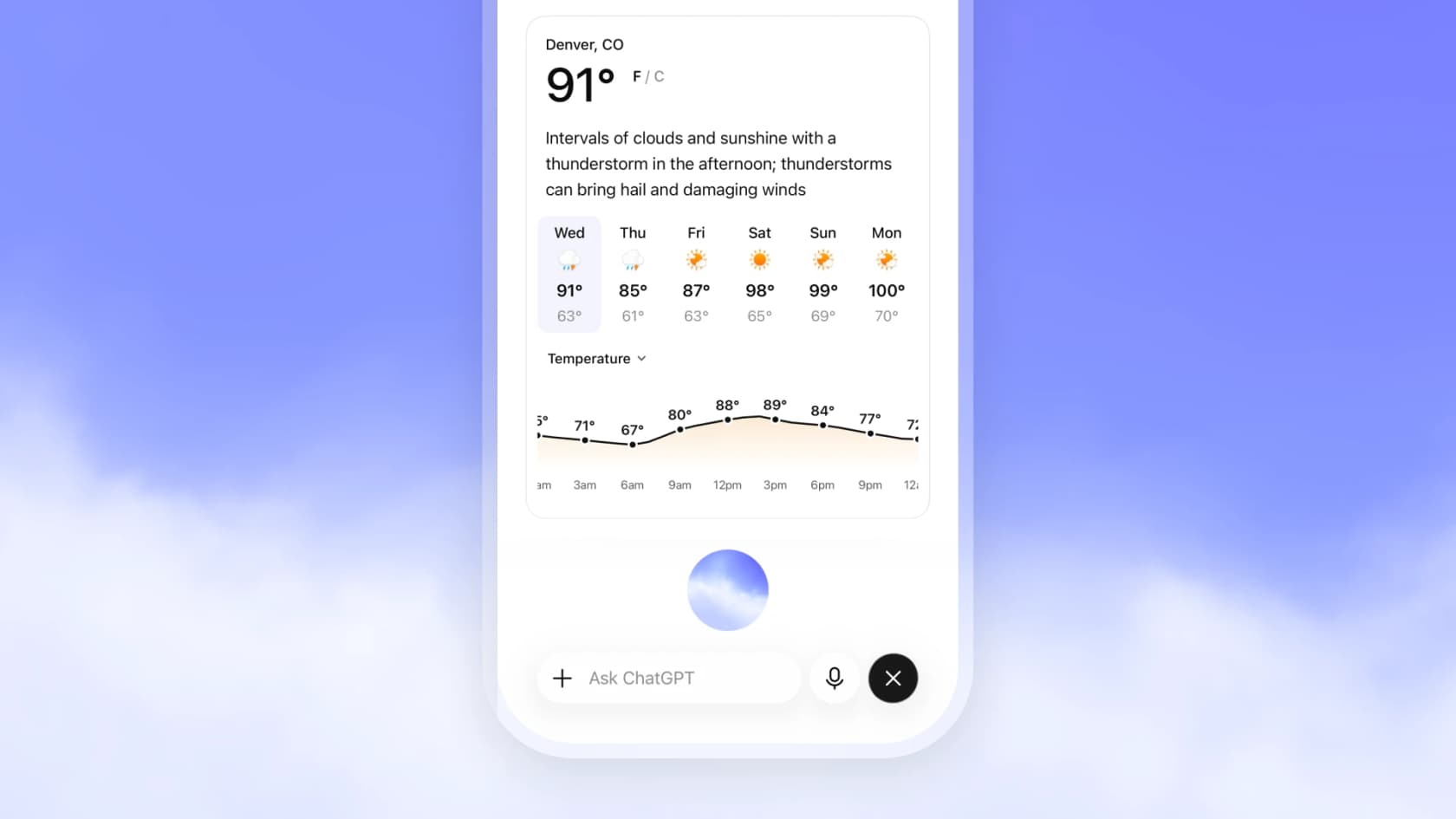
The model is built on a full-duplex design, and it's also the smartest voice model OpenAI has shipped. When a question needs web search or deeper reasoning, GPT-Live-1 quietly hands that work to a frontier model behind the scenes (GPT-5.5 at launch inside ChatGPT) and keeps the conversation flowing while it waits. You also get nine remastered voices and visual answer cards for things like weather, stocks, sports, and maps. It's a big step up from the last generation of AI customer service software that bolted a voice on as an afterthought.
One nice touch on the safety side: since July 31, audio generated through GPT-Live carries SynthID watermarking, and OpenAI shipped a public tool to detect its provenance signals. The model also uses a fixed set of predefined voices and is designed not to imitate a real person, which sidesteps the voice-cloning problem that's dogged this space.
Why full-duplex is the real change
To see why this matters, you have to look at what came before. Voice AI has been through two awkward generations, and GPT-Live-1 is the third.
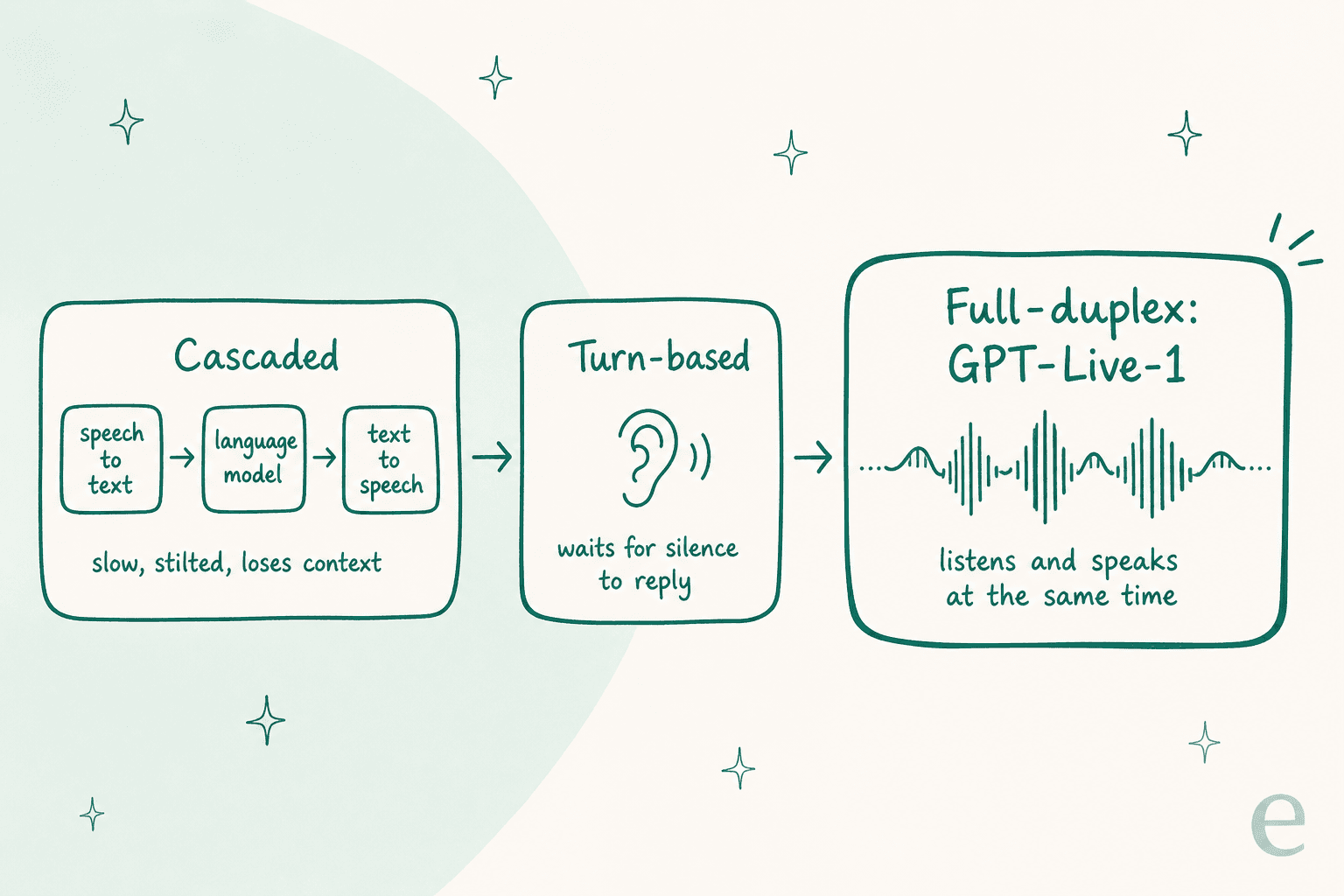
The first generation was cascaded. The original ChatGPT Voice chained three separate models together: speech-to-text to transcribe you, a language model to think, and text-to-speech to talk back. It worked, but every handoff added latency and lost a little context, so replies came out slow and stilted.
The second generation was turn-based, like ChatGPT Advanced Voice Mode. It processed audio inside a single model, which was smoother, but it still worked in discrete turns. It had to wait for you to stop speaking before replying, and because it detected turns from silence, a brief pause or a passing car could get mistaken for "your turn is over." That's the model interrupting you mid-thought.
GPT-Live-1 collapses those turns entirely. Instead of processing a sequence of separate messages, it continuously takes in audio while generating audio, and makes an interaction decision many times per second: speak, keep listening, pause, interrupt, or call a tool. That's what lets it do natural back-and-forth, keep a sense of timing, and even handle live translation.
The delegation trick: a fast talker with a smart backstage
The second architectural change is the clever one, and it's the thing most coverage glosses over. OpenAI decoupled the part that handles the conversation from the part that does the thinking.
GPT-Live-1 runs the live conversation. When a question needs search, real reasoning, or agentic work, it delegates that task to a separate backend model and keeps talking to you in the meantime. Inside ChatGPT that backend is GPT-5.5. In the API, you choose it yourself: GPT-6 Astra for complex issues, a leaner model for high-volume tasks like scheduling or order lookups, or even a third-party model.
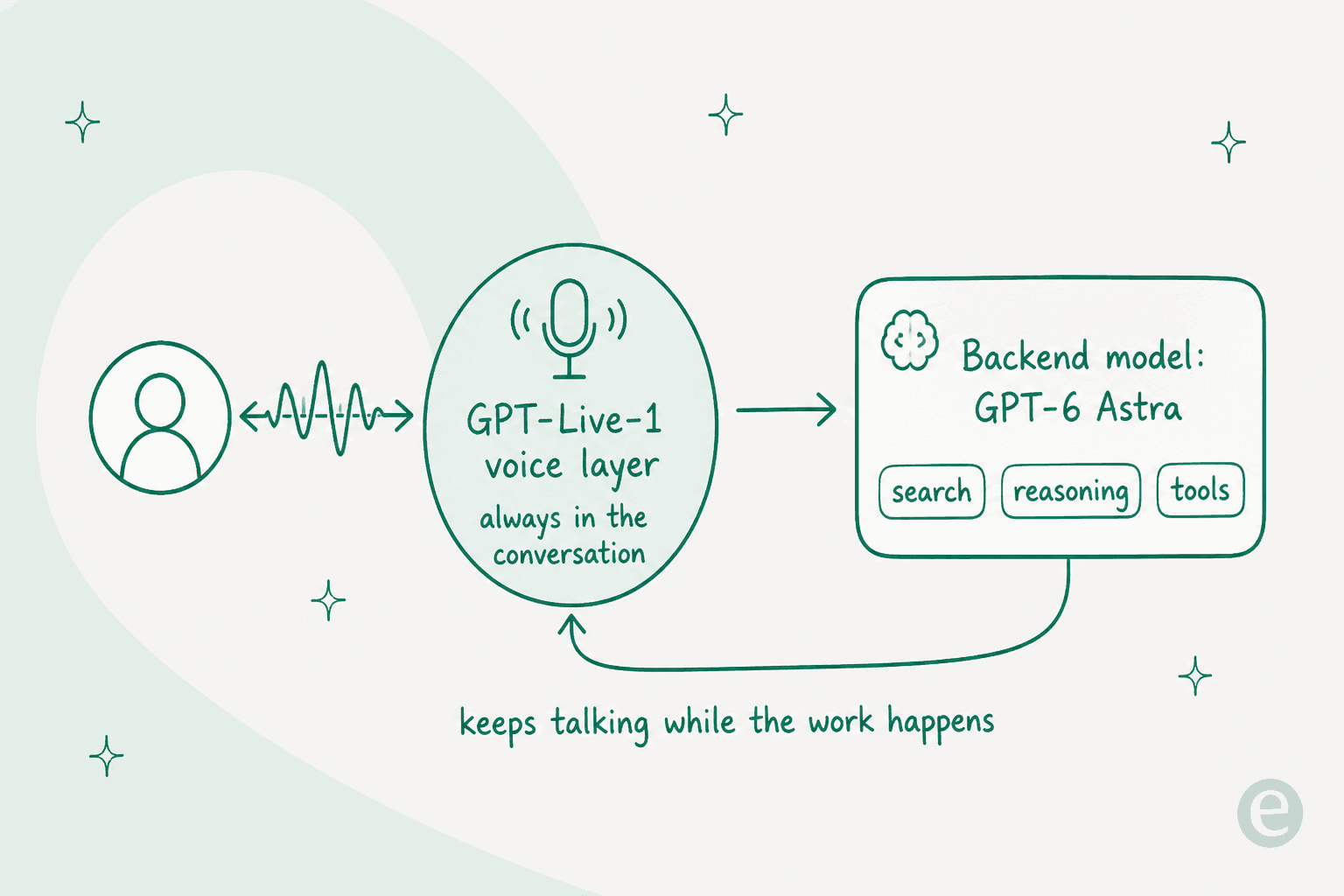
There's a practical payoff here beyond "it feels smart." Because the conversation layer and the reasoning layer are separate, you can dial reasoning effort per interaction. ChatGPT exposes three levels: Instant for fast replies, then Medium and High when you want it to actually think. GPT-Live-1 Instant and the mini run on GPT-5.5 Instant in the background, while Medium and High reach for GPT-5.5 Thinking. It's the same idea I lean on when building AI agents: don't make one model do everything, match the depth to the job.
How good is it, really?
OpenAI ran head-to-head human evaluations, and the numbers are genuinely lopsided against the old Advanced Voice Mode (AVM). Here's the shape of it.
| Benchmark | What it measures | AVM | GPT-Live-1 mini | GPT-Live-1 (high) |
|---|---|---|---|---|
| Pairwise preference | Which conversation people preferred | (baseline) | 69.2% | 75.7% |
| Flow of conversation | Mean rating out of 7 | 3.80 | 4.33 | 4.96 |
| Pleasantness | Mean rating out of 7 | 3.82 | 4.47 | 5.19 |
| GPQA | Expert-level scientific reasoning | 45.3% | 74.9% | 84.2% |
| BrowseComp | Agentic web search | 0.7% | 31.6% | 75.2% |
That BrowseComp jump is the eye-catcher: from basically zero to 75.2%. That's the delegation architecture doing its job, since agentic search is exactly the kind of "deep work" GPT-Live-1 hands off to the backend model.
The API launch added two more numbers I'd trust for judging voice agents specifically. GPT-Live-1 improves Full Duplex Bench by 30 percentage points over GPT-Realtime-2.1, and paired with GPT-6 Astra at medium reasoning effort, it ranks #1 on Tau3, a benchmark for frontier voice-agent intelligence on end-to-end tasks across airline, retail, telecom, and banking support. If you care about support, those are the tasks that map to your actual work, and the ones your AI customer service metrics will actually move.
What people are actually saying
Benchmarks are one thing, living with the model is another. The early Hacker News thread asking people about their experience is a good, unvarnished read. The consensus is "the conversation quality is a real leap, the intelligence is uneven."
The person who started the thread put the upside plainly:
"Its conversational skills are an incredible leap from its predecessor: The acknowledgments it makes, and the natural flow it exhibits overall are awesome."

The live-translation and hands-free use cases are where it seems to shine most for regular users:
"I use it to help with learning a language (French) and have been leaning into the CarPlay app. The model has done surprisingly well in conversations where it has to go back and forth across languages in the same response."
But the same backchannels that make it feel human can grate. One commenter flagged the flip side of all those "mhmm"s:
"The new gpt-live feature tends to interrupt with 'human' sounding injections like 'hmm', 'huh' a bit too much."
That tracks with OpenAI's own honesty about limits: at launch it doesn't support voice with video or screen sharing in ChatGPT, and some non-English languages still get a non-native accent or gaps in fluency. Worth knowing before you promise multilingual customer support on it.
GPT-Live-1 in the API: the interesting part for builders
The API release on September 10 is where GPT-Live-1 stops being a ChatGPT feature and becomes something you can build on. The pitch to developers is that it collapses the old speech-to-text plus reasoning plus text-to-speech stack into one voice layer, so you're not hand-coding what happens when someone interrupts or trails off mid-sentence.
The headline capabilities OpenAI called out:
- Interruption handling by reasoning over incoming and outgoing audio in a single model, avoiding the brittle handoffs of chained architectures.
- Reasoning and tool-call delegation to a backend text model or a third-party model.
- Tone, pace, and style control through the system prompt.
- Telephony support, so you can deploy full-duplex voice agents on phone calls, from reservations to customer support.
- Native ASR transcripts, alphanumeric understanding, and keyword biasing, plus turn detection for teams that still want explicit turn boundaries.
Early adopters are reporting real engineering wins, not just vibes. The language-learning app Speak found GPT-Live-1 cut interruptions during thinking pauses by almost 80% versus previous turn-based systems, according to co-founder and CTO Andrew Hsu. Yelp's Alex Levy said using it to answer reservation and food-order calls drove "meaningful improvements in call handling rates." A healthcare team even reported it "simplified our code base by 80% and removed 23K lines of code" compared with their cascaded build.
Pricing is refreshingly simple to state and easy to underestimate: $0.05 per minute for the front-end voice layer, and you bring the backend model and agent harness that fit your product. That second half is the real cost driver, because the voice layer is cheap and the reasoning you pair with it is not. OpenAI also pointed enterprises at OpenAI Presence, a higher-level way to deploy trusted voice agents on top of the same model.
What this means for customer support
Here's where I'd pump the brakes, because "OpenAI shipped a great voice model" and "you can now run AI voice support" are not the same sentence.
GPT-Live-1 solves the conversation problem, and it solves it well. The stop-start rhythm that made phone bots feel robotic is largely gone. On spoken support benchmarks like Tau3 and its telecom variant, GPT-Live-1 clearly outperforms the previous generation. If your bottleneck was "the voice experience feels like a 2019 IVR," this fixes it.
What it does not solve is the resolution problem. The model, by design, is the ears and mouth. It has no idea what your refund policy is, whether this customer's order actually shipped, or which of your 400 help articles answers their question. All of that lives in the backend model, the agent harness, and the business context you wire up, which is the genuinely hard part of AI for customer service automation. It's the difference between a slick demo and a real AI copilot for customer service.

So the honest read is: GPT-Live-1 is infrastructure. It's a beautiful voice layer that any support product can now build on. The differentiator moves up a level, to the teammate that actually knows your company and can resolve the ticket. That's the same reason the build-vs-buy question keeps mattering: wiring up the voice is the easy 20%, and getting a reliable agent that you'd trust with real customers is the other 80%. If you're mapping that out, our customer support AI implementation guide walks the harder half.
Try eesel
If you're looking at GPT-Live-1 and thinking about support, the thing to solve isn't the voice, it's the teammate behind it. That's what I work on. eesel is an AI teammate platform where you hire a ready-to-work AI support teammate that learns from your help center, past tickets, and macros, then joins your existing helpdesk and starts resolving conversations.
The part that pairs naturally with a model like GPT-Live-1 is the discipline around it. Before an eesel teammate ever touches a live customer, you can simulate it against thousands of your own historical tickets to see exactly what it would have said and what it would have resolved. I've watched confident-sounding bots quietly give wrong answers, which is precisely why that dry run over real history exists, instead of flipping a switch and hoping.
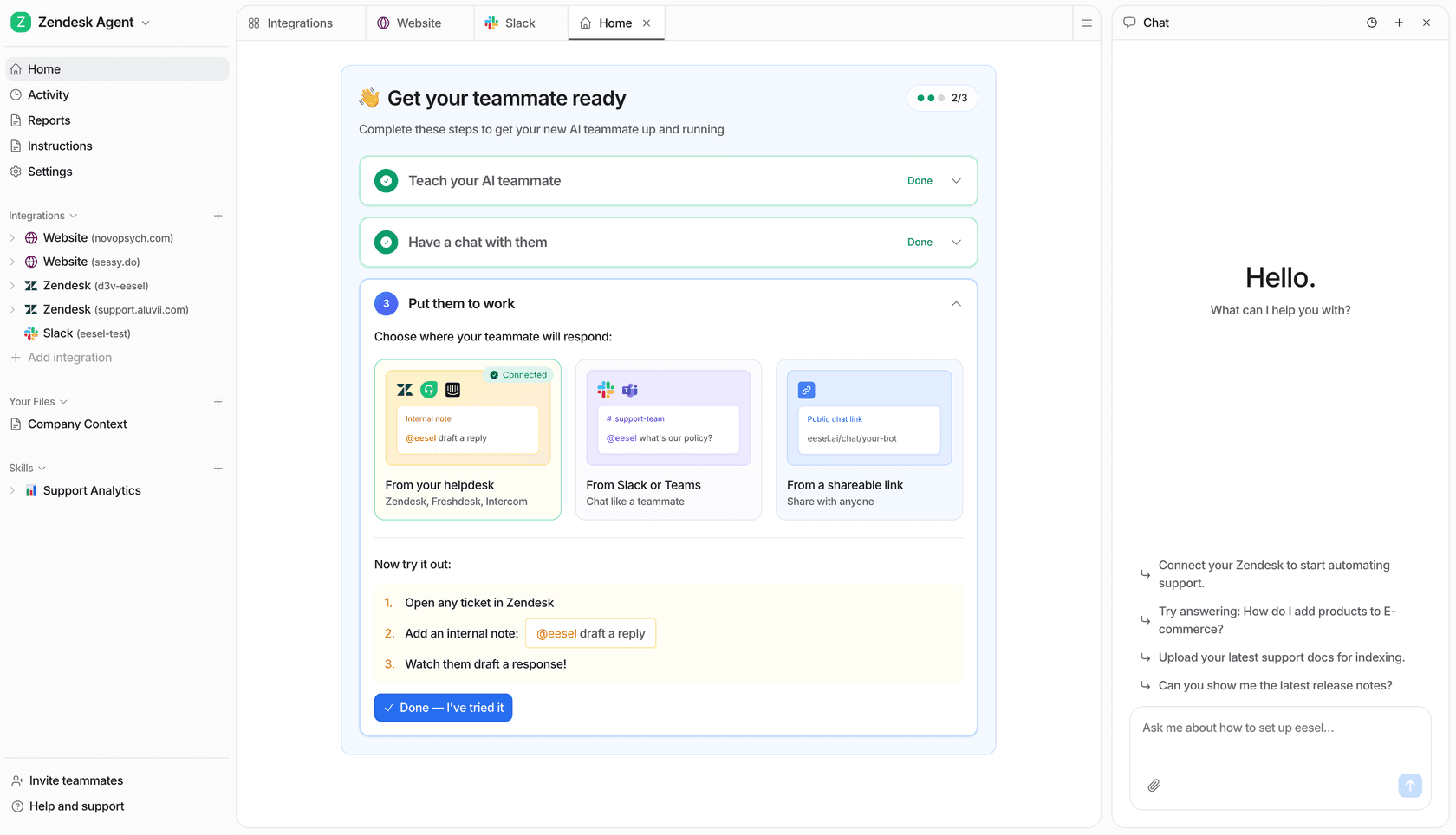
And because the theme of GPT-Live-1 is programmatic voice, it's worth knowing eesel is drivable the same way. Beyond the dashboard, there's an eesel CLI plus an MCP server, so you can operate the same teammate from a terminal, wire it into scripts, or let a coding agent like Claude Code or Codex inspect its instructions, propose a change, and review the test responses before anything ships. It's the agent-friendly way to manage the resolution layer that a voice model like GPT-Live-1 sits in front of. You can try eesel for free and simulate it on your own tickets in a few minutes.