


What is Kimi K3?
Kimi K3 is the flagship from Moonshot AI, the Chinese lab behind the earlier open-weight Kimi K2. Moonshot describes K3 as "the world's first open 3T-class model, designed for frontier intelligence across long-horizon coding, knowledge work, and reasoning."
What stands out is that Moonshot is unusually honest about where K3 sits. The launch blog says plainly that "while its overall performance still trails the most powerful proprietary models, Claude Fable 5 and GPT 5.6 Sol, Kimi K3 demonstrated frontier-level performance across our evaluation suite, consistently outperforming other tested models." You rarely see a lab lead with what its model isn't, and it makes the rest of their claims easier to trust.
There's one catch worth flagging up front. Moonshot calls this an open model, but at launch it was API-only. The official blog says "the full model weights will be released by July 27, 2026," and as of launch week the HuggingFace repo still returned a 404. So if your plan was to self-host it on day one, that plan waits a couple of weeks.
How Kimi K3 actually works
If you've built with these models before, the interesting part of K3 isn't the parameter count, it's how Moonshot got there without the cost blowing up. Here's the pipeline in one picture.
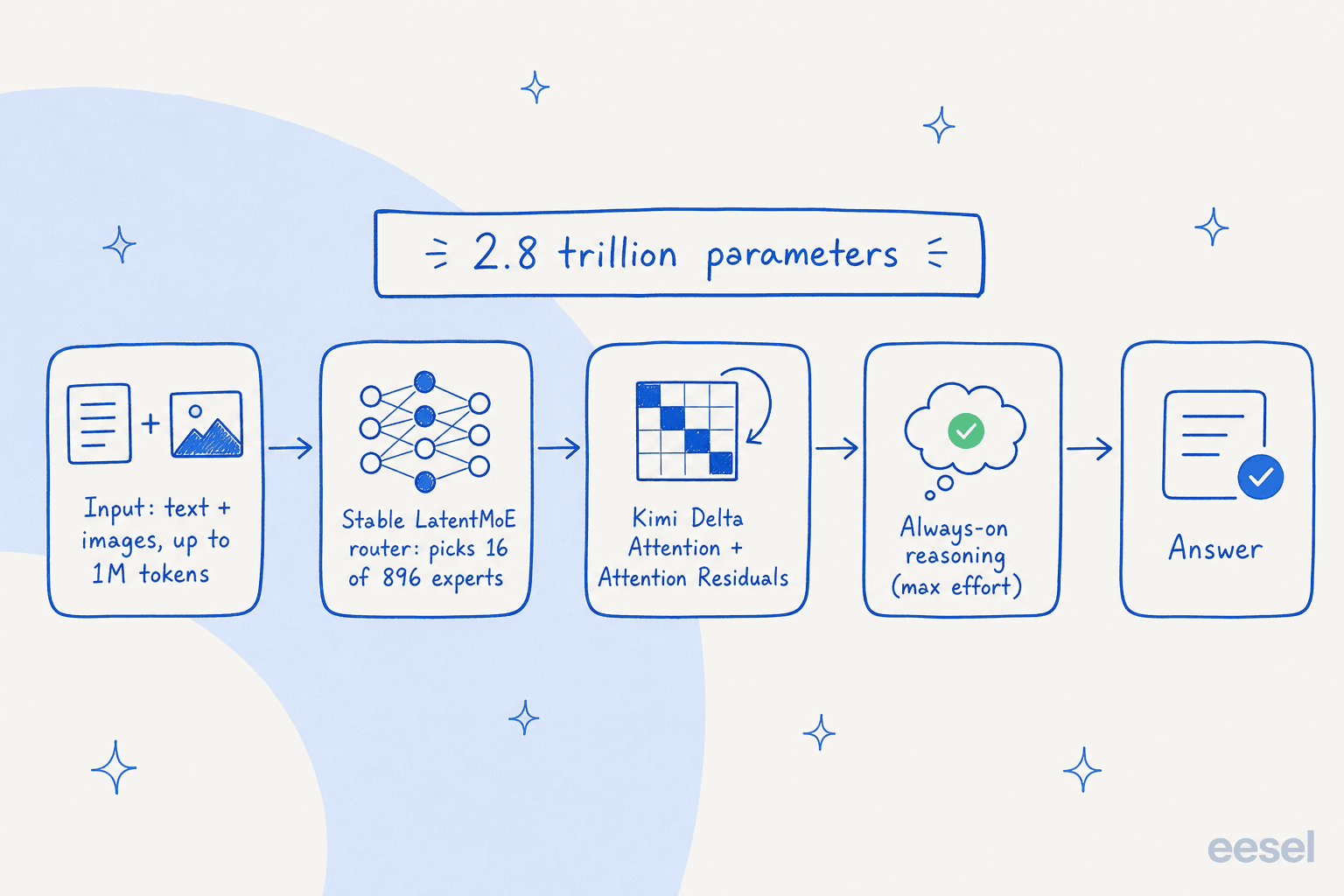
A few pieces are doing the heavy lifting:
- A very sparse mixture of experts. K3 is 2.8 trillion parameters total, but it only "effectively activat[es] 16 out of 896 experts" per token, using what Moonshot calls a Stable LatentMoE framework. Sparse routing is how you get a huge model that's still affordable to run, only a sliver of it fires for any given token.
- Kimi Delta Attention (KDA). A hybrid linear attention mechanism that keeps the 1M-token context window practical instead of ruinously expensive.
- Attention Residuals (AttnRes). A drop-in replacement for standard residual connections, which Moonshot open-sourced separately at github.com/MoonshotAI/Attention-Residuals.
- Always-on reasoning. K3 always "thinks", there's no cheaper non-reasoning mode. Effort is set with a
reasoning_effortfield that currently only acceptsmax, with lower levels "coming soon."
Put together, Moonshot claims "an approximate 2.5x improvement in overall scaling efficiency compared to Kimi K2." That's the real story here: not just bigger, but a lot more output per unit of training compute. One honest gap: the full technical report and the exact active-parameter count aren't out yet, so some of the how is still a promise.
How Kimi K3 scores on benchmarks
This is where K3 earns the "frontier" label. Moonshot published head-to-head charts against Fable 5, GPT-5.6 Sol, Opus 4.8, and GPT-5.5, and independent testing has started to corroborate them.
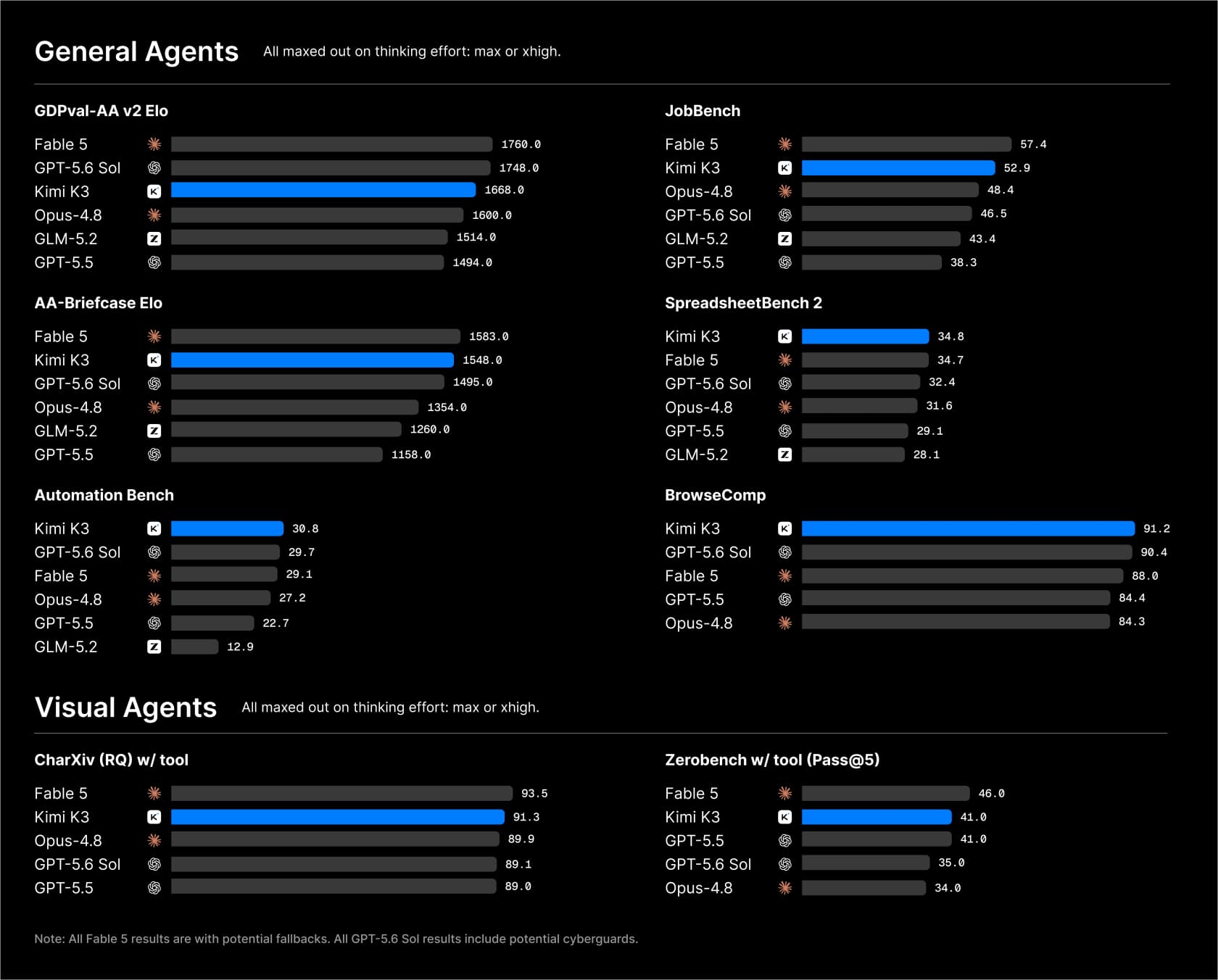
The pattern is consistent. K3 is usually a step behind Fable 5 and GPT-5.6 Sol, but comfortably ahead of the previous flagship tier. A few concrete reads from Moonshot's charts:
- Agentic web tasks (BrowseComp): K3 leads at 91.2, ahead of GPT-5.6 Sol (90.4) and Fable 5 (88.0).
- Automation Bench: K3 first at 30.8, edging GPT-5.6 Sol (29.7) and Fable 5 (29.1).
- SWE Marathon (long-horizon coding): K3 tops it at 42.0, above Opus 4.8 (40.0) and GPT-5.6 Sol (39.0).
- GDPval-AA v2 (knowledge work): here it slips to third at 1668, behind Fable 5 (1760) and GPT-5.6 Sol (1748).
Independent testing tells the same story. On Artificial Analysis, K3 posts an Intelligence Index of 57, ranked #4 of 189 models, and on their private long-horizon knowledge-work evaluation it "mostly beats Claude Opus 4.8 max and GPT-5.5 high, while losing to Claude Fable 5 and GPT-5.6 Sol." Output speed is a more ordinary ~62 tokens/second. My take: treat K3 as a strong, reliable number two rather than a giant-killer, and read any "beats Opus 4.8" headline as task-specific, because on plenty of tasks it does exactly that.
What changed from Kimi K2 to K3
If you knew Kimi as the cheap, capable Chinese model, K3 rewrites two of those assumptions. It's much bigger and much more efficient per unit of compute, but it's also no longer cheap.

That price row is the one that shifted the whole narrative. "Kimi is the ultra-cheap frontier killer" was a K2-era story. With K3, Moonshot priced up into flagship territory and is betting the intelligence justifies it.
Kimi K3 pricing
Let's put the real numbers down, because "affordable open model" no longer describes what you'll actually pay. The official K3 API pricing is refreshingly simple, one model, one price, flat across the full context window.
| Model | Unit | Input (cache hit) | Input (cache miss) | Output | Context window |
|---|---|---|---|---|---|
kimi-k3 | 1M tokens | $0.30 | $3.00 | $15.00 | 1,048,576 (1M) |
Two things I like here. There's no premium tier for long prompts, the 1M window is priced the same all the way through, unlike some rivals that charge more past a token threshold. And the context-caching discount is real: a cache hit drops input to $0.30/M, a 90% saving. For long-document or long-horizon agent work where most of the input is a stable, cached context, that's where K3 gets genuinely competitive.
If you're using the consumer app instead of the API, Kimi charges four subscription tiers, named after musical tempos, on top of a free plan:
| Tier | Monthly | Annual (per month) | Notable inclusions |
|---|---|---|---|
| Free | $0 | - | Basic chat |
| Moderato | $19 | $15 | Deep Research, Docs/Sheets/Slides, Kimi Code access |
| Allegretto | $39 | $31 | 2x agent credits, 5x Kimi Code credits |
| Allegro | $99 | $79 | 5x agent credits, Swarm parallel agents |
| Vivace | $199 | $159 | 10x agent credits, max Swarm concurrency |
Source: Kimi membership pricing. Worth knowing: that page carries a banner saying new plans are coming and that Kimi chat and Kimi Code benefits will be split into separate products, so this ladder may look different soon.
So how does $3 / $15 actually stack up? The one hard, first-party contrast is DeepSeek, whose V4 Flash runs $0.14 / $0.28 per million, roughly 21x cheaper on output than K3. DeepSeek is still the true budget frontier option; K3 isn't competing on that axis anymore. The launch-week community read was blunter, as one commenter put it on Hacker News, the shift is from "it's totally cheap" to a model that costs about what Claude's Sonnet tier does. K3's pricing edge isn't the headline per-token rate, it's the flat 1M window plus that 90% cache discount.
What people actually think
Launch week for an open frontier model is loud, and K3's reaction split cleanly into excitement about the capability and skepticism about the cost. The most useful signal came from people who actually ran it on real work.
The coding parity takes were the strongest praise:
"I've been playing around with it for the past few hours, and I think it's an amazing model. I'm not sure I could tell the difference between this and Fable in a blind test. The quota in the $100 Kimi Coding plan seems to roughly align with what I get from the $200 Anthropic plan when I primarily use Fable."

There's also a real emotional beat about an open model trading blows with the closed labs:
"Kimi K3 has been officially released! Look at this voxel game created with this basic prompt: 'Voxel star wars pod-racers run'. Chinese models have filled the gap! We are entering in a new phase of AI."

The pre-launch hype had set the bar even higher:
"K3 is a different animal. The rumors say that Kimi K3 is a much larger model, on par with Claude Opus 4.7."
And the calmer camp landed it about where the numbers do, a touch below the very top:
"Umm, Fable only really came out 2 weeks ago, and GPT-5.6 Sol only 1 week ago. Yes, Kimi K3 appears a touch below them both, but above all other models. So I'd say a few weeks behind, not months now..."
The biggest gripe wasn't quality, it was cost, plus a running complaint that K3 burns more tokens than Fable to finish the same task. That token-efficiency question is the one that actually decides your bill, and it's worth watching as independent testing matures.
What Kimi K3 can build
The launch showcase is genuinely fun, and it's the clearest demonstration of the long-horizon coding Moonshot is selling. In a single 48-hour autonomous run K3 designed a chip (Nangate 45nm, 4mm², simulated at over 8,700 tokens/second decode). It also built "MiniTriton," a Triton-like GPU compiler with its own IR, matching or beating torch.compile on some workloads. And it generated playable 3D games from single prompts:

The community reaction to the GPU compiler summed up the mood, equal parts awe and "show me the receipts":
"Did anyone see on the blog post that it was able to code up an entire GPU compiler from scratch? It looks like it even outperformed triton on some GPU kernels. That just seems insane to me. Wonder if they'll open-source this and show how many tokens it cost."
Demos like these are real, and they're also the best-case, heavily-scaffolded runs any lab shows at launch. The gap between "did this once in a sandbox" and "does this reliably for my use case" is the whole game, which brings me to the part I care about most.
A benchmark score is not a support agent
Here's the thing every model-launch post glosses over, and the one that matters if you landed here trying to pick a model for customer service. A 57 on the Intelligence Index tells you the raw engine is strong. It tells you nothing about whether it'll safely answer your customers.
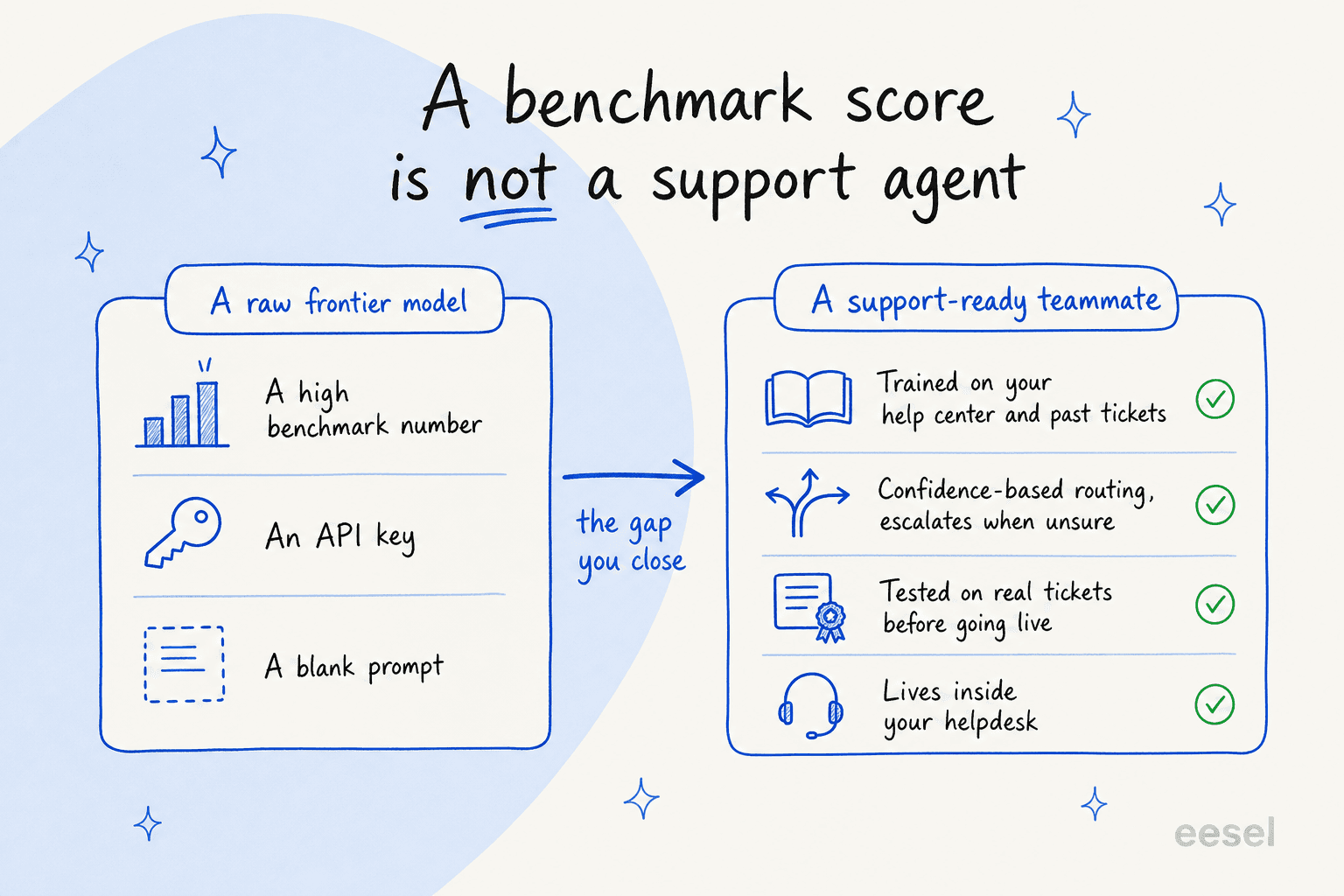
I build AI agents at eesel, and the thing we learned the hard way is that model quality is maybe a third of the problem. We've watched confident-sounding bots quietly give wrong answers, which is exactly why we now simulate every rollout against a company's historical tickets before it ever talks to a customer. A raw K3 API key gives you none of that. To go from a great model to a teammate you'd trust on the queue, you still need to train it on your knowledge base, wrap it in routing that escalates when it's unsure, and put it where your team already works. That's the gap, and it's the same gap whether the underlying model is K3, Claude Opus, or anything else.
Try eesel
If you're reading a Kimi K3 review because you want better AI on your support queue, the model is the easy part. eesel is the layer that turns a frontier model into an actual support agent: it trains on your help center and past tickets, drafts or fully resolves replies inside your existing helpdesk, and, crucially, lets you simulate the whole thing against your real ticket history so you see the resolution rate and cost before it goes live.
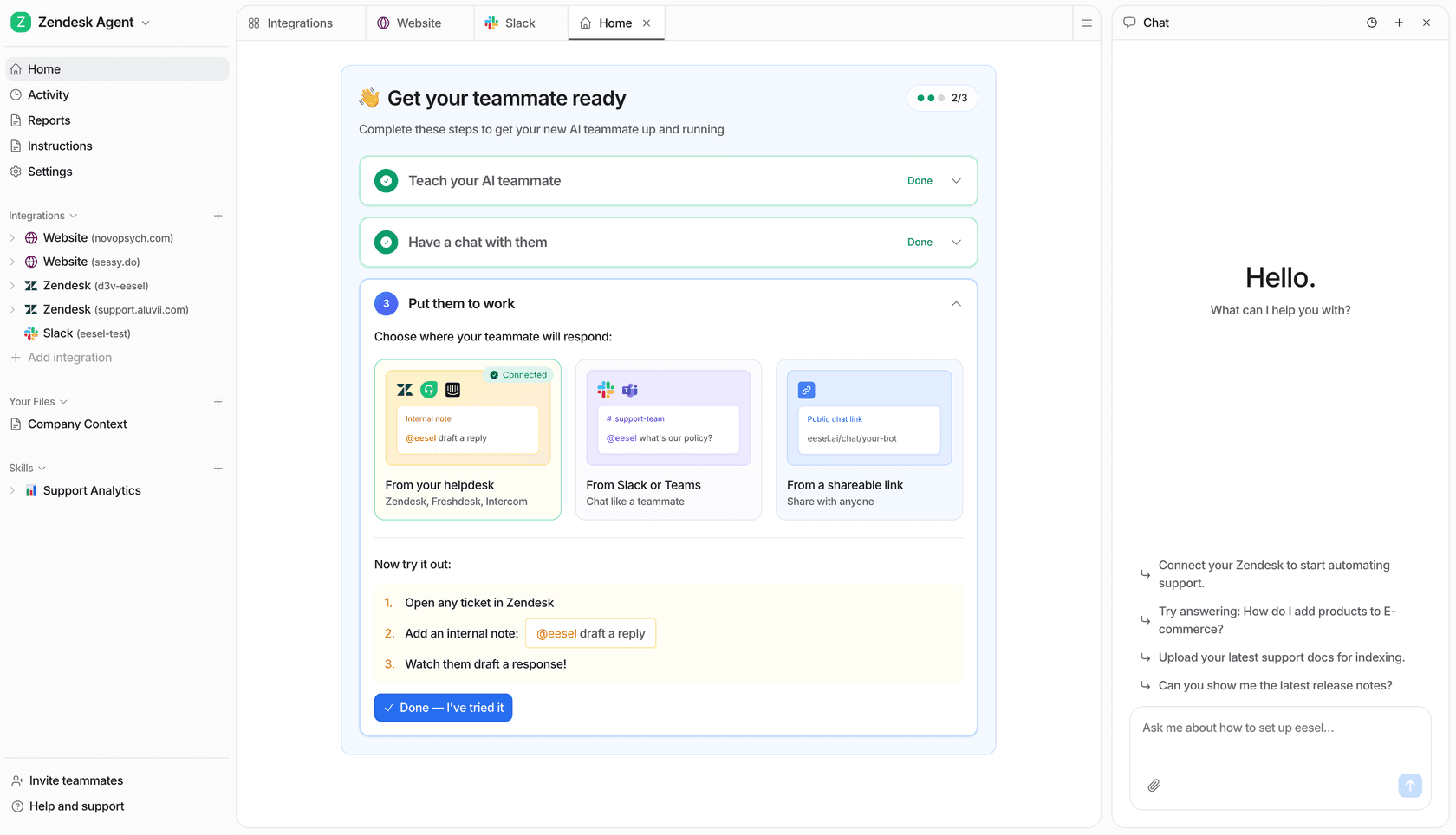
Because eesel is model-agnostic, you get to ride the frontier, run on whichever top model is best this month, without rewriting prompts or babysitting a raw API. And the pricing is built for support economics: one fixed monthly price from $299/month for 500 credits, no per-seat fees, so a busy month doesn't punish you for having a bigger team. You can try eesel free with 100 credits and simulate it on your own tickets in a few minutes.