


So, you're looking into Twilio Flex. On paper, it sounds like a dream: a totally customizable contact center. But then you get to the pricing page, and suddenly you feel like you need a finance degree to understand it. It's not a simple monthly fee. It's a jumble of per-user plans, per-minute charges, and the one detail that often gets buried,you'll need developers for pretty much everything.
Let's cut through the noise. We'll break down the main Twilio Flex pricing models, shine a light on the hidden costs that always seem to pop up, and figure out what you'd actually pay. By the end, you'll have a much better idea of whether Twilio Flex is the right fit for your team, and you'll know about a much simpler alternative.
What is Twilio Flex, and how does it impact Twilio Flex pricing?
The first thing to get straight is that Twilio Flex isn't an out-of-the-box contact center. It’s more like a set of high-end Lego bricks for developers. Being "API-first" is just a fancy way of saying it’s a blank slate that your engineering team has to build on from the ground up.
It can handle all your calls, texts, and chats, but your team is the one who has to build the logic for how all of that works. And if you don't have developers ready to go, that "blank canvas" can feel pretty empty and overwhelming. That total control is the main selling point, but it comes with a serious learning curve and a constant need for technical help.
Decoding the core Twilio Flex pricing models
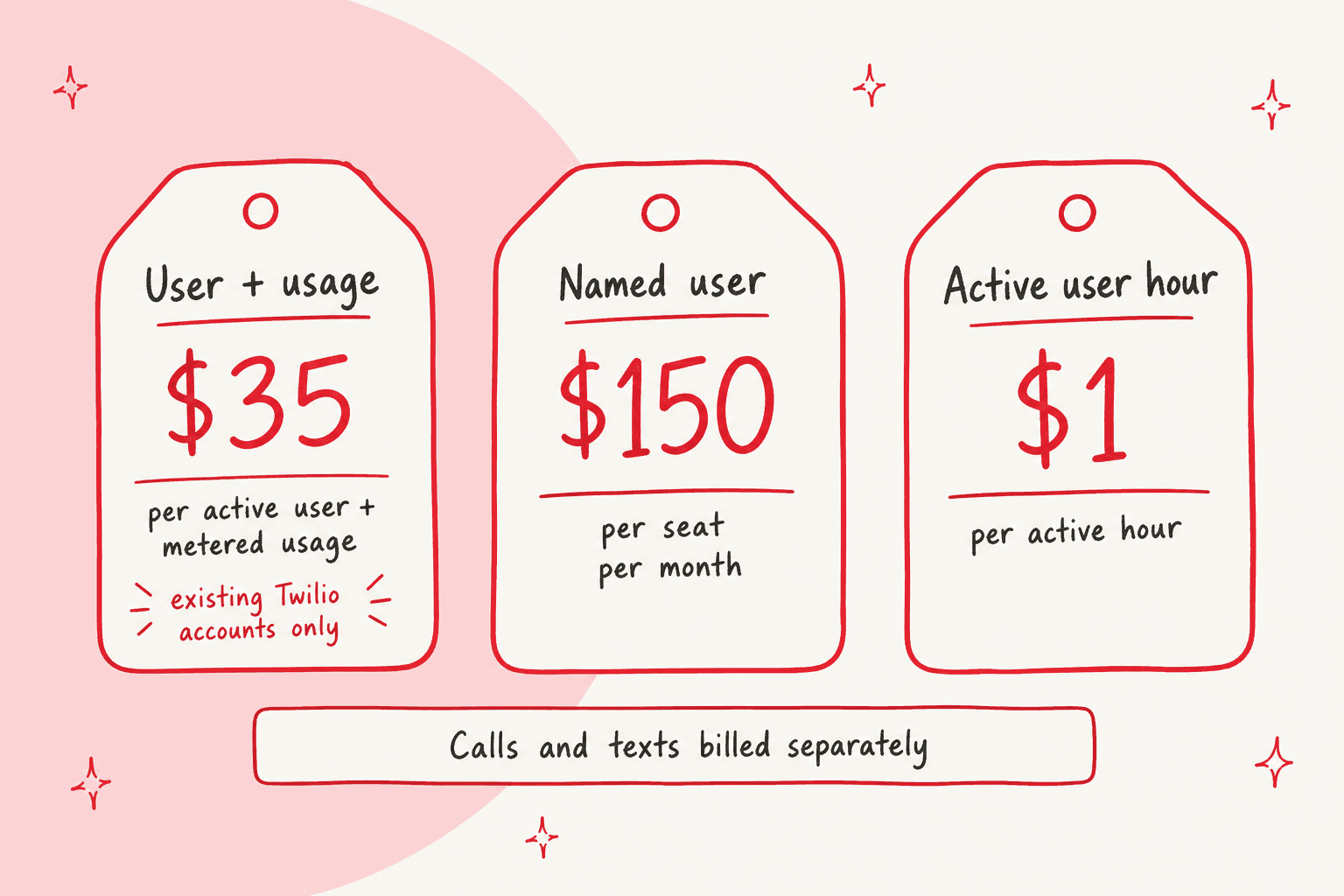
Twilio offers three main ways to pay for its platform. But here's the kicker: those prices are just for the license to use the software. Every call and text your team handles costs extra.
It’s a mix that trips a lot of people up. One person on Reddit even asked if Twilio had "plans" at all, or if it was just pay-as-you-go. The reality is, it's both, and that’s where things get complicated.
Per-user hourly pricing: Paying for what you use
This plan comes in at $1 per active user hour. It seems straightforward,you only pay when your agents or supervisors are logged in and working.
This sounds appealing for teams with part-time staff or those who get slammed during certain seasons. The catch? Your bill will be completely unpredictable. It will swing wildly depending on agent hours and call volume, making budgeting a total guessing game. Good luck explaining that to your finance department.
Named user pricing: A predictable monthly fee
The other option is a flat rate of $150 per user, per month. This makes more sense if you have a full-time team who are logged in consistently.
At least your license cost is predictable here, which is a relief. The downside is that it's a hefty price per person before you've even handled a single customer query. And just like the hourly option, it doesn't include your usage costs, phone numbers, or the massive setup project that’s just around the corner.
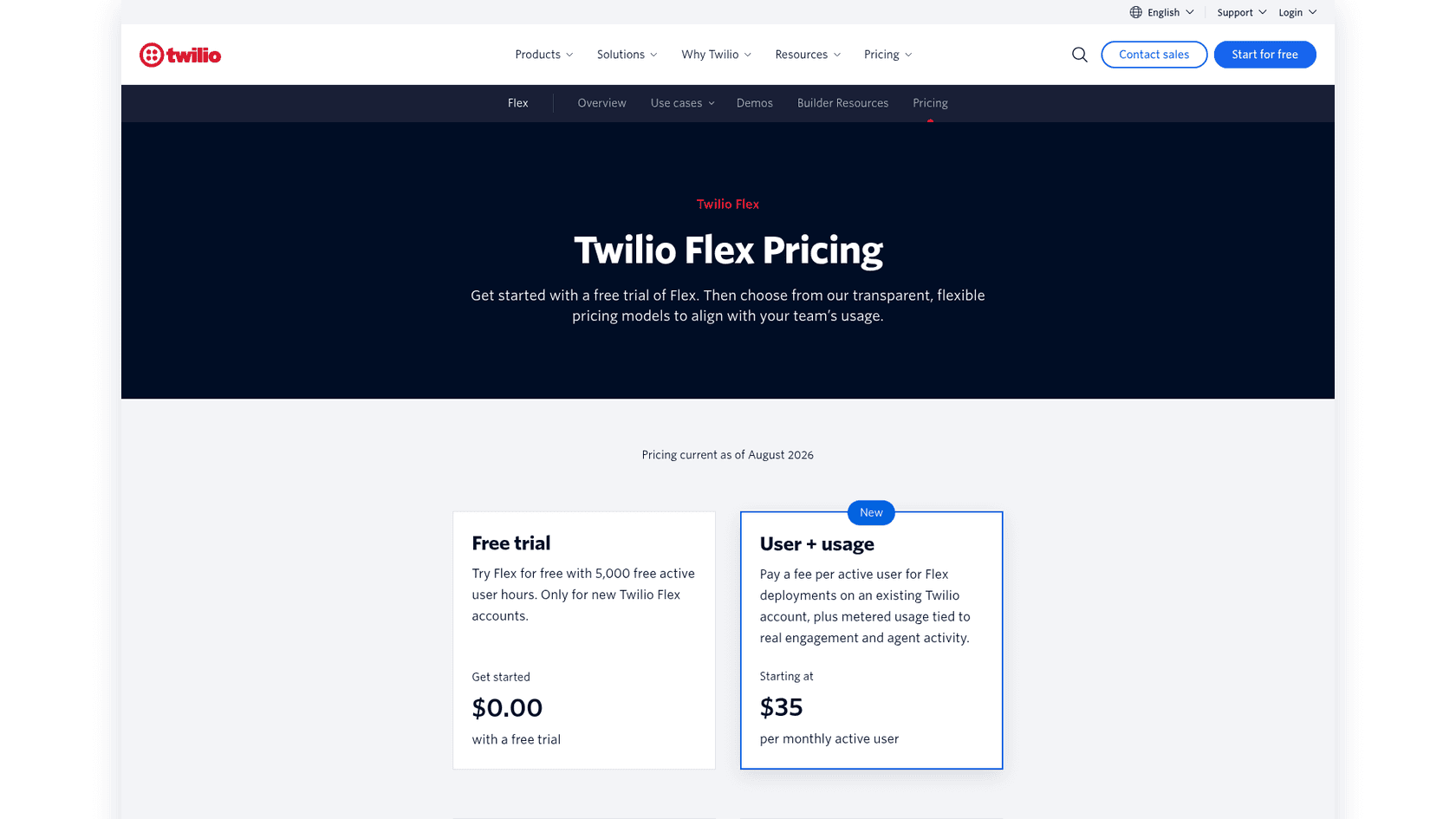
Since this guide first ran, Twilio has added a User + usage plan at $35 per monthly active user, with every underlying service metered and no free quotas. It is only available for Flex deployments added to an existing Twilio account, not for accounts created with Flex.
A side-by-side comparison of Twilio Flex pricing
To make it clearer, here’s how the two plans stack up:
| Feature | Per-Hour Plan | Named User Plan |
|---|---|---|
| Base Cost | $1 per active user hour | $150 per user per month |
| Best For | Seasonal or part-time teams | Full-time, consistent teams |
| Budgeting | Variable and less predictable | Stable and predictable license cost |
| Usage Fees | Billed separately (voice, SMS, etc.) | Billed separately (voice, SMS, etc.) |
| Implementation | Required (significant cost) | Required (significant cost) |
| Free Trial | 5,000 active user hours | 5,000 active user hours |
The hidden costs of Twilio Flex pricing you can’t ignore
The advertised price for Twilio Flex is just the tip of the iceberg. The real costs are tucked away in the setup process and the ongoing maintenance needed to keep it running.
Hefty implementation and setup fees
You don't just "turn on" Twilio Flex. Getting it running is a full-blown development project that requires a serious upfront investment. Most businesses end up spending at least $10,000 on outside help just to get it off the ground. And that doesn't even factor in the time your own team will sink into it for weeks, or even months.
The ongoing cost of developer dependency
This is the part that really catches people by surprise. Twilio Flex isn't owned by your support lead; it's owned by your engineering team. You don't just need them for the setup,you need them for everything that comes after.
Want to add a new feature? Need to fix a bug? Want to tweak a menu option in your phone system? All of those are tickets for your developer. This isn't just a one-time cost; it's an ongoing drain on your engineering resources.
How pay-as-you-go usage fees impact Twilio Flex pricing
On top of the license fee and developer time, you're paying for every action that takes place on the platform. For any team with decent volume, these costs add up fast. Here’s a quick look at some of the common usage fees:
| Service | Unit | Estimated Cost | Notes |
|---|---|---|---|
| Voice Call (Outbound) | Per Minute | ~$0.014 | Varies by destination. |
| SMS Message | Per Message | ~$0.0083 | Carrier fees may also apply. |
| WhatsApp Message | Per Message | ~$0.005 + Meta fees | Twilio says session messages are included in the Flex license; template messages are billed. |
| Local Phone Number | Per Month | ~$1.15 | Toll-free and international numbers cost more. |
| Call Recording Storage | Per GB-Month | ~$0.0025 | Billed after the first 10,000 minutes. |
Twilio also lists Agent Copilot in public beta at $0.035 per minute on voice and $0.005 per message on digital channels. It notes that additional professional services may be required to deploy it.
A simpler, more powerful alternative to complex Twilio Flex pricing
So with Twilio Flex, you're looking at a complicated pricing structure, a lengthy and expensive setup, and a permanent reliance on your developers. It’s a powerful tool, no doubt, but its complexity and cost are too much for most teams.
So what's the alternative? What if you could get smart automation without the engineering headache? Instead of tearing down your current system to build a new one from scratch, you can just add an AI layer right on top of the helpdesk you already use. That's what we do at eesel AI.
Go live in minutes with transparent, predictable pricing
With a tool like eesel AI, you can be up and solving tickets in minutes, not months. You don't have to schedule a sales demo to get started,you can just sign up yourself. Connect it to your helpdesk (like Zendesk or Freshdesk), show it your knowledge sources, and you're good to go.
And the pricing is actually straightforward. You pay a fixed monthly price for a batch of credits, where a ticket or chat handled is one credit, with no weird per-resolution fees or hidden charges. Plans start at $299 for 500 credits. Budgeting becomes simple again, and you can scale up without worrying about a surprise bill.
Full control without writing a single line of code
Remember how every little change in Twilio requires a developer? With eesel AI, your support managers are in the driver's seat. Everything is managed from a simple dashboard, no coding required. You don't need a technical background to build a smart and effective AI assistant.
Here are a few things you can do all on your own:
-
Selective Automation: You have full control over which tickets the AI handles and which go to a human agent. A simple workflow builder lets you start small and gradually give the AI more responsibility as you see the results.
-
Custom AI Actions: You can teach the AI to do more than just answer questions. It can look up order information in Shopify, tag tickets for reporting, or notify the right person in Slack automatically.
-
Powerful Simulation: This part is especially cool. Before the AI ever talks to a real customer, you can run it in a simulation on hundreds of your past tickets. It's a safe sandbox that shows you exactly how it would have performed and gives you a solid forecast of your resolution rate. No more crossing your fingers and hoping for the best.
Is Twilio Flex right for your team? A final look at Twilio Flex pricing
Let's be real: Twilio Flex is a powerful platform. But it's designed for massive companies with dedicated engineering teams, big budgets, and very niche requirements. For most teams, the total cost of ownership, the constant need for developers, and the complicated pricing just aren't worth the hassle.
For most teams, a modern AI tool like eesel AI is a much more direct path to results. You'll see an impact faster, your costs will be predictable, and your own support team will be the ones in control of their own automation. Instead of getting stuck in a months-long development project, you could be automating tickets and delighting your customers by this afternoon.
Ready to see how simple AI-powered support can be? Start your free eesel AI trial and automate your first tickets today.
Frequently asked questions
Can you explain the main components of Twilio Flex pricing for base usage?
Twilio Flex offers three core base pricing models: $1 per active user hour or $150 per named user per month, plus a newer $35 per monthly active user plan with metered usage. These cover the software license itself but do not include usage costs or implementation services.
How predictable is Twilio Flex pricing when it comes to monthly budgeting?
Budgeting can be challenging. The per-user hourly plan is highly unpredictable due to variable agent hours and call volume. While the named user plan offers a predictable license fee, usage costs for calls, SMS, and other services remain variable and can add up quickly.
Does Twilio Flex pricing include all communication usage like calls and texts?
No, the base Twilio Flex pricing models only cover the software license. All communication usage, such as voice calls, SMS messages, WhatsApp template messages, and phone numbers, are billed separately on a pay-as-you-go basis, adding to the overall cost.
For what kind of team or company is Twilio Flex pricing most suitable?
Twilio Flex pricing and its overall model are best suited for large enterprises with substantial budgets, dedicated in-house engineering teams, and highly specific, complex contact center requirements that necessitate deep customization.
How long does it typically take to get started with Twilio Flex pricing and implementation?
Getting Twilio Flex operational is a significant development project, often taking weeks or even months to implement. It requires substantial upfront investment in developer time and potentially outside consulting to build the contact center from scratch.