

Let's be honest, talking to a robot on the phone used to be a joke. Now, it's serious business, and we're all hunting for AI that can hold a natural, human-like conversation to get things done. In this space, Vapi AI has built a reputation as a seriously powerful platform for developers who want to construct sophisticated voice agents from scratch.
But is a powerful tool for developers the same thing as a complete solution for a business? This article gives you an honest look at Vapi AI. We’ll explore its strengths as a developer's playground, dig into its hidden complexities, and help you decide if it’s the right tool for a modern, multichannel support team.
What is Vapi AI?
Vapi AI is a platform built specifically for developers to create, launch, and manage advanced voice AI agents over the phone. Think of it less as a ready-made product and more like a high-tech box of Legos for engineers to build with.
Its primary uses are what you’d expect: automating inbound customer service calls, running outbound sales campaigns, or even conducting market research. The core idea behind Vapi AI is its "bring your own stack" model. It doesn't force you into using one specific technology. Instead, it gives developers the freedom to plug in their favorite services for each piece of the puzzle: speech-to-text (STT) to listen, a Large Language Model (LLM) to think, and text-to-speech (TTS) to talk back. As a Y Combinator-backed company, it's got plenty of street cred in the tech world as a tool for serious builders.
Key features and capabilities of Vapi AI
For its target audience of engineers, Vapi AI has some genuinely impressive features. It’s easy to see why developers are drawn to it.
Vapi AI: Built for developers, from the ground up
Vapi AI is an engineer's tool, through and through. Almost every feature is accessible via an API, giving developers fine-grained control over how their voice agent behaves and connects to other systems. It provides Software Development Kits (SDKs) in common languages like Python and TypeScript, which makes it easier for a dev team to weave Vapi's features into their existing apps and workflows. This is fantastic, assuming you have the engineering team to build and look after these custom integrations.
Vapi AI's mix-and-match models for the perfect setup
One of Vapi AI's biggest draws is its flexibility. You aren't stuck with a single provider for your entire voice setup. You can pick and choose components to build the perfect agent for your specific needs.
For instance, you could use a model from OpenAI or Anthropic as the agent's "brain," tap into Deepgram for lightning-fast transcription, and use ElevenLabs for voices that sound incredibly real. This modular approach means you can fine-tune your agent to prioritize cost, speed, or specific language skills. Want the absolute best voice quality and don't mind the price tag? Go for it. Need to keep the budget tight? You can choose a more cost-effective LLM.
Low-latency, real-time conversations with Vapi AI
Nothing ruins an automated call faster than that awkward, robotic pause. Vapi AI gets this right, with sub-600ms response times cited in its docs. This speed is what makes a conversation feel fluid and natural, more like talking to a person and less like interacting with a machine. It also handles interruptions well, so a caller can speak over the agent without confusing it, just like in a normal conversation.
The Vapi AI Flow Studio for visual workflows
Vapi's drag-and-drop workflow builder was retired on August 18, 2026, and Vapi now points new builds to Assistants (one prompt plus tools) or Squads (several assistants that hand off). It also offers Composer, an alpha chat-based helper that creates assistants and sets up numbers from a plain-language description.
But it’s important to know the limits. A first phone agent can be built in the dashboard without code, while anything more complicated, like pulling data from an external API, managing errors, or performing multi-step actions, still calls for someone comfortable with API configuration. It’s a developer platform with a no-code starting point, not a no-code automation platform.
The hidden costs: understanding Vapi AI pricing and setup
Okay, this is where you'll want to grab a coffee, because the pricing gets a bit tricky. It’s a huge hurdle for any business trying to figure out what Vapi AI will actually cost them. The price you see upfront is rarely the price you end up paying.
Let's break down the Vapi AI pricing model
Vapi AI's advertised rate of $0.05 per minute sounds simple enough, but that fee only covers their orchestration layer, the part that acts as the traffic cop for all the other services. The catch is that you have to pay for every one of those other services separately, and those costs pile up quickly.
Here’s a more realistic glimpse at what one minute of a Vapi AI call could actually cost you:
| Component | Example Provider | Typical Cost/Minute |
|---|---|---|
| Vapi Orchestration | Vapi.ai | $0.05 |
| Transcription (STT) | Deepgram | ~$0.01 |
| Language Model (LLM) | OpenAI | ~$0.008 - $0.045 |
| Voice Synthesis (TTS) | ElevenLabs | ~$0.015 - $0.024 |
| Telephony | Twilio (inbound / outbound) | $0.008 / $0.014 |
| Total Estimated Cost | ~$0.08 - $0.13 (Vapi's own calculator, Vapi telephony at $0) |
As you can see, Vapi's own calculator puts 1,000 minutes at $82 to $129 a month, roughly 1.6 to 2.6 times the advertised rate, depending on the components you pick. This layered, usage-based pricing makes forecasting your monthly spend incredibly difficult. Trying to predict your bill can feel like guessing the weather a month from now, which is a headache for any operations or finance team.
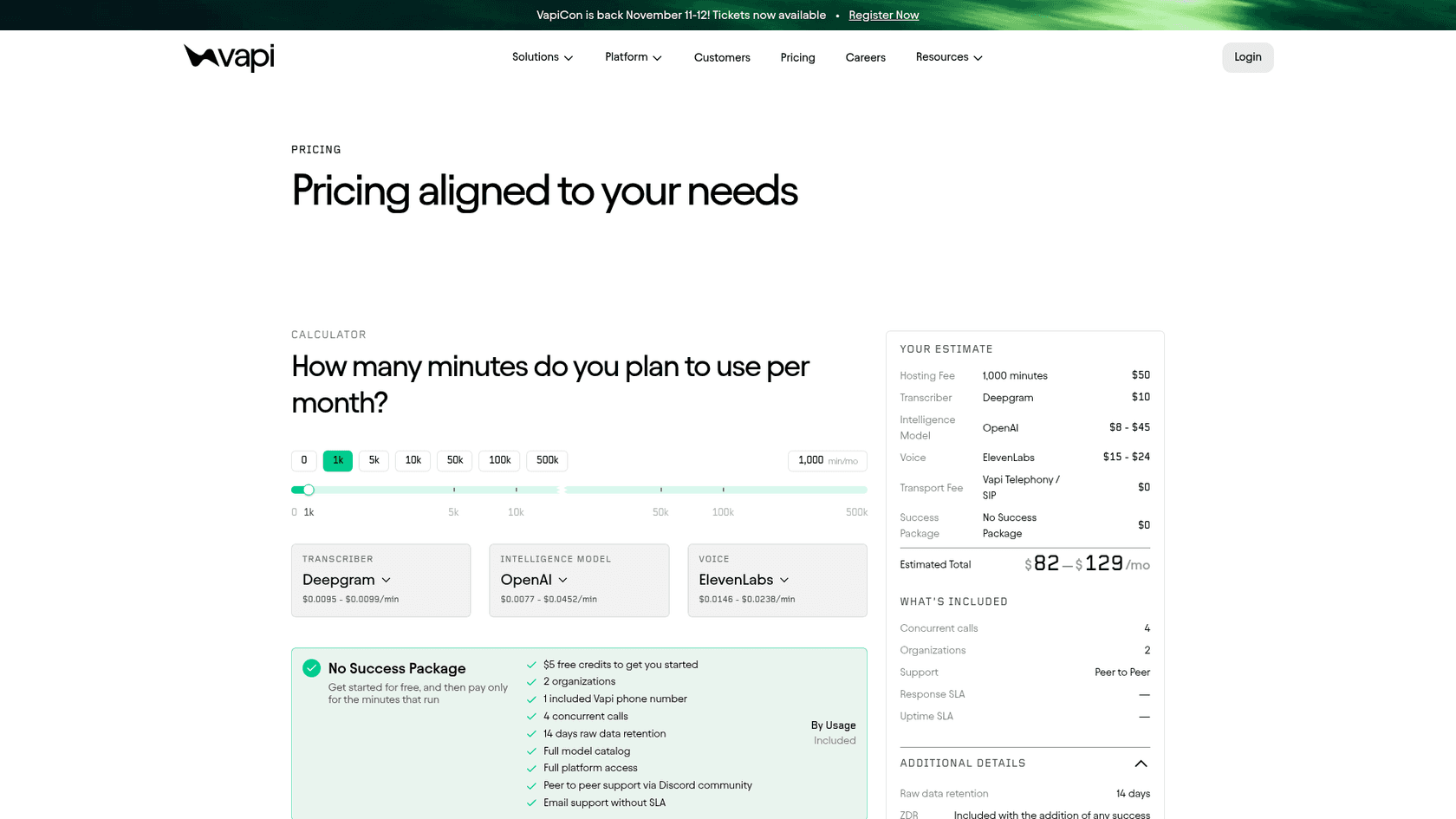
On top of usage, Vapi now sells paid success packages: Core is $29 a month and Pro is $999 a month (or 10% of the hosting fee, with $999 as the minimum). Pay-as-you-go includes 4 concurrent calls, extra lines cost $10 each per month, and the HIPAA add-on is $2,000 a month. Support also scales with the package: pay-as-you-go gets Discord and email support without an SLA, Core a 2 business day email response SLA, and Pro a 1 business day SLA plus a 99% uptime SLA.
Why you're going to need a developer for Vapi AI
Let’s be clear: Vapi AI is built for engineers, not for the support managers or IT leads who typically own automation projects. A seemingly simple task, like having the AI check a customer's order status in Shopify, isn’t something the tool does out of the box. Someone has to configure an API Request or Function tool and build the endpoint it calls, then maintain it.
This is a world away from a platform like eesel AI, which offers fixed monthly credit plans (a ticket or chat is 1 credit), not a dozen different meters running at once. eesel gives you a completely no-code way to build AI Actions, allowing non-technical users to connect their tools and automate entire processes without ever touching a line of code.
Beyond the phone call: where Vapi AI falls short for support teams
Even if you have the budget and the engineering team, Vapi AI’s narrow focus on voice creates some major blind spots for any team trying to manage the entire customer experience.
Vapi AI only does phone calls (and that's a problem)
Your customers don’t just call you anymore. They send emails, pop into your website's live chat, and message you on social media. They expect good, consistent help no matter how they reach out. Because Vapi AI is so focused on voice, it only solves one small piece of the support puzzle, even with its chat and SMS options.
This creates an information silo. You end up with one tool for phone calls and a completely separate system, like your Zendesk or Freshdesk help desk, for everything else. Your agents have to constantly switch between tools, your customer data is scattered, and you lose any chance of seeing a complete picture of the customer's journey.
Why Vapi AI doesn't know what your team knows
An AI is only as smart as the information you give it. You can feed a Vapi agent a prompt or upload files (.pdf, .docx, .csv and more) to a knowledge base, or point it at your own retrieval server. The docs describe no ready-made connectors that keep it synced with the places where your company knowledge actually lives. Your most valuable information is spread across years of past support tickets, internal wikis in Confluence, and shared project plans in Google Docs.
This is where the difference in approach really shows. eesel AI was built from the ground up to connect directly to all your sources of truth. It securely trains on your past tickets, help center articles, and internal documents. This ensures the AI gives consistent, accurate, and on-brand answers everywhere it works, whether that’s in an email, a Slack thread, or a website chat.
The lack of a Vapi AI safety net for business users
Letting an AI talk directly to your customers is a big step. If it starts making mistakes, it can damage trust and leave customers frustrated. Deploying an AI without testing it first is a huge gamble.
Vapi does include testing: Evals and Simulations are part of every plan, and a Simulation has an AI tester play a caller with a stated goal, in chat or voice. You write those scenarios yourself, though. eesel AI's simulation skill instead runs your agent against hundreds of your own past tickets or generated test cases, scores each answer, and suggests instruction changes before a customer ever sees it. That gives support leads a starting test set without writing scenarios by hand.
Is Vapi AI the right tool for you?
So, where does this leave us? For the right kind of team, Vapi AI is a best-in-class tool. If you're a developer-led company building a custom, voice-first product and you have the engineering muscle to handle its complexity and unpredictable costs, it’s one of the most powerful platforms out there.
However, for most customer support, IT, and operations teams, it's a tough sell. The high technical bar, confusing pricing, and voice-first focus often create more problems than they solve. These teams need a solution that’s easy to manage, works everywhere their customers are, and plugs into their existing tools without needing a developer on call.
The comprehensive alternative for your entire support operation
For teams looking for a true, end-to-end automation platform, eesel AI is the ideal solution. It’s designed to automate support across email, chat, and internal channels, all without needing a dedicated engineering team to run it.
eesel AI offers one-click integrations with your help desk and knowledge bases, trains on your unique support history, and has fixed monthly credit plans with unlimited seats. It works as an AI helpdesk teammate that answers tickets and chats, so your support operation runs from one place. eesel has no voice channel, so if inbound phone calls are your main need, Vapi is still worth evaluating.
Try eesel free (100 credits, no card) and see how it handles your own tickets.
Frequently Asked Questions
Does our support team need to hire a developer just to get started with vapi ai?
Usually, yes, for anything beyond a simple conversational flow. Vapi says you can build a first phone agent in its dashboard with no coding, but connecting it to other systems or writing complex logic means configuring API Request or Function tools, and Function tools run on your own server.
We handle a lot of emails and live chats. Can Vapi AI manage those conversations, or is it strictly for phone calls?
Vapi AI is voice-first. It also offers a Chat API for text conversations and inbound SMS (Twilio US numbers only), but its docs describe no native inbox for email, social media, or a helpdesk queue, so you still need a separate system for those.
How difficult is it to make Vapi AI perform a specific action, like looking up a customer's order history in our database?
Performing custom actions like that means pointing an API Request tool (or a Function tool) at an endpoint that can reach your database, and someone has to build and maintain that endpoint. The tool is set up in the dashboard, but the integration itself usually needs technical resources.
What kind of flexibility do we have with the voice and intelligence of a Vapi AI agent? Are we locked into one specific provider?
This is one of Vapi AI's main strengths for developers. You can 'bring your own stack,' meaning you have the freedom to choose different providers for transcription (like Deepgram), language models (like Anthropic), and voice synthesis (like ElevenLabs).