

How I reviewed Bland, and what I'm leaning on
I spend most of my week looking at what people actually search before they buy, and "Bland AI review" is almost never a curiosity query. It's a buyer who has seen the demo voice, liked it, and now wants to know three things: what it really costs, what breaks in production, and whether their team can run it. So that's what this review is built around.
I read Bland's pricing page, the full billing docs, the developer docs index, the changelog, and every Bland review on G2. I didn't run Bland on a live queue for months, so where I talk about production behaviour I'm quoting people who have.
My bias, stated plainly: I write for eesel, and the team here has spent years putting AI agents on live support queues. The scar from that work is the reason I care so much about testing. We've watched a confident-sounding bot give wrong answers to real customers, which is why every eesel rollout now gets simulated against past tickets before it goes live. One CX lead running about 7,000 tickets a month put the buyer's fear better than I can:
"I need an AI who is only handling the tickets that it's confident to handle and all the other ones, leave them alone."
CX lead at a 7K-ticket-a-month DTC brand, from an eesel sales call
On a phone call, "leave it alone" isn't an option. The caller is on the line. That makes Bland's testing and handoff features the most important part of this review.
What is Bland AI?
Bland is an enterprise voice AI platform for building, running and monitoring AI phone agents, inbound and outbound. It was founded in 2023 by Isaiah Granet and Sobhan Nejad, and in June 2026 it raised another $50 million, taking it past $100 million in total. The same post says Bland handles more than 3.5 million calls a week for companies like Samsara and Kin Insurance.
The positioning is narrow on purpose. The homepage pitches "Voice AI for high-stakes calls" in healthcare, insurance and financial services, the kind of regulated work where one bad call can mean a complaint or a lawsuit. Bland's main technical bet is that it runs its own models end to end, while, in its words, other platforms "stitch vendors together."
A few numbers from Bland's own docs index: sub-400ms response latency, up to 1 million concurrent calls, and 40+ languages. Those are vendor claims, and I couldn't test the concurrency one, but the latency claim lines up with what G2 reviewers keep saying (more on that below).
Bland's flagship customer story is a good example of the sweet spot. The Idaho Housing and Finance Association reports $750K in annual savings from retiring its IVR, and its CIO says Bland "transfers callers after verification of their loan." That is a structured, high-volume, regulated phone workflow, exactly what the product is built for.
The scorecard
Here's the short version before the detail.
| Area | My score | Why |
|---|---|---|
| Voice quality and latency | 4.5/5 | Own speech stack, sub-400ms claimed, reviewers praise the speed |
| Builder and testing | 4/5 | New Agents builder adds environments and evaluations, but has a learning curve |
| Pricing clarity | 3.5/5 | Simple headline rate, then transfer fees, minimums and a telephony contradiction |
| Support-team fit on self-serve | 3/5 | Warm transfers, citations and KB gaps are Enterprise-only |
| Compliance | 4.5/5 | SOC 2 Type I and II, HIPAA with BAA, GDPR, PCI DSS (BAA on Enterprise) |
| Helpdesk integrations | 2.5/5 | Salesforce and HubSpot, no native Zendesk, Freshdesk or Gorgias |
| Overall | 4/5 | Excellent phone infrastructure; you supply the build team and the support stack |
What Bland AI costs in 2026
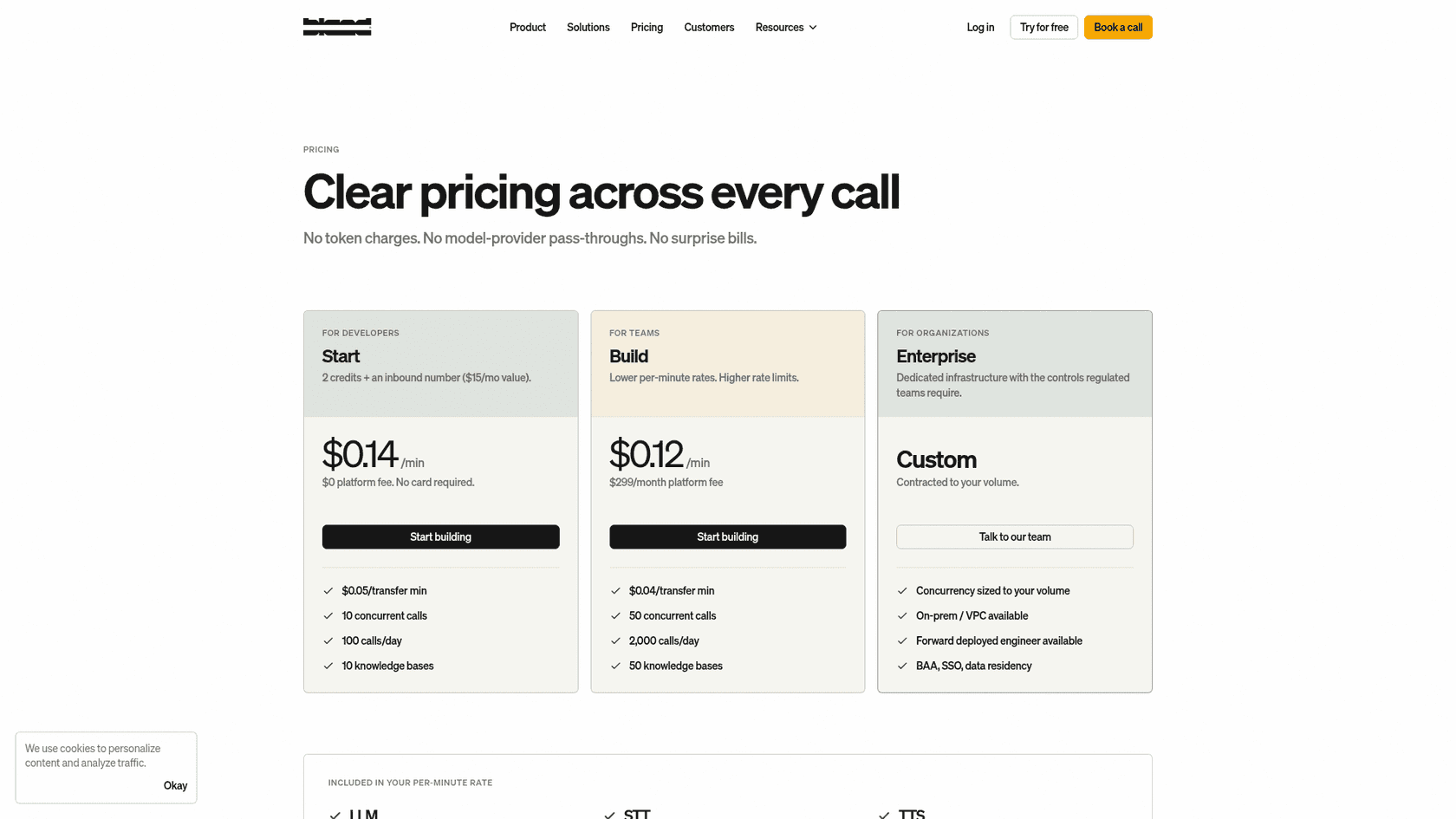
Bland's pricing page now shows three cards: Start, Build and Enterprise. That's a change worth knowing about. In August the page also listed a Scale plan at $0.11 a minute and $499 a month. It's gone from the live pricing page, though the billing docs still list it, so if you need Scale's limits, ask sales whether it's still on offer.
| Start | Build | Enterprise | |
|---|---|---|---|
| Talk time | $0.14/min | $0.12/min | Custom |
| Platform fee | $0 (no card) | $299/month | Contracted |
| Transfer time | $0.05/min | $0.04/min | Custom |
| Concurrent calls | 10 | 50 | Sized to volume |
| Daily cap | 100 calls | 2,000 calls | Unlimited |
| Hourly cap | 100 calls | 1,000 calls | Unlimited |
| Voices | 1 | 5 | Unlimited |
| Knowledge bases | 10 | 50 | Unlimited |
| Uptime SLA | 99.9% | 99.9% | 99.9% |
All figures from Bland's compare-plans table. Start also comes with two credits and an inbound number Bland values at $15 a month.
These rates are newer than many of the reviews you'll find. Bland's billing docs explain that on December 5, 2025 it moved from a flat $0.09 a minute to plan-based rates, so Start users saw their rate rise to $0.14. Older comparison posts quoting $0.09 are out of date.
What sits outside the per-minute rate
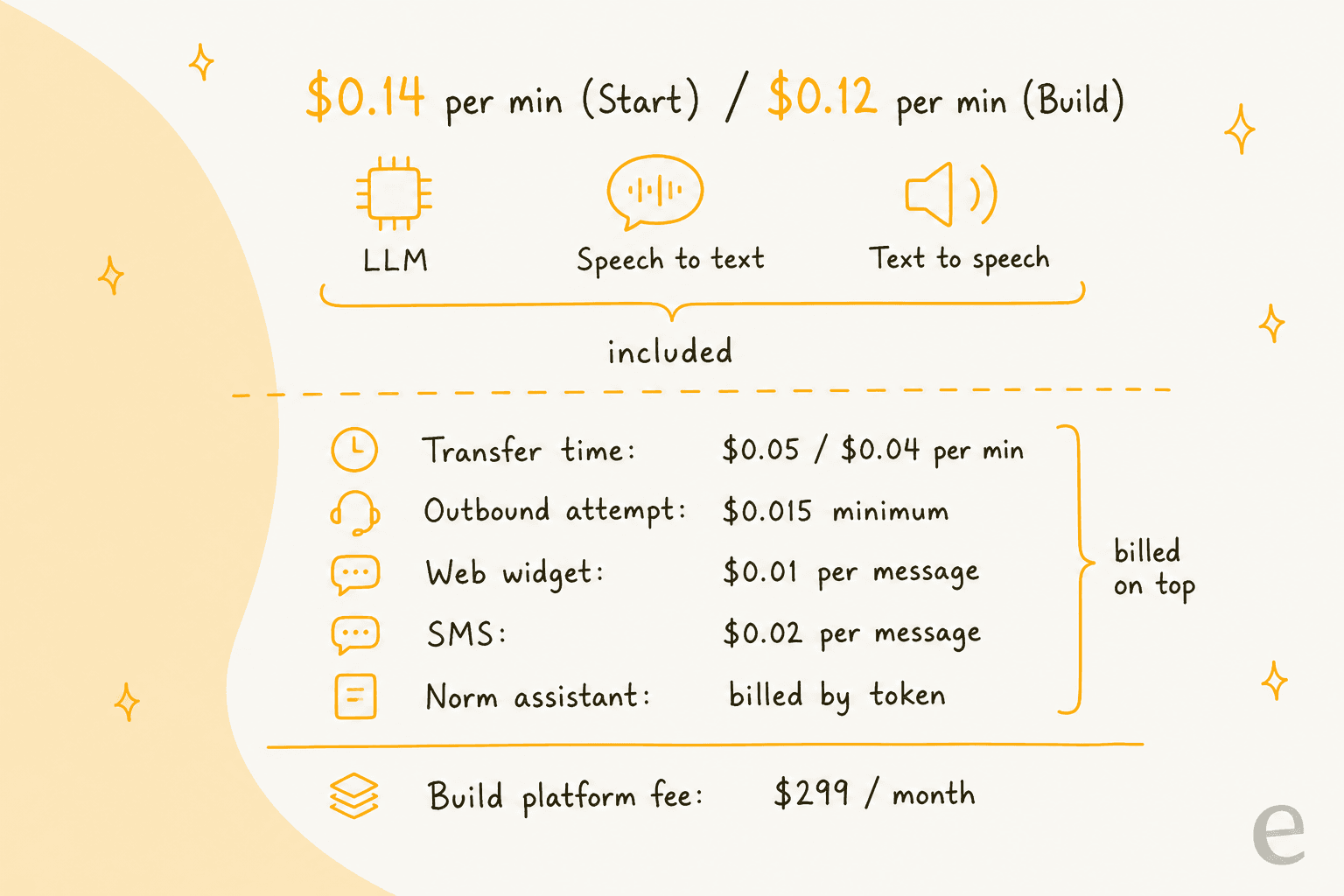
The headline promise on the pricing page is "No token charges. No model-provider pass-throughs. No surprise bills." The model, speech-to-text and text-to-speech really are inside the rate. But a few line items sit beside it, all from the billing docs:
- Transfer time at $0.05 or $0.04 a minute when a call is handed to a person on a Bland number. It's free if you bring your own Twilio.
- Outbound minimum of $0.015 per call attempt on Bland's telephony, which also applies to failed calls.
- Web widget messages at $0.01 each, and SMS at $0.02 per message in or out (SMS itself is an Enterprise feature).
- Norm, Bland's AI build assistant, billed separately by token.
Then there's telephony, where Bland's own pages disagree. The pricing page FAQ says "Telephony is billed separately, on your own carrier or Bland's at pass-through cost." The homepage FAQ says one per-minute rate covers "the language model, speech-to-text, text-to-speech, and telephony." I'd budget for carrier costs and get the answer in writing during the sales call. If you bring your own carrier, the pricing FAQ is clear that you pay your carrier directly and Bland charges only the AI rate.
Run your own numbers
The interesting maths is the break-even. Build's $299 fee buys a 2-cent discount per talk minute, so you need about 15,000 talk minutes a month before Build is cheaper than Start on price alone. Below that, the real reason to upgrade is Start's 100-calls-a-day cap. Plug in your own call volume:
Plug in your call volume, handle time and transfer rate to see Bland's monthly bill on Start and Build, and which plan your daily volume actually fits.
At the default numbers, 3,000 calls a month at 4 minutes each with a fifth of them transferred, Start comes to about $1,770 and Build about $1,811. Start wins on price, but it sits right at its 100-calls-a-day ceiling with only 10 concurrent calls, and inbound support traffic is peaky. For a real support phone line that size, I'd budget for Build.
For context on the rest of the market, Bland's pricing page argues that Vapi's $0.05 and Retell's roughly $0.07 a minute are platform fees only, and that a full stack on those tools lands around $0.11 to $0.30 a minute. That's Bland's estimate of its competitors, so check it against Retell AI pricing and Vapi directly. My read is that Bland's bundled rate is competitive, not dramatically cheaper.
Where Bland is strong
Four things stood out in the docs and in what reviewers keep repeating: the voice itself, the new testing tools, how open the platform is to developers, and the compliance list.
Voice quality and latency
This is the part every happy reviewer leads with. On G2, Bland holds a 5.0 out of 5 from 11 reviews, and speed comes up again and again. The most useful review is from a team in death care, where calls come from families and hospice staff at the worst moment of their week:
"Latency was the first thing that got me. It's fast enough to feel natural, which is non-negotiable for real phone calls, but also slow enough for difficult conversations allowing the caller to take a beat, if needed. On top of that, it actually stays on script."

"Stays on script" is the important half of that quote. For regulated calls, predictability beats charm. Bland also gives you fine control over timing: a July 2026 changelog entry added five interruptibility levels and a resumption speed setting, set per node, so you can make an agent harder to talk over during a disclosure and easier to interrupt everywhere else.
On voice realism, Bland's homepage shows its own Audio Realism Bench with Bland at 0.91 against human speech at 0.99. It's a vendor chart, so treat it as a claim, but G2 reviewers back up the general point. One team that replaced its IVR wrote that customers "rank their experience as better" with the AI than with their human team.
The new Agents builder and real testing
In September 2026 Bland rebuilt its application. Conversational pathways and personas are being replaced by Bland Agents, and every production agent has to be migrated by November 15, 2026. Accounts created after September 18 are on Agents only. The migration is additive, so nothing breaks on day one, but if you're on the old builder, put this on your calendar now.
Two things in the new architecture are new rather than renamed. Environments pin a version to staging and production, so shipping is a deliberate step rather than a save. Evaluations let you write a judge, build simulated callers as test cases, and make a passing run a condition of promotion. That is exactly the gate I'd want on a phone agent.
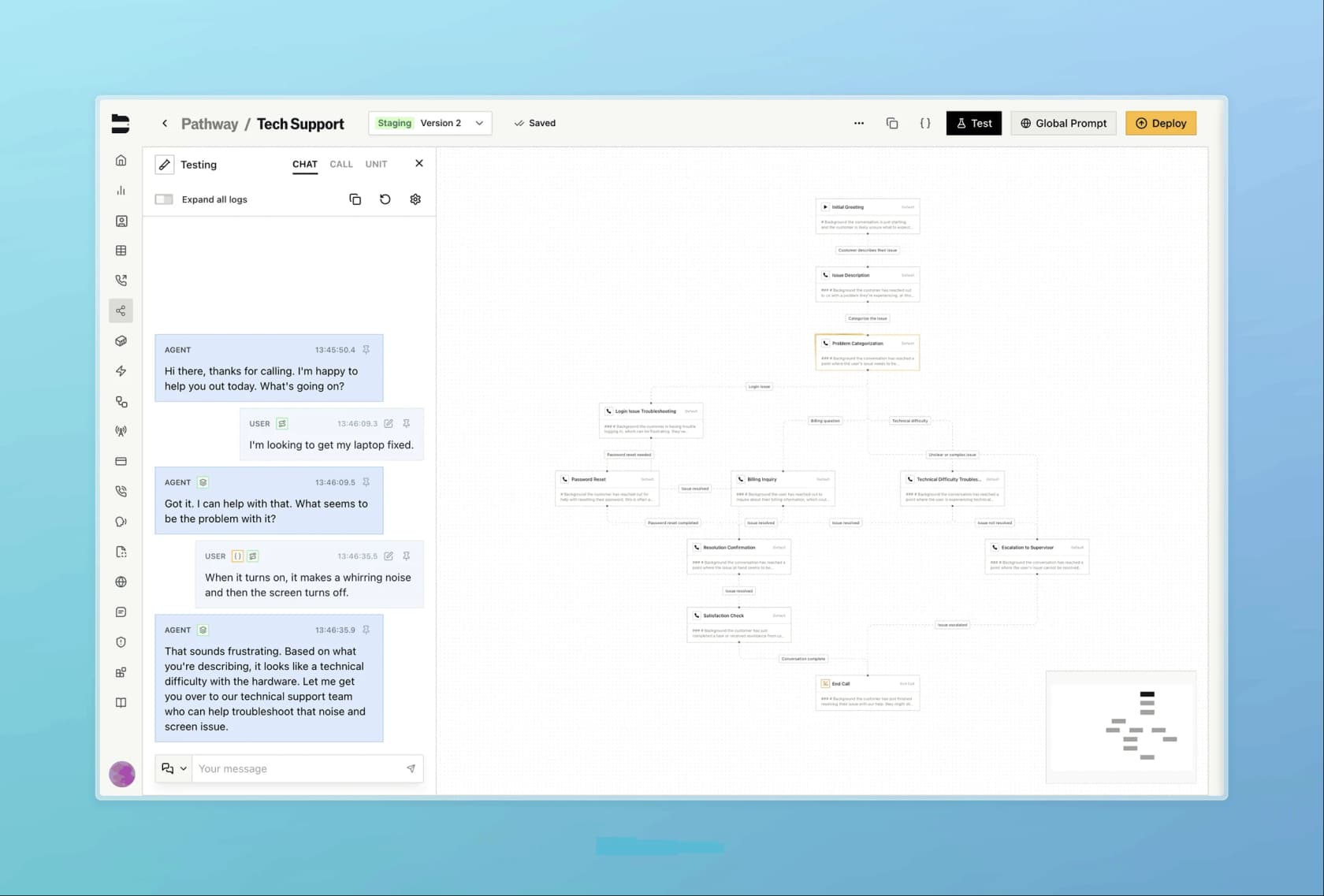
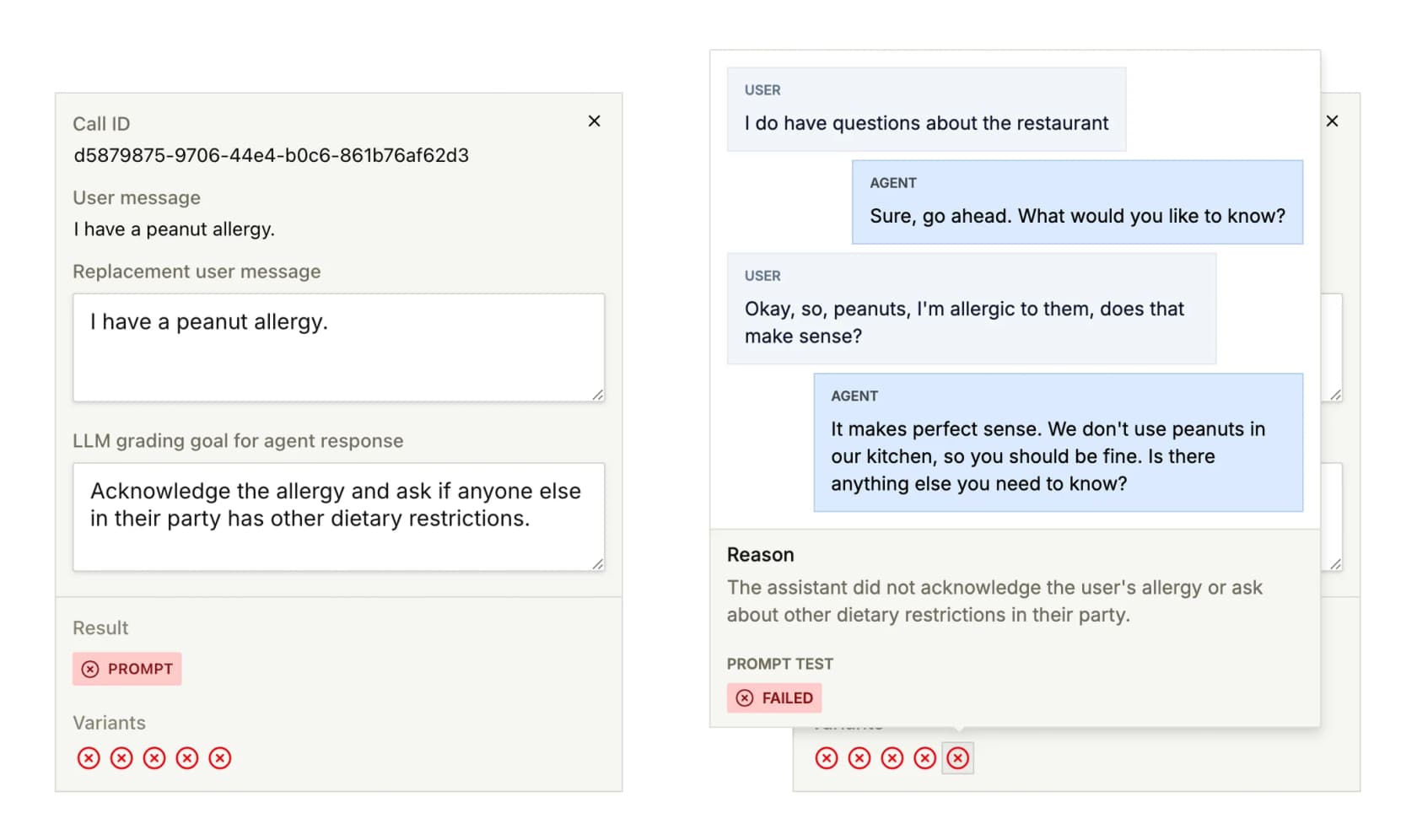
The testing tools existed before the relaunch too. Bland's unit tests take one turn from a real conversation, set a grading goal, and tell you whether the agent passed. The screenshot below is a good example of why this matters: a caller mentions a peanut allergy, and the agent fails because it never acknowledges it.
The knowledge side improved as well. Knowledge now has a Questions tab for things callers asked that the agent couldn't answer, query logs for every retrieval, and a coverage score per source. That's the right instinct: on a phone line, a missing answer becomes a transfer or a bad call, so you need to see the gaps. If you're new to this kind of testing, my guide to AI support agent testing walks through how to build a useful test set.
Built for developers and coding agents
Bland is very open to builders. It has a REST API, a command line interface, an MCP server, and a Norm plugin that lets Claude Code, Cursor or Codex build and test Bland Agents. Pathway versions can sync to GitHub. One G2 reviewer, a product manager on an Enterprise contract, explained why that matters in practice:
"Getting started is hard, but Bland has built Norm, an AI Agent, which allows you to "vibe code" your first pathway. This is super helpful for new builders. But you'll quickly outgrow Norm in its current version."
Her same review has a practical money tip: bring your own Twilio numbers if you dial a lot, because you'll save on telephony, though Bland's own numbers support more features.
Compliance that's built in
Bland's pricing FAQ lists SOC 2 Type I and Type II, HIPAA eligibility with a signed BAA, GDPR and PCI DSS, and the homepage adds FedRAMP and ISO 27001 badges. On-prem and VPC deployment are available on Enterprise. For healthcare and finance buyers, that list is often the first filter, and Bland clears it.
Where Bland asks more of you
The trade-offs are just as consistent. None of them is a dealbreaker on its own, but together they decide whether Bland fits a support team or a contact center with a build team.
The Enterprise line runs through support features
This is the finding that should shape your decision. Bland's compare-plans table marks a long list of features as Enterprise-only, and several of them are the ones a support team reaches for first.
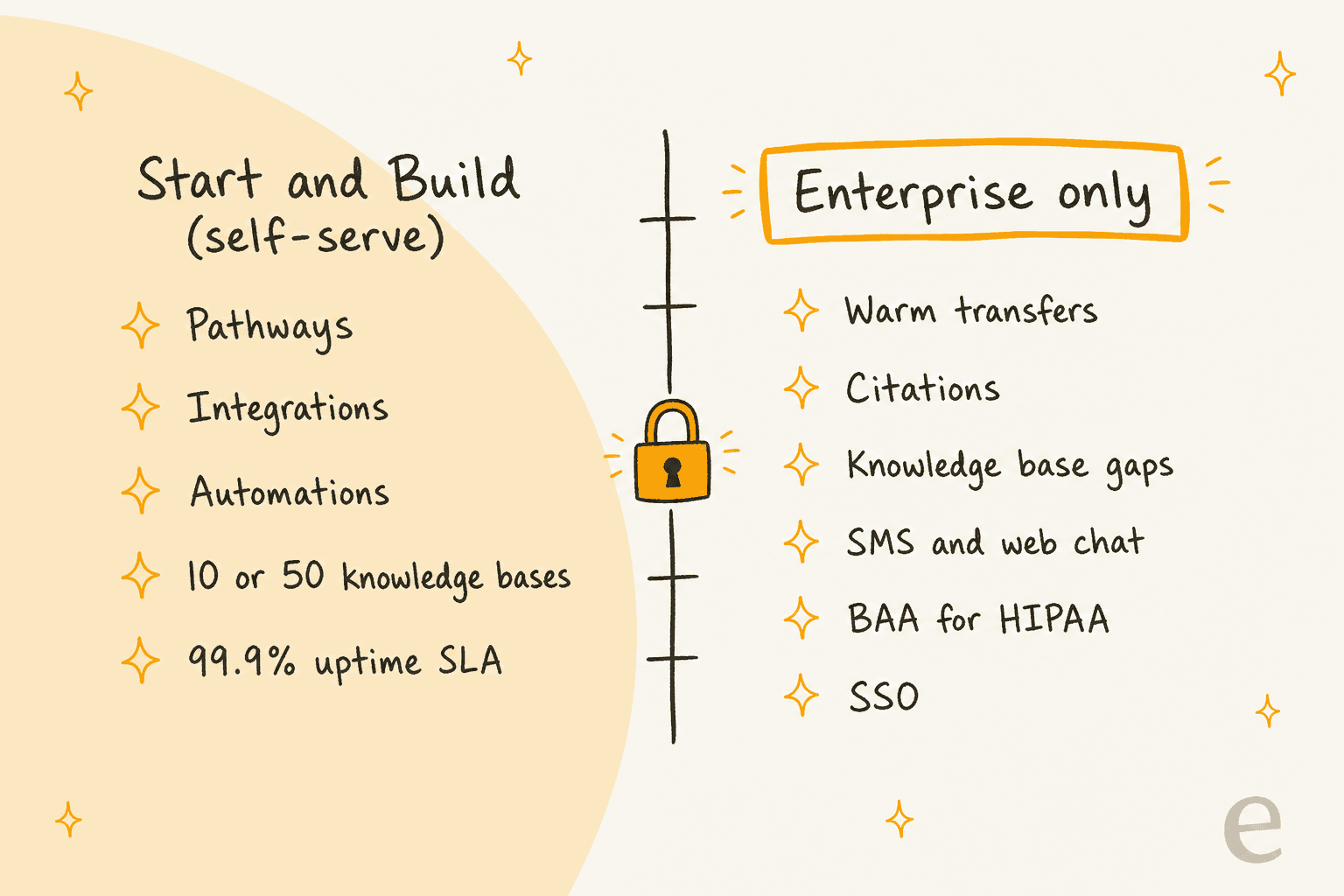
- Warm and live transfers. On a warm transfer the AI briefs your human agent before the caller is merged, so nobody has to repeat their story. Bland's warm transfer docs say plainly: "Enterprise Feature Required." Self-serve plans get a cold transfer.
- Citations and knowledge base gaps. Knowing which source an answer came from, and what callers asked that you couldn't answer, are both Enterprise lines on the pricing table.
- SMS and web chat. Self-serve Bland is a phone product. Messaging, including the iMessage support added in May 2026, is Enterprise.
- The BAA and SSO. If you handle patient data, you're on Enterprise.
None of this is unusual for an enterprise-first company, and Bland is upfront about it. But it means the self-serve plans are best read as a place to prototype, and the version a support team would run in production is the custom-priced one. If human handoff is central to your workflow, price Enterprise from day one.
There's a real learning curve
Even the happiest reviewers mention it. The death care reviewer said Bland "gives you a lot of control, which is a strength, but it means you need to think through your conversational design and logic instead of expecting it to just magically work out of the box." Another G2 reviewer whose team automated its IVR put it more bluntly:
"The platform isn't the most user friendly, but they're continuing to build out tools and provide support so we've seen a big improvement over the last several months already."
Bland's own timelines reflect this. Self-serve teams can deploy a first agent "within a day," but the homepage says most production agents go live in two to six weeks, and Enterprise follows a 28-day deployment framework with Bland's forward deployed engineers. If you have no one who can own call flows and test sets, factor that in.
Results depend heavily on the build
Community feedback is less glowing than G2's on the self-serve, outbound side. In a widely shared r/AI_Agents post, one builder ran a 200-call outbound campaign across three platforms:
"I started with Bland ai because of the hype. Looked slick, setup was fast, but once I actually put it in front of customers, the cracks showed immediately. The voice sounded too 'bot-like,' long pauses made people drop off, and most calls ended in 20–30 seconds."

That test is from October 2025, before the December pricing change, the new interruptibility controls and the Agents relaunch, so I wouldn't treat it as current. What it does show is the gap between a quick self-serve build and the tuned Enterprise deployments behind Bland's customer stories. The same platform can produce both results.
Helpdesk integrations are thin
Bland's built-in integrations include Cal.com, Salesforce and Slack, a HubSpot app, and since July 2026 contact memory sync to HubSpot and Salesforce. I couldn't find a native Zendesk, Freshdesk or Gorgias integration anywhere in the docs index. You can reach any helpdesk through custom tools and webhooks, but someone has to build and maintain that.
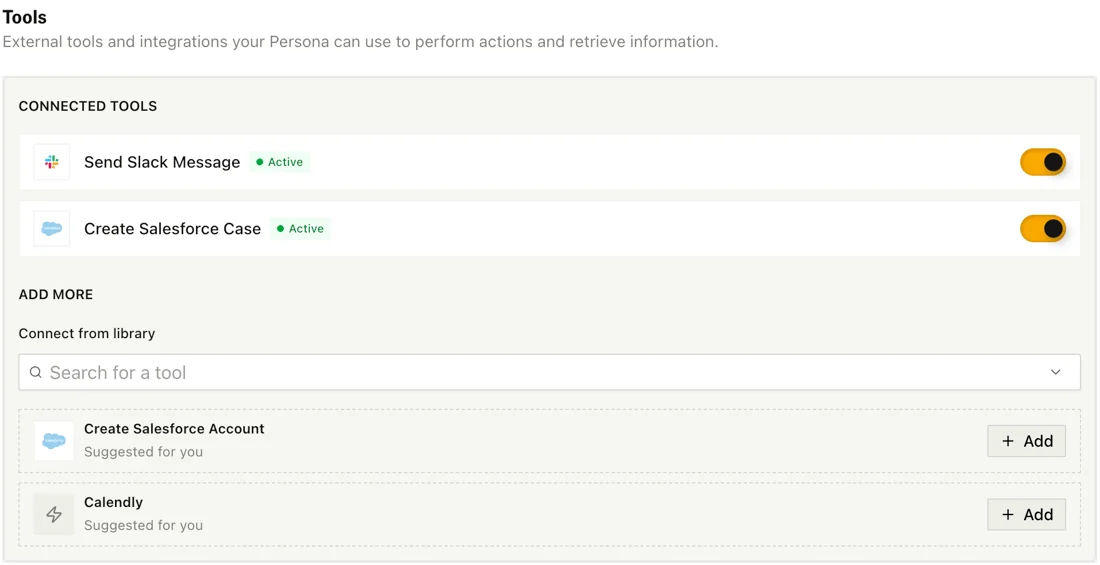
For support teams this matters more than it sounds. A phone call rarely ends the conversation. The caller gets a confirmation email, replies to it, opens a chat two days later. That follow-up lands in your helpdesk, and Bland isn't there.
Bland is the phone line. Who works the queue?
This is the reframe I'd offer anyone shortlisting Bland for customer support. Bland is excellent voice infrastructure: a builder plus a runtime for phone agents. You design the agent, connect it to your systems, test it and staff the edge cases. That's a great fit for a contact center with a high call volume and an engineering team.
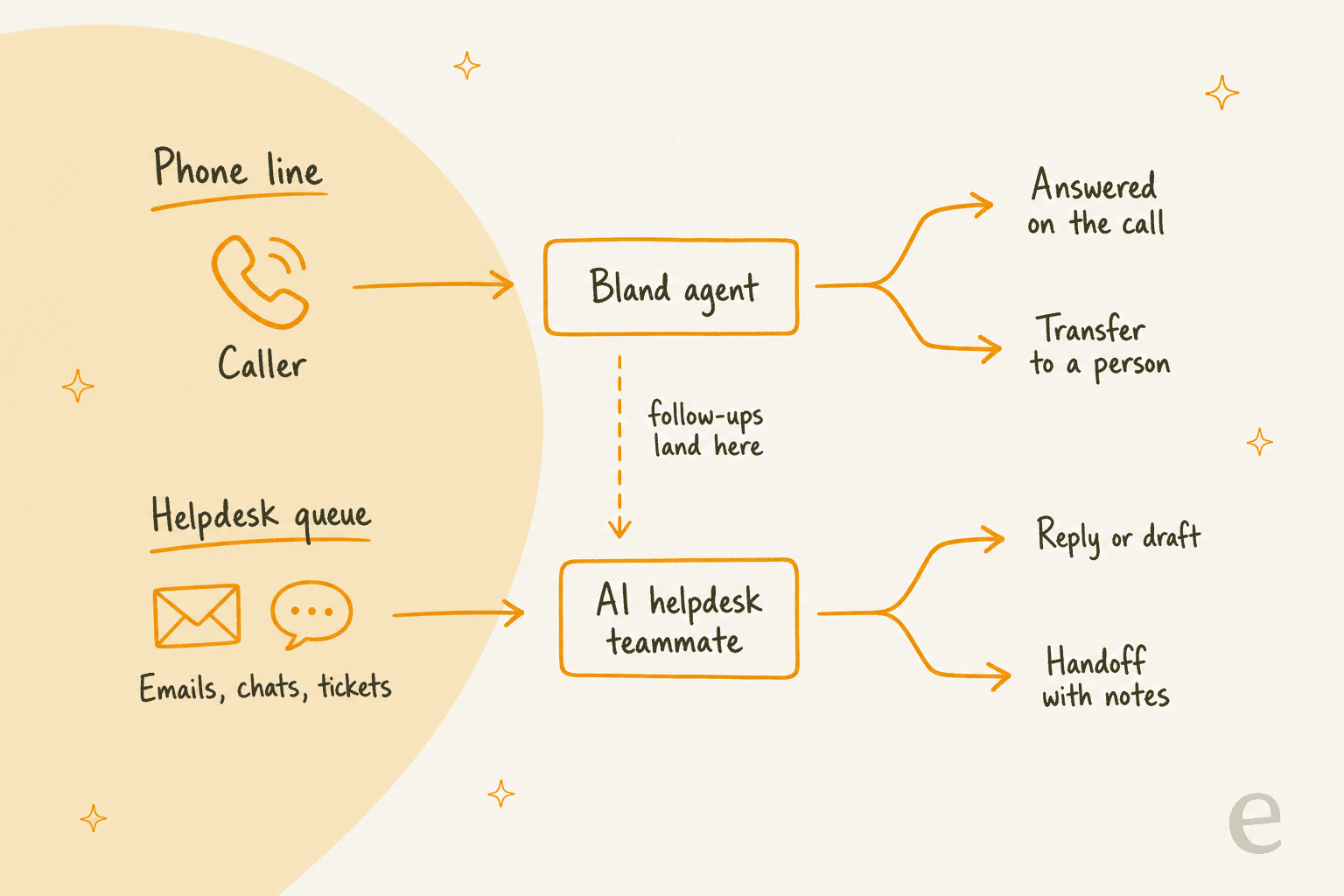
Most support teams, though, don't have a phone problem first. They have a queue problem: email, chat and ticket volume growing faster than headcount. For that job, infrastructure is the wrong starting point. You want a teammate that already knows how to work a helpdesk. That's the distinction I'd draw: Bland is infrastructure you build a phone agent on; eesel is the employee you hire for the ticket queue.
eesel's AI helpdesk teammate joins your existing helpdesk, learns from your past tickets, macros and help center, and works the email and chat queue. At smava, a German loan comparison company in the same regulated-finance world Bland targets, it handled 27,000 Zendesk tickets in a month, categorised 14,600 and drafted 15,300 replies from 820 macros and help center articles, kept apart by brand. At Cactus Club Cafe, the agent drafts tier 1 IT fixes from the team's own runbooks, step for step, which is the same "stays on script" quality Bland's reviewers praise on calls.
To be fair about the limit: eesel's self-serve teammate doesn't answer phone calls. Its channels are your helpdesk, Slack, a chat bubble and email. If voice is your main channel, Bland or a similar platform is the right tool, and the two can live side by side, with call follow-ups landing in a helpdesk where eesel picks them up. If you'd rather hand off phone and everything else, eesel's Managed Support runs the whole support operation, phone included, for a flat monthly fee.
For builders, eesel is as scriptable as Bland. The eesel CLI lets you inspect and drive the same teammate from a terminal or a script, and every eesel workspace is also an MCP server, so a coding agent like Claude Code or Cursor can work with your support agent the way the Norm plugin works with Bland Agents.
Who should pick Bland, and who should look elsewhere
Pick Bland if:
- You run a regulated, high-volume phone line in healthcare, insurance, financial services or logistics.
- You have engineers or a partner who can own call flows, tools and tests.
- You need a BAA, on-prem deployment or dedicated infrastructure, and you're ready for an Enterprise contract.
- You want one bundled per-minute rate instead of stitching together model, speech and voice vendors.
Look elsewhere if:
- You want warm transfers or citations without an Enterprise contract.
- Your team is small and nobody owns conversation design.
- Most of your support volume is email, chat and tickets, not calls. Start with an AI helpdesk teammate inside Zendesk or your current helpdesk instead.
- You're comparing voice developer platforms on cost alone. Check Retell AI, Vapi and ElevenLabs side by side in my best AI voice agents roundup.
If you're still deciding whether AI should take calls at all, my piece on whether AI can answer support calls is a better first read than any vendor review, including this one.
Try eesel for the queue behind the phone line
Bland can give your phone line a fast, compliant voice. The tickets, emails and chats that pile up around those calls need a teammate that already knows your helpdesk. eesel joins Zendesk, Freshdesk or Gorgias, learns from your past tickets, and lets you run it against your own history before it answers a single customer.
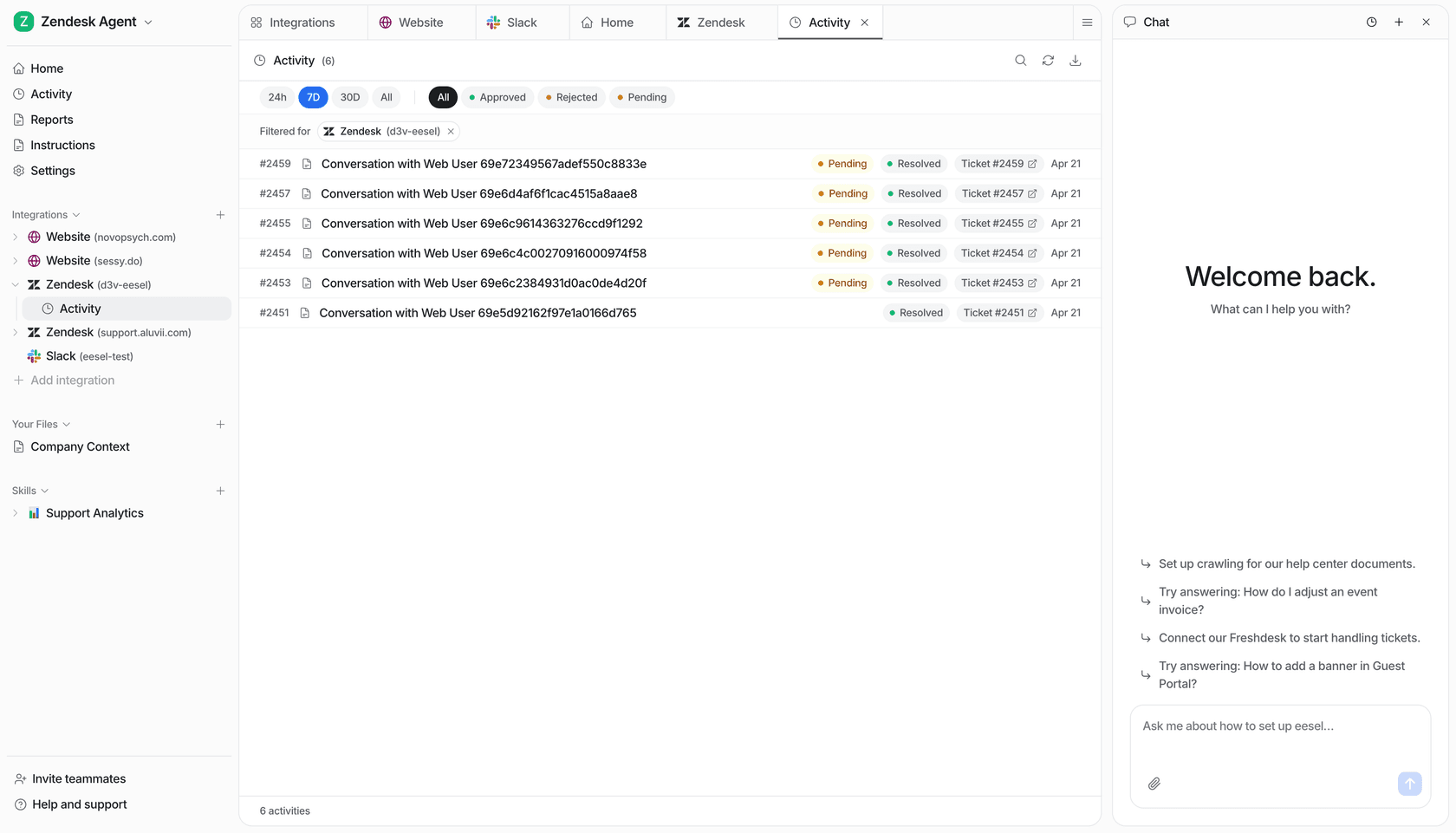
Pricing is a fixed monthly plan: $299 for 500 credits, where a ticket or chat is one credit however long it runs, and there are 100 free credits to start with no card. Try eesel on a slice of your queue while your Bland pilot is still in staging.