


What CellCog actually charges for
I spend a lot of my week pulling apart AI pricing pages, and I've watched what happens when the meter and the work don't line up. At eesel, we've spent the last three-plus years putting AI agents on live support queues, and the hardest lesson wasn't about model quality, it was that a buyer needs to know the cost of one finished piece of work before they turn the thing on. That's the lens I brought to CellCog, and it's the lens this whole post runs on.
CellCog is a general-purpose AI employee platform: you describe a role in plain language and get a persistent worker with its own inbox, memory, shifts, and task board. It's the work of a single founder, Nitish Garg, running on "zero funding, and no team," out of stealth since July 2026, by his own account. That's a real achievement, and it's worth keeping in mind: this is a young, one-person company, so the pricing reads like an early-stage bet rather than a mature enterprise rate card.
The model itself is simple to state. You don't buy seats and you don't buy resolutions. You buy credits, on a monthly or yearly subscription, and every AI action you take draws them down. The pricing page leads with "Simple, transparent pricing" and "No hidden fees," which is a fair description of the rate and, as we'll see, an optimistic one about the bill.
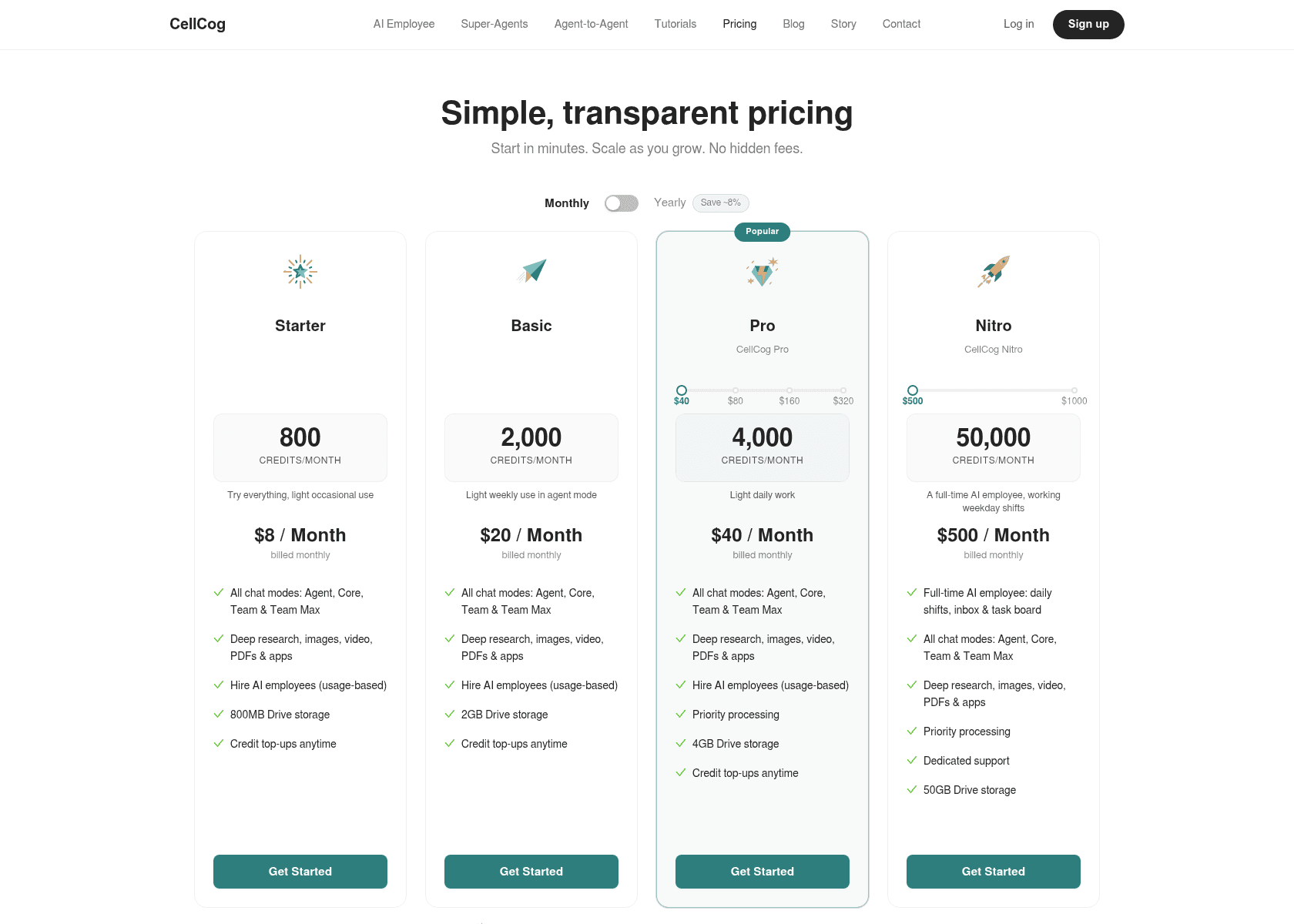
Here's the full rate card, pulled straight from CellCog's live billing plans data:
| Plan card | Price / month | Credits / month | Drive storage | First thing it adds |
|---|---|---|---|---|
| Starter | $8 | 800 | 800MB | The cheapest visible tier |
| Basic | $20 | 2,000 | 2GB | Same features, more credits |
| Pro (slider) | $40 / $80 / $160 / $320 | 4,000 / 8,000 / 16,000 / 32,000 | 4 / 8 / 16 / 32GB | Priority processing from $40; dedicated support from $320 |
| Nitro (slider) | $500 / $1,000 | 50,000 / 100,000 | 50 / 100GB | "Full-time AI employee" framing |
| Enterprise | Custom quote | "Unlimited" | Custom | Contact sales, "replies within 1 business day" |
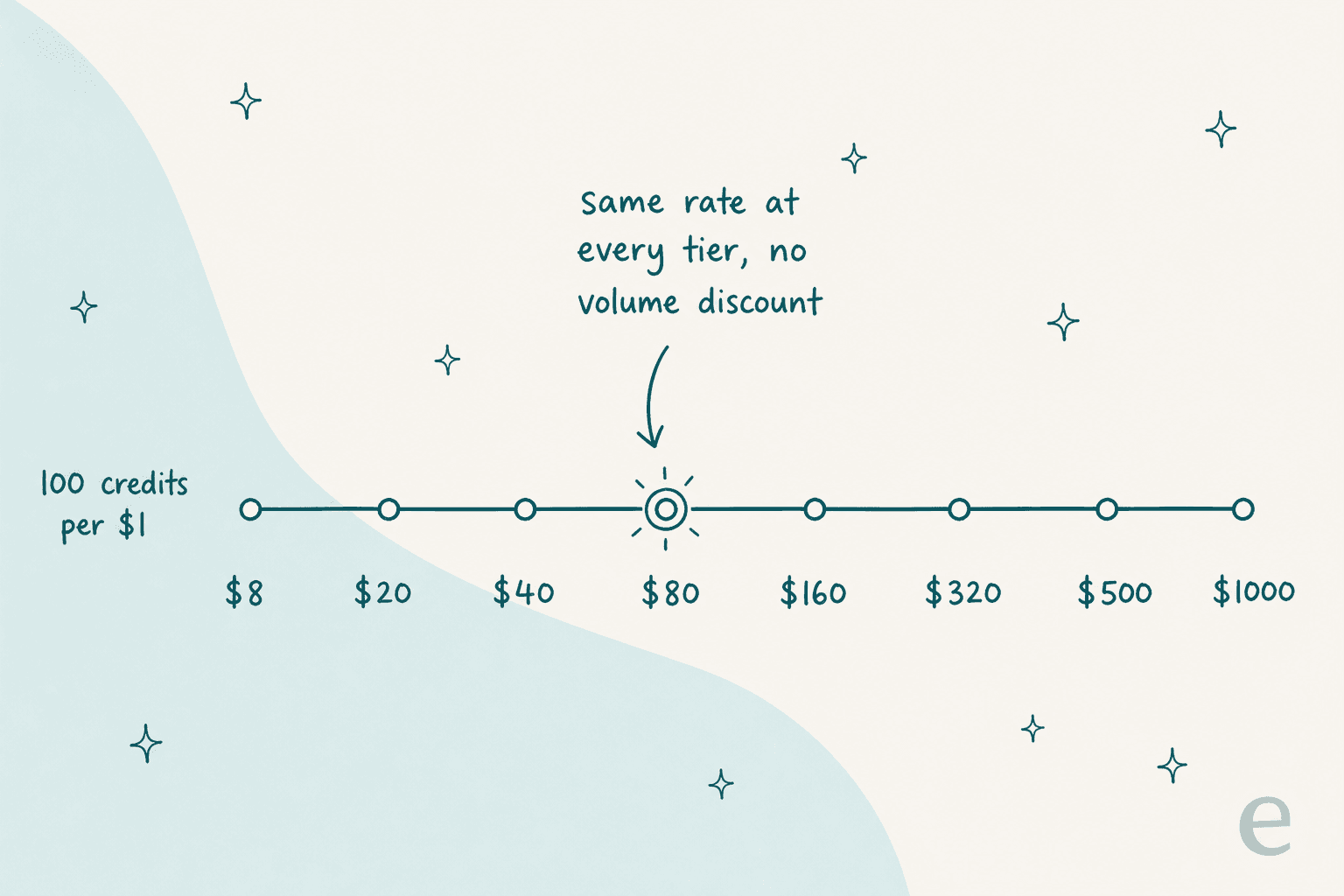
Two patterns jump out immediately. Storage scales at exactly 1GB per $10 across every tier, and credits scale at exactly 100 per $1. There is no bulk break: the person spending $1,000 a month buys credits at the identical rate as the person spending $8. That's unusually flat, and I'll come back to whether it's a feature or a missed opportunity.
The four cards actually hide eight tiers
The thing the screenshot won't tell you at a glance is that CellCog runs eight paid tiers behind four cards. Starter and Basic are normal cards. But the Pro card is a slider that steps through $40, $80, $160, and $320, and the Nitro card steps through $500 and $1,000. In the underlying data these carry internal names like PRO_2X, PRO_4X, PRO_8X, and NITRO_2X, and each step doubles both the price and the credit grant.
It's a tidy piece of UX, and it keeps the page from looking like a wall of eight columns. The one thing to watch is that the feature gates move as you slide. Priority processing first appears at Pro $40, and dedicated support doesn't show up until the $320 step. So "Pro" isn't one thing you're buying, it's a range, and the support you get depends on where you leave the slider. If you're weighing this the way you'd weigh a credit-based pricing model elsewhere, budget for the step you'll actually sit on, not the one the card opens at.
What one credit is really worth
On subscription, the math never changes: $1 buys 100 credits, whether you're on Starter or on the biggest Nitro step. I like that CellCog didn't dress this up with a fake "save more at scale" ladder, because most credit systems bury a worse effective rate in the small tiers. Here the rate is honest and identical everywhere.
The one place the rate does move is top-ups. If you burn through your monthly credits and need more before the next cycle, you can buy them anytime, but at 90 credits per $1, roughly 10% worse than the subscription rate. So the incentive is to size your plan correctly up front rather than lean on top-ups, and the penalty for guessing low is a standing ~10% tax on the overflow.
That's the entire published economics of a CellCog credit: 100 per dollar on plan, 90 per dollar on top-up, flat across every tier. Which sounds complete, until you try to answer the only question a buyer actually has.
The number that isn't on the pricing page
Here's the question I couldn't answer from CellCog's own pages: how much does one piece of finished work cost?
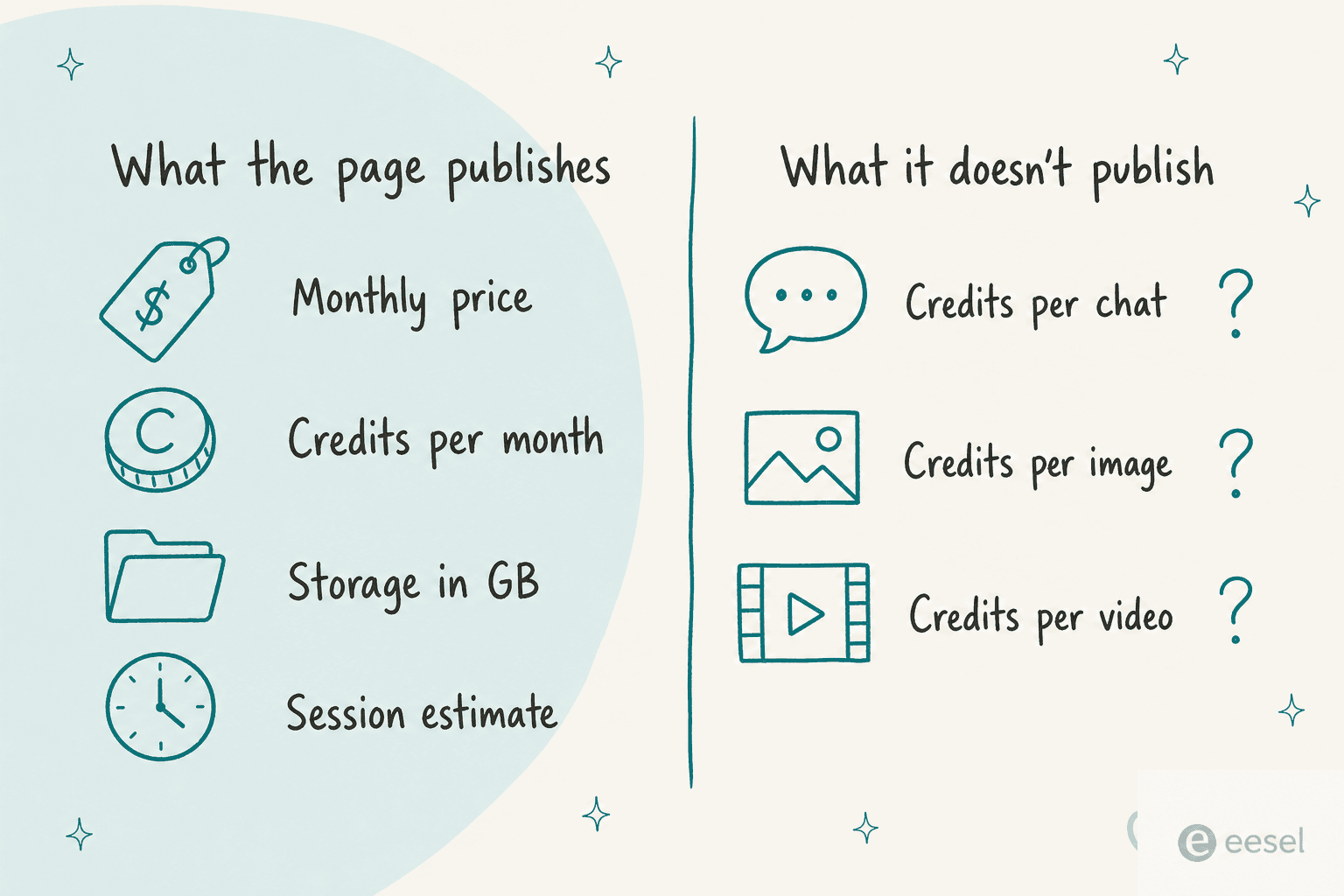
A credit is the unit you pay in. But CellCog never publishes how many credits a single action consumes. The closest the page gets is a qualitative line, "Every AI operation uses credits. More complex tasks use more credits," and three unpriced buckets labelled Chat & Research, Video & Audio, and Documents & Apps. I searched the site's own code for a credits-per-chat or credits-per-image figure, and the only "credits per" number anywhere is the 90-per-dollar top-up rate. There is no rate card for the operations themselves.
The single bridge CellCog offers lives inside a collapsed FAQ accordion. Expand "What does an AI employee cost to run?" and you get a per-session estimate, in CellCog's words:
"You pay for the work, not the hire. Hiring is free."
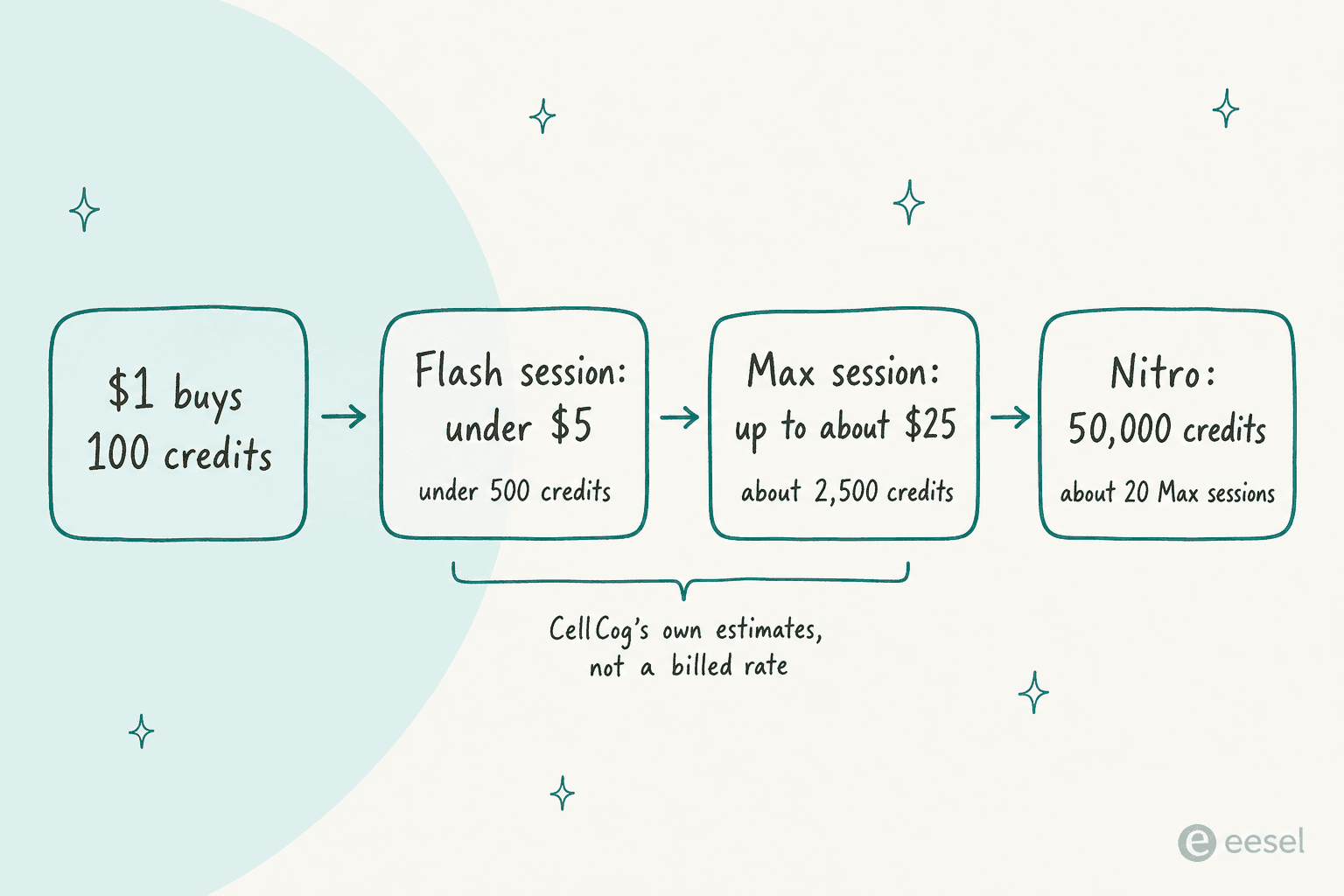
It's a good line, and it's the emotional core of the whole "pay for the work, not the hire" pitch. The FAQ goes on to say a working session typically runs under $5 on Flash, built for speed, and up to about $25 on Max, its deepest reasoning model. The problem is that those dollar figures are estimates, not billed units. Sessions don't have a price tag in the system; they draw down the same credits as everything else. At 100 credits per $1, "under $5" implies under 500 credits and "about $25" implies roughly 2,500 credits per Max session, which reconciles the taglines neatly: Nitro's 50,000 credits works out to about 20 Max-sized sessions, or a month of weekdays.
So the arithmetic hangs together. But notice what you're doing: you're reverse-engineering the cost of your own work from a per-session estimate, because the actual per-operation rate isn't published. A "complex agent prompt" and a light lookup both cost "credits," and you find out how many only after you've spent them. For a solo user experimenting, that's fine. For anyone who needs to forecast a monthly bill against a known workload, it's the piece that's missing.
If you want to feel out how that plays against your own budget, here's a quick translator built entirely from CellCog's published rates:
Top-ups, yearly billing, and the fine print
A few details decide the real cost of ownership, and they're easy to skim past.
Yearly billing. The toggle promises "Save ~8%," and unusually, that badge is honest. Every yearly price is exactly 11 times the monthly one, so you pay for 11 months and get 12, which is an 8.33% saving. Worth noting: the yearly card shows a rounded per-month figure (Starter reads "$7 / Month"), and 12 times $7 is $84, not the $88 you're actually billed. The discount is real; the rounded display just isn't the number that hits your card.
Top-ups expire, and so do plan credits, sort of. This is the one spot where CellCog's own page contradicts itself. A footnote under the grid says credits "stay valid for 60 days after your billing period." The FAQ on the same page says monthly plan credits last about 90 days and yearly credits about 14 months, with top-up credits expiring 12 months from purchase. Both can't be right, and CellCog hasn't reconciled them. If credit expiry matters to how you'd use it, that's a question worth sending to sales before you commit.
Everything is final. CellCog states plainly that all payments, "including subscription fees, automatic renewals, and credit top-up purchases," are final and non-refundable, and that cancelling before renewal is on you. Billing runs through Stripe on all major cards. There's no overage charge (you simply top up), no per-seat fee on the public page, and no free plan card, though a "start free, no credit card needed" allowance does exist in the prose.
Is the price worth it? the evidence question
Price is only half of value. The other half is whether the thing does what it says, and here CellCog is a real mix that I want to represent fairly.
On the strong side, CellCog's headline claim is real and checkable. Its CellCog Max agent ranks #1 on DeepResearch Bench with an overall score of 55.78, under the GPT-5.5 judge, as of the August 7, 2026 board. That's not just a self-report: the benchmark's independent maintainers logged CellCog at #1 back in November 2025 and again in early 2026, so there's an outside paper trail. Two fair caveats go with it. Entries are self-submitted, the margin over second place is a single point, and the founder himself says the rank swings between #1 and #5 as the field moves. It's a strong result, read in proportion.
The weaker side is evidence that the AI employee product delivers what the pricing implies. CellCog's homepage shows a "used by people who work at" logo strip but no named customer case studies, and its workspace visuals are labelled as illustrative examples. On G2 it shows six reviews and a 4.9 average as of my September 28, 2026 check. And the honest tell is what those reviews actually describe:
"The depth of research is what stands out most. CellCog doesn't just give you a generic or overly verbose response, it actually surfaces useful insights, connects the dots, and helps improve the way you look at a problem."

The reviews I read describe a deep-research assistant or a document engine they ask for finished reports and decks. None of them mentions a shift, an inbox, a standing role, or a delegated outcome, which is the thing the credits are priced around. Six reviews is far too small to generalize, and I want to be clear that this is a young company, not a failing one. But if you're paying for autonomous agents that hold a standing role, the public evidence today is for the research engine, not the employee.
One more thing to price in: CellCog's security page lists a CASA Tier 2 assessment by TAC Security and Google's Gmail OAuth verification from September 2026, but no SOC 2, ISO 27001, GDPR, or HIPAA attestation. For a solo user that may not matter. For anyone putting company data through it, that gap is part of the cost.
How CellCog pricing compares
Set against other generalist AI agents, CellCog's rate is fair and its transparency about the unit of work is the outlier, in the wrong direction. Manus pricing publishes credits per task (200 for a 15-minute chart, 900 for an 80-minute web app). Relevance AI prices per action, and Lindy at least gives credit bands. All of them let you multiply your workload by a rate and get a number. CellCog's flat 100-credits-per-dollar is cleaner at the top level, but you can't finish the sentence "one report costs ___," and that's the sentence a buyer needs. It's the same opacity you hit with HubSpot credits or Rovo credit usage, just without even the per-action hint. I went deeper on the field in our CellCog alternatives roundup if you're actively shopping.
The comparison gets sharper the moment your use case is specific. CellCog is a generalist with no helpdesk integrations at all, so if you're trying to price AI for a support queue, none of this maps to your Zendesk or Gorgias volume. That's where a purpose-built tool priced on the actual unit of work pulls ahead.
Try eesel for work you can actually price
If the thing you want to automate is a defined job rather than an open-ended "employee," this is where I'd point you, and I'll be upfront that eesel AI is our own product.
eesel isn't a generalist you configure from scratch. You hire a ready-to-work teammate for a specific role: an AI helpdesk agent that resolves support tickets, or an AI blog writer that researches and drafts posts. Each one arrives already knowing how to do its job and plugs into the tools you already run.
The pricing is the deliberate opposite of a token-based credit balance. eesel charges one fixed monthly price, from $299 for 500 credits, where 1 credit is one support ticket or chat, however many messages or replies it takes, and a full blog draft is $4.00 each. You're never charged for tickets your human team handles, and if you run out of credits the agents pause, or you can turn on overage with a monthly cap you set, rather than being surprised. That's a bill you can forecast from your ticket volume before you turn anything on, which is exactly the sentence CellCog can't finish.

Two more things worth knowing, both aimed at the same "know before you commit" instinct. Before go-live, eesel's simulation runs the agent against your own past tickets and scores it, so you see how it'll perform before a customer ever does, something we built precisely because we've watched confident-sounding bots quietly give wrong answers. And if you'd rather drive it from a terminal or a script, the eesel CLI lets you and your coding agents operate the same teammate programmatically, so it fits a headless workflow as easily as the dashboard. You can start free with 100 free credits and no card.