
What the older tiers actually meant
Zendesk describes Essential as the older, quick-adoption experience built around AI-generated answers from connected knowledge. The upgraded experience adds the agentic features that were formerly associated with Advanced, including dialogue builder, use cases, generative procedures, and richer automation. Its current migration guide also calls out an important configuration change: Essential agents were omnichannel, while new AI agents are single-channel.
That means the meaningful assessment is no longer “which old tier is better?” It is whether your current Essential setup can be rebuilt safely as a new, channel-specific agent and whether you need the upgraded workflow capabilities.
Start with one case, not a package name
Take a common request such as “Where is my order?” and write down what the agent actually must do. If it can answer from a current shipping article, this is a knowledge job. If it must identify the customer, look up an order, distinguish a delayed shipment from a lost one, follow a policy, and hand off an exception, it is a workflow job.
| Same case | Knowledge-only version | Workflow version |
|---|---|---|
| Delivery status | Explain published delivery windows | Verify an order, classify its status, then follow the permitted next step |
| Refund request | Explain the refund policy | Collect order context, check eligibility, and escalate an exception |
| Password reset | Link the reset instructions | Detect account-specific blockers and route safely |
That difference is why I would not rebuild every FAQ as a procedure. A workflow creates a larger obligation: someone must own the procedure, the sources, its stop conditions, and the review of results.
What to compare
Zendesk distinguishes its AI-agent experiences and describes agentic AI as using AI-driven procedures inside business procedures. Check its product guidance for the controls on your plan.
For an Essential-to-new-agent migration, ask whether the support team has clean, current knowledge and a reliable human escalation path. If the case needs the upgraded capabilities, ask these additional questions:
- What procedure is the agent allowed to follow?
- Which step changes data or affects money, access, or an order?
- What fact makes the procedure stop and hand off?
- Who reviews a failed or unexpected path?
The upgraded agent is not merely Essential with more buttons. It is a different operating commitment when the agent moves beyond answering from content into guided work.
Test the boundary before you choose
Test the replacement configuration against a compact pack: a normal question, missing knowledge, policy exception, ambiguous wording, and a customer request that could trigger an action. Record more than the final reply. Did it use the right information? Did it select the right procedure? Did it transfer the ticket with enough context?
Zendesk's settings documentation also makes clear that access and controls depend on the account. A polished trial answer is not evidence that a full workflow has safe channel, origin, CRM, and handoff boundaries.
Inspect the work in the same workspace
If your comparison includes an eesel teammate, its dashboard and CLI operate the same workspace. A person can use the dashboard; a script, Claude Code, Codex, or Cursor can use the terminal because the CLI prints JSON. Node.js 18.17+ is enough to run npx @eesel/cli.
For the delivery-status case above, ask Claude Code to produce a comparison of the eesel teammate's knowledge and permitted work before expanding it from policy answers to order-specific assistance:
npx @eesel/cli integrations download list --agent "Zendesk support"
npx @eesel/cli instructions --agent "Zendesk support"
npx @eesel/cli automations --agent "Zendesk support"
Have the coding agent flag any mismatch: the policy may say “explain delivery windows,” while the proposed workflow requires an order lookup that has not been configured. It can propose revised instructions through chat; the owner approves changes only after checking what connected actions may run. Use --dry-run to preview a write before sending it. Test a normal delivery query and a lost-order exception, then inspect activity and the ticket to see whether the handoff preserved useful context. The benefit is a reviewable change in support scope, not a list of package features. This operates the eesel teammate connected to Zendesk; it does not migrate Zendesk's native agents.
Decision
If you still run Essential, plan the migration before Zendesk's removal date. Rebuild a tightly bounded knowledge job first, then add procedures only where the customer case truly needs them and your team can maintain the rules and review exceptions. Keep the first scope narrow enough that a human can explain why each response or handoff happened.
Give your Zendesk team a teammate it can audit
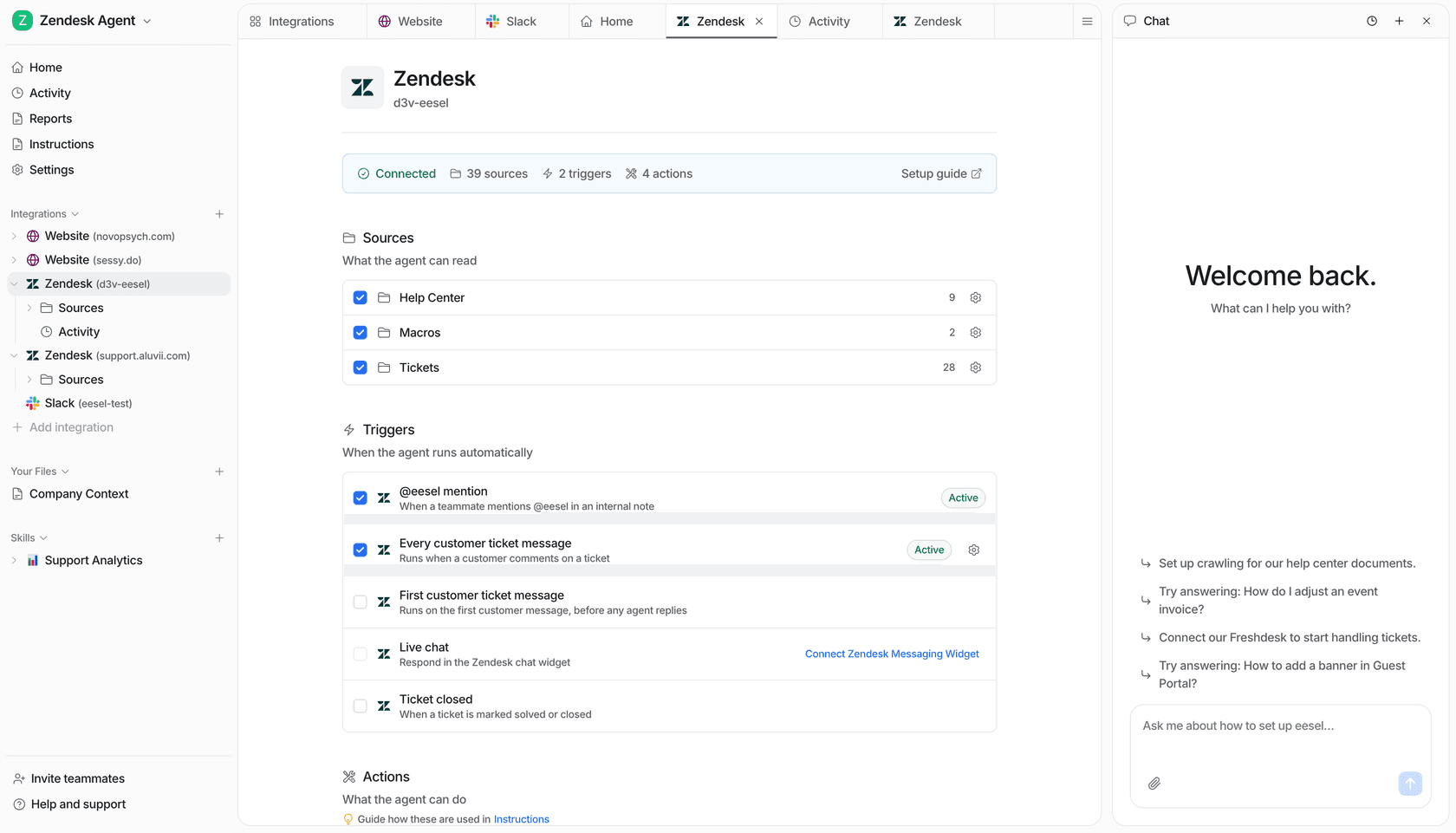
The Zendesk integration in eesel shows source, trigger, and action settings alongside teammate chat.
eesel joins the Zendesk queue your team already owns. Connect it, inspect the sources and rules behind one support case, test the exception path, and let the owner approve the next step. Try eesel.
Frequently asked questions
What is the difference between Zendesk AI Agent Advanced and Essential?
Essential focused on knowledge-based answers; Advanced added more complex workflow capabilities. Zendesk removed the packaging distinction in May–June 2026. Existing Essential and legacy agents need migration to the upgraded experience.
Is Essential enough for FAQ automation?
The old Essential experience handled knowledge-based answers, but it entered maintenance on August 31, 2026 and is scheduled for removal on December 10, 2026. Build that scope in the upgraded experience instead.
Does the removal affect previous Advanced customers?
Zendesk explicitly excludes customers who previously purchased the Advanced add-on from its Essential and legacy removal announcement. Check which experience your account actually runs.
Does the upgraded experience still need maintained knowledge?
Yes. Accurate, owned sources remain necessary whether the agent answers directly from knowledge or follows a procedure.